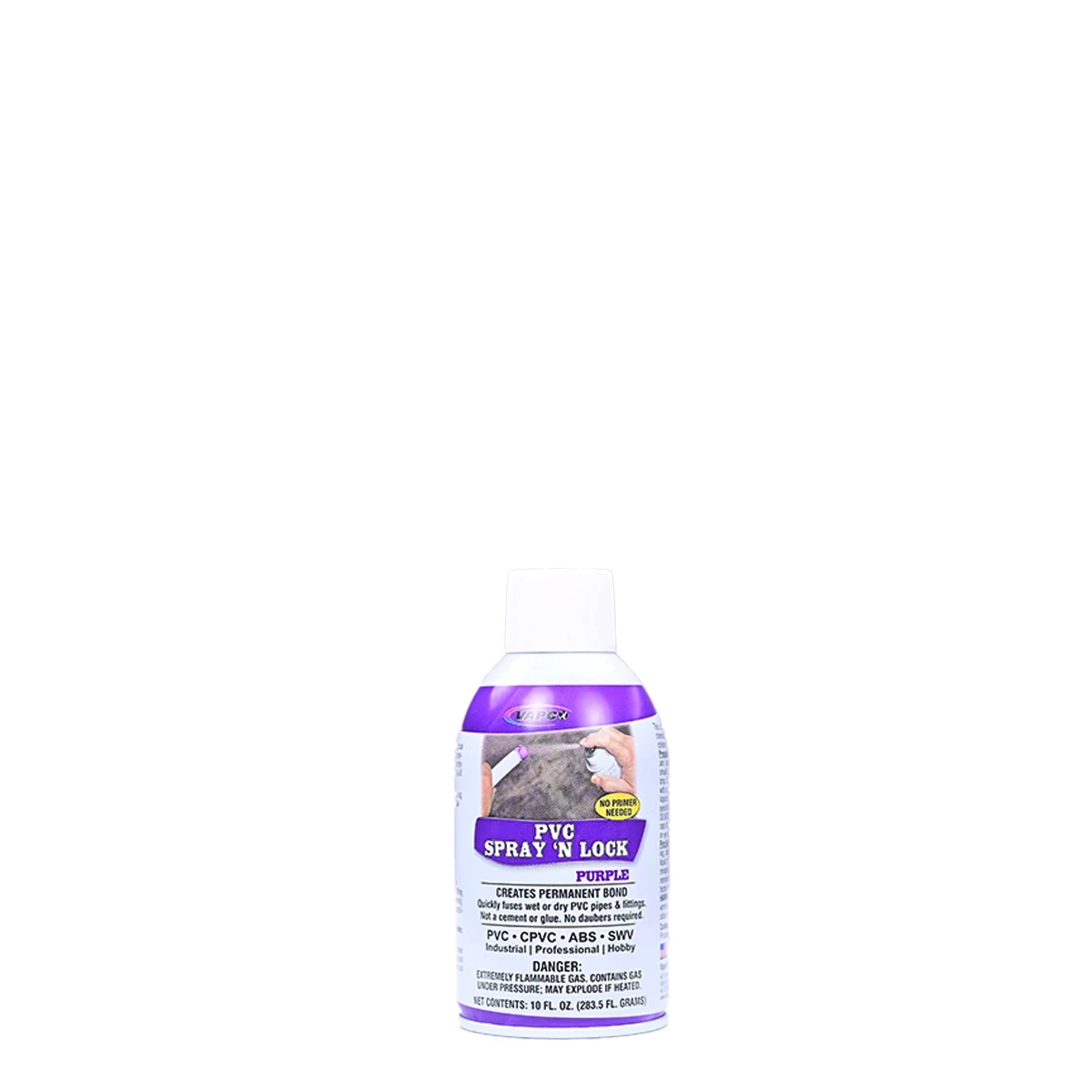
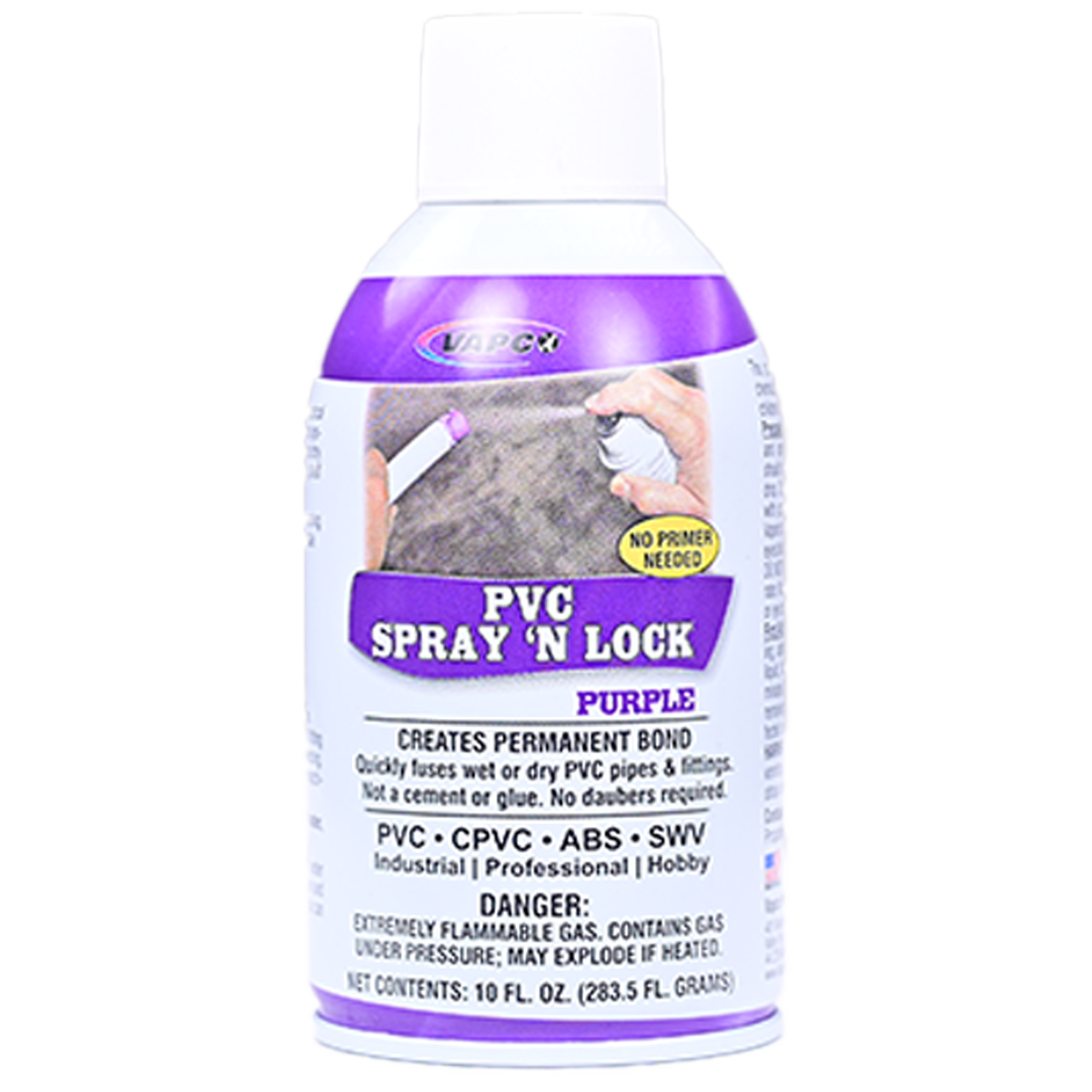
PVC Spray ‘N Lock Purple
Revolutionary PVC Pipe and Fitting Adhesive
PVC Spray ‘N Lock is a powerful and innovative adhesive designed to simplify the construction and repair of potable and non-potable PVC systems. It is industry purple and professional clear. Its unique formula provides a fast, reliable, and permanent bond without the need for primers or daubers.
Key Features and Benefits:
- Rapid Curing: Forms a permanent bond in seconds.
- Versatile Conditions: Works in wet, dry, hot, or cold conditions.
- Safe for Potable Water: Does not negatively impact the potability of water.
- Ideal for HVACR Applications: Perfect for drain lines and venting.
- High-Yield Formula: One can bonds over 100 fittings and pipes of 3/4″.
PVC Spray ‘N Lock is a game-changer for contractors, professionals, and hobbyists seeking a faster, easier, and more efficient way to work with PVC. Its exceptional performance and ease of use make it a valuable tool for a variety of applications.
Available Colors: Industry purple and professional clear
Note: For optimal results, follow the provided directions and safety precautions.
PVC Spray ‘N Lock Part Number; Size
(This PVC Spray ‘N Lock display is available at no extra charge and comes with 2 cases of clear and 2 cases of purple. It holds 40 cans with 10 on each row and is a great way to bring attention to a new product)
Directions:
Effective PVC Pipe and Fitting Bonding
Before Use:
- Read Warnings and Directions: Carefully review the product label for safety information.
- Take Precautions: Handle with care, as the product is flammable.
Application:
- Cut Pipe Square: Ensure the pipe is cut squarely.
- Remove Debris: Remove any dirt or burrs from the pipe and fitting.
- Dry Fit: Fit the pipe into the fitting to ensure proper alignment.
- Mark Pipe: Mark the pipe for alignment.
- Spray: Spray both the pipe and fitting with PVC Spray ‘N Lock.
- Insert and Turn: Insert the pipe into the fitting and turn 1/4 turn.
- Hold: Hold the pipe in place for 10 seconds.
- Repeat for Other Joints: Follow the same steps for remaining joints.
Additional Tips:
- Ensure Wet Surfaces: Make sure both the pipe and fitting are thoroughly wet with the product before connecting.
- Recommended Pipe Size: For best results, use on pipe 3″ and smaller.
By following these directions, you can effectively bond PVC pipe and fittings using PVC Spray ‘N Lock.
The product works on both dry and wet PVC pipes!
NOTE: Product designed to bond SIMILAR PVC COMPONENTS; results vary if DISSIMILAR types are used. The product dries rapidly. Make sure PVC pipe and fitting are saturated with the product before connecting. For best results, use on 3” and under pipes made of matching material.
Certified not to negatively impact the potability of water, ASTM D3452-06(2017).
Colder temperatures require more time to cure.
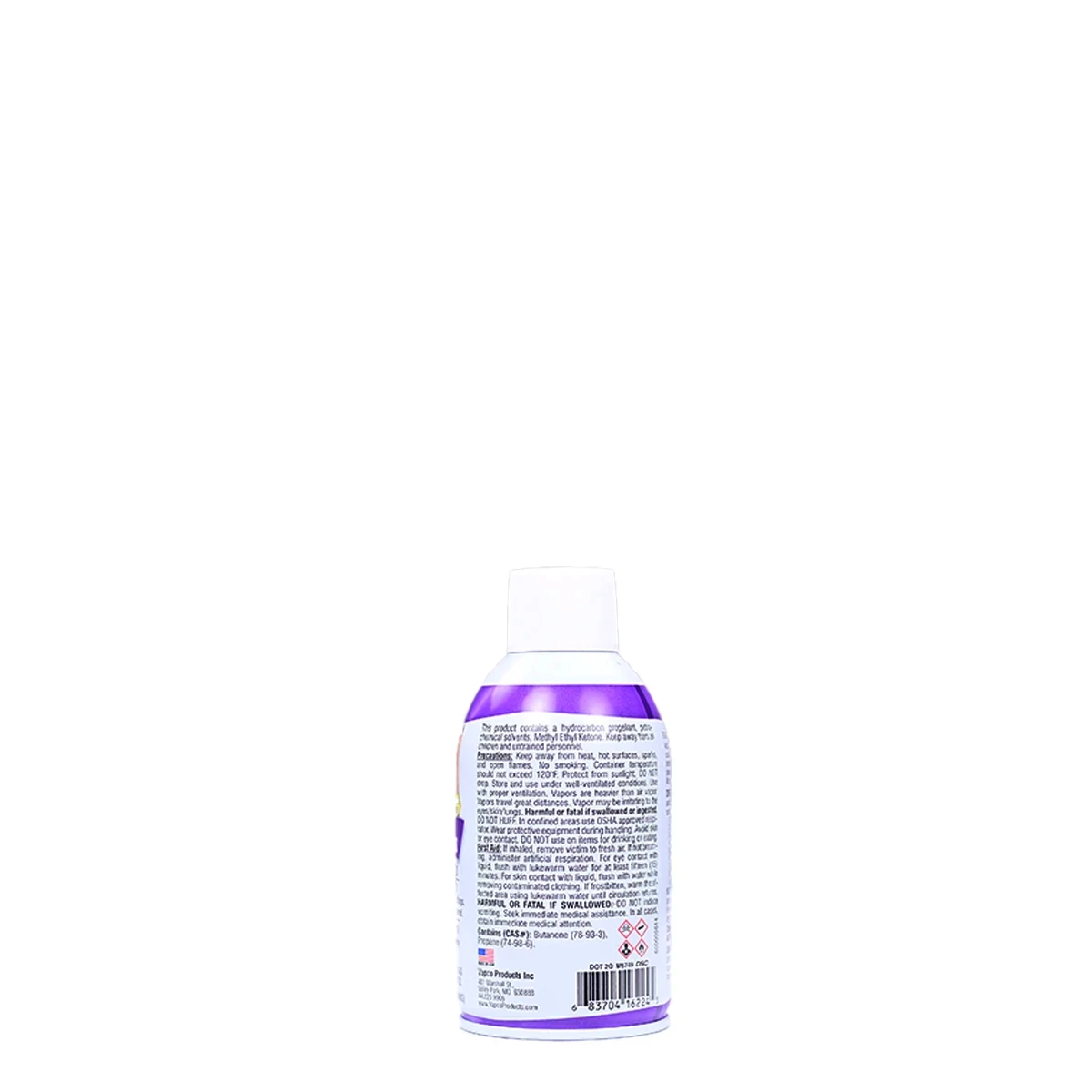
DANGERS & PRECAUTIONS:
This product contains a hydrocarbon propellant, petrochemical solvents, Methyl Ethyl Keton. Keep away from all children and untrained personnel. Keep away from heat, hot surfaces, sparks, and open flames. No smoking. The container temperature should not exceed 120F. Protect from sunlight. DO NOT drop. Harmful or fatal if swallowed or ingested. DO NOT HUFF.
Contact Us
News and Updates
Subscribe on Youtube
Follow Us on Facebook
SDS
⚠️ MGLT Safety Data Sheet (SDS)
1. Identification & Supplier Details
| Product Name |
PVC SPRAY ‘N LOCK |
| Product Numbers |
PVC-SNLC, PVC-SCLP |
| Brand |
Vapco |
| Recommended Use |
Spray-on PVC bonding agent |
| Supplier |
Vapco Products, Inc.
401 Marshall Road
Valley Park, Missouri 63088 United States |
| Contact Information |
Phone: (636) 923-2121
Fax: (636) 923-3002
Email: [email protected] |
| Emergency Phone |
(800) 255-3924 |
2. Hazard Identification & Composition
| GHS Classification |
Eye damage/irritation, Cat. 2A
Flammable aerosols, Cat. 1
Gases under pressure, liquefied gas
Specific target organ toxicity (single exposure), Cat. 3 |
| Signal Word |
DANGER |
| Hazard Statements |
H222: Extremely flammable aerosol
H280: Contains gas under pressure; may explode if heated
H319: Causes serious eye irritation
H336: May cause drowsiness or dizziness |
| Precautionary Statements |
P210: Keep away from heat/sparks/open flames/hot surfaces. No smoking.
P211: Do not spray on an open flame or other ignition source.
P251: Pressurized container: do not pierce or burn, even after use.
P261: Avoid breathing dust/fume/gas/mist/vapors/spray.
P280: Wear eye protection/face protection.
P305+P351+P338: IF IN EYES: Rinse cautiously with water for several minutes.
P410+P412: Protect from sunlight. Do not expose to temperatures exceeding 50 °C/122 °F. |
| Hazardous Component |
CAS No. |
Concentration |
| Methyl ethyl ketone (MEK) |
78-93-3 |
50 – 75 % (weight) |
| Propane, liquid |
74-98-6 |
50 – 75 % (weight) |
3. Physical & Chemical Properties
| Physical State / Appearance |
Liquid / Aerosol spray (Colorless) |
| Odor |
Characteristic ketone odor |
| Freezing Point |
-176.67°C (-286°F) |
| Boiling Point |
-37.8°C (-36.1°F) |
| Flash Point |
N/D (Extremely Flammable) |
| Explosion Limits |
LEL: 2.5% / UEL: 9.0% |
| Vapor Pressure |
586.05 kPa (85 psi) at 21.1°C (70°F) |
| Relative Density |
0.53 |
| Solubility |
Insoluble in water |
4. Stability & Reactivity
| Chemical Stability |
Stable under recommended handling and storage conditions. |
| Reactivity |
Contains gas under pressure; may explode if heated. Vapors may ignite via static discharge. |
| Conditions to Avoid |
Direct sunlight, extreme temperatures, open flames, sparks, or static discharge. |
| Incompatible Materials |
Strong oxidizing agents, strong caustics, and hydrogen peroxide. |
| Hazardous Decomposition |
Carbon oxide(s). |
5. Toxicological Information
| Acute Toxicity |
MEK: LD50 Oral (Rat): 2.6 g/kg; LD50 Dermal (Rabbit): 6.4 g/kg; LC50 Inhalation (Rat): 11300 ppm (4hr)
Propane: LC50 Inhalation (Rat): 658 mg/l (4hr) |
| Eye Contact |
Causes serious eye irritation, redness, tearing, and blurred vision. |
| Inhalation Effects |
May cause CNS depression (dizziness, drowsiness, headache). High concentrations may cause asphyxiation or death. |
| Skin Contact |
May cause localized defatting and drying with prolonged contact. |
| Carcinogenicity / Mutagenicity |
Not classified. |
6. First-Aid Measures
| General Advice |
Never give anything by mouth to an unconscious person. Seek medical advice if you feel unwell. |
| If Inhaled |
Remove to fresh air. Keep at rest in a comfortable breathing position. Call a POISON CENTER if unwell. |
| If On Skin |
Drench with water for 15 minutes. Remove contaminated clothing. Seek medical attention if irritation persists. |
| If In Eyes |
Rinse with water for at least 15 minutes. Remove contact lenses. Seek medical attention if irritation persists. |
| If Swallowed |
Rinse mouth. Do NOT induce vomiting. Obtain medical attention. |
7. Fire-Fighting & Accidental Release Measures
| Extinguishing Media |
CO2, alcohol-resistant foam, dry chemical, or sand. |
| Fire Hazards |
Extremely flammable. Container may explode in heat. Vapors are heavier than air and may flash back. |
| Fire Fighting Protection |
Wear NIOSH-approved SCBA and full body protective clothing. Fight fire remotely due to explosion risk. |
| Accidental Release |
Eliminate all ignition sources. Ventilate area. Evacuate unnecessary personnel. Stop leak if safe. Absorb liquid spills and transfer to disposal container. |
8. Handling, Storage & PPE
| Safe Handling |
Do not handle until all safety precautions are read. Avoid contact with eyes and skin. Do not breathe gas/mist. Keep away from ignition sources. Do not pierce or burn. |
| Storage Conditions |
Store in a dry, cool, well-ventilated place locked up. Protect from sunlight. Do not exceed 50°C/122°F. Keep away from incompatible materials. |
| Exposure Controls |
Limit Values |
| Propane (OSHA/NIOSH) |
PEL/REL: 1000 ppm (1800 mg/m3) |
| MEK (OSHA PEL) |
TWA: 200 ppm (590 mg/m3) |
| MEK (NIOSH REL) |
TWA: 200 ppm; STEL: 300 ppm |
| Personal Protection (PPE) |
Eyes: Chemical safety goggles.
Skin/Body: Protective gloves and fire/flame resistant clothing.
Respiratory: NIOSH-approved SCBA if exposure exceeds limits. |
9. Transport & Regulatory Information
| DOT / IMDG / IATA |
UN Number: UN1950
Class: 2.1 (Flammable Gas)
Shipping Name: Aerosols, flammable, (each not exceeding 1 L capacity) |
| State Regulations |
MA, NJ, PA: Propane and 2-Butanone (MEK) are listed. |
| TSCA Inventory |
All components are listed on the US EPA TSCA public inventory. |
10. Disposal & Ecological Information
| Ecotoxicity |
MEK: LC50 (Pimephales promelas) 3130-3320 mg/L. Hazardous to the aquatic environment. |
| Degradability |
Readily biodegradable. |
| Disposal Methods |
Dispose in accordance with local/national regulations. Do not puncture or incinerate containers. Keep out of sewers. |
11. Disclaimer & Preparation Information
| Disclaimer |
Information is accurate to the best of our knowledge. No warranty is expressed or implied. Users are responsible for safe use and compliance. |
| Prepared By |
Jessica Wilson |
| Date Prepared |
8/6/2025 |