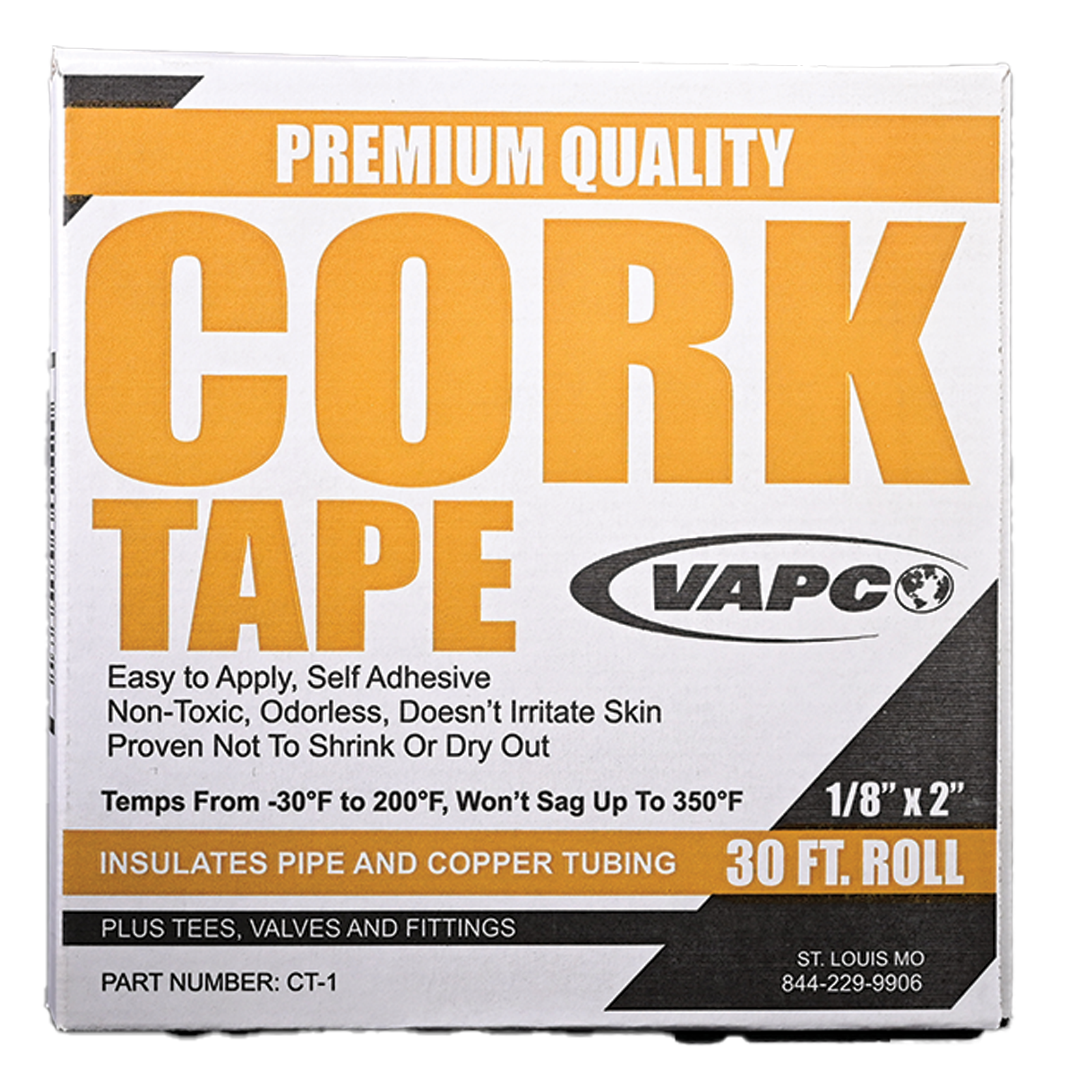
Cork Tape | CT-1 Anti-Condensation Pipe Wrap
It Was Never Insulation. That’s Why It Works.
Insulation slows heat down. A vapor seal shuts moisture out. Cork tape is the second thing, and that’s why it stops sweating in the places foam can’t reach.
Condensation doesn’t start in the middle of a clean run of foam. It starts at a seam. A butt joint. A tee, an elbow, a valve body, anywhere a sleeve had to be cut and taped around geometry it was never shaped for. Humid air finds the gap, finds the cold copper behind it, and you find the water stain three weeks later.
CT-1 Cork Tape closes that path. It’s a butyl sealant loaded with 40 to 50 percent cork by volume, bonded straight to the pipe and overlapped at the edges. Humid air never touches the cold surface. No contact, no dew point at the metal, no water.
Vapco Tech Note: CT-1 is not an air gap and it isn’t built for R-value. At 1/8″ thick it runs about R-0.07 (calculated from ASTM E1530). Its job is the seal. Apply it tight to clean, dry pipe with a 1/4″ overlap so there’s no path for air to get in behind it. Use foam on the long straight runs and CT-1 at the fittings, terminations, and transitions where foam can’t conform.
Foam on the Runs. Cork Tape at the Fittings.
Most jobs need both. The failures happen where one ends and the other should have started.
- Foam owns: Long straight runs where thickness is achievable and thermal resistance matters.
- CT-1 owns: Tees, elbows, valve bodies, service ports, foam terminations, and butt joints. Anywhere a sleeve has to be cut, butted, and hoped for.
Professional Application: Air conditioning, commercial refrigeration, walk-in coolers and freezers, and any cold line where condensation is a problem.
| KEY FEATURE / SPECIFICATION |
TRADE BENEFIT / RESULT |
| 40-50% Cork by Volume |
Moldable Body: The cork gives the mastic enough body to form around a valve body or tee and stay where you put it. |
| Asphalt-Free Butyl |
No Asphalt Binder: Nothing asphalt-based to bleed onto a ceiling tile, and no odor in a hot attic. |
| 25 psi Tensile Adhesion (ASTM C907) |
Stays Bonded: Tested to the method written specifically for preformed tape sealants. Bonds to copper, aluminum, PVC, and most metals. |
| Permanently Flexible, Service to -40°F |
Low Temp Ready: Won’t crack on freezer and low temp suction lines where the seal matters most. |
| No Sag to 249°F (AAMA 807.1) |
Stays Put: Won’t slump off a vertical riser in a hot mechanical room. |
| 100% Solids, No Shrinkage |
Seams Stay Closed: Nothing evaporates out of it, so nothing pulls back and opens the overlap over a season. |
| FDA 21 CFR 175.105 Compliant |
Food Service Accounts: Compliant with FDA Regulation CFR Title 21, 175.105 for packaging and transporting food. |
| No Intentionally Added PFAS |
Spec Friendly: One less question from the compliance desk. |
| Non-Corrosive to Metals |
Safe on Copper: Sits on copper and steel for years without attacking the pipe it’s protecting. |
| No Prop 65 Listed Chemicals |
California Ready: No Prop 65 warning required. |
| DOT & IATA Not Regulated |
Ships Anywhere: Ground or air, no hazmat paperwork. |
| Made in USA |
Domestic Supply: Made in the United States. |
Vapco Field Guide: Where CT-1 Earns Its Keep
Where to reach for cork tape and where to reach for something else. (★★★ = Best Tool for the Job)
| APPLICATION |
RATING |
WHY IT WINS |
| Tees & Elbows |
★★★ |
Wraps the geometry in one continuous seal instead of three cut pieces of foam. |
| Valve Bodies & Service Ports |
★★★ |
Molds around irregular shapes and stays formed. |
| Foam Terminations & Butt Joints |
★★★ |
Seals the exact spot where sweating usually starts. |
| Low Temp Suction Lines |
★★★ |
Stays flexible in service down to -40°F. |
| Long Straight Runs |
USE FOAM |
Foam brings the thermal resistance. Finish the ends with CT-1. |
| Application Limits |
RESTRICTED |
Apply at -20°F to 180°F on clean, dry pipe. Not for continuous service above 249°F. |
Technical Data
| PROPERTY |
VALUE |
TEST METHOD |
| Composition |
Asphalt-free butyl, 40-50% cork by volume |
Manufacturer |
| Specific Gravity |
1.2 (74.9 lb/ft³) |
ASTM D71-94R19 |
| Thermal Conductivity |
0.272 W/m-K (approx. 1.89 BTU·in/hr·ft²·°F) |
ASTM E1530 |
| Tensile Adhesion |
25 psi |
ASTM C907 |
| Sag |
None up to 249°F / 120°C |
AAMA 807.1 |
| Application Temp |
-20°F to 180°F |
Manufacturer |
| Service Temp |
-40°F to 249°F |
Manufacturer |
| Storage Temp |
40°F to 100°F, clean dry area |
Manufacturer |
| Solids / Odor / Color |
100% / None / Black |
Internal Lab |
| Shelf Life |
18 months |
Manufacturer |
📄 CT-1 TDS – DOWNLOAD
Part Number Reference:
| PART NUMBER |
SIZE / PACK |
APPLICATION FIT |
| CT-1 |
2″ x 1/8″ x 30′ Roll
(Case of 12) |
Service Truck Standard: Fittings, valves, terminations, and short sections on residential and commercial lines. |
Directions
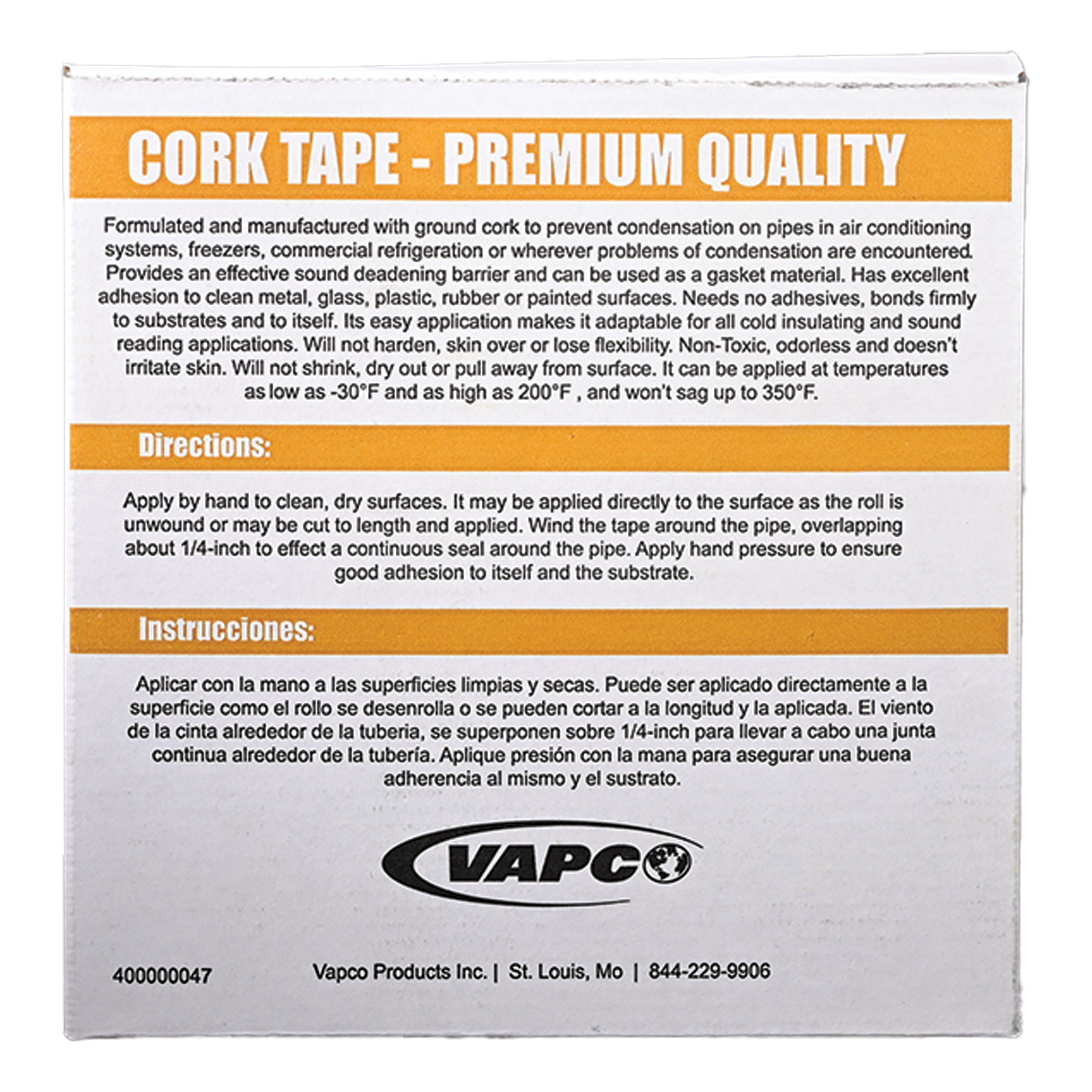
- Clean and Dry: Pipe must be clean, dry, and free of oil and dirt. Apply between -20°F and 180°F.
- Cut to Length: Apply straight from the roll or cut to length first.
- Wrap and Overlap: Wind the tape around the pipe, overlapping each wrap about 1/4″ to form a continuous seal.
- Press Firmly: Hand pressure bonds the tape to the pipe and to itself. Make sure there are no gaps underneath.
- Tape First, Foam Second: Where CT-1 meets foam insulation, tape the pipe first, then slide the foam end over the tape.
One layer handles most conditions. In high humidity or extreme temperatures, add layers before installing any jacketing or coating.
Field Tip: Taping the copper at the transition and sliding the foam over it plugs the end of the foam, so humid air can’t travel down the gap between the foam and the pipe. The extra thickness makes for a snug fit, so on a tight sleeve you may need to slit the foam or go up a size. On a retrofit, pull the foam back and do it right.
Contractors: Please contact your local Vapco distributor for pricing and availability.
Why Fittings Sweat – Use Cork Tape Where Foam Can’t Seal
| THE PAIN POINT |
THE CT-1 ADVANTAGE |
“The Seam”
Foam cut and butted around a fitting leaves a path for humid air to reach cold copper. |
“Continuous Seal”
Wraps and overlaps with no seam for air to get behind. |
“The Bleed”
Asphalt-based binders can bleed, stain, and smell in hot spaces. |
“Asphalt-Free Butyl”
No asphalt binder in the formula. |
“The Shrink-Back”
Wraps that shrink over a season pull the overlap open. |
“100% Solids”
No shrinkage, so the seal you made is the seal you keep. |
“The Crack”
Wraps that stiffen in the cold split on low temp lines. |
“Flexible to -40°F”
Permanently flexible in service where it matters most. |
SDS
⚠️ CT-1 CORK TAPE SDS – DOWNLOAD
SAFETY DATA SHEET
CT-1 Cork Tape | Premium Butyl Sealant Cork Tape | Part Number CT-1
Prepared in accordance with OSHA Hazard Communication Standard 29 CFR 1910.1200
Identification & Supplier Details
SECTION 1: IDENTIFICATION
| Product Identifier |
CT-1 Cork Tape |
| Other Means of Identification |
Part Number CT-1. Premium Butyl Sealant Cork Tape, 2″ x 1/8″ x 30′ roll |
| Recommended Use |
Condensation control and vapor seal on pipes, tubing, tees, valves and fittings in HVAC, refrigeration and similar applications |
| Restrictions on Use |
Apply between -20°F and 180°F. Not for continuous service above 249°F |
| Supplier |
Vapco Products, Inc., 401 Marshall Rd, Suite A, Valley Park, MO 63088 |
| Phone |
(844) 229-9906 |
| Email |
info@vapcoproducts.com |
| Emergency Phone |
(800) 255-3924 |
Hazard Identification & Composition
SECTION 2: HAZARD(S) IDENTIFICATION & SECTION 3: COMPOSITION / INFORMATION ON INGREDIENTS
| Section 2: Hazard(s) Identification |
| Classification |
Not classified as hazardous under OSHA Hazard Communication Standard 29 CFR 1910.1200 |
| Signal Word |
None |
| Hazard Pictograms |
None |
| Hazard Statements |
None |
| Precautionary Statements |
None required |
| Hazards Not Otherwise Classified |
None known |
| Section 3: Composition / Information on Ingredients |
| Substance / Mixture |
Mixture |
| Description |
Butyl rubber (polyisobutylene) compound with 40-50% cork by volume and inert inorganic mineral fillers. Asphalt-free |
| Hazardous Components |
None. No components meet the criteria for classification or disclosure under 29 CFR 1910.1200 |
First-Aid Measures
SECTION 4: FIRST-AID MEASURES
| Exposure Route |
First-Aid Description |
| Eye Contact |
Do not rub. Seek medical attention immediately |
| Skin Contact |
Wash with soap and water. Seek medical attention if irritation develops |
| Inhalation |
Not an expected route of exposure |
| Ingestion |
Unlikely. If swallowed, may cause obstruction. Seek medical attention |
| Most Important Symptoms / Effects |
None known |
| Immediate Medical Attention |
Not normally required, except as noted above |
Fire-Fighting & Accidental Release Measures
SECTION 5: FIRE-FIGHTING MEASURES & SECTION 6: ACCIDENTAL RELEASE MEASURES
| Section 5: Fire-Fighting Measures |
| Suitable Extinguishing Media |
Water, foam, carbon dioxide, dry chemical |
| Unsuitable Extinguishing Media |
None known |
| Specific Hazards |
Incomplete combustion may produce carbon monoxide, nitrogen oxides and hydrocarbons |
| Protective Equipment for Firefighters |
Self-contained breathing apparatus and full protective gear |
| Section 6: Accidental Release Measures |
| Personal Precautions |
None required |
| Environmental Precautions |
None required |
| Containment and Clean-Up |
Solid product. Pick up and dispose of according to Section 13 |
Handling, Storage & PPE
SECTION 7: HANDLING AND STORAGE & SECTION 8: EXPOSURE CONTROLS / PERSONAL PROTECTION
| Section 7: Handling and Storage |
| Safe Handling |
Wash hands with soap and water before eating |
| Storage Conditions |
Store in a clean, dry area between 40°F and 100°F. Keep away from excessive heat and strong oxidizers |
| Shelf Life |
18 months |
| Section 8: Exposure Controls / Personal Protection |
| Occupational Exposure Limits |
None established |
| Engineering Controls |
None required |
| Hand Protection |
Cotton or other work gloves recommended |
| Eye Protection |
Safety glasses recommended as good industrial practice |
| Skin and Body Protection |
Long sleeves recommended to limit adhesive contact |
| Respiratory Protection |
Not required |
Physical & Chemical Properties
SECTION 9: PHYSICAL AND CHEMICAL PROPERTIES
| Property |
Value |
| Physical State |
Solid |
| Appearance |
Black, soft, tacky extruded mastic tape |
| Odor |
None |
| Odor Threshold |
Not applicable |
| pH |
Not applicable |
| Melting Point / Freezing Point |
Not determined |
| Initial Boiling Point / Range |
Not applicable |
| Flash Point |
218°C (424°F), Cleveland Open Cup |
| Evaporation Rate |
Not applicable |
| Flammability (Solid, Gas) |
Not classified as a flammable solid |
| Upper / Lower Flammability or Explosive Limits |
Not applicable |
| Vapor Pressure |
Not applicable |
| Vapor Density |
Not applicable |
| Relative Density |
1.2 |
| Solubility |
Insoluble in water |
| Partition Coefficient (n-octanol/water) |
Not applicable |
| Auto-Ignition Temperature |
Not determined |
| Decomposition Temperature |
Not determined |
| Viscosity |
Not applicable (solid) |
| Solids Content |
100% |
Stability & Reactivity
SECTION 10: STABILITY AND REACTIVITY
| Reactivity |
Not reactive under normal conditions of use and storage |
| Chemical Stability |
Stable |
| Possibility of Hazardous Reactions |
None known |
| Conditions to Avoid |
Excessive heat and open flame |
| Incompatible Materials |
Strong oxidizers |
| Hazardous Decomposition Products |
None under normal use. See Section 5 for combustion products |
Toxicological Information
SECTION 11: TOXICOLOGICAL INFORMATION
| Effect / Endpoint |
Information |
| Likely Routes of Exposure |
Skin contact, eye contact |
| Acute Effects |
None known |
| Chronic Effects |
None known |
| Irritation / Sensitization |
None known |
| Carcinogenicity |
No components listed as carcinogens by NTP, IARC or OSHA |
| Reproductive Toxicity / Mutagenicity / Teratogenicity |
None known |
| Numerical Measures of Toxicity |
No data available |
Ecological & Disposal Information
SECTION 12: ECOLOGICAL INFORMATION & SECTION 13: DISPOSAL CONSIDERATIONS
| Section 12: Ecological Information |
| Ecotoxicity |
No evidence of harm to the environment |
| Persistence and Degradability |
Not determined |
| Bioaccumulative Potential |
Not expected to bioaccumulate |
| Mobility in Soil |
Solid product. Not expected to be mobile |
| Section 13: Disposal Considerations |
| Waste Classification |
Not a hazardous waste under U.S. EPA regulations, 40 CFR 261 |
| Disposal |
Dispose of in accordance with all local, state and federal regulations |
Transport & Regulatory Information
SECTION 14: TRANSPORT INFORMATION & SECTION 15: REGULATORY INFORMATION
| Section 14: Transport Information |
| DOT |
Not regulated |
| IATA |
Not regulated |
| Section 15: Regulatory Information |
| OSHA |
Not hazardous under 29 CFR 1910.1200 |
| TSCA |
All components are listed on the TSCA Inventory |
| SARA 311/312 |
No hazard categories apply |
| SARA 313 |
No components subject to reporting |
| California Proposition 65 |
This product does not contain any chemicals known to the State of California to cause cancer, birth defects or other reproductive harm |
| FDA |
Compliant with FDA Regulation CFR Title 21, 175.105 for packaging and transporting food |
| PFAS |
No intentionally added PFAS |
| RoHS |
Meets RoHS requirements |
Disclaimer & Preparation Information
SECTION 16: OTHER INFORMATION
| HMIS Rating |
Health 1, Flammability 1, Physical Hazard 0 |
| Prepared By |
Vapco Products, Inc. |
| Date Prepared |
September 21, 2026 |
| Revision |
New issue. Supersedes all previous versions for CT-1 |
| Abbreviations |
N/A = Not applicable. N/D = Not determined |
| Disclaimer |
| The information in this Safety Data Sheet is believed to be accurate as of the date prepared. It is provided for safe handling, use, storage and disposal and is not a warranty or specification. Users are responsible for determining suitability for their specific application. |