Vapco Products
Safety Data Sheet
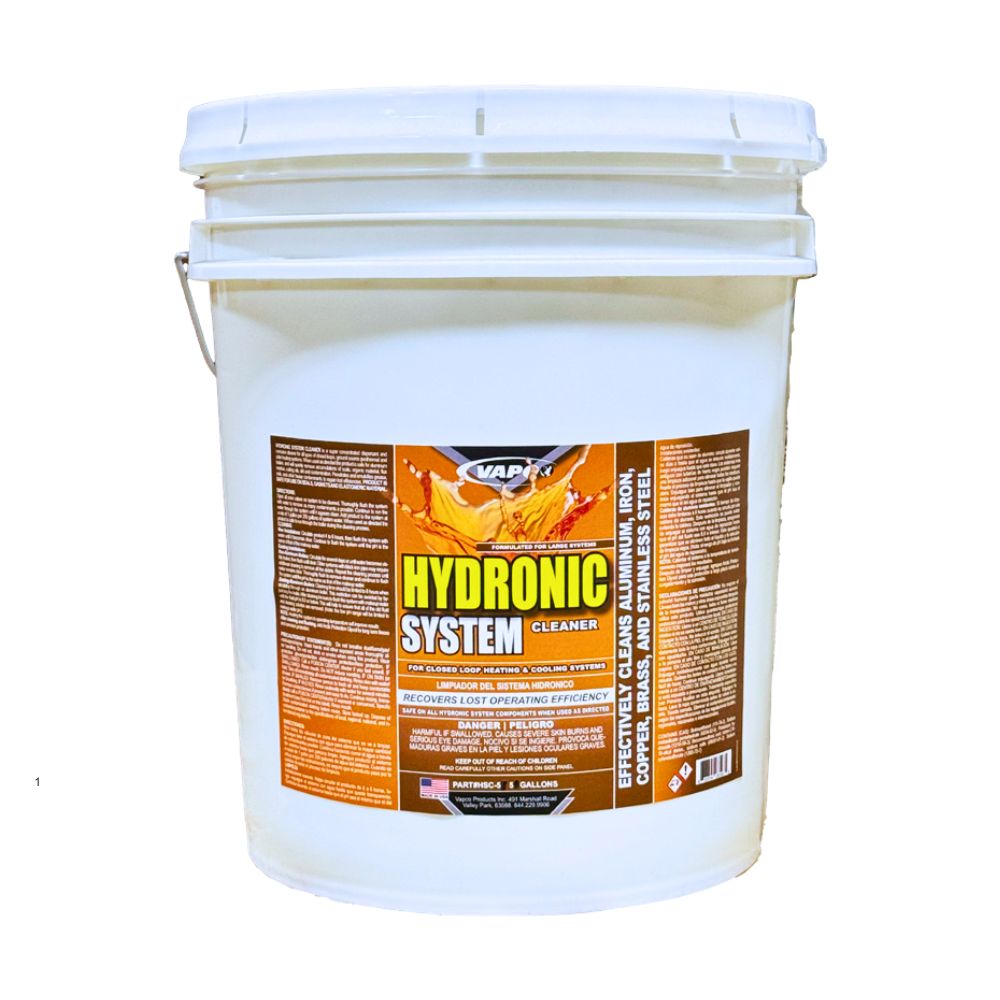
Hydronic System Cleaner
SECTION 1: Identification
1.1 GHS Product identifier
Product name: Hydronic System Cleaner
Product number: HSC-1, HSC-5, HSC-55
Brand: Vapco
1.3 Recommended use of the chemical and restrictions on use
Hydronic system cleaner
1.4 Supplier’s details
Name: Vapco Products
Address: 401 Marshall Road, Valley Park, Missouri 63088, United States
Telephone: (636) 923-2121
Fax: (636) 923-3002
email: info@VapcoProducts.com
1.5 Emergency phone number
(800) 255-3924
SECTION 2: Hazard identification
2.1 Classification of the substance or mixture
GHS classification in accordance with: OSHA (29 CFR 1910.1200, 2024)
– Eye damage/irritation, Cat. 1
– Skin corrosion/irritation, Cat. 1
2.2 GHS label elements, including precautionary statements
Signal word: Danger
Hazard statement(s)
H314 Causes severe skin burns and eye damage
Precautionary statement(s)
P260 Do not breathe dust/fume/gas/mist/vapors/spray.
P264 Wash hands thoroughly after handling.
P280 Wear protective gloves/protective clothing/eye protection/face protection.
P301+P330+P331 IF SWALLOWED: Rinse mouth. Do NOT induce vomiting.
P303+P361+P353 IF ON SKIN (or hair): Take off immediately all contaminated clothing. Rinse skin with water/shower.
P304+P340 IF INHALED: Remove person to fresh air and keep comfortable for breathing.
P305+P351+P338 IF IN EYES: Rinse cautiously with water for several minutes. Remove contact lenses if present and easy to do. Continue rinsing.
P310 Immediately call a POISON CENTER/doctor if exposed or concerned.
P321 Specific treatment (see First Aid on this label).
P363 Wash contaminated clothing before reuse.
P405 Store locked up.
P501 Dispose of contents/container to the specifications of local, regional, national, and international regulations.
SECTION 3: Composition/information on ingredients
3.2 Mixtures
| Hazardous components |
CAS no. |
Concentration |
| 1. 2-Butoxyethanol (EC no. 203-905-0; Index no. 603-014-00-0) |
111-76-2 |
0.1 – 1 % (weight) |
| 2. Potassium Hydroxide (EC no. 215-181-3; Index no. 019-002-00-8) |
1310-58-3 |
0.01 – 0.1 % (weight) |
| 3. Dodecylbenzenesulfonic acid, sodium salt |
68081-81-2 |
0.01 – 0.1 % (weight) |
| 4. Sodium xylenesulfonate |
1300-72-7 |
0.01 – 0.1 % (weight) |
SECTION 4: First-aid measures
4.1 Description of necessary first-aid measures
General advice: Never give anything by mouth to an unconscious person.If you feel unwell, seek medical advice (show the label where possible).
If inhaled: First, take proper precautions to ensure your own safety before attempting rescue (e.g. wear appropriate respiratory protective equipment, use the buddy system), then remove the exposed person to fresh air.Keep at rest in a position comfortable for breathing.Get medical advice/attention.
In case of skin contact: Immediately drench affected area with water for at least 15 minutes.Remove contaminated clothing immediately.Obtain medical attention if irritation develops or persists.
In case of eye contact: Immediately rinse with water for at least 15 minutes.Remove contact lenses, if present and easy to do.Continue rinsing.Obtain medical attention if irritation develops or persists.
If swallowed: Rinse mouth.Do NOT induce vomiting.Obtain medical attention.
4.2 Most important symptoms/effects, acute and delayed
Symptoms/Injuries: Harmful if inhaled.Causes serious eye and skin irritation.
Symptoms/Injuries After Skin Contact: Contact causes severe irritation with burns.Dermatitis may occur due to long-term irritation.
Symptoms/Injuries After Eye Contact: Contact causes severe irritation with redness and swelling of conjunctiva.Contact with gas/liquid escaping the container can cause permanent eye damage.
4.3 Indication of immediate medical attention and special treatment needed, if necessary
Provide general support measures and treat symptomatically.Chemical burns: flush with water immediately.While flushing, remove clothes which do not adhere to affected area.Call for immediate medical attention.Continue flushing during transportation to medical care.Keep victim warm and under observation.Symptoms may be delayed.If exposed or concerned, get medical advice and attention.If medical advice is needed, have product container or label at hand.
Note to physician: The absence of visible signs or symptoms of burns does not reliably exclude the presence of actual tissue damage.
SECTION 5: Fire-fighting measures
5.1 Suitable extinguishing media
Water spray, fog, carbon dioxide (CO2), alcohol-resistant foam, dry chemical, or sand.Use appropriate media for surrounding fire.
5.2 Specific hazards arising from the chemical
Reactivity: Stable under recommended storage conditions.May be corrosive to metals.Increased risk of fire or explosion.
5.3 Special protective actions for fire-fighters
Precautionary Fire Measures: Exercise caution when fighting any chemical fire.
Firefighting Instructions: Use dry chemical, foam, or carbon dioxide (CO2).Do not breathe fumes from fire or vapors from decomposition.Do NOT fight fire when fire reaches containers.Evacuate area.Fight fire remotely due to the risk of explosion.Shut off all sources of ignition.Use water spray or fog for cooling exposed containers.
Protection During Firefighting: Do not enter fire area without proper protective equipment, including respiratory protection.Wear NIOSH-approved Self-Contained Breathing Apparatus with a full face piece operated in a positive pressure demand mode with full body protective clothing when fighting fires.
Hazardous Combustion Products: Sodium oxide(s), silicon oxide(s).
SECTION 6: Accidental release measures
6.1 Personal precautions, protective equipment and emergency procedures
General Measures: Do not get in eyes, on skin, or on clothing.Do not breathe vapors, spray, mist, gas.Keep away from heat, hot surfaces, sparks, open flames, and other ignition sources.No smoking.
For Non-Emergency Personnel Protective Equipment: Use appropriate personal protective equipment (PPE).Emergency Procedures: Evacuate unnecessary personnel.Stop leak if safe to do so.
For Emergency Personnel Protective Equipment: Equip cleanup crew with proper protection.Emergency Procedure: Eliminate ignition sources first, then ventilate the area.Evacuate unnecessary personnel, isolate, and ventilate area.Upon arrival at the scene, a first responder is expected to recognize the presence of dangerous goods, protect oneself and the public, secure the area, and call for the assistance of trained personnel as soon as conditions permit.
6.2 Environmental precautions
Prevent further leakage or spillage if safe to do so.Do not allow material to contaminate ground water system.Prevent product from entering drains.Report spills as required by local and federal regulations.
6.3 Methods and materials for containment and cleaning up
For Containment: Ventilate the area.Contain any spills with dikes or absorbents to prevent further migration and entry into sewers or streams.As an immediate precautionary measure, isolate spill or leak area in all directions.
Methods for Cleaning Up: Clean up spills immediately and dispose of waste safely.Eliminate all ignition sources.Ventilate area.Stop the ignition source of the release, if safe to do so.Consider the use of water spray to disperse vapors.Isolate the area until gas has dispersed.Ventilate and gas test area before entering.Take up liquid spill into absorbent material.Transfer spilled material to a suitable container for disposal.Contact competent authorities after a spill.
Waste Disposal: Dispose of in accordance with local, regional, national, and international regulations.Containers may be hazardous when empty.Do not flame cut, braze, or weld.Product should be fully characterized prior to disposal (40 CFR 261).
Reference to other sections
See Section 8 for exposure controls and personal protection and Section 13 for disposal considerations.
SECTION 7: Handling and storage
7.1 Precautions for safe handling
Additional Hazards When Processed: Do not pressurize, cut, or weld containers.Ruptured cylinders may rocket.Pressurized container: May burst if heated.Do not pierce or burn, even after use.
Precautions for Safe Handling: Do not handle until all safety precautions have been read and understood.Avoid contact with skin, eyes and clothing.Do not breathe gas, mist, spray, vapors.Wash hands and other exposed areas with mild soap and water before eating, drinking or smoking and when leaving work.Do not spray on open flame or other ignition source.
Hygiene Measures: Handle in accordance with good industrial hygiene and safety procedures.
Other Precautions: Keep out of reach of children.Follow label instructions.Vapors may collect in low lying areas.
7.2 Conditions for safe storage, including any incompatibilities
Technical Measures: Comply with applicable regulations.Proper grounding procedures to avoid static electricity should be followed.
Storage Conditions: Store in a dry, cool place.Keep only in the original container in a cool, well-ventilated place away from ignition sources.Protect from sunlight.Do not expose to temperatures exceeding 50°C/122°F.Keep/Store away from direct sunlight, extremely high or low temperatures and incompatible materials.Store locked up/in a secure area.
Incompatible Materials: Strong acids and alkalis, or oxidizing agents.
Specific end use(s)
Hydronic system cleaner
SECTION 8: Exposure controls/personal protection
8.1 Control parameters
1. 2-butoxyethanol (CAS: 111-76-2)
IOELV-LTEL (Inhalation): 98 mg/m3; 20 ppm; EU (EU/OSHA) Skin designation: Yes.List no. 1 under Council Directive 98/24/EC as amended. List last updated on 8/29/2023.
IOELV-STEL (Inhalation): 246 mg/m3; 50 ppm; EU (EU/OSHA) Skin designation: Yes.List no. 1 under Council Directive 98/24/EC as amended. List last updated on 8/29/2023.
PEL (Inhalation): 20 ppm (Cal/OSHA); 50 ppm, 240 mg/m3 (US/OSHA) OSHA Annotated Table Z-1, www.osha.gov.
REL (Inhalation): 5 ppm (NIOSH) OSHA Annotated Table Z-1, www.osha.gov.
STEL (Inhalation): 50 ppm; 242 mg/m3; AU (AU/SWA) Other advisory: Sk.
TWA (Inhalation): 20 ppm (ACGIH); 20 ppm, 96.9 mg/m3 (AU/SWA) Other advisory: Sk.
2. Potassium Hydroxide (CAS: 1310-58-3)
PEL-C (Inhalation): 2 mg/m3; USA (ACGIH, Cal/OSHA, NIOSH).
TWA (Inhalation): 2 Peak limitation mg/m3; AU (AU/SWA).
8.2 Appropriate engineering controls
Emergency eye wash fountains and safety showers should be available in the immediate vicinity of any potential exposure.Ensure adequate ventilation, especially in confined areas.Use explosion-proof equipment.Proper grounding procedures to avoid static electricity should be followed.Use only outdoors or in well-ventilated area.Ensure all local, regional, national, and international regulations are being observed.Obtain special instructions before use.Do not handle until all safety precautions have been read and understood.
8.3 Individual protection measures, such as personal protective equipment (PPE)
Eye/face protection: Chemical safety goggles.Insufficient ventilation: wear respiratory protection.Respiratory protection of the dependent type.
Skin protection: Wear protective gloves and clothing.
Body protection: Wear suitable protective clothing.Wear protective gloves.Chemical resistant materials and fabrics.Wear fire/flame resistant/retardant clothing.
Respiratory protection: Use a NIOSH-approved Self-Containing Breathing Apparatus whenever exposure may exceed established Occupational Exposure Limits.
SECTION 9: Physical and chemical properties
| Physical state |
Liquid |
| Appearance |
Clear liquid |
| Color |
Orange |
| Odor |
Citrus |
| Odor threshold |
N/D |
| Melting point/freezing point |
32°F (0°C) estimated |
| Boiling point or initial boiling point and boiling range |
212°F (100°C) estimated |
| Flammability |
N/D |
| Lower and upper explosion limit/flammability limit |
N/D |
| Flash point |
None through boiling |
| Auto-ignition temperature |
N/D |
| Decomposition temperature |
N/D |
| pH |
11.5-12.5 |
| Kinematic viscosity |
N/D |
| Solubility |
Completely soluble in water |
| Partition coefficient n-octanol/water (log value) |
N/D |
| Vapor pressure |
17.5 mmHg at 20°C (Water) |
| Evaporation rate |
Same as water |
| Density and/or relative density |
1.03-1.05 |
| Relative vapor density |
> 1 (Air=1) |
SECTION 10: Stability and reactivity
10.1 Reactivity: Reacts strongly with strong acids.This product may react with oxidizing agents.
10.2 Chemical stability: Stable under recommended storage conditions.
10.3 Possibility of hazardous reactions: None under normal use conditions.
10.4 Conditions to avoid: Direct sunlight, extremely high or low temperatures, heat, hot surfaces, sparks, open flames, incompatible materials, and other ignition sources.
10.5 Incompatible materials: Strong acids and alkalis, or oxidizing agents.
10.6 Hazardous decomposition products: Carbon oxides, potassium oxides, and fumes.
SECTION 11: Toxicological information
Information on toxicological effects
Acute toxicity:
The ATE (gas inhalation) of the mixture is: 45000 ppmV.
The ATE (oral) of the mixture is: 1666.67 mg/kg bw.
2-Butoxyethanol: LD50 Oral (Rat): 880 mg/kg; LD50 Skin (Rabbit): 1,060 mg/kg; LC50 Inhalation (Rat): 450 ppm.
Dodecylbenzene sodium sulfonate: LD50 Oral (Rat): 1090 mg/kg.
Potassium Hydroxide: LD50 Oral (Rat): 333 mg/kg.
Sodium xylenesulfonate: LD50 Oral (Rat): ≥7,200 mg/kg; LD50 Oral (Rabbit): > 2,000 mg/kg.
Skin corrosion/irritation: Causes skin irritation.Causes severe burns, prolonged contact will destroy tissue.
Serious eye damage/irritation: Irritating to eyes.Causes severe burns, irritation, redness, tearing, and pain.
Respiratory or skin sensitization: May cause irritation (possible severe), chemical burns, upper respiratory damage, and pulmonary edema.
Germ cell mutagenicity: Not a germ cell mutagen.
Carcinogenicity: No component of this product is present at levels greater than or equal to 0.1% that is identified as a human carcinogen.
Reproductive toxicity: This product does not contain any known or suspected reproductive hazards.
Specific target organ toxicity (STOT) – single exposure: None known.
Specific target organ toxicity (STOT) – repeated exposure: None known.
Aspiration hazard: No information available.
Additional information:
Intentional misuse by deliberately concentrating and inhaling contents may be harmful or fatal.
Medical Conditions Aggravated: Asthma, bronchitis, emphysema and other lung diseases; skin irritation may be aggravated.
Symptoms/Injuries: Harmful if inhaled; causes serious eye and skin irritation.
Symptoms/Injuries After Skin Contact: Severe irritation with burns; dermatitis.
Symptoms/Injuries After Eye Contact: Severe irritation with redness and swelling; potential permanent eye damage.
SECTION 12: Ecological information
Toxicity:
2-Butoxyethanol: LC50 (Oncorhynchus mykiss): 1,474 mg/l – 96 h; EC50 (Daphnia magna): 1,550 mg/l – 48 h; EC50 (Pseudokirchneriella subcapitata): 1,840 mg/l – 72 h.
Potassium Hydroxide: LC50 (Gambusia affinis): 80 mg/l – 96 h.
Persistence and degradability: No information is available.
Bioaccumulative potential: 2-butoxyethanol: Log Pow = 0.81; Potassium hydroxide: Log Pow = 0.83.
Mobility in soil: This product is mobile in soil.
SECTION 13: Disposal considerations
Disposal methods
Product disposal: This material, as supplied, is a hazardous waste according to federal regulations (U.S. EPA 40 CFR 261).Dispose of contents/container in accordance with local, regional, national, and international regulations.Do not pierce or burn, even after use.
Waste treatment: This material is a hazardous waste (U.S. EPA 40 CFR 261).Dispose in accordance with all applicable regulations.
Other disposal recommendations: Container may remain hazardous when empty.Continue to observe all precautions.Do not puncture or incinerate container.Product should be fully characterized prior to disposal.
SECTION 14: Transport information
DOT (US): UN Number: UN3266; Class: 8; Packing Group: I; Proper Shipping Name: Corrosive liquid, basic, inorganic, n.o.s.
IMDG: UN Number: UN3266; Class: 8; Packing Group: I; Proper Shipping Name: Corrosive liquid, basic, inorganic, n.o.s.
IATA: UN Number: UN3266; Class: 8; Packing Group: I; Proper Shipping Name: Corrosive liquid, basic, inorganic, n.o.s.
SECTION 15: Regulatory information
15.1 Safety, health and environmental regulations specific for the product in question
California Prop. 65 Components: This product does not contain any chemicals known to the State of California to cause cancer, birth defects, or other reproductive harm.
Massachusetts Right To Know Components (105 CMR 670): Chemical name: 2-BUTOXYETHANOL; POTASSIUM HYDROXIDE.
New Jersey Right To Know Components: Common name: 2-BUTOXY ETHANOL; POTASSIUM HYDROXIDE.
Pennsylvania Right To Know Components: Chemical name: ETHANOL, 2-BUTOXY-; POTASSIUM HYDROXIDE.
SARA 302 Components: No chemicals in this material are subject to the reporting requirements.
SARA 311/312 Hazards: Fire Hazard, Acute Health Hazard, Chronic Health Hazard.
SARA 313 Components: Ethylene glycol monobutyl ether (CAS: 111-76-2).
Toxic Substances Control Act (TSCA) Inventory: All chemicals are listed or exempt.
SECTION 16: Other information
N/A = Not applicable; N/D = Not determined
16.1 Further information/disclaimer: To the best of our knowledge, information contained herein is accurate.However there is no assumption of liability for accuracy or completeness.Final determination of suitability is the sole responsibility of the user.All materials may present unknown hazards.Although certain hazards are described herein, we cannot guarantee that these are the only hazard which exists.The information was obtained from current and reliable sources;however, the data is provided without warranty, expressed or implied.Since conditions of handling, storage and disposal are beyond the control of the manufacturer, the manufacturer will not be responsible for loss or injury.No warranty, expressed or inferred, shall be created by any statement in this SDS.Various government agencies may have specific regulations regarding this product which may not be covered by this SDS.The user is responsible for full compliance.
16.2 Preparation information: Prepared by: Jessica Wilson; Date prepared: 6/6/2025