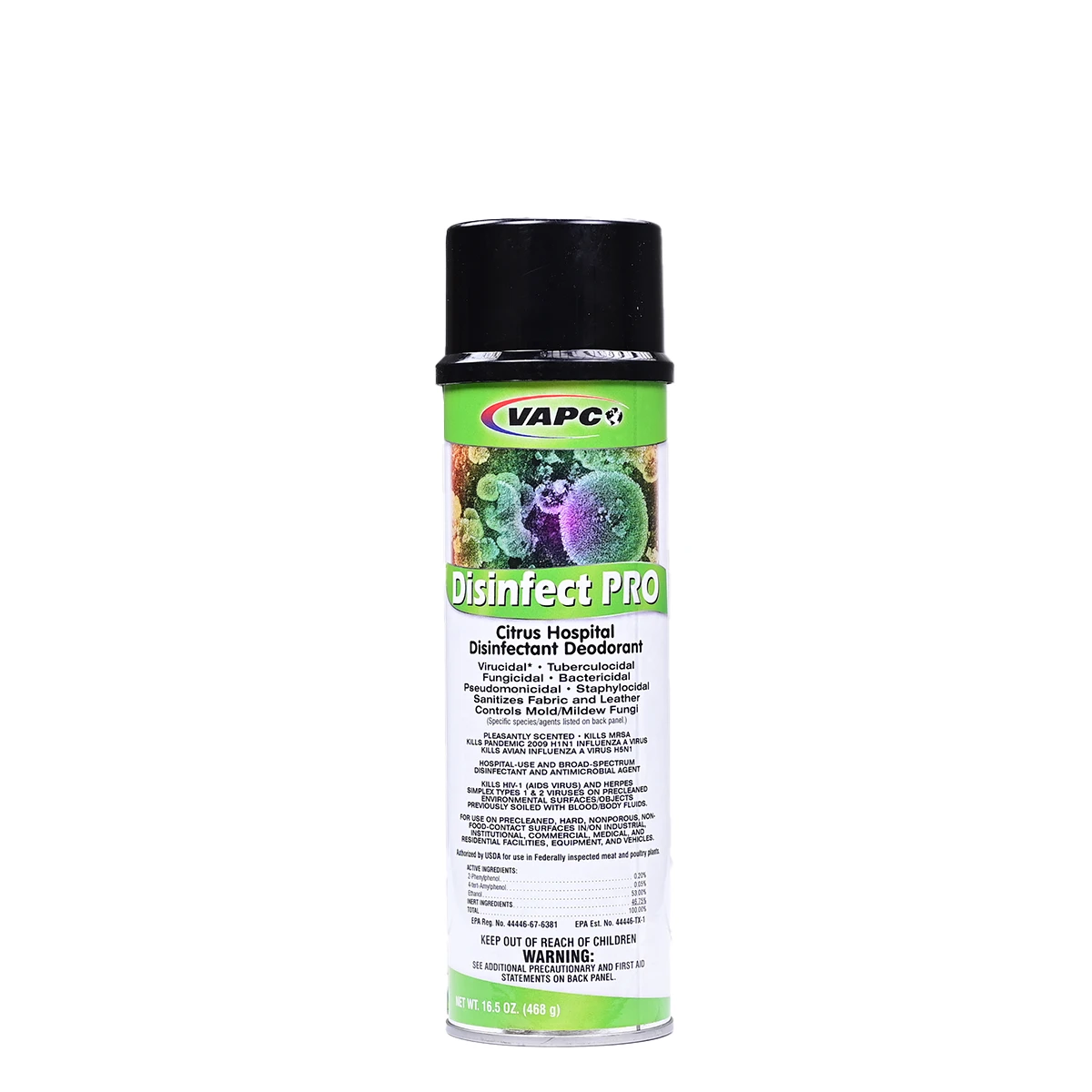
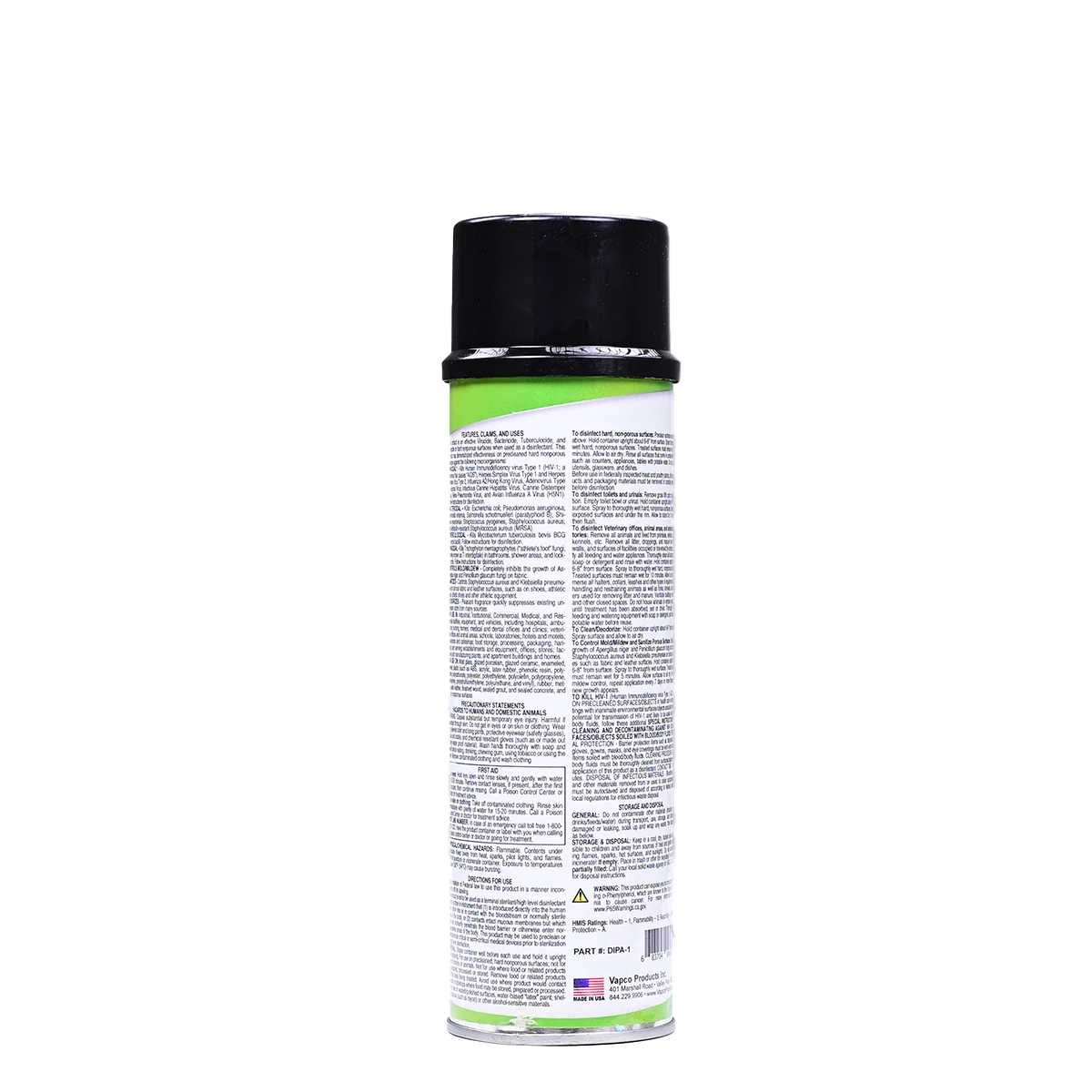
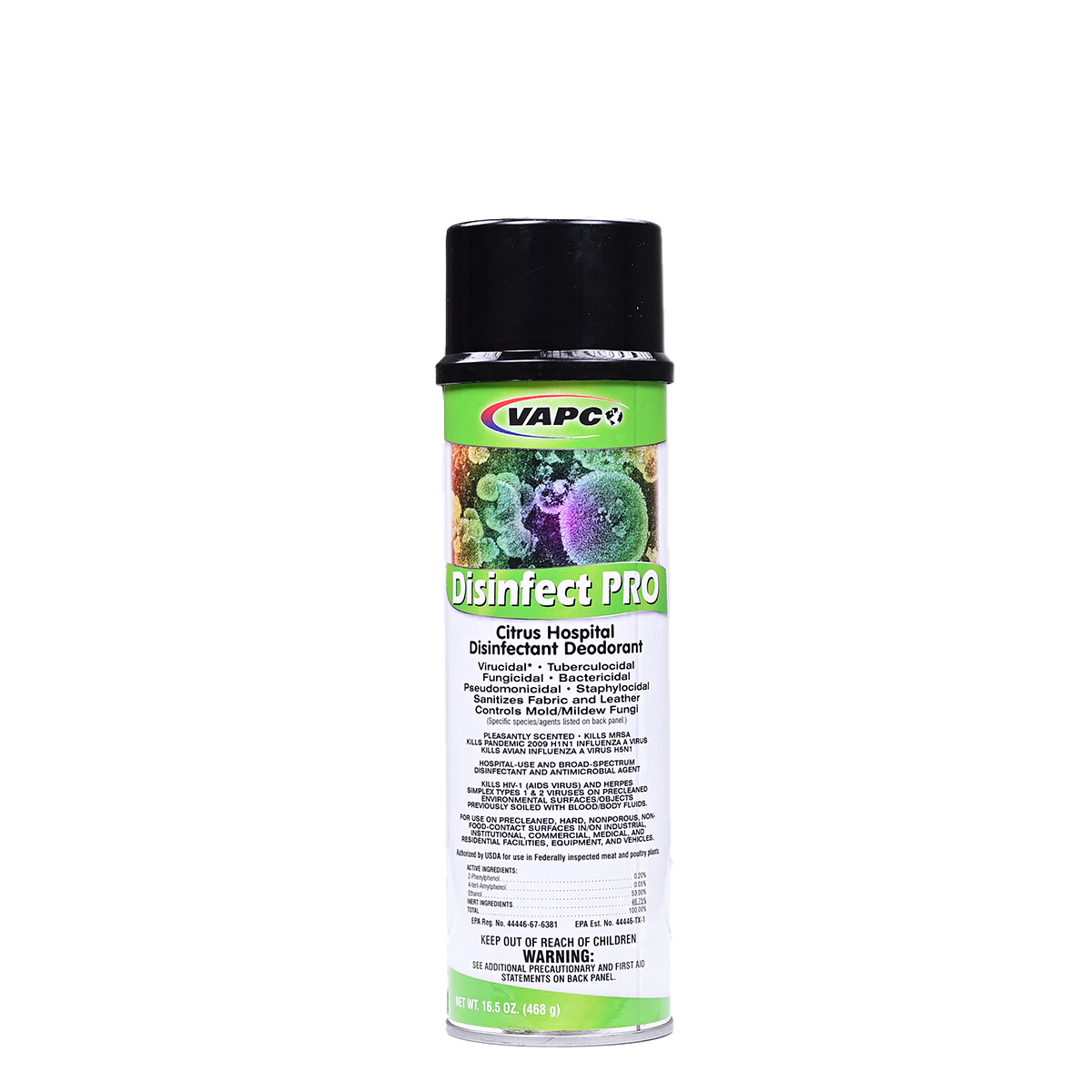
DISINFECT PRO AEROSOL
Powerful Hospital-Grade Disinfectant and Deodorizer
DISINFECT PRO is engineered for professional cleaning and maintenance applications, Disinfect Pro delivers comprehensive surface disinfection and odor control in a convenient aerosol format. This EPA-registered formula meets healthcare facility standards while remaining safe for use in offices, schools, gyms, and residential settings. The powerful formulation tackles both microbial contamination and persistent odors at their source, making it an essential tool for facility managers, HVAC technicians, and cleaning professionals seeking reliable disinfection solutions. Its aerosol delivery system ensures even coverage and reaches difficult areas where traditional liquid disinfectants may not reach effectively. A reliable and effective cleaning solution that can be used in various settings, its powerful disinfecting properties, wide range of applications, and pleasant scent make it an ideal choice for maintaining a clean and healthy environment.
Key Features and Benefits:
- EPA-registered hospital-grade formula: Meets healthcare facility standards for proven pathogen elimination and regulatory compliance
- Broad-spectrum antimicrobial action: Eliminates 99.9% of viruses, bacteria, and fungi on hard, non-porous surfaces
- Powerful odor elimination: Neutralizes stubborn odors at the source, including “dirty sock syndrome” in HVAC systems
- Convenient aerosol application: Provides even coverage and reaches difficult areas with spray-and-walk-away efficiency
- Fast-acting, no-rinse formula: Quick contact times and air-dry design save time during cleaning protocols
- Professional-strength concentration: Delivers reliable disinfection for healthcare, commercial, and residential settings
- Versatile surface compatibility: Safe for use on multiple hard, non-porous surfaces across various industries
- Dual-action cleaning: Combines disinfection and deodorization in one application for comprehensive surface treatment
- Indoor air quality improvement: Reduces microbial load and eliminates odor-causing organisms for fresher, healthier spaces
- Cross-contamination prevention: Helps maintain safer environments in high-traffic and high-touch areas
Part Number; Size
Directions
*Not for use on Humans or Animals*
- Preparation: Ensure area is well-ventilated. Remove visible soil and debris from surfaces before application.
- Application: Shake can well before use. Hold can upright 6-8 inches from surface. Spray with sweeping motion until surface is thoroughly wet.
- Contact Time: Allow surface to remain wet for 30 seconds for bacteria and 10 minutes for viruses and fungi (verify specific contact times on product label).
- Drying: Allow surface to air dry completely. No wiping or rinsing required.
- For Odor Control: Apply directly to odor source areas. For HVAC systems, spray into return air vents or directly onto evaporator coils following proper safety procedures.
- Safety: Use only as directed. Keep out of reach of children. Avoid contact with eyes and prolonged skin contact. Do not use on food contact surfaces without proper rinsing.
- Storage: Store in cool, dry place away from heat sources and open flames. Do not puncture or incinerate container.
TO CLEAN AND DEODORIZE: Hold the container upright about 6 to 8 inches away from the surface. Then spray all surfaces and allow to air dry.
TO DISINFECT: Pre-clean surfaces of large contaminants before use. Hold container upright about 6 to 8 inches away from the surface. Then spray liberally to wet the surface. The treated surface must remain wet for at least 10 minutes. Allow to air dry. All surfaces that come in to contact with food such as counters, appliances, tables, door handles, etc. should be rinsed with water after the product has dried.
TO DISINFECT TOILETS AND URINALS: Remove gross filth prior to disinfection. Empty toilet bowl or urinal. Hold container upright about 6-8″ from surface. Spray to thoroughly wet hard, nonporous surfaces. Brush over exposed surfaces and under the rim. Allow to stand for 10 minutes, then flush
VETERINARIAN OFFICES, ANIMAL AREAS, AND ANIMAL LABORATORIES:
Remove all animals and feed on the premises, vehicles, cages, kennels, etc. Make sure to remove all litter, droppings, and manure from floors, walls, and surfaces of facilities occupied or traversed by animals. Empty all feeding and water appliances, then thoroughly clean all surfaces with soap or detergent and rinse with water. Hold container upright about 6-8″ from the surface. Spray to thoroughly wet hard, nonporous surfaces. Treated surfaces must remain wet for 10 minutes. Allow to air dry. Immerse all halters, collars, leashes, and other types of equipment used in handling and restraining animals as well as forks, shovels, and scrapers used for removing litter and manure. Ventilate buildings, vehicles, and other closed spaces. Do not house animals or employ equipment until treatment has been absorbed, set, or dried. Thoroughly scrub feeding and watering equipment with soap or detergent, and rinse with potable water before reuse.
*Monkeypox is caused by monkeypox virus. Vapco Product’s DISINFECT PRO kills similar viruses and therefore can be used against monkeypox virus when used in accordance with the directions for use against Canine Parvovirus on hard, non‐porous surfaces. Refer to the CDC website at https://www.cdc.gov/poxvirus/monkeypox/index.html for additional information.
*EPA (COVID-19) Information: Coronavirus Disease 2019 (COVID-19) is caused by SARS-CoV-2. FCC PRO Evaporator Coil Cleaner & Disinfectant, EPA Reg. No. 44446-23-6381, kills similar viruses and therefore can be used against SARS-CoV-2 when used in accordance with the directions for use against Canine Parvovirus on hard, non-porous surfaces. Refer to the CDC website at https://www.cdc.gov/coronavirus/index.html for additional information.
* Read the label on the can or usage guide for complete instructions. It is a violation of federal law to use this product in a manner inconsistent with its labeling.
Contact Us
News and Updates
Subscribe on Youtube
Follow Us on Facebook
SDS
⚠️ DISINFECT PRO AEROSOL SDS – DOWNLOAD
Safety Data Sheet – Disinfect Pro
1. Identification & Supplier Details
| Product and Identity |
| Product Name: |
Disinfect Pro |
| Product Number: |
DIPA-1 |
| Brand: |
Vapco |
| Recommended Use: |
EPA Registered Disinfectant Deodorant |
| EPA Registration/Establishment: |
44446-67-6381 / 44446-TX-1 |
| Supplier Details and Emergency Contact |
| Name: |
Vapco Products, Inc. |
| Address: |
401 Marshall Road, Valley Park, Missouri 63088, United States |
| Telephone / Fax: |
(636) 923-2121 / (636) 923-3002 |
| Email: |
info@VapcoProducts.com |
| Emergency Phone Number: |
(800) 255-3924 |
2. Hazard Identification & Composition
| GHS Classification (OSHA 29 CFR 1910.1200) |
| Classification: |
Eye damage/irritation, Cat. 2A; Flammable aerosols, Cat. 2; Gases under pressure, liquefied gas |
| Signal Word: |
Warning |
| Pictograms: |
|
| Code |
Hazard Statement(s) |
| H223 |
Flammable aerosol |
| H280 |
Contains gas under pressure; may explode if heated |
| H319 |
Causes serious eye irritation |
| Code |
Precautionary Statement(s) |
| P210 |
Keep away from heat/sparks/open flames/hot surfaces. No smoking. |
| P251 |
Pressurized container: do not pierce or burn, even after use. |
| P305+P351+P338 |
IF IN EYES: Rinse cautiously with water for several minutes. Remove contact lenses if present and easy to do. Continue rinsing. |
| P410+P412 |
Protect from sunlight. Do not expose to temperatures exceeding 50 °C/122 °F. |
| Hazardous Components (Mixtures) |
| Component |
Concentration (wt%) |
CAS No. |
EC No. |
| Petroleum gases, liquified, sweetened (> 0.1% w/w Butadiene) |
10 – 30 % |
68476-86-8 |
270-705-8 |
| Ethanol |
40 – 70 % |
64-17-5 |
200-578-6 |
3. First-Aid Measures
| Description of Necessary First-Aid Measures |
| General Advice: |
Never give anything by mouth to an unconscious person. Seek medical advice if unwell (show label). |
| If Inhaled: |
Remove to fresh air. Keep at rest. Get medical advice/attention. |
| In Case of Skin Contact: |
Drench affected area with water for at least 15 minutes. Remove contaminated clothing. Obtain medical attention if irritation persists. |
| In Case of Eye Contact: |
Immediately rinse with water for at least 15 minutes. Remove contact lenses. Continue rinsing. Obtain medical attention if irritation develops or persists. |
| If Swallowed: |
Rinse mouth. DO NOT induce vomiting. Obtain medical attention. |
| Symptoms/Effects: |
Acute: Eye exposure causes transient pain and irritation. Chronic: None known. |
| Special Treatment: |
No specific treatment regimen. Treatment should be directed at the control of symptoms. |
4. Fire-Fighting & Accidental Release Measures
| Fire-Fighting Measures (Section 5) |
| Suitable Extinguishing Media: |
Carbon dioxide, standard chemical fire extinguisher, and water fog. |
| Specific Hazards: |
**Explosion Hazard:** Container may explode in heat of fire. Vapors are heavier than air and may flash back. |
| Protective Actions: |
Evacuate area. Fight fire remotely. Wear NIOSH-approved SCBA with full body protective clothing. |
| Combustion Products: |
Oxide(s) of carbon. |
| Accidental Release Measures (Section 6) |
| Personal Precautions: |
Eliminate ignition sources first, then ventilate the area. Isolate spill or leak area. |
| Containment: |
Contain any spills with dikes or absorbents to prevent entry into sewers or streams. |
| Clean-up Methods: |
Take up liquid spill into absorbent material. Ventilate and gas test area before entering. |
| Disposal Reference: |
See Section 13 for disposal considerations. |
5. Handling, Storage & PPE
| Handling and Storage (Section 7) |
| Safe Handling: |
Avoid contact with skin/eyes. Do not breathe vapors. Do not spray on open flame or ignition source. Follow grounding procedures. |
| Storage Conditions: |
Store in a dry, cool, well-ventilated place away from ignition sources. Protect from sunlight. Do not expose above 50°C/122°F. Store locked up. |
| Incompatible Materials: |
Strong oxidizing agents. |
| Exposure Controls and PPE (Section 8) |
| Control Parameter (Ethanol) |
Value |
| OSHA PEL (TWA): |
1000 ppm (1900 mg/m3) |
| NIOSH REL (TWA): |
1000 ppm |
| Engineering Controls: |
Emergency eye wash fountains/safety showers. Adequate ventilation (explosion-proof equipment). |
| Eye/Face Protection: |
Chemical safety goggles. |
| Skin Protection: |
Protective gloves and clothing. |
| Respiratory Protection: |
NIOSH-approved Self-Containing Breathing Apparatus (SCBA) if OELs are exceeded. |
6. Physical & Chemical Properties
| Basic Physical and Chemical Properties (Section 9) |
| Physical State / Appearance: |
Liquid / Clear to hazy aerosol |
| Color / Odor: |
Light yellow / Citrus-orange and alcohol scent |
| Boiling Point: |
>170°F |
| Flammability: |
Flammable aerosol |
| pH: |
7.0 |
| Solubility: |
Completely soluble in water |
| Vapor Pressure (77°F): |
44 |
| Density/Relative Density (77°F): |
0.875 |
| Relative Vapor Density (77°F): |
>1 |
| Other (Odor Threshold, Melting Point, Flash Point, Limits, etc.): |
N/D (Not Determined) |
7. Stability & Reactivity
| Reactivity and Stability (Section 10) |
| Reactivity: |
None known. |
| Chemical Stability: |
Stable under normal conditions of use. |
| Possibility of Hazardous Reactions: |
None known. |
| Conditions to Avoid: |
Temperatures greater than 122°F (may cause bursting). |
| Incompatible Materials: |
Strong oxidizing agents. |
| Hazardous Decomposition Products: |
Oxide(s) of carbon. |
8. Toxicological Information
| Toxicological Effects (Section 11) |
| Acute Toxicity (Ethanol): |
LC50 Inhalation (Rat): 20,000 ppm – 10 hrs; LD50 Oral (Rabbit): 6300 – 7060 mg/kg |
| Skin Corrosion/Irritation: |
Causes irritation with prolonged contact. |
| Serious Eye Damage/Irritation: |
Causes severe irritation, redness, tearing. |
| Respiratory Sensitization: |
Acute exposure may cause nausea, vomiting, coughing and pulmonary irritation. |
| Carcinogenicity/Mutagenicity/Reproductive Toxicity/Aspiration: |
No data available. |
| STOT – Single Exposure: |
Eye exposure causes transient pain and irritation. |
| STOT – Repeated Exposure: |
None known. |
9. Disposal & Ecological Information
| Ecological Information (Section 12) |
| Toxicity (Ethanol): |
LC50 Fish: 12,900-15,300 mg/L – 96 hrs; EC50 Bacteria: 34,900 mg/L – 5-30 minutes |
| Persistence/Degradability: |
Component(s) of this product are **not biodegradable**. |
| Bioaccumulative Potential: |
Not expected to bioaccumulate. |
| Mobility in Soil: |
This product is mobile in soil. |
| Disposal Considerations (Section 13) |
| Product Disposal: |
Dispose of contents/container in accordance with local, regional, national, and international regulations. Do not pierce or burn. |
| Waste Treatment: |
This material is hazardous waste (U.S. EPA 40CFR 261) as supplied. |
10. Transport & Regulatory Information
| Transport Information (Section 14) |
| Agency |
UN Number |
Class |
Proper Shipping Name |
| DOT (US) / IMDG / IATA |
UN1950 |
2.1 |
Aerosols, flammable, (each not exceeding 1 L capacity) |
| Regulatory Information (Section 15) |
| California Proposition 65: |
Contains 2-Phenylphenol (known to cause cancer). |
| SARA 311/312 Hazards: |
Acute Health, Chronic Health, Fire Hazard (Ethyl Alcohol) |
| US EPA TSCA Inventory: |
Components listed (68476-86-8, 64-17-5). |
| HMIS Rating: |
Health: 1, Flammability: 3, Physical Hazard: 1, Personal Protection: A |
| NFPA Rating: |
[Image of NFPA 704 Diamond with Flammability 3, Health 1, Reactivity 1] |
11. Disclaimer & Preparation Information
| Other Information (Section 16) |
| Disclaimer: |
Information is accurate to the best of our knowledge, but provided without warranty. Final determination of suitability is the sole responsibility of the user. |
| Preparation Information: |
Prepared by: Jessica Wilson. Date prepared: 11-19-2025. |