
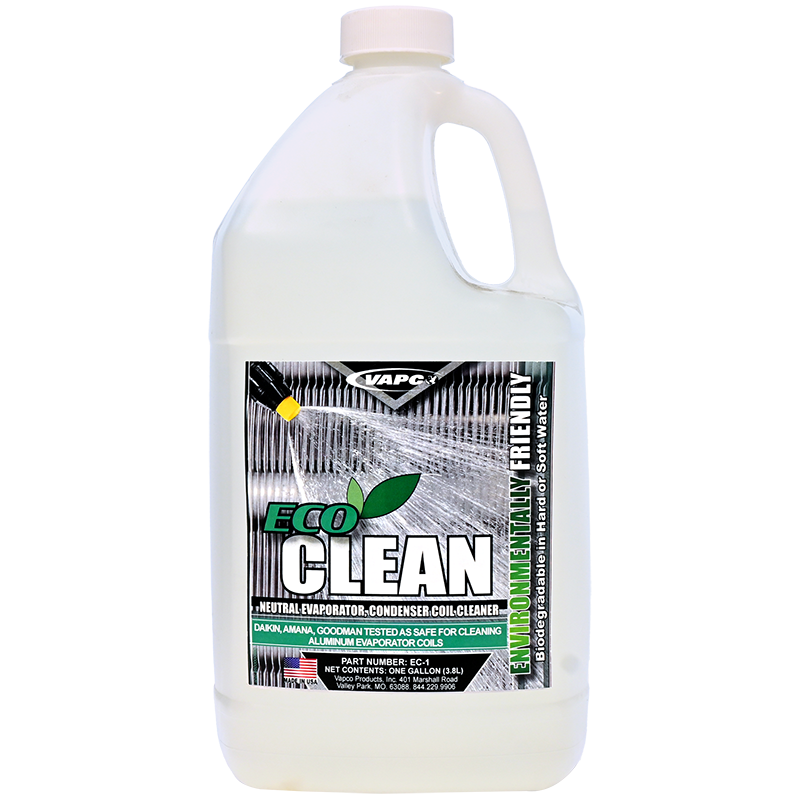
Non-Toxic HVAC Cleaner Multi-Surface | ECO CLEAN – EC-1
The Green Cleaner That Actually Cleans.
Green cleaners have a reputation problem in the trades. Contractors have been burned at both ends of the spectrum: harsh chemicals that strip paint, irritate skin, and damage coated coils on one side — and products labeled “eco-friendly” that couldn’t cut through a dusty residential evaporator coil on the other. The safe stuff doesn’t clean. The stuff that cleans isn’t safe. That’s the assumption ECO CLEAN was built to challenge.
ECO CLEAN is a mildly alkaline concentrate built on industrial degreaser chemistry, formulated to protect aluminum and coated metals during cleaning while delivering real performance on grease, soot, and urban pollutants. It contains no hazardous ingredients at or above OSHA reportable levels. It works on every coil configuration — evaporator, condenser, microchannel, and mini-split. And when the coil job is done, it follows you to the walls, the floors, and the roof — at the right dilution for each surface — without reaching for a second product.
Manufacturer’s Tech Note: No rinse is required on evaporator coils operating in cooling mode where sufficient ambient humidity is present to produce condensate. On condenser coils and any application where condensate is not present, rinse with clear water after the dwell period.
Important: ECO CLEAN is a maintenance cleaner, not a remediation product. It is not designed for heavily impacted coils with years of neglected buildup. For severely fouled coils requiring aggressive intervention, see Foaminator.
Coil Protocol: Three Ratios for Three Job Types
Because ECO CLEAN is a concentrate, you control the strength based on what the job calls for. All coil configurations — evaporator, condenser, and microchannel — are compatible.
- 3:1 Ratio (Heavy Soiling): For coils with significant grease accumulation, soot deposits, or heavy urban pollutant buildup. Maximum cleaning strength while remaining within safe chemistry parameters.
- 7:1 Ratio (Routine Maintenance): The go-to ratio for standard PM visits. Effective on the dust, grime, and light soiling that accumulates on most residential and commercial coils between scheduled service intervals.
- 10:1 Ratio (Light-Duty / Sensitive Coils): For microchannel coils, freshly installed equipment, or light maintenance where minimal soil load is present. Maximum economy — one gallon yields ten gallons of solution.
Rinse Note: No rinse is required on evaporator coils operating in cooling mode where sufficient ambient humidity is present to produce condensate. On condenser coils and any application where condensate is not present, rinse with clear water after the dwell period.
Important: ECO CLEAN is a maintenance cleaner, not a remediation product. It is not designed for heavily impacted coils with years of neglected buildup. For severely fouled coils requiring aggressive intervention, see Foaminator.
Key Features & Trade Benefits
| KEY FEATURE / SPECIFICATION | TRADE BENEFIT / RESULT |
|---|---|
| Slightly Alkaline Formula (pH 9.2) | Cleans Without Damaging: Alkaline enough to emulsify grease, soot, and urban pollutants — mild enough for painted surfaces, marble, and coated coils where high-pH cleaners cause irreversible damage. |
| Three Coil Dilution Ratios (3:1 / 7:1 / 10:1) | One Product, Every Coil Job: Scale from maximum cleaning power to light maintenance economy without switching products. At 10:1, one gallon yields eleven gallons of solution. |
| All Coil Configuration Compatibility | No Coil Left Behind: Works on evaporator, condenser, and microchannel coils. Most eco cleaners are positioned for evaporator use only — ECO CLEAN works across all coil types on the truck. |
| No Hazardous Ingredients at OSHA Reportable Levels | Safe for Occupied Spaces: Use in schools, government buildings, and healthcare facilities without restricting building occupants. No OSHA hazardous ingredient disclosure required. |
| Multi-Surface Formula | Replaces Multiple Products: Separate surface protocol covers floors, walls, woodwork, porcelain, enamel, and metal. One product for the mechanical room and the rest of the building. |
| Formulated to Meet EPA Safer Choice Criteria | Specification-Ready: Meets the ingredient and environmental standards required by facilities with green procurement policies, environmental compliance requirements, or LEED-adjacent cleaning protocols. |
Surface Protocol: One Product Beyond the Mechanical Room
Where most HVAC cleaners stop at the coil, ECO CLEAN’s dilute surface protocol extends to the rest of the building. Use cold water for all surface applications. Rinse with clear water after scrubbing.
| SURFACE TYPE | DILUTION | METHOD |
|---|---|---|
| Composition, Terrazzo, Tile & Marble Floors | 1–4 oz per gallon cold water | Mop and rinse with squeegee or damp mop. Increase concentration for stubborn areas. |
| Wood & Concrete Floors | 4 oz per gallon cold water | Scrub surface and rinse clean with clear water. |
| Walls, Woodwork, Porcelain, Enamel & Metal Surfaces | 4 oz per gallon cold water | Scrub surface and rinse clean with clear water. |
Vapco Field Guide: Application Matrix
ECO CLEAN performance by application type. (★★★ = Best in Class | ★★ = Effective | ★ = Light Duty Only)
| APPLICATION | RATING | NOTES |
|---|---|---|
| Evaporator Coil — Routine PM | ★★★ | Purpose-built application. No rinse required in cooling mode with adequate condensate. |
| Condenser Coil — Routine PM | ★★ | Use at 3:1–7:1. Rinse with water after dwell period. |
| Micro-channel Coil | ★★★ | Safe for all-aluminum microchannel designs. Use at 7:1–10:1. |
| Urban Soot & Pollution on Coils | ★★★ | Effective on particulate and exhaust-based buildup common in urban and rooftop installations. |
| Tile, Terrazzo & Marble Floors | ★★★ | 1–4 oz per gallon. Safe for polished stone and composite flooring. |
| Walls, Painted Surfaces & Woodwork | ★★★ | 4 oz per gallon. Safe for paint, enamel, porcelain, and metal. |
| Light Grease on Coils | ★ | Handles maintenance-level grease accumulation. Use at 3:1 for best results. |
| Heavily Impacted / Neglected Coils | NOT RECOMMENDED | ECO CLEAN is a maintenance product, not a remediation cleaner. For significant buildup, use Foaminator. |
Part Number Reference:
ECO CLEAN is available in a 1-gallon format. Contact your Vapco distributor for case pricing and availability.
| PART NUMBER | SIZE / PACK | APPLICATION FIT |
|---|---|---|
| EC-1 | 1 Gallon (Case of 4) | Service Truck Standard: Mixes into standard pump sprayers for coil work or into a mop bucket for surface cleaning. The right size for the tech running a route. |
Contractors: Please contact your local Vapco distributor for pricing and availability.
Why “Safe” Cleaners Keep Failing HVAC Contractors
| THE PROBLEM (Most Eco Cleaners) | THE ECO CLEAN DIFFERENCE |
|---|---|
| “It Only Does One Thing” Most eco-labeled HVAC cleaners are evaporator-only products. They rely on condensate to rinse and can’t be used outdoors or on other surfaces without a different product or significant volume of product to clean well. |
“One Product, Every Surface” ECO CLEAN works on all coil types — evaporator, condenser, and micro-channel, mini-splits — plus floors, walls, and building surfaces. One product on the truck for every safe-cleaning application. |
| “Safe Means Weak” Contractors who’ve tried green cleaners before know the pattern: gentle formula, light foam, rinsed off before it did anything. Urban grime and coil grease require actual chemistry. |
“Alkaline Enough to Clean” pH 9-10 is the balance point — strong enough to break down grease, soot, and pollutants, mild enough to use in schools and on coated surfaces. Safety and cleaning power are not a trade-off here. There’s also built in chemistry to protect |
| “One Ratio Fits All” Most eco cleaners ship pre-diluted or at a single fixed ratio. If the job is lighter or heavier than expected, there’s no adjustment — you’re using more product or switching to something else. |
“Three Ratios, Total Control” Mix at 3:1 for heavy soiling, 7:1 for routine PM, or 10:1 for light maintenance and maximum economy. The same concentrate adapts to the job — no second product needed. |