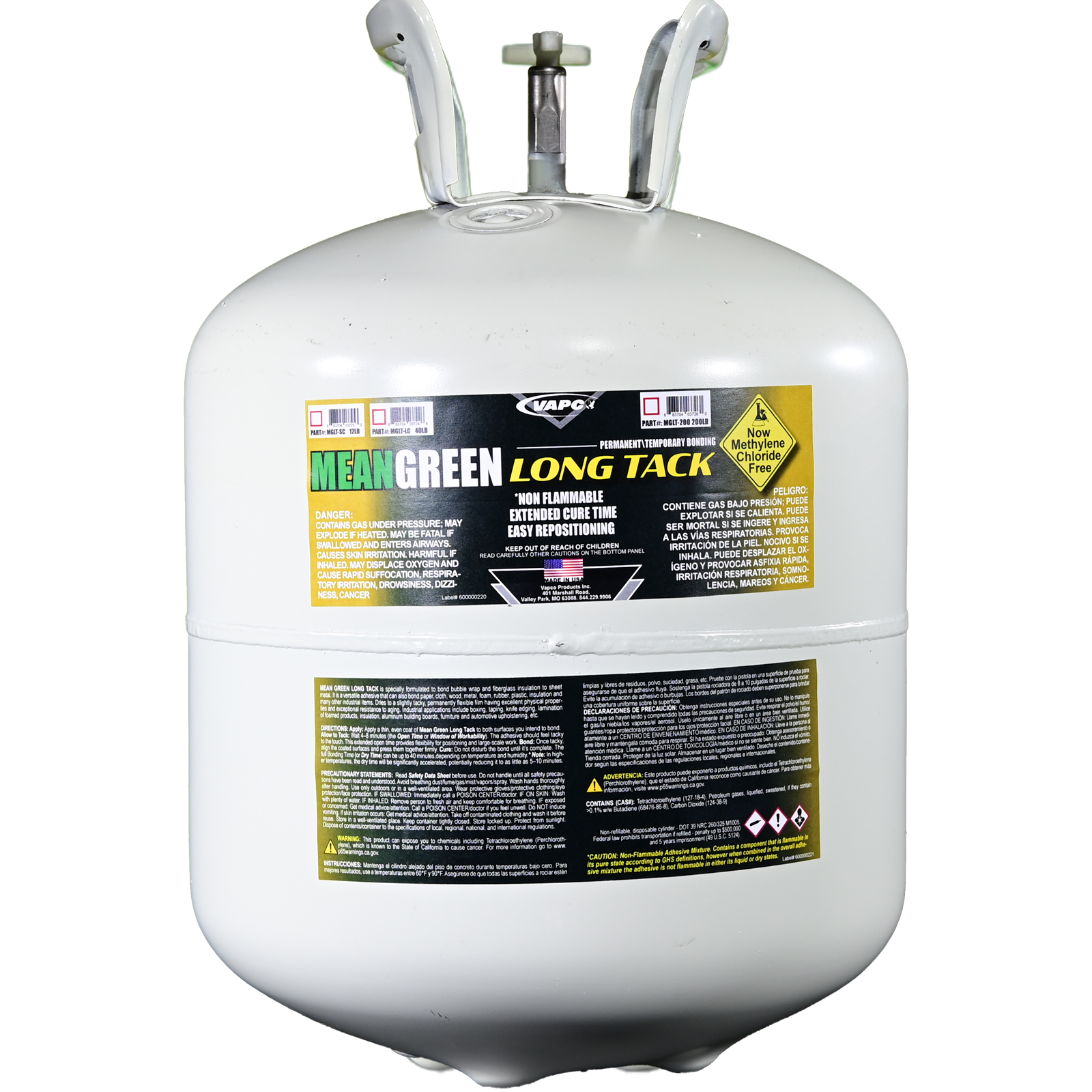
Non-Flammable Long Tack HVAC Adhesive: Mean Green Long Tack Cylinders MGLT- SC, LC, 200
More Flexibility. Better Margins. Improved Safety.
In the fast-paced world of HVAC fabrication, “speed” is usually king. But when you are wrapping massive duct work, laminating 10-foot sheets of acoustic liner, or training a new apprentice, speed can be your enemy. If your glue dries before the insulation is straight, you are looking at costly rework.
Mean Green Long Tack (MGLT) is the “Forgiving” Solution. We engineered this formula for the jobs that require patience. By modifying the solvent blend to evaporate slower, MGLT creates a “Long Tack” profile with a 4–8 minute open window. This allows your team to spray large surface areas and take their time positioning the liner for a perfect, wrinkle-free fit.
The “Value” Choice for Commercial Shops Not every job needs the lightning-fast speed of our standard Mean Green (MG-LC). MGLT is formulated to be our most affordable non-flammable option. It allows high-volume shops to maintain their “Non-Flammable” safety standards and insurance compliance while significantly lowering their cost-per-pound on materials.
Ideal Applications:
- Large Duct Runs: Spray entire 10+ foot sections without worrying about the leading edge drying out.
- Complex Fittings: Great for radius bends and transitions that require repositioning.
- Training Bench: Perfect for new installers learning the trade who need extra time to get the fit right.
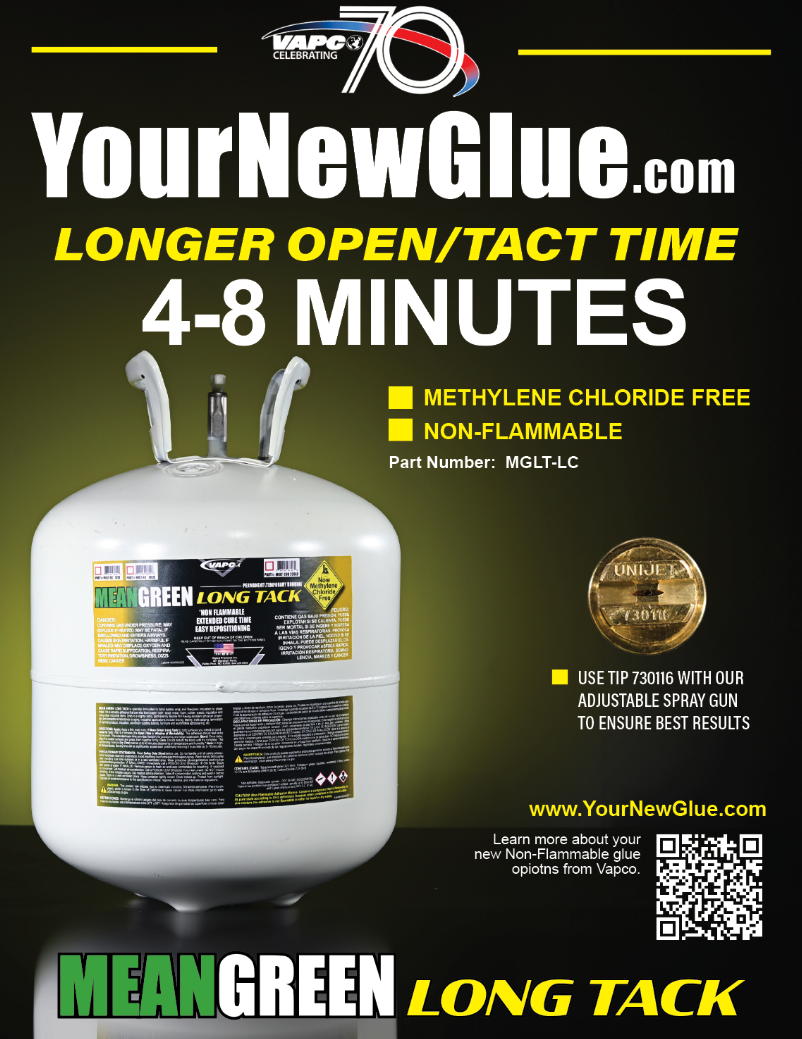
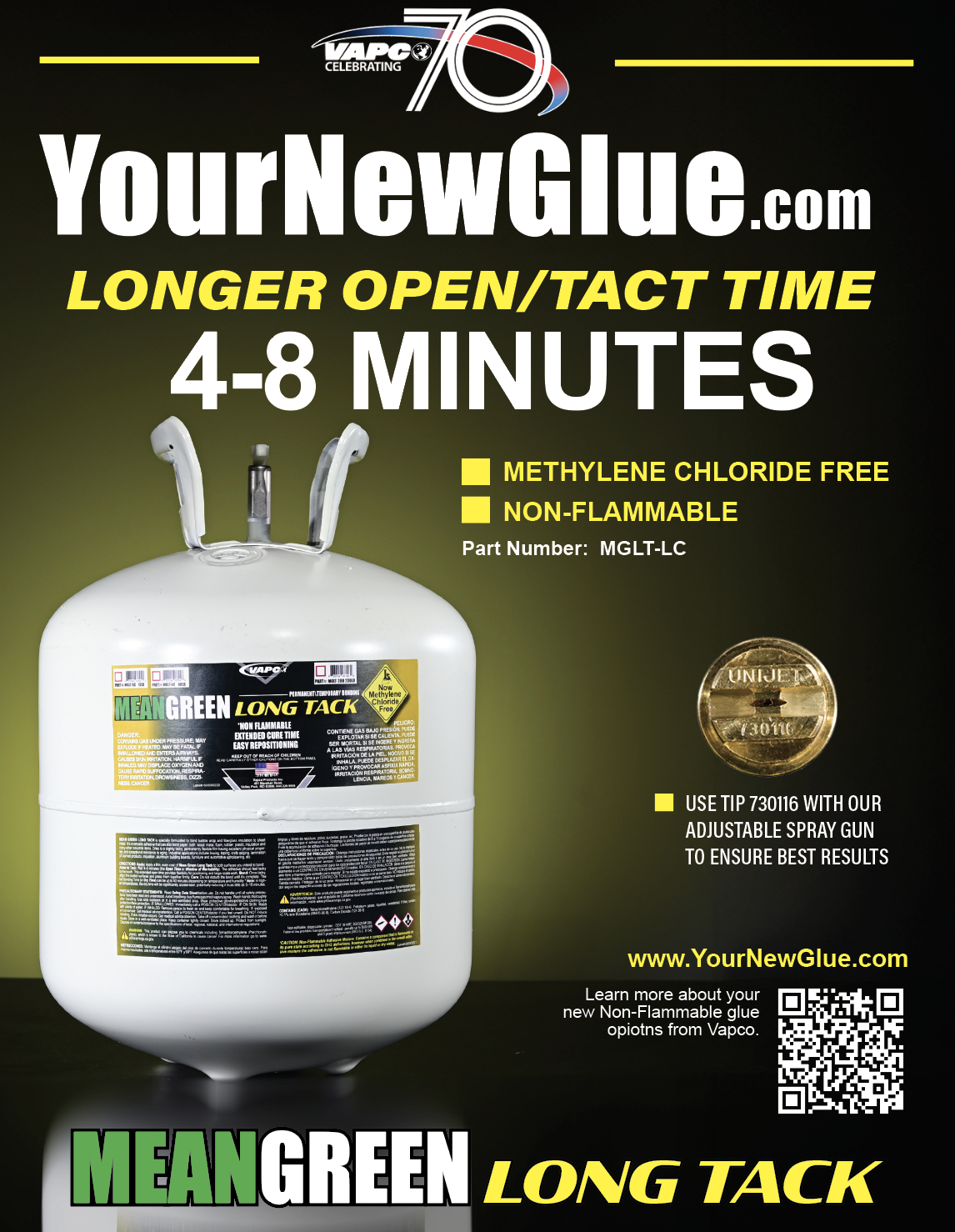
- PRO TIP: Watch Your Tip! Because MGLT is a high-viscosity (thicker) formula designed for affordability and hold, it requires a larger orifice to spray correctly. You MUST use Tip 730116 with your spray gun. Standard tips may cause the adhesive to stream rather than web.
| KEY FEATURE / SPECIFICATION |
TRADE BENEFIT / RESULT |
| Non-Flammable Status (Wet & Dry) |
Job-Site Safety & Insurance: Truly non-flammable. Eliminates fire risk and satisfies strict safety and insurance requirements for commercial fabrication shops. |
| Extended Open Time (4–8 min) |
Positioning Forgiveness: Provides a wider working window than standard adhesives, allowing extra time to align large sheets and complex fittings without the glue drying prematurely. |
| High Solids Content: ≈ 30% |
Superior Yield & Value: Our most cost-effective non-flammable option. High resin load sits on top of porous fiberglass for a permanent bond with less product usage. |
| Low VOC Content: < 5% |
Environmental Safety: Extremely low VOC formulation (approx 0.67 g/L) meets strict air quality standards while maintaining aggressive bond strength. |
| Methylene Chloride-Free |
Safety Bridge Solution: Replaces restricted MeCl solvents with a safer non-flammable alternative, ensuring compliance with EPA safety mandates through 2026. |
| Distinctive Green Color |
Visual Quality Control (QC): The green color allows for instant visual confirmation of 100% coverage on the substrate, eliminating costly misses. |
| Controlled Web Spray Pattern |
Zero Waste & Cleanliness: Ensures precise application with minimal overspray/misting, keeping the adhesive on the insulation and off the floor. |
| Requires Tip 730116 |
Viscosity Warning: Due to the thicker formula, you MUST use Tip 730116 to achieve a proper web pattern. Standard tips will not spray correctly. |
| WARNING: Contains Perchloroethylene (PCE) |
TSCA & Inventory Planning: This product is a strategic stop-gap.
• Dec 8, 2026: Distribution to retailers ends.
• Mar 8, 2027: Commercial/Industrial use ends. |
Part Number Reference:
Select the right cylinder size for your job, and don’t forget the hose, spray gun and universal adhesive remover to keep you spraying.
1. Select Your Cylinder
| PART NUMBER |
NET WEIGHT |
RECOMMENDED APPLICATION |
| MGLT-SC |
12 lbs |
Portable / Service: Lightweight disposable tank. ideal for complex field repairs or smaller installations. |
| MGLT-LC |
40 lbs |
Shop Standard: Best balance for large duct runs, fabrication tables and portability. |
| MGLT-200 |
200 lbs |
Production: High-volume stationary setup for consistent lining. |
2. Accessories – for the absolute best performance, be sure to use Vapco equipment with your cylinders.
| Spray Gun |
SPR-AG
Professional Adjustable Spray Gun (Comes with Tip 6501 & 730116)
MGLT Requires tip 730116 for best results |
| Hoses |
THA- 6, 12, 18
Teflon Hose Assemblies (Available in 6ft, 12ft, and 18ft lengths) |
| Cleanup |
UAR-SC
Adhesive Remover Spray (Essential for cleaning gun tips and overspray) |
Contractors: Please contact your local Vapco distributor for pricing and availability.
Directions for Non-Flammable Long Tack HVAC Adhesive (MGLT):
Pre-Application Checklist (Safety & Setup)
This section ensures job-site safety and optimal bond strength for the high-viscosity Long Tack formula.
- Ventilation is Mandatory: This product contains chlorinated solvents (Perchloroethylene). Use outdoors or in a well-ventilated area with forced air movement. Consult the SDS for required PPE.
- Surface Preparation: Ensure both surfaces are clean, dry, and completely free of dirt, oil, or mold release agents.
- Temperature Check: Maintain the adhesive and substrate temperature between 60°F-90F for optimal spray pressure and tack development.
- Non-Flammable Safety: Although the mixture is non-flammable, keep the work area clear of ignition sources, heat, and sparks.
Application Procedure (Cylinder Use)
This procedure ensures maximum yield and correct web pattern.
- Hose, Gun & Tip: Attach the hose and spray gun. CRITICAL: You MUST use Tip 730116. Other tips will not handle the thicker flow of the Long Tack formula.
- Maintain Distance: Hold the spray gun nozzle 6–10 inches from the surface.
- Spray Technique: Apply a uniform web coat of Mean Green to both surfaces (contact bond style), ensuring 80-100% coverage. Use a side-to-side sweeping motion to avoid uneven pooling.
- Allow to Tack (Extended Open Time): Wait 4–8 minutes. Do not rush this step. The adhesive needs this extra time to flash off the solvent carrier. It should feel tacky to the touch but should not transfer to your finger when lightly pressed.
- Bond: Once the adhesive is tacky, align your materials. You have a wider window to position large sheets. Press firmly across the entire surface.
- Cure (Full Bonding Time): Don’t hang this vertical immediately; give it time to set. Do not disturb the bond until it’s complete. The Bonding Time can be up to 40 minutes, depending on temperature, humidity and volume of glue sprayed.
- ⚠️ Important Temperature Note: In higher temperatures, the dry time will be significantly accelerated, potentially reducing it to as little as 5–10 minutes. Always check tackiness before bonding in hot environments.
Post-Bonding and Cleanup
- Handling Strength: Do not disturb the bond for 10–30 minutes. This is the initial “grab” phase where the adhesive achieves handling strength.
- Full Cure Time: Allow 24 hours for the bond to achieve maximum structural integrity and peak thermal resistance.
- Cleanup: If the cylinder will sit for more than 72 hours without use, close the valve, purge the hose/gun, and connect to UAR-SC to clean the components and increase the longevity of your setup.
Transparency & Regulatory Roadmap (Distributor Notice)
At Vapco, we believe in full transparency with our partners. This Non-Flammable Solvent Contact Adhesive for HVAC Insulation formula utilizes Perchloroethylene (Perc/PCE) to achieve its non-flammable safety rating. We view this as a vital transition tool—a reliable stop-gap that keeps your business running safely while the industry adapts to new non-solvent technologies.
Please note the following EPA compliance dates for inventory planning:
- Status Today: Fully Compliant for all Professional Uses.
- December 8, 2026: Deadline for distribution to retailers.
- March 8, 2027: Deadline for commercial and industrial use.
This gives you a clear runway to use this proven product while Vapco works alongside our chemical supply partners to finalize the next generation of permanent, non-flammable solvent technologies.
FAQs
Frequently Asked Questions: Mean Green Long Tack (MGLT)
Application & Performance
Q: Why do I need to use the specific Spray Tip 730116?
A: MGLT is a High-Viscosity Formula designed to hold heavy insulation. Because it is thicker than standard adhesives, it requires the larger orifice of Tip 730116 to atomize correctly. Using a standard tip will result in “streaming” or “spitting” rather than a proper web pattern.
Q: What is the “Open Time” or working window?
A: Mean Green Long Tack offers an extended open time of 4–8 minutes. This gives you significantly more time to position large sheets of fiberglass duct liner or wrap complex fittings compared to standard “instant tack” adhesives.
Q: What happens if I bond it too soon (before 4 minutes)?
A: Patience is key. If you bond before the solvent has flashed off (while it is still wet), the solvent can get trapped, leading to a weak bond or “bubbles” under the liner. Wait until the adhesive is tacky and does not transfer to your finger.
Q: Can I use MGLT on Styrofoam or Polystyrene?
A: NO. MGLT contains chlorinated solvents that will dissolve low-density polystyrene foam (EPS/XPS). It is designed specifically for fiberglass, rubber, and acoustic liners applied to metal.
Trouble Shooting
Q: Why is the spray pattern inconsistent or “spitting”?
A: This usually indicates one of a few things:
1. Wrong Tip: You are likely using a standard tip instead of the required Tip 730116.
2. Cold Cylinder: The adhesive is too cold. MGLT must be maintained between 60°F – 90°F. If the cylinder is cold, the pressure drops and the thick glue cannot spray properly. Warm the cylinder to room temperature before use, get it up off cold floors or away from exterior walls if possible.
3. Clogged Equipment: Clogged Equipment: if the hose or tip sit too long with product not being used the glue can start to setup and cause flow issues, use universal adhesive remover UAR-SC to purge the hose and tip of dry adhesive.
Safety & Compliance
Q: How does the VOC content compare to standard Mean Green?
A: Mean Green Long Tack is our most eco-friendly non-flammable solvent option, featuring an extremely low VOC content of < 5% (approx 0.67 g/L), making it an excellent choice for shops prioritizing air quality while maintaining a non-flammable safety profile.
Q: Is this product Non-Flammable?
A: Yes. Mean Green Long Tack is certified Non-Flammable in both Wet and Dry states, satisfying strict insurance requirements for commercial fabrication shops.
Q: How long can I buy this product? (EPA Regulations)
A: MGLT is fully compliant for professional use today. Under current EPA TSCA guidelines, distribution to retailers ends Dec 8, 2026, and commercial use ends March 8, 2027. Vapco is actively developing the next generation of permanent non-flammable solutions to replace it before these dates.
Q: What cylinder sizes are available?
A: MGLT is available in three sizes to suit your workflow:
• 12 lbs (MGLT-SC): Portable/Disposable for field service.
• 40 lbs (MGLT-LC): Standard size for shop fabrication.
• 200 lbs (MGLT-200): Large volume for production lines.
SDS
⚠️ MGLT Safety Data Sheet (SDS)
SAFETY DATA SHEET
MEAN GREEN LONG TACK
1. Identification & Supplier Details
Product Identification (Section 1.1)
| GHS Product Identifier (Product Name) |
Mean Green Long Tack |
| Product Number / Brand |
MGLT-LC, MGLT-SC- MGLT-200 / Vapco |
| Recommended Use (1.3) |
Solvent-based contact adhesive |
Supplier Details & Emergency Contact (Section 1.4 & 1.5)
| Supplier Name |
Vapco Products, Inc. |
| Supplier Address |
401 Marshall Road
Valley Park, Missouri 63088, United States |
| Telephone / Fax / Email |
(636) 923-2121 / (636) 923-3002 / info@VapcoProducts.com |
| Emergency Phone Number |
(800) 255-3924 |
Restrictions on Use (1.3): After December 8, 2026 this chemical substance (as defined in TSCA section 3(2))/product cannot be distributed in commerce to retailers for any use. After March 8, 2027, this substance can only be distributed/processed for specific industrial/commercial uses (e.g., as a reactant/intermediate, in vapor degreasing, laboratory chemicals, etc.).
2. Hazard Identification & Composition
GHS Classification (Section 2.1)
| GHS Classification (OSHA) |
Acute toxicity, inhalation, Cat. 4; Aspiration hazard, Cat. 1; Carcinogenicity, Cat. 1A; Gases under pressure, liquefied gas; Skin corrosion/irritation, Cat. 2; Specific target organ toxicity (single exposure), Cat. 3; Simple asphyxiants. |
| Signal Word |
Danger |
| Hazard Statement(s) |
H280: Contains gas under pressure; may explode if heated.
H304: May be fatal if swallowed and enters airways.
H315: Causes skin irritation.
H332: Harmful if inhaled.
H335: May cause respiratory irritation.
H336: May cause drowsiness or dizziness.
H350: May cause cancer.
—: May displace oxygen and cause rapid suffocation (Simple Asphyxiant). |
| Pictograms |
|
| Unknown Toxicity |
This product contains 30% of chemicals of unknown toxicity. |
Precautionary Statements (Section 2.2)
| Category |
Statement(s) |
| Prevention |
P201, P202 (Obtain special instructions before use. Do not handle until all safety precautions have been read and understood). P261 (Avoid breathing dust/fume/gas/mist/vapors/spray). P280 (Wear PPE). |
| Response (First Aid) |
P301+P310 (IF SWALLOWED: Immediately call a POISON CENTER/doctor). P331 (Do NOT induce vomiting). P308+P313 (IF exposed or concerned: Get medical advice/attention). P304+P340 (IF INHALED: Remove to fresh air). |
| Storage / Disposal |
P405 (Store locked up). P410+P403 (Protect from sunlight. Store in a well-ventilated place). P501 (Dispose of contents/container to regulations). |
Hazardous Components (Section 3.2)
| Chemical Name |
Concentration |
CAS No. |
Classification Note |
| Tetrachloroethylene |
55 – 65 % (weight) |
127-18-4 |
Acute Tox. 4 (Inhal.), Carc. 1A, Asp. Haz. 1, Skin Irrit. 2, STOT SE 3 |
| Petroleum gases, liquified, sweetened |
4 – 6 % (weight) |
68476-86-8 |
Liquefied Gas, Simple Asphyxiant |
| Carbon Dioxide |
3 – 4 % (weight) |
124-38-9 |
Liquefied Gas, Simple Asphyxiant |
3. Physical & Chemical Properties
Basic Physical and Chemical Properties (Section 9)
| Physical State / Appearance |
Liquid / Web spray |
| Color / Odor |
Green / Chlorinated solvent odor |
| pH / Solubility |
N/A / Insoluble in water |
| Melting Point / Boiling Range |
-8.4°F (-22.4°C) / 250°F (121.1°C) |
| Flammability / Flash Point |
Non-flammable / N/D |
| Vapor Pressure (Perchloroethylene) |
14.7 mmHg at 20°C |
| Density and/or Relative Density |
1.43 g/L |
| Relative Vapor Density / Evaporation Rate |
5.83 (Air=1) / 0.1 (Ether=1) |
| Partition coefficient n-octanol/water (log value) |
2.88 (Perchloroethylene) |
| Kinematic Viscosity / Percent Solids |
400-600 cPs / 29.1% |
| VOC Content / MIR |
4.70% [0.67 g/L] / 0.46 |
4. Stability & Reactivity
Reactivity and Stability (Section 10)
| Reactivity / Possibility of Hazardous Reactions |
May be reactive to chemically active metals and bases. Certain mixtures of chlorinated solvents may be flammable or reactive. None known other than those listed. |
| Chemical Stability |
Contains gas under pressure; may explode if heated. Pressurized container; may burst if heated. |
| Conditions to Avoid |
Chlorine liberating material. Avoid contact with open flame, electric arcs, or other hot surfaces that may cause thermal decomposition. Do not mix with acids, ammonia or other cleaning compounds. |
| Incompatible Materials |
May react with some plastics, strong oxidizing agents, acids, caustics, alkalis, and chemically active metals (e.g. aluminum, magnesium, sodium, potassium, and lithium). May react with freshly galvanized surfaces to produce highly toxic dichloroacetylene. |
| Hazardous Decomposition Products |
Hydrogen chloride, phosgene, chlorine, hexachloroethane, hexachlorobenzene, carbon oxide(s), and various hydrocarbons. |
5. Toxicological Information
Information on Acute Toxicity (Section 11)
| Component |
Test / Route |
Dose / Result (Species) |
| Tetrachloroethylene |
LC50 Inhalation (8 hrs) |
34,200 mg/m3 (Rat) |
| Tetrachloroethylene |
LD50 Dermal (Rabbit) |
>3,228 mg/kg |
| Tetrachloroethylene |
LD50 Oral (Rat) |
>2,629 mg/kg |
Other Toxicological Effects (Section 11)
| Skin/Eye Irritation |
Causes skin irritation (localized defatting, drying, dermatitis). Causes mild eye irritation (redness, tearing, blurred vision). |
| Respiratory Sensitization / Cardiac Risk |
Harmful by inhalation. Causes CNS depression, dizziness, headaches. High exposures may cause anesthetic effects, unconsciousness, and death. Can cause cardiac sensitization leading to sudden, fatal cardiac arrhythmias. |
| Carcinogenicity (Tetrachloroethylene) |
IARC: 2A (Probably carcinogenic to humans). NTP: Reasonably anticipated to be a human carcinogen. Not listed by OSHA. |
| STOT Repeated Exposure / Target Organs |
Repeated or prolonged exposure may be toxic to kidneys, liver, skin, central nervous system (CNS). Associated with changes in renal and liver function. |
| Aspiration Hazard |
Yes. May be fatal if swallowed and enters airways. |
| Medical Conditions Aggravated |
Pre-existing disorders of the liver, kidneys, heart, and nervous system. Consumption of alcoholic beverages may increase toxic effects. |
6. First-Aid Measures
Description of Necessary First-Aid Measures (Section 4.1)
| General Advice |
Never give anything by mouth to an unconscious person. If you feel unwell, seek medical advice (show the label where possible). |
| If Inhaled |
Remove person to fresh air and keep comfortable for breathing. Get medical advice/attention. Excessive exposure may increase sensitivity to epinephrine and cause irregular heartbeats. |
| In Case of Skin Contact |
Immediately drench affected area with water for at least 15 minutes. Remove contaminated clothing immediately. Obtain medical attention if irritation develops or persists. |
| In Case of Eye Contact |
Immediately rinse with water for at least 15 minutes. Remove contact lenses, if present and easy to do. Continue rinsing. Obtain medical attention if irritation develops or persists. |
| If Swallowed |
Rinse mouth. Do NOT induce vomiting. Immediately call a POISON CENTER/doctor (H304 Aspiration Hazard). Obtain medical attention. |
Immediate Medical Attention (Section 4.3): If medical advice is needed, have product container or label at hand. Note to Physician: No specific antidote. This material sensitizes the heart to sympathomimetic amines; Adrenaline, epinephrine, and similar drugs should be avoided as cardiac arrhythmia may result. Risk of aspiration must be weighed against possible toxicity when deciding on gastric lavage.
7. Fire-Fighting & Accidental Release Measures
Fire-Fighting Measures (Section 5)
| Suitable Extinguishing Media |
Dry chemical, foam, or carbon dioxide (CO2). |
| Specific Hazards |
Container may explode in heat of fire (Pressurized Gas Hazard). Vapors are heavier than air and may travel to an ignition source and flash back. Hazardous decomposition products include Phosgene and Hydrogen Chloride. |
| Protection During Firefighting |
Do NOT fight fire when fire reaches containers. Evacuate area. Fight fire remotely. Use water spray or fog for cooling exposed containers. Wear NIOSH-approved SCBA with full face piece. |
Accidental Release Measures (Section 6)
| Personal Precautions/PPE |
Eliminate ignition sources. Do not get in eyes, on skin, or on clothing. Do not breathe vapors, spray, mist, gas. Evacuate unnecessary personnel. |
| Environmental Precautions |
Prevent entry to sewers and public waterways. Avoid release to the environment. |
| Containment & Clean Up Methods |
Ventilate the area. Contain any spills with dikes or absorbents. Take up liquid spill into absorbent material. Transfer spilled material to a suitable container for disposal. |
8. Handling, Storage & PPE
Precautions for Safe Handling (Section 7.1)
| Precautions for Safe Handling |
Do not handle until all safety precautions have been read and understood. Avoid contact with skin, eyes and clothing. Do not spray on open flame or other ignition source. |
| Additional Hazards |
Do not pressurize, cut, or weld containers. Ruptured cylinders may rocket. Do not pierce or burn, even after use. |
Conditions for Safe Storage (Section 7.2)
| Storage Conditions |
Store in a dry, cool, well-ventilated place. Store locked up/in a secure area. Protect from sunlight. Do not expose to temperatures exceeding 50°C/122°F. |
| Incompatible Materials |
Strong oxidizing agents, acids, caustics, alkalis, and chemically active metals (e.g. aluminum). |
Exposure Controls and PPE (Section 8)
| Exposure Limit (Select Components) |
Value |
Source / Type |
| Tetrachloroethylene TWA |
25 ppm |
US/OSHA, ACGIH |
| Carbon Dioxide TWA |
5,000 ppm |
US/OSHA, NIOSH, ACGIH |
| Eye/Face Protection |
Chemical safety goggles. Emergency eye wash fountains/safety showers must be available. |
| Skin/Body Protection |
Wear protective gloves and clothing. Chemical resistant materials. |
| Respiratory Protection |
Use a NIOSH-approved SCBA whenever exposure may exceed OELs. |
9. Transport & Regulatory Information
Transport Information (Section 14)
| UN Number / Class |
UN1956 / 2.2 (Non-flammable, Non-toxic Gas) |
| Proper Shipping Name (DOT/IMDG/IATA) |
Compressed gas, n.o.s. |
Regulatory Information (Section 15)
| California Proposition 65 |
WARNING: This product can expose you to chemicals including Tetrachloroethylene (Perchloroethylene), which is known to the State of California to cause cancer. |
| US EPA TSCA Public Inventory |
Tetrachloroethylene (CAS: 127-18-4), Petroleum gases, liquified (CAS: 68476-86-8), Carbon Dioxide (CAS: 124-38-9). |
| State RTK Components (PA, NJ, MA) |
Tetrachloroethylene (CAS: 127-18-4) and Carbon Dioxide (CAS: 124-38-9) are listed in Pennsylvania, New Jersey, and Massachusetts Right To Know inventories. |
| Chemical Safety Assessment / TSCA Restrictions |
Detailed restrictions on distribution and use after December 8, 2026, and March 8, 2027, respectively (see Section 1.3). |
10. Disposal & Ecological Information
Ecological Information (Section 12)
| Toxicity (LC50) – Tetrachloroethylene |
Species |
Value / Result |
| LC50 (96 hr) |
Fathead Minnow / Bluegill |
18.4 ppm / 12.9 ppm |
| Persistence and Degradability |
Biodegradation under aerobic conditions is below detectable limits. Degradation is expected in the atmospheric environment (days to weeks). Persists in ground water. |
| Bioaccumulative Potential |
Not expected to significantly bio-accumulate in aquatic organisms or absorb to sediment. (Log Kow: 2.88). |
| Mobility in Soil |
Product can leach through soil to reach groundwater. Potential for mobility in soil is medium (Log Koc estimated 2.1-3.2). |
| Other Adverse Effects |
This material is hazardous to aquatic life. Avoid release to the environment, sewers, and waterways. |
Disposal Methods (Section 13)
| Product Disposal |
Dispose of contents/container in accordance with local, regional, national, and international regulations. Do not pierce or burn, even after use. Product should be fully characterized prior to disposal. |
| Sewage Disposal |
Avoid release into the environment. Keep out of sewers and waterways. |
11. Disclaimer & Preparation Information
Preparation Information (Section 16.2)
| Prepared by |
Jessica Wilson |
| Date Prepared |
1-23-2025 |
Disclaimer (Section 16.1):
To the best of our knowledge, information contained herein is accurate. No warranty, expressed or inferred, is created or inferred by any statement in this SDS. Final determination of suitability of any material is the sole responsibility of the user. The user is responsible for full compliance with various government agency regulations. The manufacturer is not responsible for loss, injury, or expense arising out of the product’s improper use. No warranty, expressed or inferred, regarding the product described in this SDS shall be created or inferred by any statement in this SDS. Key: N/A = Not applicable; N/D = Not determined.
Technical Data
⚠️ MGLT TECHNICAL DATA REPORT – DOWNLOAD
Field Guide: Substrate Compatibility Matrix
Mean Green Long Tack (MGLT) provides an extended open window for large-scale commercial HVAC insulation.
| SUBSTRATE A |
SUBSTRATE B |
BOND TYPE |
PERFORMANCE / WHY IT WORKS |
| Fiberglass Duct Liner / Duct Board |
Galvanized Steel / Aluminum |
Permanent |
High Solids (27-32%) creates a heavy web that bridges porous insulation without soaking in, ensuring structural hold. |
| Bubble-Wrap / Bubble-Foil |
Sheet Metal / Vinyl / Wood |
Permanent |
Non-flammable solvent blend provides rapid flash-off and excellent bite on aluminum lined insulation and plastic films without melting sensitive surfaces. |
| Rubber Sheeting / Urethane / Foam |
Metal / Wood / Paper |
Permanent |
Flexible cured film accommodates thermal expansion/contraction in HVAC systems. |
| Vinyl Fabrics / Leather / Felt |
Vehicle Interiors / Panels |
Permanent |
Heavy body formula prevents bleed-through on fabrics while delivering high shear strength. |
1. Physical & Chemical Properties
| PROPERTY |
SPECIFICATION |
| Flammability Status |
Non-Flammable (Wet & Dry States) |
| Solvent System |
Chlorinated Solvent Blend (Methylene Chloride Free) |
| Color / Appearance |
Green (Visual Coverage Indicator) |
| Solids Content (by weight) |
27% – 32% (High Solids) |
| VOC Content |
< 5% |
| Service Temperature Range |
-20°F to 200°F (-29°C to 93°C) |
2. Application & Performance Metrics
| METRIC |
PERFORMANCE DATA |
| Tack Time (Flash-Off) |
4 – 8 Minutes (Depending on Temp/Humidity) |
| Open Time (Working Window) |
Up to 20 Minutes |
| Cure Time (Full Structural Strength) |
10 – 40 Minutes (Handling Strength) / 24 Hours (Full Cure) |
| Cleanup Solvent |
Universal Adhesive Remover (UAR-SC) or compatible solvent |
3. Logistics & Compliance Checklist
| ITEM |
DETAILS / CLASSIFICATION |
| California Proposition 65 |
WARNING: Contains Perchloroethylene (Known to cause cancer) |
| TSCA Sunset Date (Retail) |
December 8, 2026 (Distribution to Retailers Ends) |
| TSCA Sunset Date (Commercial) |
March 8, 2027 (Commercial/Industrial Use Ends) |
| UN Number / Shipping Name |
UN1956, Compressed Gas, N.O.S. (Non-Flammable) |
|
Non-refillable, disposable cylinder
|
DOT 39 NRC 260/325 M1005. Federal law prohibits transportation if refilled -penalty up to $500,000 and 5 years imprisonment (49 U.S.C. 5124). |
4. Estimated Structural Performance Data*
| METRIC (ASTM Type) |
LAB ESTIMATED VALUE |
| Peel Strength (180° Peel) (Aluminum to Fiberglass) |
18 – 24 PIW (Pounds per Inch Width) |
| Shear Strength (Static Load) (Aluminum to Aluminum) |
> 125 PSI (Pounds per Square Inch) |
| Adhesion Failure Mode (Typical) |
Substrate Failure (Adhesive bond exceeds strength of low-density materials) |
*Vapco has not run certified laboratory tests (e.g., ASTM) to verify these specific metrics. Performance will vary based on application technique, substrate material composition, temperature, humidity, and curing conditions.