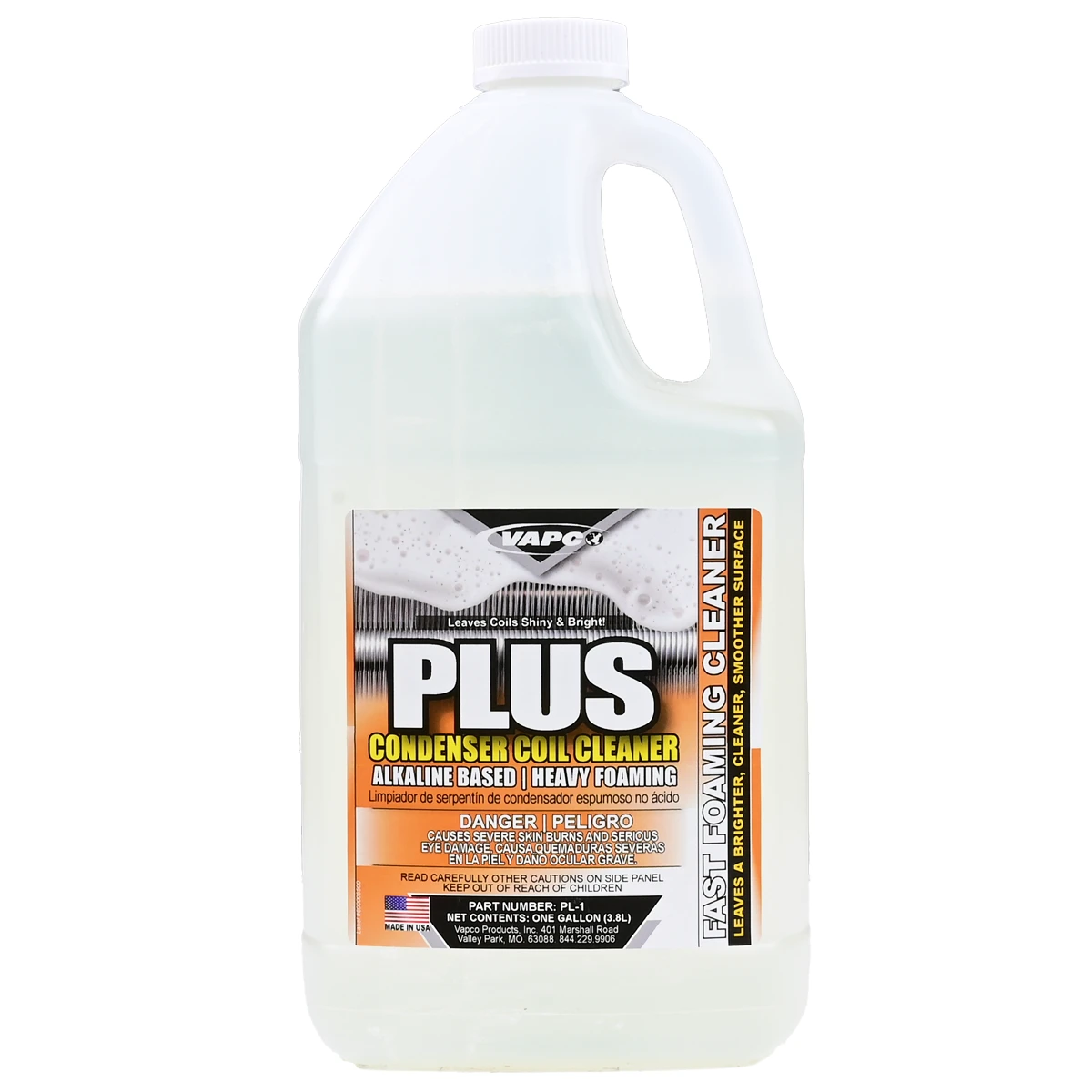
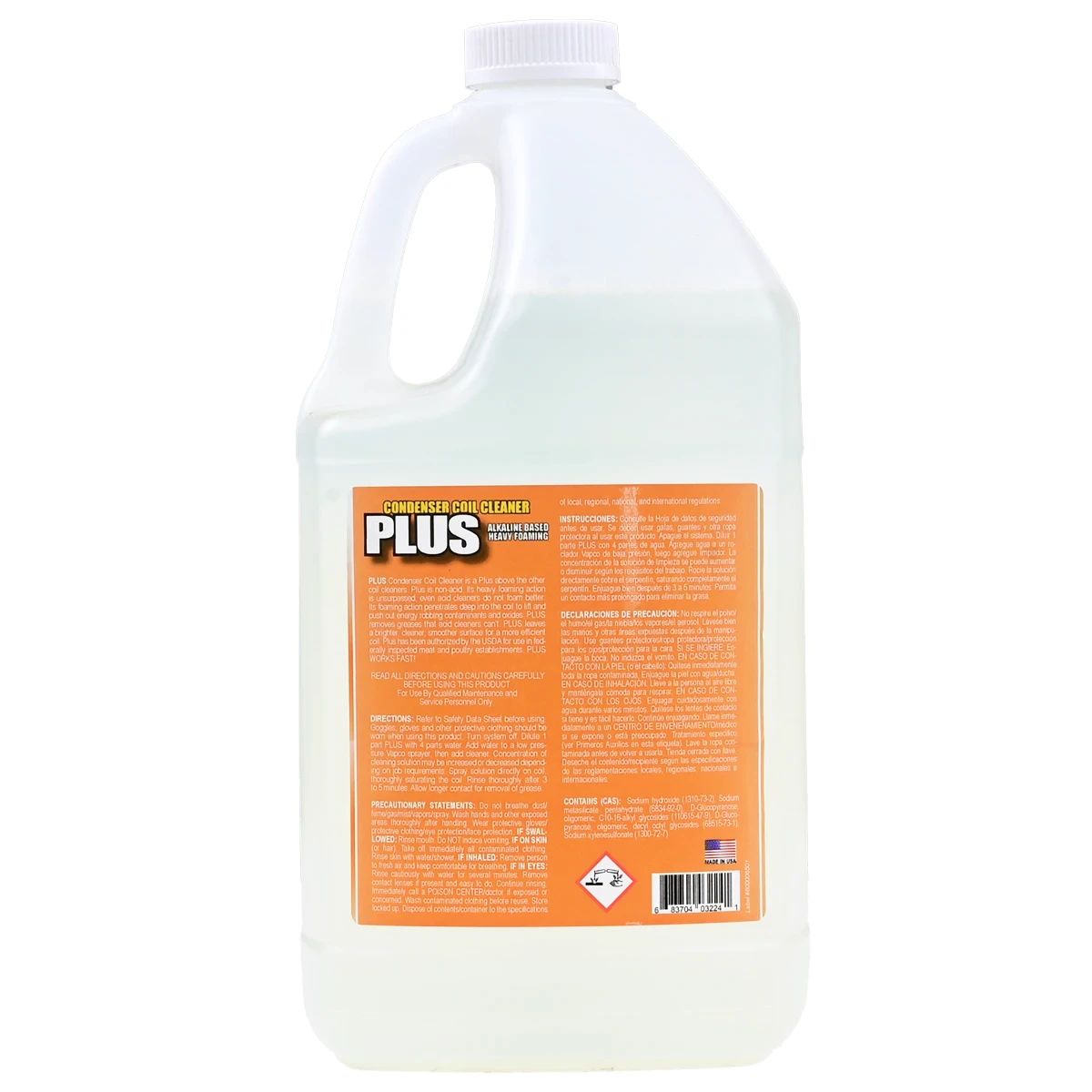
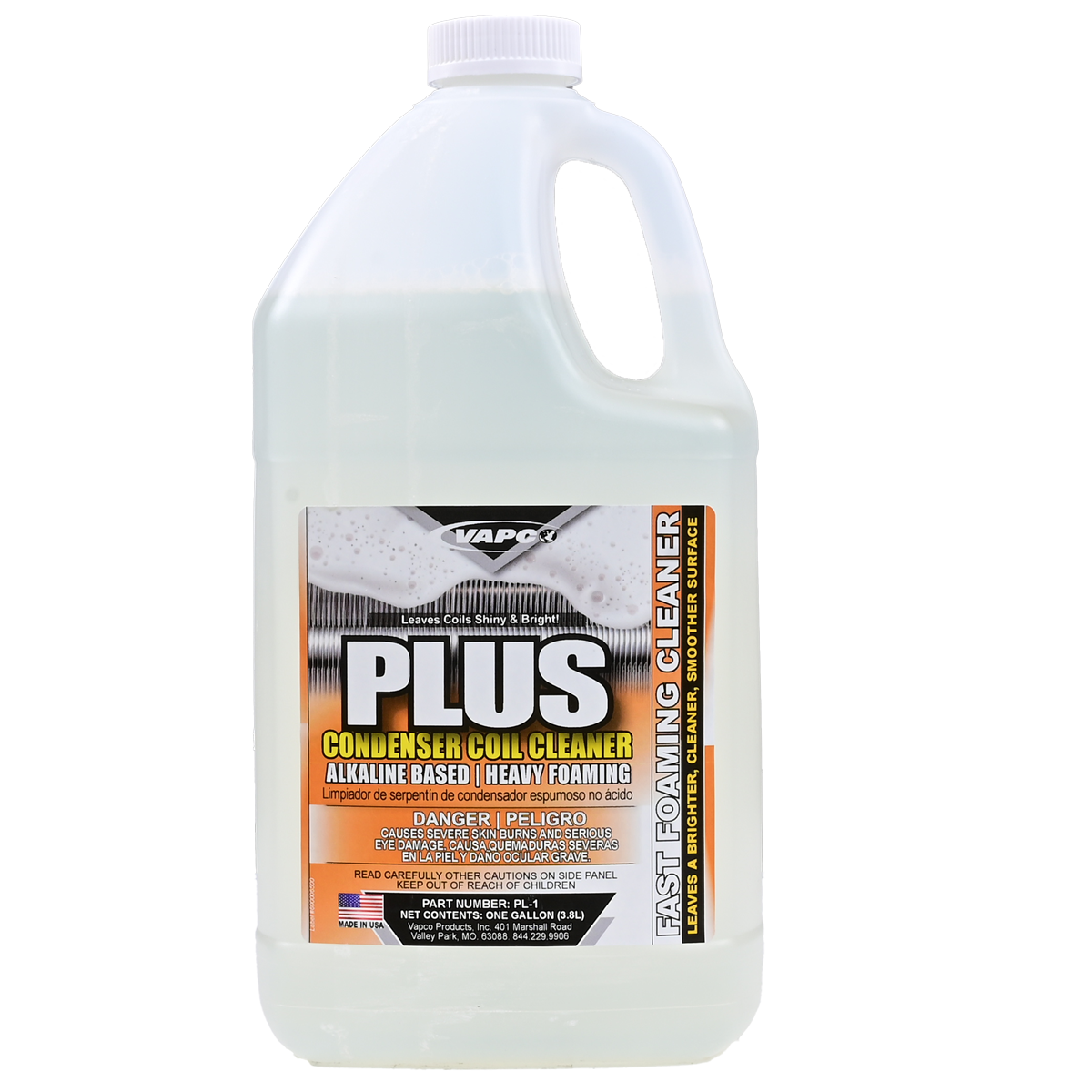
Plus PL-1  

COIL BRIGHTENING, FOAMING, ALKALINE COIL CLEANER – Plus was the first alkaline foaming cleaner in the industry and still one of the best available. Designed to leave coils bright and smooth, Plus will eliminate grease, contaminants, and oxides to return coils to a like-new state. While Plus is clear to white in color, it compares directly to the blue, alkaline, condenser coil cleaners on the market

PLUS

Powerful and Effective Coil Cleaning Solution

PLUS is a specialized condenser coil cleaner designed to remove stubborn contaminants and restore optimal performance.Its heavy foaming action penetrates deep into coils, lifting and pushing out dirt, grease, oxides, and other buildup. 

Key Features and Benefits:
  • Powerful Cleaning: Effectively removes contaminants that can reduce coil efficiency.   
  • Non-Acid Formula: Gentle on surfaces while providing powerful cleaning action.  
  • Heavy Foaming Action: Ensures deep penetration and thorough cleaning.  
  • Brightens and Shines Coils: Leaves coils looking clean and well-maintained.  
  • Meets USDA Standards: Approved for use in federally inspected meat and poultry establishments.  
  • Fast-Acting: Provides quick and efficient cleaning results.  

PLUS is a reliable and effective coil cleaning solution that can be used on a variety of HVAC systems. Its powerful cleaning action, versatility,

Part Number;     Size
  • PL-1                                      1 gal 4/cs
Directions:

Effective Coil Cleaning in a Few Simple Steps

Before Use:
  • Consult SDS: Refer to the Safety Data Sheet (SDS) for detailed safety information.
  • Wear Protective Gear: Always wear goggles, gloves, and protective clothing.
Application:
  1. Power Off: Turn off the HVAC system.
  2. Dilute: Mix 1 part PLUS with 4 parts water. Adjust the ratio based on the level of dirt and grime.
  3. Prepare Sprayer: Add water to a low-pressure Vapco sprayer, then add the diluted cleaner.
  4. Spray Coil: Spray the solution directly onto the coil, ensuring thorough saturation.
  5. Allow to Sit: Let the solution sit for 3-5 minutes, or longer for heavy grease.
  6. Rinse Thoroughly: Rinse the coils completely to remove any remaining solution and foam.

By following these steps, you can effectively clean your condenser coils using PLUS.


DANGERS & PRECAUTIONS

 Do not breathe mists. Do not mix with bases, ammonia, or other cleaning compounds.


Contact Us

News and Updates

Subscribe on Youtube

Follow Us on Facebook 


SDS

⚠️ PLUS SDS – DOWNLOAD

1. Identification & Supplier Details

Product Name Plus
Product Number PL-1, PL-5, PL-55
Brand Vapco
Recommended Use Alkaline coil cleaner
Supplier Information Vapco Products, Inc.
401 Marshall Road, Valley Park, Missouri 63088, United States
Phone: (636) 923-2121 | Email: [email protected]
Emergency Phone (800) 255-3924

2. Hazard Identification & Composition

GHS Classification Eye damage/irritation, Cat. 1; Skin corrosion/irritation, Cat. 1A
Signal Word DANGER
Hazard Statements H314: Causes severe skin burns and eye damage
Hazardous Components CAS No. Concentration
Sodium Hydroxide 1310-73-2 10 – 20 % (weight)
Silicic acid (H2SiO3), disodium salt 6834-92-0 1 – 10 % (weight)
C10_16-alkyl, oligomeric, D-glucopyranoside 110615-47-9 0.1 – 1 % (weight)
D-Glucopyranose, oligomeric, decyl octyl glycosides 68515-73-1 0.1 – 1 % (weight)
Sodium xylenesulfonate 1300-72-7 0.1 – 1 % (weight)

3. Physical & Chemical Properties

Physical State & Appearance Liquid; Clear colorless liquid; Bland odor
pH >13 (Highly Alkaline)
Melting/Freezing Point < 32°F (0°C)
Solubility in Water Soluble
Density / Relative Density 1.26 at 77°F (25°C)
Vapor Pressure / Rate 23.8 mmHg / <0.8 (Slow)
VOC Content <1%

4. Stability & Reactivity

Chemical Stability Stable under normal conditions.
Reactivity May react with strong acids and chemically active metals. Corrosive to metals.
Conditions to Avoid Chlorine-liberating material. Do not mix with bases, ammonia, or other cleaning compounds. Direct sunlight and extreme temperatures.
Incompatible Materials Strong acids and chemically active metals.
Hazardous Decomposition Carbon oxide(s), nitrogen oxide(s), and sodium oxide(s).

5. Toxicological Information

Acute Toxicity Sodium xylenesulfonate: LD50 Oral (Rat) >=7,200 mg/kg.
Alkyl polyglycoside: LD50 Oral >5,000 mg/kg.
Skin/Eye Effects Causes severe burns; prolonged contact will destroy tissue. Contact with eyes may result in loss of sight.
Sensitization / STOT May cause upper respiratory damage and pulmonary edema. Dermatitis may occur from long-term irritation.
Carcinogenicity Not classified.

6. First-Aid Measures

Inhalation Remove to fresh air. Keep at rest. Seek medical attention.
Skin Contact Immediately drench area with water for 15 minutes. Remove contaminated clothing. Seek medical attention if irritation persists.
Eye Contact Rinse with water for at least 15 minutes. Remove contact lenses. Obtain immediate medical attention.
Ingestion Rinse mouth. Do NOT induce vomiting. Obtain medical attention.

7. Fire-Fighting & Accidental Release Measures

Extinguishing Media Water spray, CO2, alcohol-resistant foam, dry chemical, or sand.
Firefighting Hazards Hazardous combustion products include carbon, nitrogen, and metal oxides. Wear NIOSH-approved SCBA.
Spill Clean-up Ventilate area. Contain spills with dikes or absorbents. Transfer to suitable container for disposal. Prevent entry into sewers or streams.

8. Handling, Storage & PPE

Safe Handling Avoid contact with skin and eyes. Do not breathe vapors/mist. Wash hands thoroughly. Keep out of reach of children.
Storage Conditions Store locked up in a dry, cool, well-ventilated place. Keep in original container. Do not exceed 50°C/122°F.
Engineering Controls Ensure adequate ventilation. Emergency eye wash and safety showers must be available.
Personal Protection Chemical safety goggles; Protective gloves; Chemical resistant clothing; NIOSH-approved SCBA if limits are exceeded.

9. Transport & Regulatory Information

DOT / IMDG / IATA UN Number: UN1719; Class: 8; Packing Group: II; Proper Shipping Name: Caustic alkali liquids, n.o.s.
Regulatory Lists TSCA Public Inventory; MA Right to Know; NJ Right to Know; PA Right to Know.

10. Disposal & Ecological Information

Ecological Toxicity LC50 (Rainbow Trout): 45.4 mg/l (96h). Product is biodegradable and not expected to bioaccumulate.
Waste Classification If pH > 12.5, handle as RCRA hazardous waste (D002).
Disposal Method Dispose of contents/container to local and international regulations. Do not puncture or incinerate.

11. Disclaimer & Preparation Information

Disclaimer Information contained herein is accurate to the best of our knowledge. Final determination of suitability is the sole responsibility of the user. The manufacturer assumes no liability for the accuracy or completeness of the information.
Prepared By Jessica Wilson
Date Prepared 2-28-2025

TDR

Studio Photos