
R-290 R-600a Refrigerant Service:
What HVAC/R Technicians Need to Know
TL;DR
R-290 and R-600a are already in new refrigeration equipment coming off the truck. Both are A3 hydrocarbon refrigerants — flammable, precise charge weights, different applications, not interchangeable. R-290 goes in commercial equipment, R-600a goes in household appliances. Always verify the nameplate.
The most common mistake: using fuel-grade or unreliably sourced product instead of refrigerant-grade. New equipment is shipping pre-charged with hydrocarbons as the HFC phase-down continues. If you're servicing these systems, R-290 and R-600a are already part of the job — and not all product on the shelf is refrigerant-grade.
If You Haven't Seen One Yet, You Will
If you haven't pulled a service call on one yet, you will soon — a reach-in cooler, household fridge, ice machine, or beverage center that came from the factory charged with propane or isobutane. Not R-404A. Not R-134a. Hydrocarbon refrigerant, straight from the OEM.
This isn't coming. It's already here.
The AIM Act is phasing down HFCs because of their Global Warming Potential, and manufacturers aren't waiting around — new equipment is shipping pre-charged with R-290 or R-600a right now. If you're servicing modern refrigeration equipment, these refrigerants are part of the job whether you've trained on them or not. Knowing the difference between the two, what grade of refrigerant to use, and what tools actually belong on these jobs isn't specialty knowledge anymore. It's baseline.
What Are R-290 and R-600a?
Both are natural hydrocarbon refrigerants. Both are classified A3 under ASHRAE 34 — low toxicity, high flammability. Both carry a GWP of 3 and zero Ozone Depletion Potential, which is the main reason regulators and manufacturers are pushing toward them. Both are EPA SNAP approved for systems designed to use them. That's where the similarities mostly end.
R-290 vs. R-600a: Not the Same Refrigerant
R-290 is refrigerant-grade propane (C₃H₈). Runs at higher pressures and covers a wide range of commercial and domestic applications:
- •Self-contained commercial reach-ins and display cases
- •Restaurant prep tables and underbar coolers
- •Stand-alone ice makers
- •Portable air conditioners
- •Residential refrigerators and freezers spec'd for R-290
- •Wine coolers, beverage centers, kegerators
In commercial equipment it's commonly replacing R-404A and R-407 series refrigerants in self-contained units. If you've been servicing reach-ins for any length of time, that's the context where you're most likely to encounter it. R-600a is refrigerant-grade isobutane (C₄H₁₀). Runs at much lower pressures than R-290. That's why you see it in household appliances — quieter compressor operation, less mechanical stress, and those systems are sealed tight from the factory anyway. You're not going to find R-600a in a commercial reach-in.
- •Household refrigerators and freezers
- •Compact and under-counter refrigerators
- •Wine coolers and beverage centers
- •Dehumidifiers
R-600a is already the dominant refrigerant in new domestic appliances globally. North America is catching up fast. The rule nobody should have to learn the hard way: never swap them. The compressor, metering device, and charge weight are all engineered around one specific refrigerant. Put the wrong one in and you're looking at poor performance at best, compressor failure or a safety issue at worst. Check the nameplate before you charge anything. Every time.
Refrigerant-Grade vs. Fuel-Grade: This Is Where People Get Into Trouble
Propane and isobutane are commodity gases. You can buy them for fuel. You can buy them for refrigeration. They are not the same product and using the wrong one will cost your customer a compressor. Here's the problem: fuel-grade propane and isobutane are odorized. Ethyl mercaptan — the compound that gives LP gas that distinctive smell — gets added so leaks are detectable before they become dangerous. Makes total sense for a fuel application.
It has no business in a refrigeration system. When odorized gas enters a sealed refrigeration circuit, the odorant doesn't stay inert. It gets into the compressor oil, breaks down viscosity, and contaminates the lubrication film protecting the bearings and valve components. The wear builds up quietly. Efficiency drops. System lifespan shortens. And it doesn't reverse itself — you're looking at a full Purge and oil change to address it, which costs a lot more than the price difference between refrigerant-grade and fuel-grade product ever would have. Refrigerant-grade R-290 and R-600a are non-odorized. No ethyl mercaptan, nothing added that doesn't belong in a refrigeration system. They're manufactured to AHRI 700 purity standard — minimum 99.5% purity — which is the spec that keeps the system running the way the OEM designed it to. When you're sourcing R-290 or R-600a, verify it's explicitly labeled refrigerant-grade. Fuel-grade is not a substitute regardless of what it costs or what the label looks like at a glance.
A3 Safety: What You Need to Know Before the Job
A3 means extremely flammable. That's not a reason to avoid these refrigerants — it's a reason to treat them the way you'd treat any flammable gas on a job site. Most techs who've worked around propane systems already understand the fundamentals. The difference is you're working with it inside a sealed refrigeration circuit, so the protocols matter more and they need to be consistent. Ventilate first. Hydrocarbon vapors are heavier than air. In an enclosed space — a back room, a walk-in corridor, a tight kitchen — they accumulate at floor level. Get air moving before you open any service connections. This isn't optional. Eliminate ignition sources. Lock out the equipment. No open flames, no sparking tools, no non-intrinsically safe electronics in the work area. If you wouldn't use it near a gas line, it doesn't belong on this job. Check your recovery machine before the job. Not all recovery machines are rated for flammable refrigerants — verify yours is before you use it on A3 equipment. Standard manifold gauges and hoses are generally compatible, but R-600a operates at significantly lower pressures than most techs are used to, so confirm your gauge set covers that range or you'll get inaccurate readings. And check your hose condition — hydrocarbons can degrade certain elastomers over time, so worn hoses that might be fine on other refrigerants aren't worth the risk here. Charge by weight, not pressure. OEM charge weights on these systems are specified in grams on most domestic applications — not ounces, grams. Overcharging is both a safety issue and a system killer. Don't charge by pressure and don't use a sight glass. Use the right leak detector. Standard electronic leak detectors may not reliably pick up hydrocarbon refrigerants. Use one rated for A3 gases. After charging, go over all joints and fittings with a liquid leak detector — Vapco Bird Dog is what we'd use — before you close up.
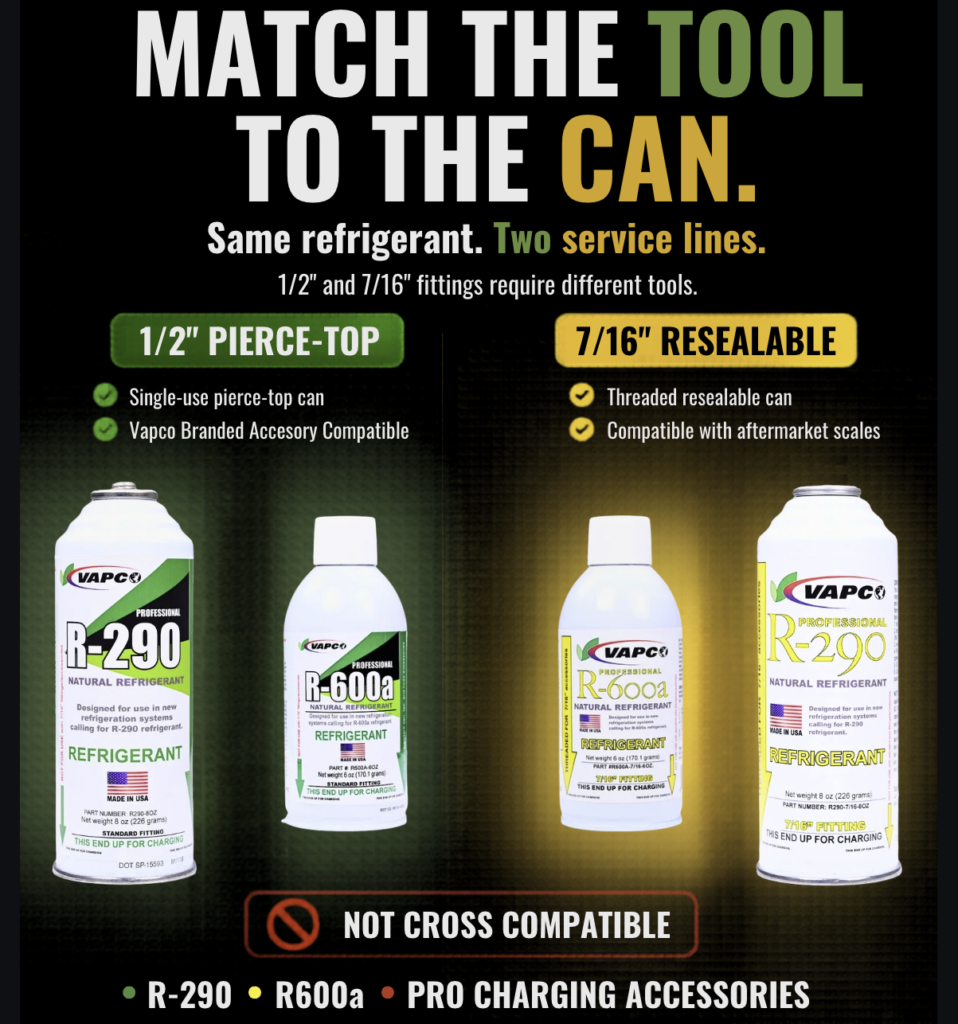
The Two Fitting Systems: 1/2" and 7/16"
When we got into the hydrocarbon refrigerant market, the only service can available had a 1/2" ACME pierce-top fitting. So that's what we built our tooling around — can taps, charging hoses, gauges, everything a tech needs without having to cobble together accessories from three different suppliers. Later, a resealable can format came to market through a partnership between a refrigerant producer and scale manufacturers. It uses a 7/16" fitting and was designed specifically for by-weight charging with compatible refrigerant scales. The resealable valve lets you cap a partial charge and bring the remainder to the next job. For techs doing multiple small-charge appliance calls, that's a real advantage — no waste, no half-empty cans you can't do anything with.
The problem when it launched: there was no compatible service tooling beyond the scale itself. If you bought the refrigerant but didn't own a compatible scale, you had no way to get it into the system. The 7/16" fitting wasn't compatible with any existing 1/2" accessories. We built the RCT-7/16 — a 7/16" can tap — specifically to solve that. Techs using the resealable can format can now connect to standard charging hoses whether or not they have a scale on the truck that day.
Both formats are in active use. The split between 1/2" and 7/16" customers runs roughly 50/50.
The 1/2" Fitting Ecosystem (Green Line)
The 1/2" pierce-top can is single-use. Once it's tapped, it's open — use it or manage it accordingly. It's the straightforward option for techs who move through a consistent volume of appliances and don't want to deal with extra steps or additional tooling investment.
Available refrigerants:
- R-290 — 8 oz, 1/2" fitting (R290-8OZ)
- R-600a — 6 oz, 1/2" fitting (R600A-6OZ)
Compatible accessories:
- RCT-1 — Can Tap: mounts to the 1/2" can, pierces the top, controls flow
- RCTH-1 — Can Tap and Hose: charging hose with brass fittings for system service port connection
- RCTHG-1 — Can Tap, Hose, and Gauge: full assembly with pressure gauge for monitoring during charge
- PSV-1 — Piercing Saddle Valve: for accessing refrigerant lines on equipment without a dedicated service port
The 7/16" Fitting Ecosystem (Yellow Line)
The 7/16" resealable can is for techs who charge by weight and want to document it. Cap the valve after a partial charge, the refrigerant stays in the can, nothing gets wasted on a small-charge job. It's the better format if you're running multiple appliance calls and precision matters to you or your customers.
Available refrigerants:
- R-290 — 8 oz, 7/16" fitting (R290-7/16-8OZ)
- R-600a — 6 oz, 7/16" fitting (R600A-7/16-6OZ)
Compatible accessories:
- RCT-7/16 — Can Tap (7/16"): connects the resealable can to standard charging hoses, however the can is designed to be inverted and used with aftermarket scales for accurate system charging by weight. The scale handles measurement, the inverted can delivers liquid refrigerant, the resealable valve preserves what's left for the next job. The RCT-7/16 is there for jobs where the scale isn't on the truck. It's not a replacement for the scale workflow, it's a backup that keeps you from being stuck.
- PSV-1 — Piercing Saddle Valve: shared across both ecosystems
Which Format Makes Sense for Your Operation?
Straight answer: it depends on how you work.
The 1/2" pierce-top makes sense if you're running steady appliance volume, you use a full can regularly, and you want a complete accessory ecosystem — tap, hose, gauge — without investing in additional equipment. Simplest path from can to system.
The 7/16" resealable makes sense if by-weight charging is standard practice for you, you're already using or planning to invest in refrigerant scales, and you're doing enough small-charge jobs that wasting the tail end of a can adds up.
Stock both if you're a distributor serving a mixed customer base — appliance techs and commercial contractors — or you've got customers with different workflows. The 50/50 split in the market isn't an accident. Both formats have a real use case and the techs who use one usually have a reason.
Vapco's Hydrocarbon Refrigerant Line
Vapco offers R-290 and R-600a in both fitting formats alongside the service tooling to use them correctly. All refrigerants are AHRI 700 certified, refrigerant-grade, and non-odorized — formulated for refrigeration systems, not fuel applications. The 1/2" green line and 7/16" yellow line are color-coded so techs and counter staff can confirm at a glance they have the right refrigerant and the right tools before the job starts.
For product details, SDS documents, and ordering:
Shop Vapco Hydrocarbon Refrigerants
R-290 and R-600a — 1/2" Fitting
R-290 and R-600a — 7/16" Fitting
Further Reading
Why Refrigerant Grade Matters: AHRI 700 Certified R-290 & R-600a →
Frequently Asked Questions
Can I use regular propane instead of R-290?
No. Fuel-grade propane is odorized with ethyl mercaptan, which contaminates compressor oil and degrades system components. R-290 is refrigerant-grade propane — non-odorized and manufactured to AHRI 700 purity standards. They share the same base molecule but they are not the same product.
What is the difference between R-290 and R-600a?
R-290 is refrigerant-grade propane, used in commercial reach-ins, ice machines, and some residential equipment. R-600a is refrigerant-grade isobutane, used in household refrigerators, freezers, and compact appliances. They operate at different pressures and are not interchangeable — always verify the equipment nameplate before charging.
What does A3 mean on a refrigerant label?
A3 is the ASHRAE 34 safety classification for refrigerants with low toxicity and high flammability. R-290 and R-600a are both A3. It means you need proper ventilation, no ignition sources in the work area, and tools specifically rated for hydrocarbon refrigerant service.
What is AHRI 700 certification?
AHRI 700 is the purity standard for refrigerants used in HVAC/R applications, set by the Air-Conditioning, Heating, and Refrigeration Institute. For R-290 and R-600a, it requires a minimum 99.5% purity. It's the specification that confirms you're putting refrigerant-grade product into the system, not a lower-grade substitute.
What tools do I need to service R-290 and R-600a equipment?
First thing to verify is your recovery machine — not all are rated for flammable refrigerants, so check before the job. Standard manifold gauges and hoses are generally compatible, but confirm your gauge set covers the lower pressure range R-600a operates at and inspect hose condition since hydrocarbons can degrade worn elastomers. For charging, Vapco makes can taps, charging hoses, and gauges compatible with both the 1/2" pierce-top and 7/16" resealable can formats. You also need a leak detector rated for A3 gases.
What is the difference between the 1/2" and 7/16" refrigerant can formats?
The 1/2" pierce-top can is single-use — once tapped it's open. The 7/16" resealable can can be capped after a partial charge and reused on the next job. The 7/16" format is designed for by-weight charging with a refrigerant scale. Vapco makes compatible can taps for both formats.
Can I use R-290 tools with R-600a?
The service tooling is compatible across both refrigerants within the same fitting format — the same can tap, hose, and gauge setup works for R-290 and R-600a in the 1/2" ecosystem, and the RCT-7/16 works for both in the 7/16" ecosystem. The refrigerants themselves are not interchangeable in systems.