Why Refrigerant Grade Matters:
The Case for AHRI 700 Certified: R-290 R-600a refrigerant grade
The Supply Chain Problem Nobody's Talking About Yet
Hydrocarbon refrigerant adoption is accelerating. R-290 and R-600a are showing up in new equipment across the board — household appliances, commercial reach-ins, ice machines, beverage equipment — and that's not slowing down. The AIM Act phase-down has manufacturers committed and there's no reversal coming. Here's what comes with that: as demand grows, the supply chain fills up. And not all of it is coming from sources anyone's vetting.
Propane and isobutane are commodity gases. They're produced in massive volumes for fuel, industrial, and chemical applications. As refrigerant demand for these molecules increases, more product enters the market — some of it properly manufactured to refrigeration standards, some of it repackaged commodity gas with a refrigerant label on the can. The difference isn't visible from the outside. It shows up later, inside a compressor, on a service call that shouldn't have happened. If you're a wholesaler putting product on your shelf, that callback doesn't go to the can manufacturer. It comes back to you.
Refrigerant-Grade vs. Fuel-Grade: Not the Same Product
The propane in a backyard grill cylinder and the R-290 in a refrigerant service can share the same base molecule. That's where the similarity ends.
The difference comes down to two things: what's been added to the gas, and how pure it actually is.
The odorant problem.
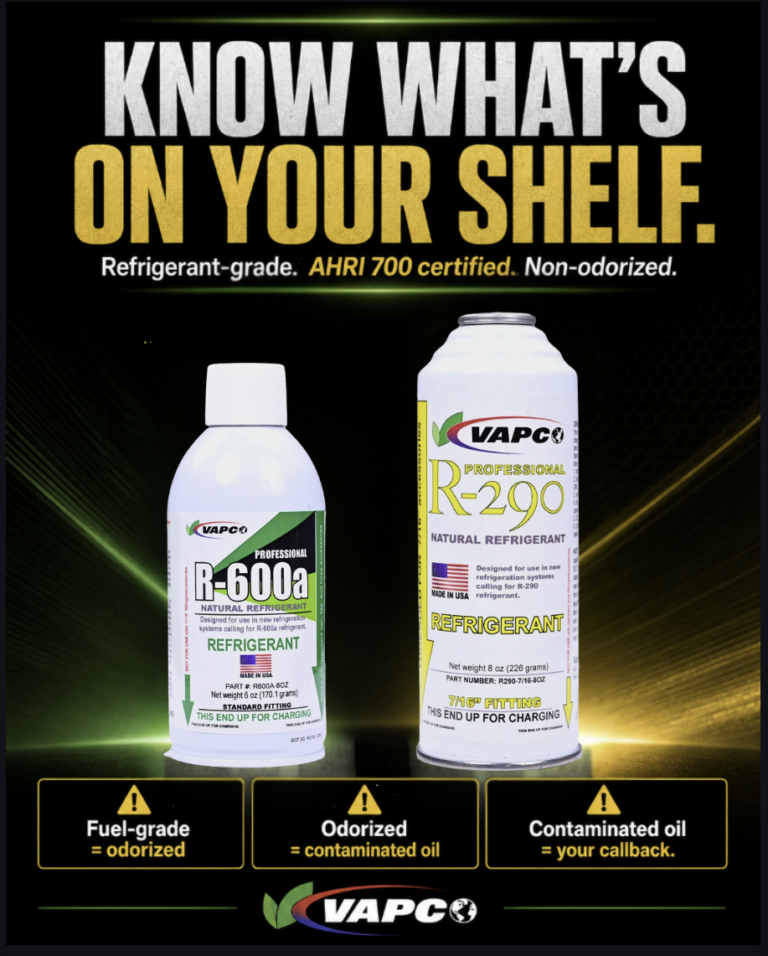
Fuel-grade propane and isobutane are legally required to be odorized in most applications. Ethyl mercaptan — the compound responsible for that distinctive LP gas smell — gets added so leaks are detectable before they become dangerous. It's a sensible safety measure for fuel applications. It has no business in a refrigeration system.
When odorized gas enters a sealed refrigeration circuit, the odorant doesn't stay inert. It gets into the compressor oil, breaks down viscosity, and contaminates the lubrication film protecting bearings and valve components. The damage accumulates quietly — slightly elevated head pressure, compressor running warmer than it should, efficiency dropping off. By the time it's obvious something is wrong, you're looking at accelerated wear that doesn't reverse without a full system flush and oil change. That service call costs significantly more than the price difference between refrigerant-grade and fuel-grade product ever would have. Refrigerant-grade R-290 and R-600a are non-odorized. No ethyl mercaptan. Nothing added that doesn't belong in a refrigeration system.
The Purity Standard: What AHRI 700 Actually Means
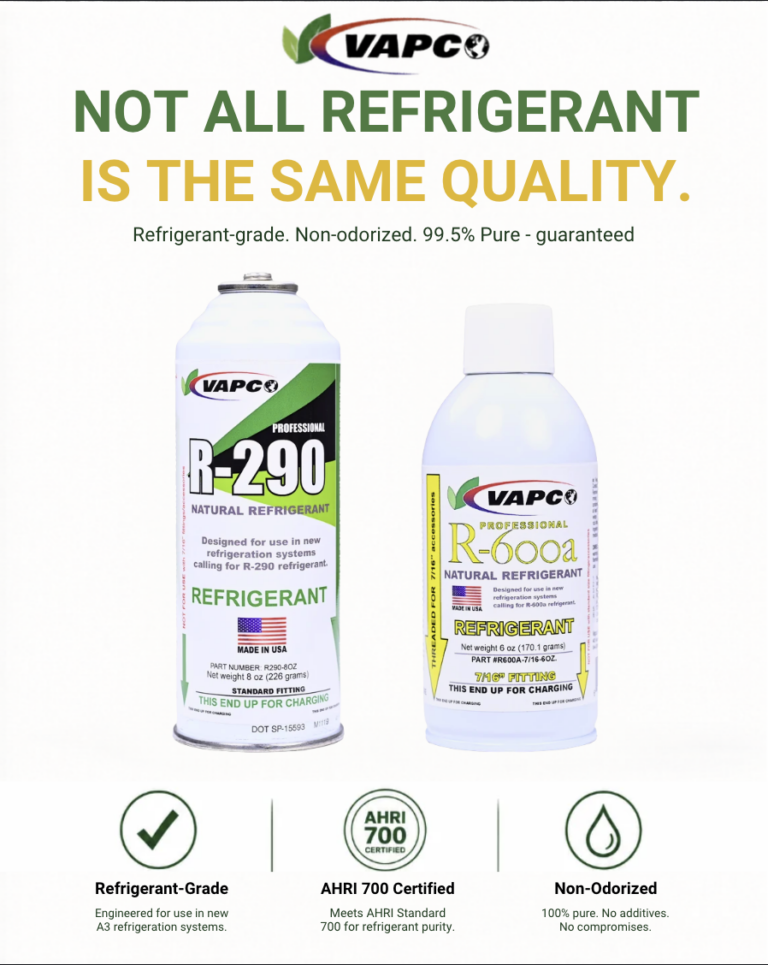
AHRI 700 is the Air-Conditioning, Heating, and Refrigeration Institute's minimum purity specification for refrigerants used in HVAC/R applications. For R-290 and R-600a, it requires a minimum 99.5% purity.
That 0.5% is where off-spec product does its damage. Contaminants in lower-grade hydrocarbon gas include moisture, air, other hydrocarbons, and residual processing compounds — none of which belong in a refrigeration system and all of which cause problems:
Moisture combines with refrigerant and oil to form acids. Those acids attack copper, steel, and elastomer components. Slowly, then all at once.
Air introduces non-condensables. Head pressure climbs, system capacity drops, the compressor runs hot. The tech on the job sees symptoms without an obvious cause.
Off-spec hydrocarbons change the thermodynamic properties of the refrigerant. The system was engineered around a specific refrigerant behaving a specific way. Put something slightly different in and it doesn't behave as designed — and the OEM spec you were trying to hit is now a guess.
AHRI 700 certification isn't a marketing phrase. It's a documented specification a product has to meet before it carries that designation. It should appear on the product spec sheet, not just the label copy. If it's not documented, it's not verified.
Vapco R-290 and R-600a are certified to meet AHRI 700. Both are non-odorized and refrigerant-grade.
What the Filling Process Has to Do With It
Here's something that doesn't get talked about enough: purity at the source doesn't guarantee purity in the can. A high-quality refrigerant can still be compromised during filling if the production line isn't built to prevent it. The specific vulnerability is atmospheric contamination — residual air and moisture inside the can before the refrigerant goes in. If a can isn't properly evacuated before filling, that atmospheric air gets sealed in with the refrigerant. The tech who taps that can introduces non-condensables and moisture into the system regardless of how pure the gas itself was at the source.
Preventing it requires one step that not every filling operation bothers with: pulling the can to vacuum before refrigerant introduction. That removes atmospheric air and moisture from the can interior. What goes in is refrigerant. Nothing else.
This isn't complicated. It's also not universal. It requires specific equipment and a filling process built around contamination prevention rather than throughput. As more cheap hydrocarbon refrigerant enters the market from commodity sources, the filling process is exactly where corners get cut.
Vapco specifies vacuum evacuation as part of the filling standard for our R-290 and R-600a. We know what the failure mode looks like when it's skipped and we know why it matters — which is why it's non-negotiable in how our product is produced. The result is a sealed can containing AHRI 700 certified, non-odorized, refrigerant-grade hydrocarbon and nothing else.
Why This Lands on the Wholesaler
A contractor puts a can of R-290 into a system. Six months later the compressor is showing wear it shouldn't have. The customer has a warranty dispute. The tech has a callback. Nobody in that conversation is calling the manufacturer whose name is on the can. The conversation goes back to whoever sold the product — the distributor, the supply house, the counter where the tech bought it.
The quality of what's on your shelf is your liability in the field. As hydrocarbon refrigerant adoption grows and more product enters the market from sources nobody's vetting, the wholesalers who've specified what they stock and why are the ones who won't be fielding those calls. That's not a sales pitch. It's how the supply chain works.
Three Questions Worth Asking About Any R-290 or R-600a You Stock
Is it refrigerant-grade?
If the product isn't explicitly labeled refrigerant-grade and non-odorized, that's where the conversation ends. Don't assume. Ask directly and get it in writing, most will have a COA as well for verification.
Is it AHRI 700 certified?
This needs to appear on the product specification — not just the label or the marketing copy. If the supplier can't show you the documentation, the certification doesn't mean anything.
What does the filling process look like?
Specifically: are the cans evacuated before filling?
Purity at the source can be completely undermined by a filling process that doesn't control for atmospheric contamination. Not every supplier does this. Ask the question and see what answer you get.
Vapco R-290 and R-600a meet all three. Refrigerant-grade, non-odorized, AHRI 700 certified, and produced to a filling standard that includes vacuum evacuation before filling. Available in both 1/2" pierce-top and 7/16" resealable formats with compatible service tooling for each.
Frequently Asked Questions
What is AHRI 700 and why does it matter for R-290 and R-600a?
AHRI 700 is the Air-Conditioning, Heating, and Refrigeration Institute's purity standard for refrigerants used in HVAC/R applications. For R-290 and R-600a it requires a minimum 99.5% purity. It's the documented specification that confirms you're working with refrigerant-grade product — not a commodity gas repackaged with a refrigerant label. It should appear on the product spec sheet, not just the marketing copy.
What happens if you use fuel-grade propane instead of refrigerant-grade R-290?
Fuel-grade propane is odorized with ethyl mercaptan. When that enters a refrigeration system it contaminates the compressor oil, breaks down lubrication, and accelerates wear on bearings and valve components. The damage doesn't reverse without a full system flush and oil change. The cost of that service call is significantly higher than the price difference between fuel-grade and refrigerant-grade product.
How do I know if R-290 or R-600a is actually refrigerant-grade?
Look for explicit refrigerant-grade labeling, non-odorized designation, and documented AHRI 700 certification on the product spec sheet. If the supplier can't provide documentation — not just label copy — the certification isn't verified.
What is vacuum evacuation and why does it matter in refrigerant can filling?
Vacuum evacuation is the process of pulling a can to vacuum before refrigerant is introduced during filling. It removes residual atmospheric air and moisture from the can interior. Without this step, air and moisture get sealed into the can with the refrigerant — and end up in the system when the can is tapped. Non-condensables raise head pressure, moisture forms acids, and the damage happens regardless of how pure the refrigerant itself was at the source.
Why should a wholesaler care about refrigerant grade?
Because when a system fails from contaminated refrigerant, the conversation goes back to whoever sold the product — not the can manufacturer. As more hydrocarbon refrigerant enters the market from unvetted commodity sources, the quality of what's on your shelf becomes a direct liability. Stocking verified, refrigerant-grade, AHRI 700 certified product is how you stay out of that conversation.
Is all R-290 and R-600a on the market the same quality?
No. Propane and isobutane are commodity gases produced in large volumes for fuel and industrial applications. As refrigerant demand grows, more product enters the market — some manufactured to refrigeration standards, some repackaged commodity gas. The difference isn't visible from the outside. It shows up in compressor oil, system performance, and service calls.
What formats does Vapco R-290 and R-600a come in?
Vapco offers both refrigerants in two formats: 1/2" pierce-top cans (green line) and 7/16" resealable cans (yellow line). Compatible service tooling — can taps, charging hoses, gauges, and piercing saddle valves — is available for each format.