How to Flush HVAC Line Sets: The 140+ PSI Gold Standard Protocol
Short answer: Nitrogen alone won't clean a line set after a compressor burnout. It moves loose debris and moisture, but it doesn't dissolve the acid, sludge and burnt oil left on the copper. Flush with a high-pressure solvent like Purge, push the solvent out with nitrogen, then pull a deep vacuum.
TL;DR — Key Takeaways
- Equipment manufacturers are not banning line set flushing. They warn against flushes that leave solvent behind, and low-pressure flushes (typically around 50–65 PSI) are the ones most likely to stall in risers and traps.
- A proper HVAC line set flush requires 140+ PSI delivery pressure to create the turbulent scouring velocity needed to fully clear vertical risers and complex piping.
- The complete 4-step protocol — 140+ PSI flush → 120 PSI nitrogen push → deep vacuum → total evacuation — eliminates all trapped solvent and satisfies manufacturer requirements.
- Reused line sets need a flush before an A2L install. The reason is contamination, not oil type: acid, sludge, carbon, moisture and degraded oil left by the old system. Manufacturers such as Bosch require it.
- Vapco Purge aerosols yield 3–6 tons per 1 lb can; the 10 lb cylinder covers up to 50 tons for commercial VRF and chiller work.
- Nitrogen moves it. Purge removes it. Nitrogen is a required step in the protocol, not a solvent.
Are Manufacturers Really Telling You to Stop Flushing Line Sets?
Three out of five wholesale counter locations I visited in a single day last week said the same thing: manufacturers are telling contractors to stop flushing line sets. Flush sales at those locations have dropped. Contractors are skipping the step. New systems are going into contaminated copper.
So I went looking for the source documents. I searched publicly available service bulletins, installation manuals, and technical guidance from every major equipment manufacturer I could find. Here is what I found — and what I didn't.
What I found: The closest thing to a "stop flushing" statement in any manufacturer's published documentation comes from a Trane Technical Tracks Bulletin issued during the R-22 to R-410A conversion era. The exact language: "Flush Kits Are Not Required or Recommended... Solvents that are not completely removed can generate strong acids in the system — leading to premature compressor failures." Read that carefully. Trane isn't saying lines don't need to be clean. They're saying an incomplete flush — one where solvent gets left behind — will kill a compressor. They're right. That concern is 100% valid and it is the exact problem that led us to build Purge the way we built it.
On the other side of the ledger: Bosch's official A2L conversion documentation explicitly requires flushing and nitrogen purge before installing any A2L system on a reused line set. Fujitsu's compressor burnout service bulletin calls a complete solvent flush of all refrigerant lines "the best way to insure against subsequent compressor failures." These aren't outlier positions — they represent what the industry's own technical documentation actually says when you go find it.
What I didn't find: A single publicly available document from any major equipment manufacturer stating that contractors should stop using line set flush for refrigerant conversions or compressor replacements. Not one.
If you have one — a specific bulletin number, a dated technical advisory, a training document — send it to us at info@vapcoproducts.com. We want to see it. But based on everything we could find, no manufacturer is afraid of clean copper. What they're afraid of is solvent that doesn't make it out of the line. And that message — technically precise, documented, and correct — traveled through a factory rep, then a regional trainer, then a distributor, then a counter salesperson, then a contractor, and arrived on the job site as three words: "don't flush anymore."
Those are not the same instruction.
The right instruction — the one the technical documentation actually supports — is this: flush until the line is clean. If oils, dyes, or sediment are still showing up in your collection basin at the output end of the line set, you're not done. Keep going. And use enough pressure to actually move the contamination through — because a flush that stalls in a low spot or a vertical riser didn't clean anything. It just moved the problem somewhere harder to see.
Manufacturers aren't your obstacle here. A weak flush is.
The Industry Problem: Fighting Your Tools on the Job
Years ago, when I was new to the sales and R&D side of this industry, I spent a lot of time on the road listening to field techs. It didn't matter whose brand was on the truck — the feedback was identical: "The aerosols don't have enough pressure."
We heard stories of technicians warming aerosol cans on dashboards because a cold night in the van meant the flush would come out as a weak trickle. We watched the best mechanics in the trade resort to buying liquid solvent and building their own nitrogen injection rigs just to get the velocity they needed to scrub a line set properly. That is a failure of the tool, not the technician.
The Engineering Response: 140+ PSI of Mechanical Scour
At Vapco, we decided to stop working around the pressure problem and solve it. Since we couldn't fix the other manufacturers' propellant limitations, we built our own aerosol manufacturing line. We gave our chemists and engineers one non-negotiable requirement: put the clearing power of a nitrogen tank into a handheld aerosol can.
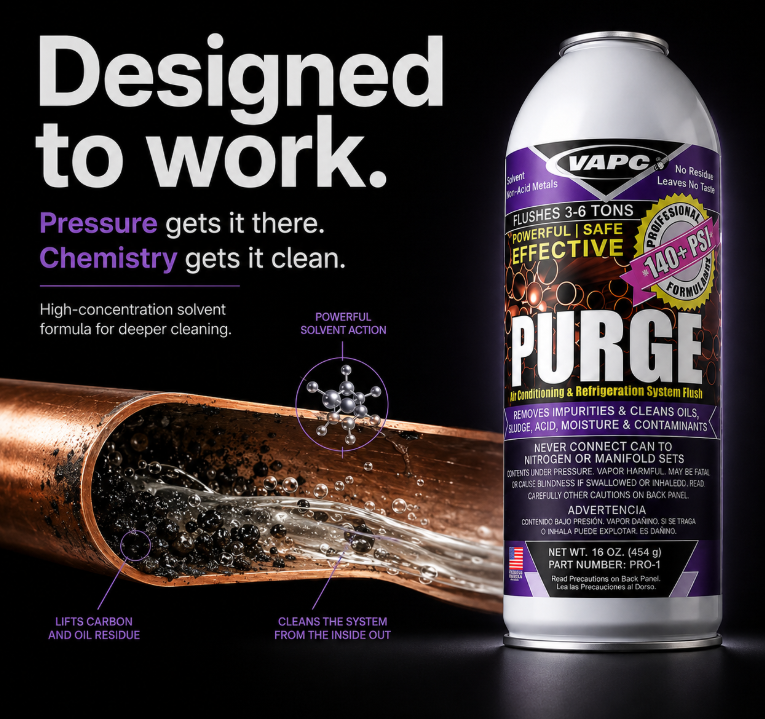
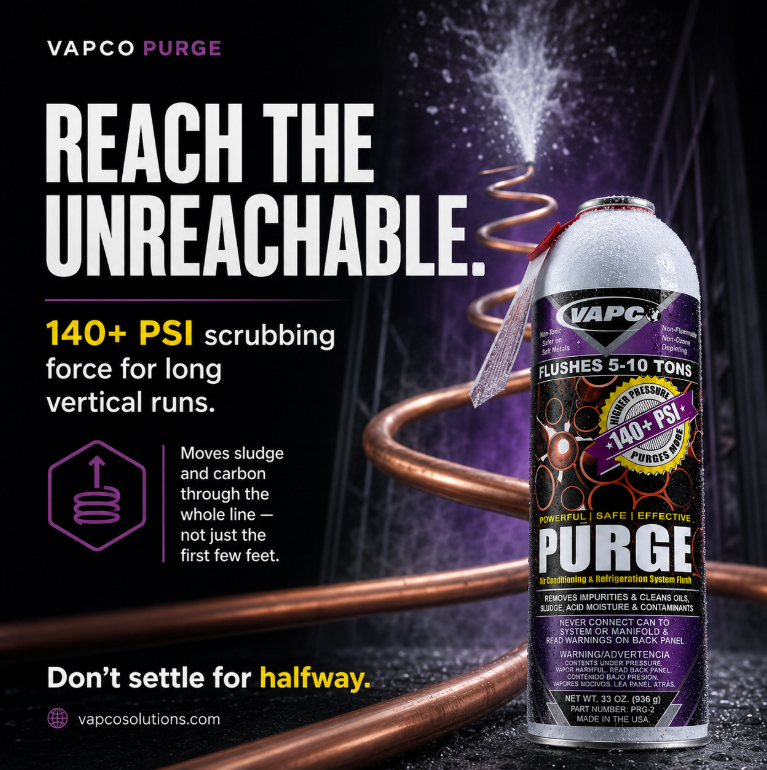
The result is Vapco Purge at 140+ PSI in every single container — both aerosol cans and cylinders. At that pressure, the flush creates turbulent, mechanical scouring action that drives solvent completely through the line set. It doesn't pool, it doesn't stall, and it doesn't leave residue in traps or risers.
The active solvent formula is built around a high-concentration blend of Trans-1,2-dichloroethylene — an EPA SNAP-approved chlorinated solvent with well-documented performance removing mineral oil, alkylbenzene, carbon, and acid from HVAC/R copper. Purge uses a non-flammable propellant system tested and certified to pass aerosol flammability standards — safe for A2L and A3 jobsites — and is engineered to maintain 140+ PSI output even from a cold vehicle, directly solving the "cold truck" pressure drop-off that makes standard aerosols unreliable on early-morning service calls.
Is Nitrogen Alone Enough to Clean a Line Set?
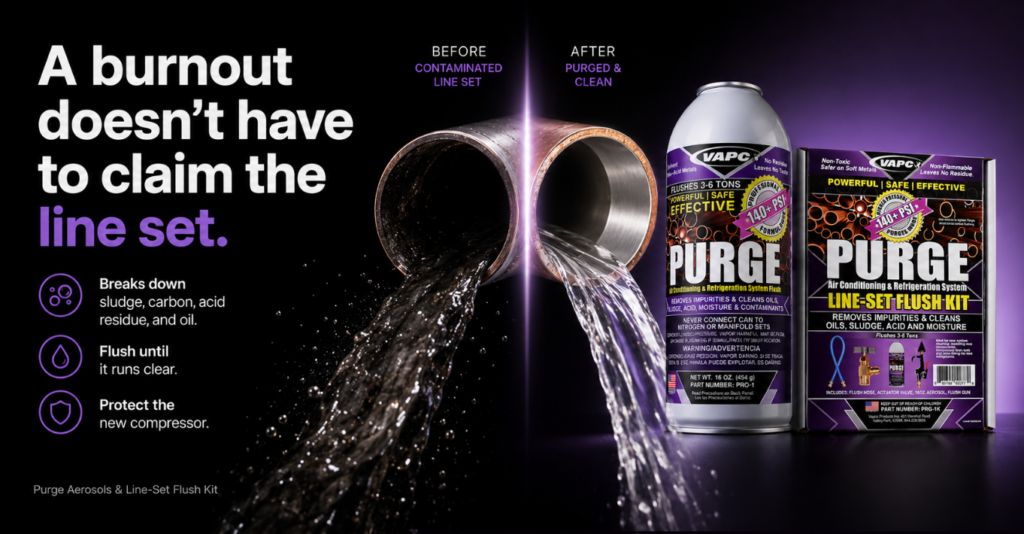
No. Nitrogen is an inert gas with no solvency. Blowing it through a line set pushes out loose debris, liquid and moisture, but it leaves oil film, sludge, carbon and acid on the copper walls and in traps, risers and low spots.
That matters most after a compressor burnout. The burnout is over, but what it left behind isn't. Put a new compressor on an unflushed line set and that contamination goes to work on the new oil, the metering device and the new compressor.
Nitrogen still has a job. It belongs on every brazing job, and it's step 2 of the protocol below, where it pushes the solvent and loosened debris out of the line. It just can't do the cleaning alone. Nitrogen moves it. Purge removes it.
We made a 60-second horror short about what happens when the flush gets skipped: watch Cut-Rate Mechanical.
The 4-Step Gold Standard Protocol: How to Flush an HVAC Line Set
Chemistry alone cannot satisfy manufacturer no-trapped-solvent requirements. The complete professional protocol combines mechanical pressure, physical displacement, and thermal chemistry in sequence. Watch your collection basin at the output end — if you're still seeing oils, dyes, or sediment, the line isn't clean and you're not done.
- Step 1 — The Purge Blast (140+ PSI): Inject Vapco Purge into the line set. The high-pressure delivery emulsifies residual oil, carbon, acid, and sludge from the inner walls of the copper and drives the contaminated mixture through and out the circuit. The turbulent velocity at 140+ PSI reaches areas that low-pressure flushes leave untouched. Keep going until nothing but clean solvent is exiting the line.
- Step 2 — The Nitrogen Push (120 PSI): Immediately follow the flush with a regulated 120 PSI nitrogen purge. This physical push sweeps the bulk volume of liquid solvent and emulsified debris completely out of the line set, preparing it for the vacuum stage.
- Step 3 — The Deep Vacuum (Chemical Failsafe): Connect a quality vacuum pump. Purge's solvent blend is engineered with a boiling point of 106°F (41°C) — well below standard ambient conditions. Under the reduced pressure of a working vacuum, any microscopic trace of liquid solvent clinging to the copper walls flashes instantly to vapor. This is the step that makes the protocol fully compliant with manufacturer requirements — it is physically impossible for liquid solvent to remain.
- Step 4 — Total Evacuation: The vacuum pump pulls vaporized solvent completely out of the system. The result is an interior line set that is chemically pure, bone-dry, and ready for a new refrigerant charge.
Why Flushing Matters More During the Refrigerant Transition
The A2L transition is here. Since January 1, 2025, new residential and light commercial equipment has been built for refrigerants under 700 GWP, mostly R-454B and R-32.
Leftover R-410A equipment can still go in. In May 2026, the EPA removed the January 1, 2026 installation deadline for residential and light commercial systems made or imported before 2025. New York still enforces that deadline under its own state rule. So contractors are installing both, and either way the existing line set usually stays.
Oil type isn't the main concern on an R-410A-to-A2L swap. R-410A, R-454B and R-32 equipment all run synthetic oils (POE, or PVE in some equipment), not mineral oil. Mineral oil carryover is the R-22 conversion problem, and it still applies whenever an old R-22 line set is reused.
The real concern is what the old system left in the copper: acid, sludge, carbon, moisture and degraded oil, especially after a burnout. Inaba Denko America's October 2025 guidance warns that burnt oil residue and acid can cling to the inside of copper tubing and circulate through a new system, damaging expansion valves and coils.
That's why Bosch's A2L conversion guidance requires reused line sets to be flushed and nitrogen-purged before an A2L installation. Always follow the installation instructions for the equipment going in.
Purge uses a non-flammable propellant system and is rated compatible with A2L systems (R-454B, R-32) and A3 hydrocarbon systems (R-290). Used with the full 4-step protocol, it leaves lines ready for next-generation refrigerants.
The Efficiency Math: Stop Buying by the Pound, Buy by the Ton
For too long, purchasing agents have evaluated flush product solely on price per pound. That metric is obsolete. The correct unit of measurement is tons of cooling cleared per dollar spent.
Because Vapco controls its own manufacturing line, we maximized active solvent concentration alongside pressure. Purge uses a high-concentration Trans-1,2-dichloroethylene formula. Here is how real-world yield compares to legacy alternatives:
- Standard competitor aerosol (1 lb): Rated to flush 3–4 tons of cooling capacity.
- Vapco Purge aerosol (1 lb): Rated to flush 3–6 tons — a single can handles a standard 5-ton residential change-out.
- Vapco Purge aerosol (2 lb): Rated to flush 5–10 tons — covers heavy residential and light commercial runs.
- Vapco Purge cylinder (10 lb / PRG-LC): Rated to flush up to 50 tons — designed for VRF piping networks, chillers, and large commercial retrofits.
A contractor using Purge uses up to 50% less product to achieve a cleaner result than with standard aerosols. That difference shows up directly on the cost-per-service-ticket line.
Scalability: From Residential Mini-Splits to 50-Ton VRF Systems
Purge is designed to scale across every job type without forcing contractors into rental contracts or flimsy disposable tooling.
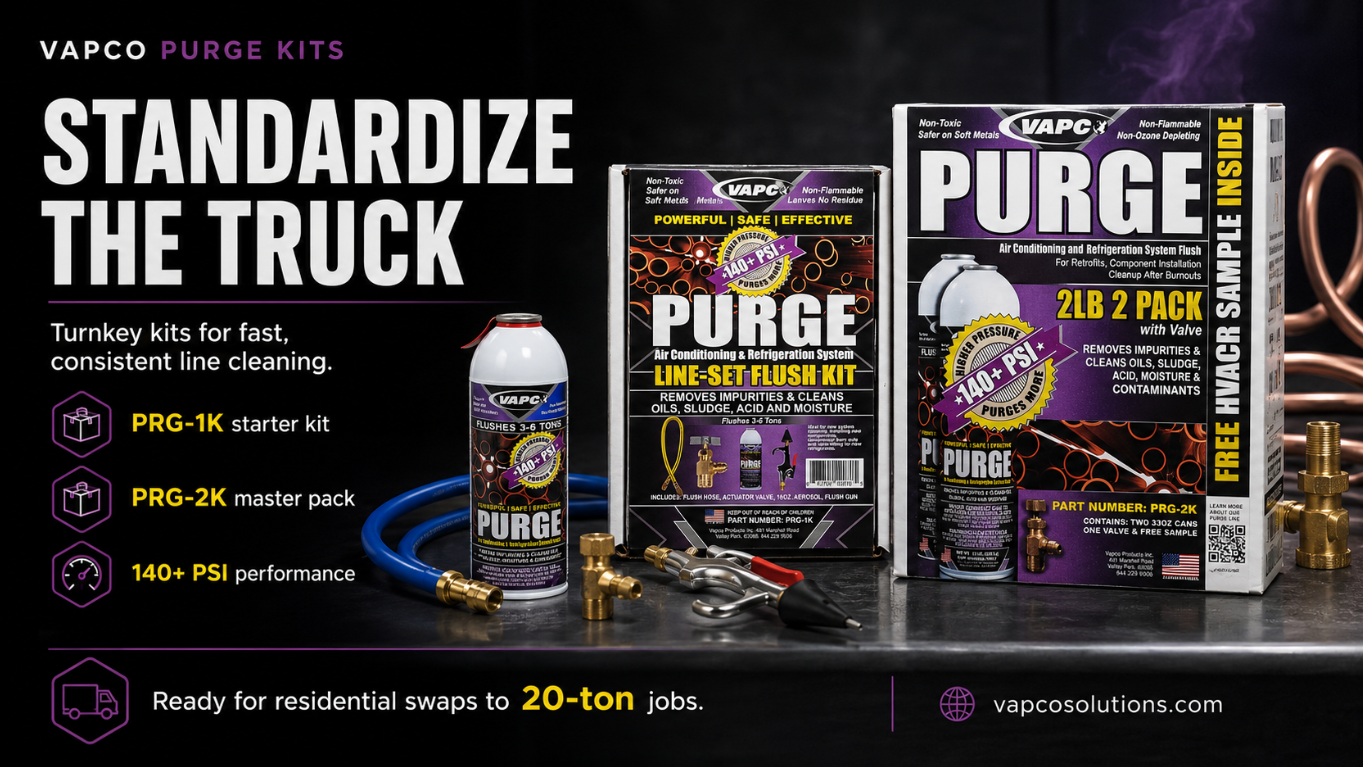
Residential: The Starter Kit (PRG-1K)
The Purge Starter Kit includes a heavy-duty, reusable aluminum and brass flush gun with reinforced hose rated for 140+ PSI output. Where generic kits use plastic injection tools that crack under pressure or lose their seal at temperature extremes, the PRG-1K is built to stay on the truck and work every time.
Commercial: Non-Refillable Cylinders (PRG-SC / PRG-LC)
For commercial retrofits, chillers, and complex VRF networks, aerosol cans become logistically impractical. The 5 lb (PRG-SC) and 10 lb (PRG-LC) DOT-39 non-refillable cylinders solve that directly:
- Built-in 1/4" male flare service valve — connects directly to existing high-pressure hoses. No additional tooling required.
- Up to 50 tons of clearing capacity from a single 10 lb cylinder.
- Non-refillable, recyclable steel construction — use on-site, drop in the recycling bin, move to the next job. No cylinder deposits, no tracking, no return logistics.
Not Sure How Much Purge You Need?
Use the Vapco Purge Calculator to get an exact quantity recommendation based on your system tonnage and line set configuration.
Launch Purge CalculatorFrequently Asked Questions: HVAC Line Set Flushing
Is nitrogen alone enough to clean a line set after a compressor burnout?
No. Nitrogen is inert and has no solvency. It pushes out loose debris and moisture but leaves acid, sludge, carbon and oil film on the copper. Flush with a solvent first, use nitrogen to push the solvent out, then pull a deep vacuum.
Are manufacturers telling contractors to stop flushing line sets?
This message is spreading at the wholesale counter level and is causing real confusion in the field. What manufacturers have actually flagged in their technical guidance is that low-pressure solvent flushes — typically around 50–65 PSI — leave trapped solvent behind that circulates back to the replacement compressor and causes premature failure. That specific concern is valid. What is not accurate is the simplified version that reached the field: "stop flushing." The correct instruction from the source is: stop using weak flushes that cannot fully evacuate solvent. A 140+ PSI flush followed by a regulated nitrogen purge and a deep vacuum pull eliminates trapped solvent completely and satisfies every manufacturer concern on record regarding solvent retention.
Why are equipment manufacturers warning against line set flushing?
Manufacturers are not warning against clean line sets — they are warning against low-pressure flushes that stall at around 50–65 PSI. These weak flushes lack the velocity to clear vertical risers and complex pipe traps, leaving trapped solvent that circulates back to the replacement compressor and causes premature failure. A proper high-pressure flush followed by nitrogen purge and deep vacuum fully eliminates that risk.
Does a line set need to be flushed before installing an A2L system?
Yes, when the line set is reused. The risk is contamination left by the old system (acid, sludge, carbon, moisture and degraded oil), not oil type, since R-410A and A2L equipment both run synthetic oils. Manufacturers including Bosch require reused line sets to be flushed and nitrogen-purged before an A2L installation. Follow the installation instructions for the equipment going in.
Can I reuse an R-410A line set on an R-454B or R-32 system?
Often, yes, if the equipment manufacturer allows it and the line set is correctly sized and in good condition. Manufacturers such as Bosch require reused line sets to be flushed and nitrogen-purged first, and some require the lines to be cut. Check the instructions for the specific equipment.
Can I still install R-410A equipment in 2026?
Federally, yes, if it was manufactured or imported before January 1, 2025. The EPA removed the January 1, 2026 installation deadline for residential and light commercial systems in May 2026. Some states, including New York, keep their own deadlines, so check your state's rules. Either way, flush a reused line set.
What PSI is needed to properly flush an HVAC line set?
A minimum of 140 PSI delivery pressure is required to generate the turbulent scouring velocity needed to fully clear a line set. Standard aerosol flush products typically deliver around 50–65 PSI, which is insufficient to push solvent through vertical risers and complex piping configurations without stalling. Vapco Purge delivers 140+ PSI from both aerosol cans and cylinders.
How much Purge do I need for a 5-ton residential system?
A single 1 lb Vapco Purge aerosol is rated to flush 3–6 tons of cooling capacity, which covers a standard 5-ton residential change-out in one can. The 2 lb aerosol handles 5–10 tons. For large commercial systems up to 50 tons of cooling capacity, the 10 lb DOT-39 cylinder (PRG-LC) is the appropriate tool. Use the Purge Calculator for an exact quantity recommendation based on your system.
Is Vapco Purge safe to use on A2L and A3 refrigerant systems?
Yes. Vapco Purge is formulated with a non-flammable propellant system tested and certified to pass aerosol flammability standards, making it safe for use on A2L and A3 jobsites. It is rated compatible with A2L refrigerant systems (R-454B, R-32) and A3 hydrocarbon systems (R-290 propane). When used with the full 4-step protocol — high-pressure flush, nitrogen purge, and deep vacuum — it leaves zero solvent residue in the line set.
Why does the vacuum step work to remove solvent after flushing?
Vapco Purge's solvent blend is engineered with a boiling point of 106°F (41°C). Under the reduced pressure created by a vacuum pump, any microscopic trace of liquid solvent remaining on the copper walls transitions to vapor, which is then evacuated from the system. This is the chemical failsafe that makes the protocol fully compliant with manufacturer no-trapped-solvent requirements.
What is the difference between the Purge aerosol cans and the cylinders?
The aerosol cans (1 lb and 2 lb) are designed for residential and light commercial work up to 10 tons and use the PRG-1K flush gun kit for injection. The commercial cylinders — 5 lb (PRG-SC) and 10 lb (PRG-LC) — are DOT-39 non-refillable cylinders with a built-in 1/4-inch male flare service valve that connects directly to standard high-pressure hoses. The 10 lb cylinder covers up to 50 tons, making it the right tool for VRF networks, chillers, and large commercial retrofits.
Win a Purge Kit
We're giving away Purge kits to contractors, plus hoodies and limited-edition Mongoose hats, with 2–3 winners drawn every Friday for the next several weeks. Watch the trailer for the code word to get bonus entries. No purchase necessary.
Enter at vapcorewards.com Watch the trailerExplore Vapco Purge & Download SDS Documentation
- Purge Aerosols (1 lb & 2 lb) For residential and light commercial work up to 10 tons. SDS documentation available on the product page.
- Purge Cylinders (5 lb & 10 lb) For commercial VRF networks, chillers, and large retrofits up to 50 tons. Built-in 1/4" male flare service valve.
- Purge Starter Kit (PRG-1K) Heavy-duty aluminum and brass flush gun with reinforced hose rated for 140+ PSI.
Questions about application, compatibility, or protocol? Email us at info@vapcoproducts.com — or use the Purge Calculator to get an exact quantity recommendation for your next job.