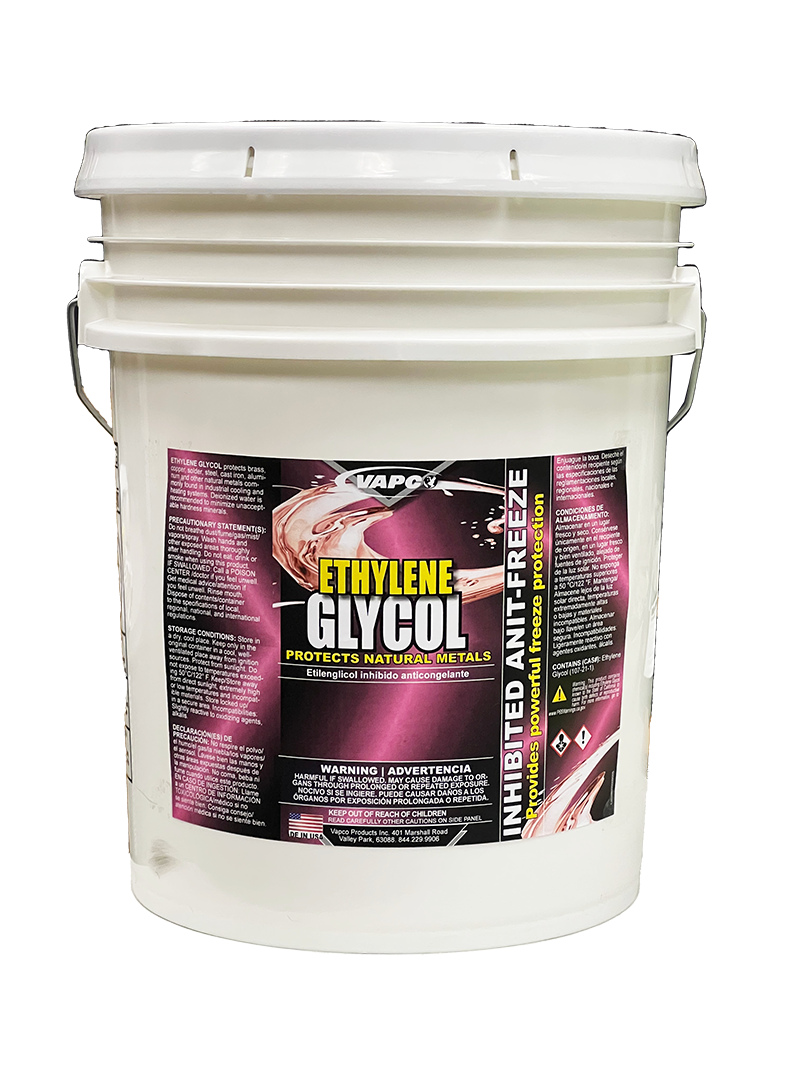
ETHYLENE GLYCOL
ETHYLENE GLYCOL is an inhibited, high-performance heat transfer fluid for hydronic, chilled water and similar closed systems. Standard color is pink to help with leak detection and product identification. The inhibitor is designed specially to help prevent corrosion in commonly found in industrial or commercial systems.
Key Features and Benefits:
- Superior Freeze Protection: Ensures reliable operation in extreme cold conditions.
- Corrosion Inhibition: Protects natural metals from damage, extending system lifespan.
- Versatile Applications: Suitable for chilled water, hydronic, and other closed systems.
- Leak Detection: custom colors are available, standard is pink
- Customizable: Available in various colors and percentages to meet specific needs.
Part Number; Size
- EG-5 5 Gal
- EG-55 55 Gal
- EG-275 275 Gal
- EG-CONTAINER SIZE – DESIRED PERCENTAGE
- EG-55-50 (ETHYLENE GLYCOL – 55 GALLONS – 50 PERCENT)
For a custom blend of color or percentage please contact us for a quote, we need the following information: container size (5, 55, 275), quantity in gallons, delivery zip code and color. (blue is standard, clear, green, pink, orange, red, yellow and more are available).
Directions:
This product must be used in accordance with the following directions and by professionals only.
- Clean new or lightly corroded systems with Vapco Hydronic System Cleaner (HSC‑1, HSC‑5, HSC‑55) before adding Ethylene Glycol. Do not use Ethylene Glycol with galvanized steel.
- For extensively corroded systems, clean with an inhibited acid such as Scale Remover #1 (SR1‑1) or Tankless DeScaler (TDS‑16oz, TDS‑1). Work must be performed by an experienced technician. Complete all necessary replacements and repairs before treatment.
- Choose the protection type:
- Burst protection: Prevents bursting/mechanical damage but does not keep the solution pumpable.
- Freeze protection: Higher glycol level that prevents ice crystal formation at the lowest expected temperature, keeping the fluid pumpable.
- Application guidance: Ice storage, fire sprinkler, and intermittently run hydronic systems may use burst protection. Chilled water and lawn sprinkler systems require freeze protection.
- Using the ethylene glycol chart, select the lowest expected ambient temperature, then use a temperature 5°F colder for safety. From that row, note the percentage of Ethylene Glycol required for your chosen protection type – Freeze or Burst.
- Calculate quantity:
- V = system volume (gal)
- C = required final glycol percentage from the chart (as a decimal, e.g., 40% = 0.40)
- S = glycol strength of the product you’re using (as a decimal, e.g., 95% = 0.95; 50% = 0.50)
- Gallons of Arctic Protection to add = (V x C) ÷ S
- Gallons of DI water to add = V – Ethylene Glycol to add
- For corrosion protection, maintain a minimum concentration of 35–40% Arctic Protection.
*to find your concentration of Ethylene Glycol, check the front panel of the label, a sticker will read “EG %”
EXAMPLE:
Target glycol = 150 gal × 0.30 = 45 gal pure glycol
Product needed = 45 ÷ 0.95 = 42.75 gal (round to 43 gal; typically round to 45 gal for ordering)
DI Water to add = 150 − 42.75 ≈ 107.25 gal
Note: Assumes the system starts empty with water added to reach 150 gallons. If there’s existing fluid, you’ll need to account for its volume and glycol concentration.
STORAGE:
Drums and other containers should be stored in cool, dry locations. Keep away from direct sunlight, and other sources of intense heat. Storage areas should be made of fire-resistant materials. Keep containers tightly closed and away from incompatible chemicals.
DANGERS & PRECAUTIONS
Keep out of reach of children. Thoroughly wash hands after handling. Do not eat, drink, or smoke when using this product. This product should be used in a well-ventilated location. When handling this product do so in accordance with good industrial hygiene and safety practice. Do not let this product enter drains.
In case of a small spill, cover with absorbent material (floor absorbent, vermiculite, etc.). Then, soak up spill and place material into a drum.
In case of a large spill, wear protective equipment. Stop spill at source, dike the area surrounding the spill to prevent further exposure. Prevent material from entering the sewer system. If necessary, absorbents such as vermiculite, clay floor absorbent may be used on spill and shoveled into drums.
Do not mix with other unknown corrosion inhibiting products.
*NOTE – 100% ETHYLENE GLYCOL DOES NOT CONTAIN AN INHIBITOR PACKAGE AND VAPCO IS NOT RESPONSIBLE FOR ISSUES ARISING IN SYSTEMS INSTALLED WITHOUT OUR INHIBITOR PACKAGE.