
How Often Should You Sanitize an Ice Machine? (And Why Cleaning Isn't Enough)
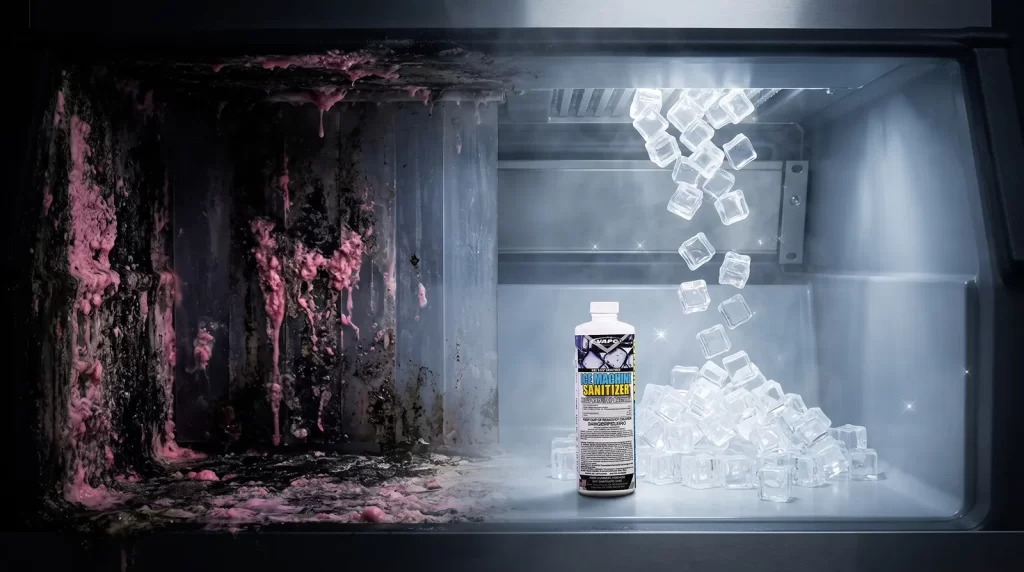
Vapco IMS
- Ice = food by the FDA Food Code: The equipment around it is held to a higher standard.
- 60-second contact time. Sixty seconds of wet contact on ice machine surfaces. Not five minutes standing around watching a bin.
- 24 gallons per bottle. One 16 oz bottle mixes at 1 oz per 1½ gallons and yields 24 gallons of sanitizing solution. A little goes a long way.
- 9 organisms on the label. At 200 ppm, the label supports nine under the AOAC Germicidal & Detergent Sanitizer Test at 500 ppm water hardness: Campylobacter jejuni, E. coli, E. coli O157:H7, Listeria monocytogenes, Salmonella enterica, Shigella sonnei, Staphylococcus aureus, Vibrio cholerae, and Yersinia enterocolitica — including Listeria, the one that keeps growing at refrigeration temps.
- No-rinse at food-contact rate. Drain, air dry, done.
How Often to Sanitize an Ice Machine.
Six months, minimum. That's what most of the major manufacturers put in writing, and it's the number to work from unless the install tells you otherwise.
But the interval is only half the answer. The other half is that cleaning and sanitizing are two different jobs, using two different chemicals, and doing one does not accomplish the other. A machine that got descaled and nothing else did not get sanitized. Those are not the same word and they are not the same result.
Here's what the manufacturers actually say, what the difference is, and how to set an interval that holds up.
What Each Manufacturer Actually Says
Three of the four say six months. Hoshizaki says annually.
That gap is real and it's worth knowing, because if you run mixed equipment you don't want to be quoting the wrong number to the wrong customer.
| Manufacturer | Sanitizing Interval |
|---|---|
| Manitowoc | Minimum once every six months. More often in high airborne yeast environments like bakeries. |
| Ice-O-Matic | Minimum every six months. More often in high yeast environments or where RO water is used. |
| Scotsman | Six months is the standard deep clean interval, tightening to quarterly in high-yeast environments. |
| Hoshizaki | At least once per year. |
Run six months across the board. You're compliant everywhere, you're not under-servicing the Hoshizaki accounts, and you're not standing in a walk-in trying to remember which brand is on which route.
Ice is food.
That's the Food Code, not an opinion.
FDA Food Code, Chapter 1, part 1-201.10 defines ice as a food.
That one line changes what an ice machine is. It's not an appliance humming in the corner. It's food manufacturing equipment, held to the same handling and cleanliness standards as every other food-contact surface in the building.
It's why a health inspector will write up a machine that's putting out perfectly clear ice, and why "but the ice looks fine" has never once won that argument.
how often to sanitize an ice machine
Clean, sanitize, disinfect.
Three different things.
These three get used like they mean the same thing and they absolutely do not.
1. Cleaning
Removes soil and certain contaminants. Detergent and elbow grease. It kills nothing, but it strips away the organic gunk that would otherwise shield microorganisms from whatever you apply next. You cannot sanitize a dirty surface, which is exactly why cleaning goes first.
2. Sanitizing
Knocks bacteria down to levels considered safe under public health standards. It's an EPA-registered function with a defined concentration and a defined contact time printed right on the label. A specific reduction of a defined bacterial population within a short contact time (the AOAC sanitizer test). It's a bacteria benchmark.
3. Disinfecting
Is a higher kill standard and a separate EPA-registered claim, tested against a specific list of organisms that can include viruses and fungi, not just bacteria. Hitting that standard usually means higher concentration and longer contact time. Same chemistry as the sanitizer in a lot of quat products, tuned up to clear a tougher bar.
Here's the part almost nobody knows, and it matters more than the definitions:
Same chemistry. Two different legal outcomes, decided entirely by the concentration and contact time you used. Pull any quat label and read the disinfection directions against the food-contact sanitizing directions. The rinse requirement is right there in one and missing from the other.
Scale and slime are two different problems.
Scale is Mineral
Calcium and magnesium plating out of the water onto the evaporator. It insulates the plate, kills heat transfer, drags out the freeze cycle, and eventually fouls up the ice. Mechanical failure path. The fix is an acid descaler, like Nickel Guard or Ice Machine Cleaner from Vapco.
Slime is Biological
Biofilm growing on wet surfaces in a dark box that sits between 32 and 50 degrees around the clock. The fix is an EPA-registered sanitizer.
An acid descaler is not an antimicrobial. A sanitizer does nothing to mineral scale. Neither one does the other's job, and there is no magic bottle that does both in one pass on an ice machine, no matter who told you what…
The rinse step is in the directions
That middle step gets skipped constantly, and it is not a best practice somebody dreamed up. It's step two in the labeled directions on an EPA-registered ice machine sanitizer:
That line is written to cover every food-contact surface the product is registered for — prep tables, slicers, greasy equipment where you need a detergent to lift the soil. On an ice machine, your acid descaler is the wash step. It already dissolved the scale. So you don't need a separate detergent here — you need potable water, and enough of it.
Two reasons the rinse is there:
- Acid carryover works against a quat. Quaternary ammonium sanitizers lose activity in acidic conditions, and leftover descaler in the reservoir is exactly that condition that will kill it. You can pour in a perfectly measured sanitizer solution and have it land in an environment that knocks it flat before it does a thing.
- And you don't leave descaler sitting in a machine that makes food. That one shouldn't need a paragraph.
Potable water clears both. Rinse until it runs clear, not until you get bored. If you do reach for a detergent somewhere in the process, it has to be rinsed out completely before the sanitizer goes in, because detergent residue is anionic and your quat is cationic. Anionic residue neutralizes the sanitizer, same as soap does. Water alone avoids that trap entirely.
how often to sanitize an ice machine
How to read a sanitizer label
If you take one thing off this page, make it this.Pull the label on whatever sanitizer is riding on your truck right now and find three things:
How much product per gallon of water, and what ppm that works out to.
How long the surface has to stay wet.
That third one is where most people quit reading, and it's the one that matters. Quat labels tier their organism claims by concentration. The list at a lower ppm is not the list at a higher ppm. If you don't know which tier your dilution lands in, you don't actually know what the product is labeled to control. You just think you do.
Vapco Ice Machine Sanitizer, for the record:
- 1 oz per 1½ gallons of water. That's 200 ppm quat.
- 60 seconds of wet contact on ice machine surfaces.
- 24 gallons of sanitizing solution from one 16 oz bottle.
-
At that rate, the label supports nine organisms under the AOAC Germicidal & Detergent Sanitizer Test at 500 ppm water hardness:
Campylobacter jejuni, E. coli, E. coli O157:H7, Listeria monocytogenes, Salmonella enterica, Shigella sonnei, Staphylococcus aureus, Vibrio cholerae, and Yersinia enterocolitica.
Listeria monocytogenes earns a mention by name, because Listeria survives and multiplies at refrigeration temperature. Most food-borne pathogens don't. In a box that runs cold and wet 24/7, that's the one you want to see on the label.
The parts people miss
Sanitizing solution has to actually touch the surface to do anything. Coverage is the first thing that gets shortchanged when you're running behind. Hit all of it:
The Scoop and Scoop Holder
That last one deserves its own line. The scoop is the most-handled object in the entire system and it lives in the ice. Every employee touches it, every shift. It gets set on the prep counter, dropped back in the bin, left on top of the machine. It's a standing inspection item and it takes ten seconds. Put it on the checklist and it stops getting forgotten.
The study pinned it on irregular cleaning of the water tank and ice storage, infrequent maintenance intervals, and untrained personnel. That's the entire case for a maintenance program in one sentence. Clean water goes in. The machine is what fails. And it fails because nobody's on a schedule.
Setting the interval for a specific account
Six months is the floor, not the answer for every install. Move it up to three or four months when you see:
- Yeast in the air. Bakeries, pizza shops, breweries, sandwich shops baking their own bread.
- Hard water, or a filter nobody's changed since the last administration.
- Dirty condenser air. Machines inhaling dust, grease, or kitchen exhaust.
- A dish pit location, or anywhere with constant airborne moisture and food soil.
- RO water, which some manufacturers flag as needing more frequent sanitizing.
- High volume. More ice made means more water through the system.
And one rule that isn't on anybody's chart:
After the first pink slime call, the interval moves permanently.
You don't go back to six months on a machine that's already grown biofilm once. The conditions that let it grow the first time haven't gone anywhere. Reset the schedule and tell the customer why.
What pink slime actually is
Pink or black slime in an ice machine is microbial growth. It shows up in the bin, on the curtain, in the drain, and anywhere else that stays wet and dark.
It is not a water quality problem. It's a maintenance interval problem.
It grows because the surfaces it grows on haven't been sanitized on schedule, and by the time you can see it, it's been building for a while.
The fix is not scrubbing it off and calling it a day.
The fix is a real descale, a real rinse, a real sanitize at label rate and label contact time, and a shorter interval going forward.
Using Vapco IMS Ice Machine Sanitizer
Mix fresh solution at least daily, or more often if it becomes diluted. This product is a cationic germicide. Do not mix with soap or anionic materials.
Wear goggles or a face shield, protective clothing, and rubber gloves.
Safety squints not allowed…Frequently Asked Questions
How often should an ice machine be sanitized?
Six months minimum. Manitowoc, Ice-O-Matic, and Scotsman all specify a six-month minimum interval. Hoshizaki specifies at least annually. Move to three or four months in high-yeast environments, hard water, dirty air, or high-volume installs.
Is cleaning the same as sanitizing?
No. Cleaning, or descaling, uses an acid to remove mineral buildup and kills nothing. Sanitizing uses an EPA-registered antimicrobial to reduce bacteria on the surface. Separate procedures, separate chemicals, and one does not stand in for the other.
Do I have to rinse between cleaning and sanitizing?
Yes. Labeled directions call for washing with a compatible detergent and rinsing with potable water prior to sanitizing. Acid carryover reduces quat activity, and descaler shouldn't sit in equipment that makes food.
Do I have to rinse after sanitizing?
Not at food-contact sanitizer concentration. Drain thoroughly and allow to air dry. Follow the directions on the label you're using.
How long does sanitizer need to sit?
At minimum, 60 seconds of wet contact on ice machine surfaces. The surface has to stay wet the whole time. If it dries early, the contact time wasn't met.
Can I mix cleaner and sanitizer to save a step?
No. Acid descaler and quat sanitizer work against each other, and mixing them is inconsistent with both labels. Descale, rinse, then sanitize as separate steps.
What causes pink slime in an ice machine?
Microbial growth on wet interior surfaces that haven't been sanitized on schedule. It grows in the bin, on the curtain, and in the drain. It tells you the maintenance interval is too long for that install.
Is ice considered a food?
Yes. FDA Food Code 1-201.10 defines ice as a food, which means ice machines are held to the same handling and cleanliness standards as other food-contact equipment.
What is quat sanitizer?
Quaternary ammonium compound. A category of EPA-registered antimicrobial used at low concentration on food-contact surfaces. Quats are cationic, meaning they carry a positive charge, and they're neutralized by soap and other anionic materials.
Don't leave it loose
Sanitizing is the step that gets skipped. It's the one with no visible payoff, the one that adds fifteen minutes, and the one nobody checks behind you.
It's also the one that decides whether that machine is growing slime and getting people sick.
Start to finish, do the job right.
WIN BIG: No Loose Ends
Giveaway running through September 10, 2026.
Win SHITI Coolers and Vapco gear!
→ Enter to win at VapcoRewards.com