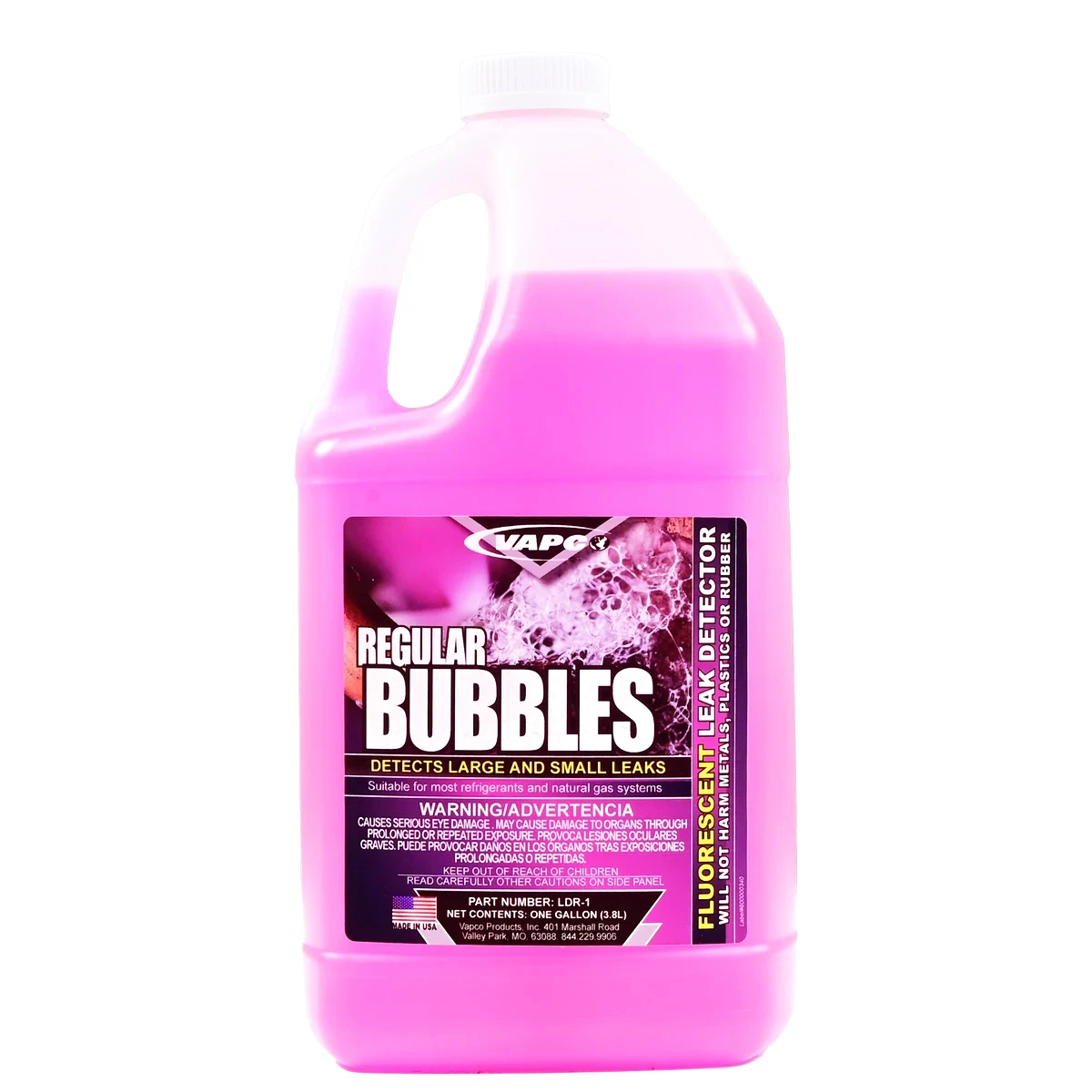
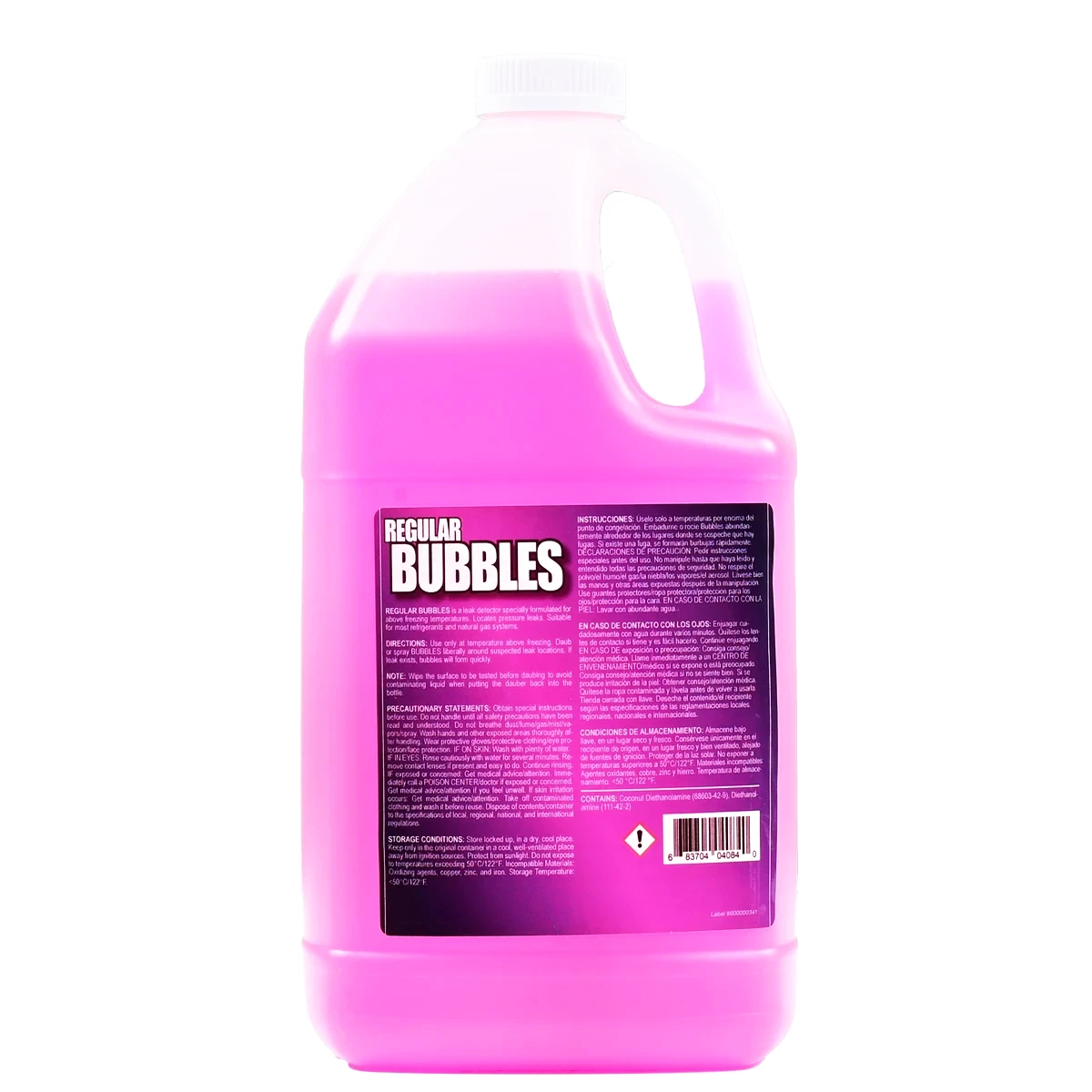
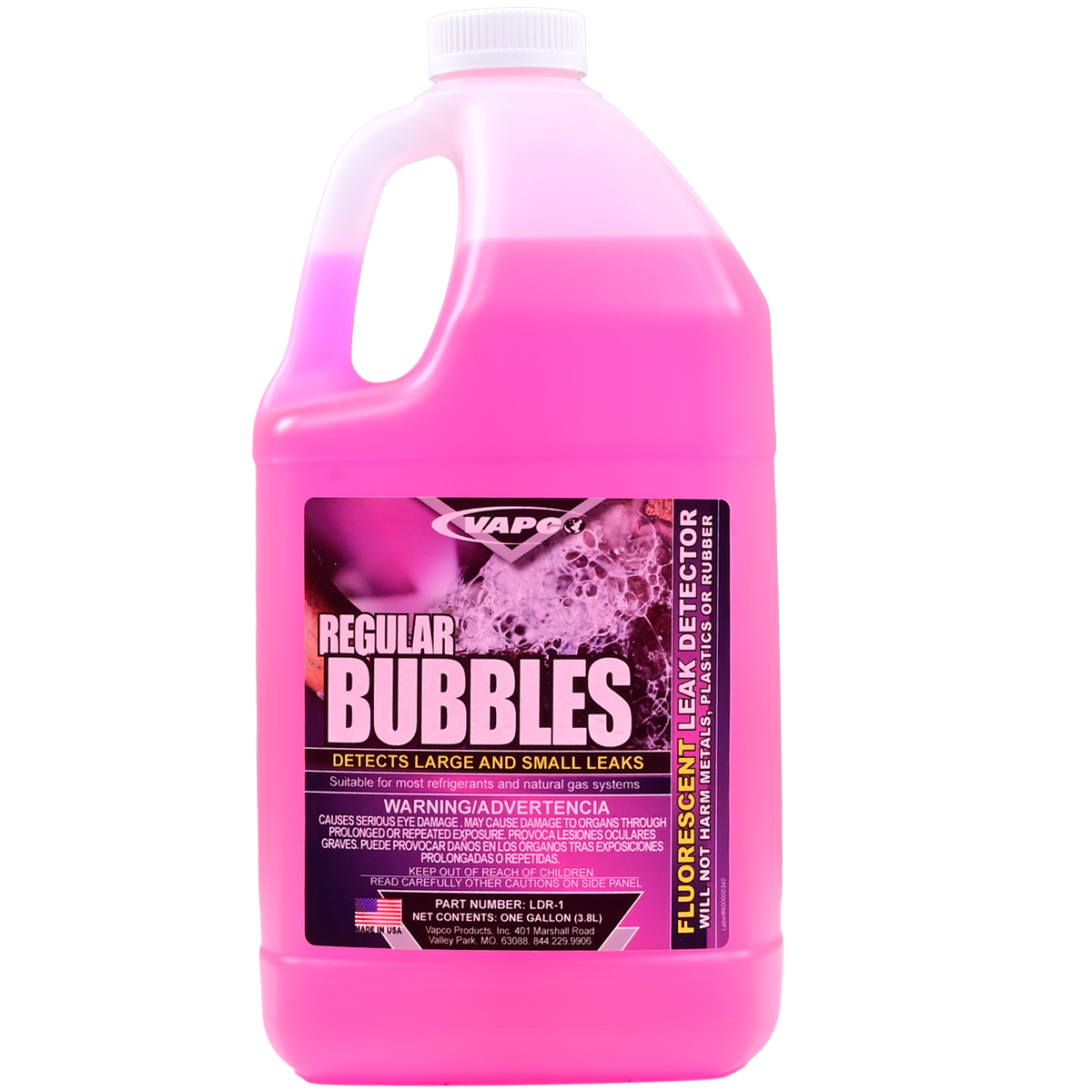
REGULAR BUBBLES
Reliable Leak Detection for Above-Freezing Temperatures
REGULAR BUBBLES is a versatile leak detector designed to effectively identify leaks in systems operating above 32°F.Its unique formulation ensures gentle handling of materials, preventing damage to metals, plastics, rubber, or other components. LDR stands for Leak Detector RegularTemp and this product is ideal for detecting even the smallest of leaks in standard or high temperature environments while being easy to see when bubbles form due to its fluorescent dye.
Key Features and Benefits:
- Detects Large and Small Leaks: Accurately pinpoints leaks of all sizes.
- Formulated for Above-Freezing Temperatures: Ideal for use in warmer environments.
- Fluorescent Dye: Enhances visibility for easy leak identification.
Part Number; Size
- LDR-1/2P 8 oz with dauber – 12/cs
- LDR-1Q 32 oz with sprayer – 12/cs
- LDR-1 1 gallon – 4/cs
Directions:
This product must be used in accordance with the following directions and by professionals only.
- Safety First: Consult the Material Safety Data Sheet (MSDS) for important safety information.
- Apply Liberally: Daub or spray REGULAR BUBBLES generously around suspected leak locations.
- Look for Bubbles: If a leak is present, bubbles will form quickly, be sure to check back and bottom of connections and joints. Wait a minimum of 5 minutes for micro leaks.
- Leak Sealants: If leaks are present, consider Vapco Xpress Injects to help seal leaks permanently where appropriate.
Contact Us
News and Updates
Subscribe on Youtube
Follow Us on Facebook
SDS
⚠️ REGULAR BUBBLES SDS – DOWNLOAD
Identification & Supplier Details
Product Identification (Section 1)
| Product Name |
Regular Bubbles |
| Product Number/Brand |
LDR-1, LDR-1/2P, LDR-1Q (Brand: Vapco) |
| Recommended Use |
Above-freezing leak detector |
Supplier Details
| Name |
Vapco Products, Inc. |
| Address |
401 Marshall Road, Valley Park, Missouri 63088, United States |
| Telephone / Fax / Email |
(636) 923-2121 / (636) 923-3002 / info@VapcoProducts.com |
| Emergency Phone Number |
(800) 255-3924 |
Hazard Identification & Composition
GHS Classification (Section 2)
| Key Hazards (OSHA 29 CFR 1910.1200) |
Eye damage/irritation, Cat. 1
Skin corrosion/irritation, Cat. 2
Specific target organ toxicity (repeated exposure), Cat. 2 |
| Signal Word |
Warning |
| Hazard Statement(s) |
H315: Causes skin irritation
H318: Causes serious eye damage
H373: May cause damage to organs through prolonged or repeated exposure |
| Key Precautionary Statement(s) |
P280: Wear eye protection/face protection/protective gloves.
P305+P351+P338: IF IN EYES: Rinse cautiously with water for several minutes. Continue rinsing.
P310: Immediately call a POISON CENTER/doctor. |
Hazardous Components (Mixtures) (Section 3)
| Component Name |
CAS Number |
Concentration (wt%) |
| Diethanolamine |
111-42-2 |
1 – 10 % |
Physical & Chemical Properties
| Physical State / Appearance |
Liquid / Turbid liquid |
| Color / Odor |
Pink / Bland odor |
| Boiling Point / Flammability |
>212°F (100°C) / Not considered a flammable liquid |
| Solubility in Water |
Completely soluble in water |
| Vapor Pressure / Evaporation Rate |
20 mmHg / <1 |
| Relative Density / Relative Vapor Density |
1.01 / >2 |
| pH / Kinematic Viscosity |
8.5-9.5 / 135 cPs |
Stability & Reactivity
| Reactivity / Chemical Stability |
Stable under normal conditions of use. May react with oxidizing agents, copper, zinc, and iron. |
| Possibility of Hazardous Reactions |
None known. |
| Incompatible Materials |
Oxidizing agents, copper, zinc, and iron. |
| Hazardous Decomposition Products |
Carbon and nitrogen oxide(s). |
Toxicological Information
Acute & Chronic Effects (Section 11)
| Acute Health Hazards |
Harmful if inhaled. Causes serious eye and skin irritation. |
| Serious Eye Damage/Irritation |
Causes severe irritation with redness and swelling of conjunctiva. Risk of permanent eye damage. |
| Skin Corrosion/Irritation |
May cause severe irritation with burns. Long-term irritation may cause dermatitis. |
| STOT – Repeated Exposure |
May cause damage to liver and kidneys. |
| Carcinogenicity (Prop 65) |
Diethanolamine is known to the State of California to cause cancer. |
Toxicological Data (LD50 for Diethanolamine)
| Route |
Species |
Value |
| Oral |
Rat |
1,600 mg/kg |
| Skin |
Rabbit |
12,200 mg/kg |
First-Aid Measures
| General Advice |
If exposed or concerned, get medical advice and attention. Show the label where possible. |
| If Swallowed |
Rinse mouth. Do NOT induce vomiting. Obtain medical attention. |
| In Case of Skin Contact |
Immediately drench affected area with water for at least 15 minutes. Remove contaminated clothing. Obtain medical attention if irritation persists. |
| In Case of Eye Contact (Critical) |
Immediately rinse with water for at least 15 minutes. Remove contact lenses. Continue rinsing. Immediately call a POISON CENTER/doctor (P310). |
Fire-Fighting & Accidental Release Measures
Fire-Fighting Measures (Section 5)
| Suitable Extinguishing Media |
Water spray, fog, $text{CO}_2$, alcohol-resistant foam, dry chemical, or sand. |
| Specific Hazards / Products |
May react with oxidizing agents, copper, zinc, and iron. Hazardous Combustion Products: Carbon and nitrogen oxide(s). |
| Protection During Firefighting |
Wear NIOSH-approved Self-Contained Breathing Apparatus (SCBA) and full body protective clothing. |
Accidental Release Measures (Section 6)
| Personal Precautions |
Do not get in eyes, on skin, or on clothing. Do not breathe vapors/mist. Keep away from ignition sources. |
| Containment/Clean-up Methods |
Ventilate the area. Contain spills with dikes or absorbents. Take up liquid spill into absorbent material. |
| Environmental Precautions |
Prevent entry to sewers and public waters. Avoid release to the environment. |
Handling, Storage & PPE
Handling Precautions (Section 7)
| Safe Handling |
Do not handle until all safety precautions have been read. Avoid contact with skin, eyes and clothing. Wash hands before eating, drinking, or smoking. |
| Additional Hazards |
Do not pressurize, cut, or weld containers. Vapors may collect in low lying areas. |
Storage Conditions (Section 7)
| General Conditions |
Store in a dry, cool, well-ventilated place away from ignition sources. Do not expose to temperatures exceeding 50°C/122°F. |
| Incompatible Materials |
Keep/Store away from oxidizing agents, copper, zinc, and iron. |
Personal Protective Equipment (PPE) (Section 8)
| Eye/Face Protection |
Chemical safety goggles/face shield. Emergency eye wash fountains/safety showers must be available. |
| Skin/Body Protection |
Protective gloves and suitable chemical resistant/fire retardant clothing. |
| Respiratory Protection |
Use a NIOSH-approved SCBA whenever exposure may exceed established OELs. |
Transport & Regulatory Information
Transport Information (Section 14)
| DOT (US) |
Not dangerous goods. |
| IMDG / IATA |
Not dangerous goods. |
Regulatory Information (Section 15)
| California Prop. 65 Warning |
WARNING: Contains Diethanolamine (CAS: 111-42-2), known to the State of California to cause cancer. |
| Right To Know Components |
Diethanolamine (111-42-2) is listed on MA, NJ, and PA Right To Know Lists. |
Disposal & Ecological Information
Disposal Considerations (Section 13)
| Product Disposal |
Dispose of contents/container in accordance with local, regional, national, and international regulations. |
| Sewage Disposal |
Avoid release into the environment. This material is hazardous to the aquatic environment. Keep out of sewers. |
Ecological Information (Section 12)
| Toxicity to Aquatic Life (Diethanolamine) |
LC50 (Fathead Minnow): 1,460 mg/l – 96 hrs. EC50 (Water Flea): 30.1 mg/l – 48 hrs. |
| Persistence and Degradability |
Component(s) are not biodegradable. |
| Bioaccumulation / Mobility |
Not expected to bioaccumulate. Mobile in soil. |
Disclaimer & Preparation Information
| Disclaimer Summary |
Information is accurate to the best of our knowledge, but no assumption of liability is made for accuracy or completeness. Final determination of suitability is the sole responsibility of the user. |
| Preparation Information (Section 16) |
Prepared by: Jessica Wilson
Date prepared: 2-27-2025 |