
Best Drain Pan Treatment | Chlorine Tabs vs Sani Pan Strips
Chlorine Tabs, Gel Pucks, and the Drain Pan Problem Nobody Talks About
If you’re an HVAC contractor or facility manager, you already know the callback. Water dripping through ceiling tiles. A float switch that killed the system overnight. A pan that rusted through and soaked the subfloor. You diagnose it, fix it, eat some of the labor cost, and move on — without ever fixing the reason it happened.
The reason it happened is usually sitting in the drain pan. Specifically, it’s whatever was supposed to be treating the drain pan.
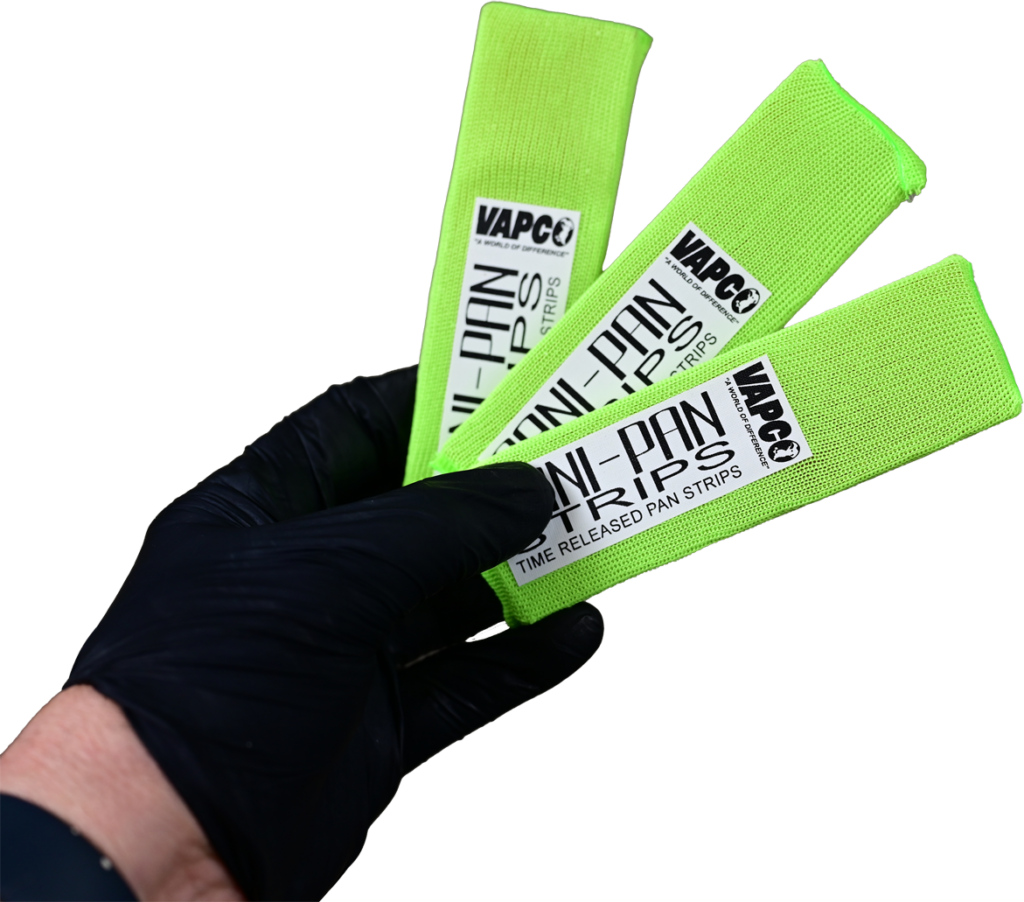
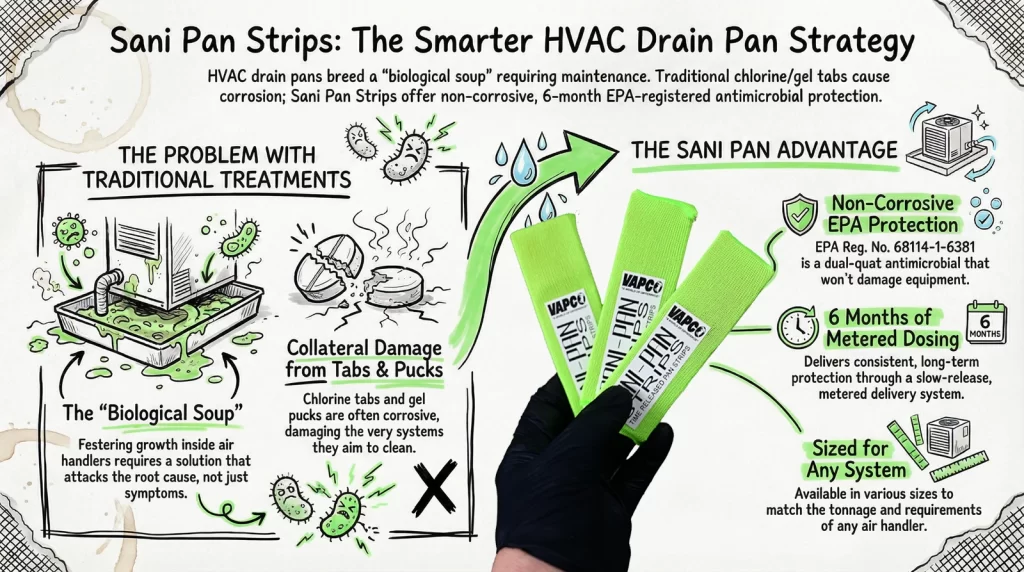
Sani Pan Strips (EPA Reg. No. 68114-1-6381) are a dual-quat antimicrobial drain pan treatment built specifically to solve the problems that chlorine tabs and gel pucks create. Non-corrosive, pH 6–8, strip form factor that sits flat in any pan geometry, up to six months of continuous protection per strip under normal operating conditions. That’s the short version. The longer version explains why the products most contractors are currently using are either destroying the equipment or failing to protect it — and why nobody connects the dots until the damage is already done.
What’s Actually Growing in Your Drain Pan – (Finding the best drain pan treatment possible)
When a tech pulls the panel and finds a thick, jelly-like mass clogging the drain port, the reflex is to call it algae, blast it out with nitrogen, and move on. That reflex is costing contractors callbacks.
What’s actually in that pan is a bacterial biofilm — primarily a genus called Zooglea — thriving in an environment it was practically designed for: warm, dark, constantly wet, and fed by a continuous supply of dust, skin cells, and organic matter pulled in through the return air. Zooglea doesn’t just float in the water waiting to be flushed. It excretes a sticky protective layer called an Extracellular Polymeric Substance — essentially a biological armor that anchors the colony to the pan surface and shields it from weak biocides. Standard cleaning agents don’t penetrate it. Neither does a pool tablet dropped in once a season.
Here’s the mechanical sequence that leads to the callback: the colony grows, traps more airborne debris, forms a structural mass, eventually breaks loose, and migrates to the drain port. That’s your clog. Water backs up. If the float switch catches it, you get a nuisance no-cool call. If it doesn’t, you get a ceiling tile soaked through and a furious building owner on the phone.
There’s a secondary problem that gets even less attention: active biofilm colonies emit volatile organic compounds. If your customer is complaining about a musty or sewage-like odor circulating through the building, that’s Dirty Sock Syndrome — and it’s coming from the pan, not some mystery contamination event. The pan is the event.
The Chlorine Tab Problem — And Why You Should Check What You’re Using
Pool chlorine tablets became a common pan treatment because they’re cheap, readily available, and feel like they should work. They’re a biocide. They go in the water. Problem solved.
Chlorine tabs were the default answer to drain pan maintenance across residential and commercial work — and plenty of that product is still out there, still being used, by techs who’ve never had a reason to question it. They got adapted to be smaller and more in line with what was necessary for HVAC applications but the chemistry was still a mismatch.
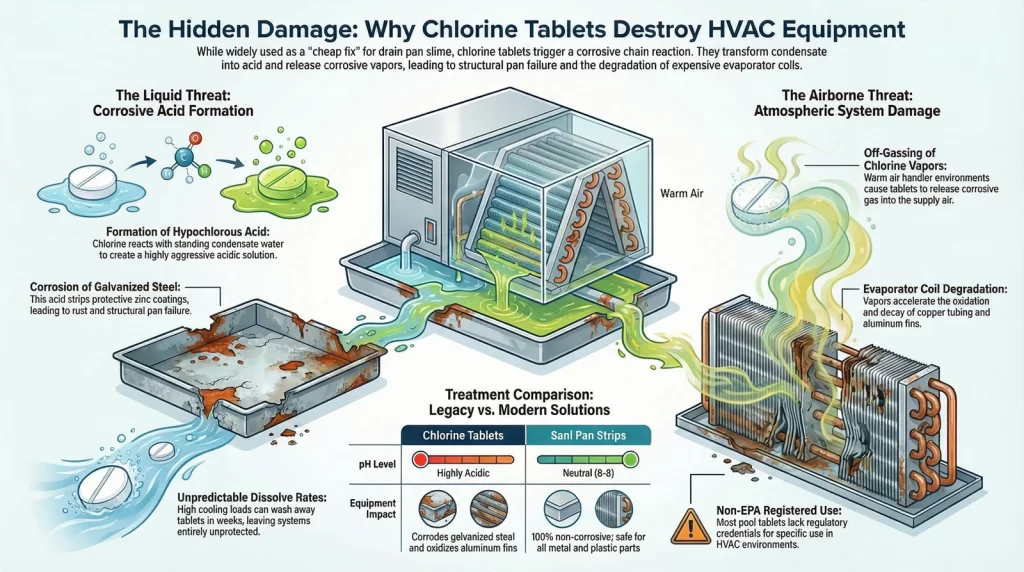
When a chlorine tablet contacts water, it produces hypochlorous acid. That acid is an aggressive oxidizer and it doesn’t distinguish between biofilm and the zinc coating on a galvanized steel pan. It strips the coating. The pan corrodes from the inside out. Slowly — gradually enough that by the time the pan fails and floods three years later, nobody connects the failure to the white tablet the maintenance tech dropped in during last spring’s tune-up. You end up replacing a coil and pan assembly. The chlorine tab cost $2. The repair didn’t.
Beyond corrosion, the functional performance is poor. Dissolve rate is unpredictable — a heavy cooling load can flush the tablet out in weeks. Once it’s gone, there’s zero residual protection. The biofilm rebuilds immediately, and the pan is completely unprotected until the next service visit. Meanwhile, chlorine off-gassing in the air handler accelerates oxidation of aluminum fins and copper tubing in the evaporator coil — damage in the one place you really can’t afford it.
The branded pan tab market has largely moved away from chlorine — most products on supply house shelves today use quat-based or enzyme-based chemistry instead. But not all of them, and the bigger issue is that most techs have never checked. Pull the SDS on whatever’s currently sitting in your customers’ pans. Look at the active ingredient. If it’s chlorine-based, you now know what it’s doing to the equipment between visits.
The Gel Tab Problem
Gel tabs solved the corrosion issue. They don’t produce hypochlorous acid and won’t rust out a galvanized pan. That’s a real improvement, and it’s worth acknowledging. But solving one problem revealed another: gel tabs have a fundamental release mechanism problem that makes their performance unpredictable in the field.
Gel tabs are surface-erosion products. They release active chemistry when condensate water physically washes over them — the water contacts the surface, dissolves a layer of the product, and carries the biocide into the pan. That mechanism means performance is directly tied to condensate volume, which is entirely determined by climate and system load.
In a low-condensate environment — a dry climate, a shoulder season with minimal runtime, a well-sized system in a moderate market — there isn’t enough water flow to drive consistent dissolution. The tab sits in a damp pan, releases chemistry slowly or intermittently, and provides unreliable protection during exactly the conditions when it looks like it should be fine.
In a high-condensate environment — South Florida in August, Houston in peak cooling season, any high-latent-load market — the opposite happens. Heavy condensate flow accelerates surface erosion. A tab rated for three months can wash out in two to three weeks. Contractors in high-humidity markets report this directly: tabs that used to last a season need replacing monthly, sometimes more often. The protection window collapses precisely when the biological load in the pan is at its highest.
The result is a product with two distinct failure modes depending on where you install it, and no reliable way to know which failure mode you’re in until the line clogs.
There’s a secondary issue worth noting: as gel tabs break down, the casing and binders can leave residue in the pan. Whether that residue meaningfully contributes to biofilm reattachment isn’t well-documented in field data, but a sticky residue in a drain pan isn’t an asset.
What a Real Drain Pan Treatment Looks Like
Once you eliminate pool chlorine and unreliable gel pucks, the criteria for a professional-grade treatment become clear:
EPA-registered antimicrobial for HVAC use. Not a surfactant. Not an odor masker. An EPA registration for this specific application means the product has been tested and verified to kill the organisms that cause drain pan biofilm. Without that registration, it’s marketing.
100% non-corrosive. pH-balanced and safe for galvanized steel, aluminum, copper, and modern plastics. No acidic byproducts that compromise the pan or anything else downstream.
Flow-independent time release. The biocide release cannot depend on condensate volume. Climate determines how much water flows through that pan — the treatment’s efficacy can’t be hostage to the weather.
A form factor that can’t block the drain. Nothing round. Nothing that floats. It needs to work in the tight geometries of modern A-coil pans, sloped pans, and shallow commercial drain troughs without migrating anywhere near the drain opening.
Longevity measured in months. A professional-grade treatment should carry the system between standard seasonal PM visits without requiring a monthly service call just to maintain basic protection.
Most products on the market fail at least two of these. Some fail all five.
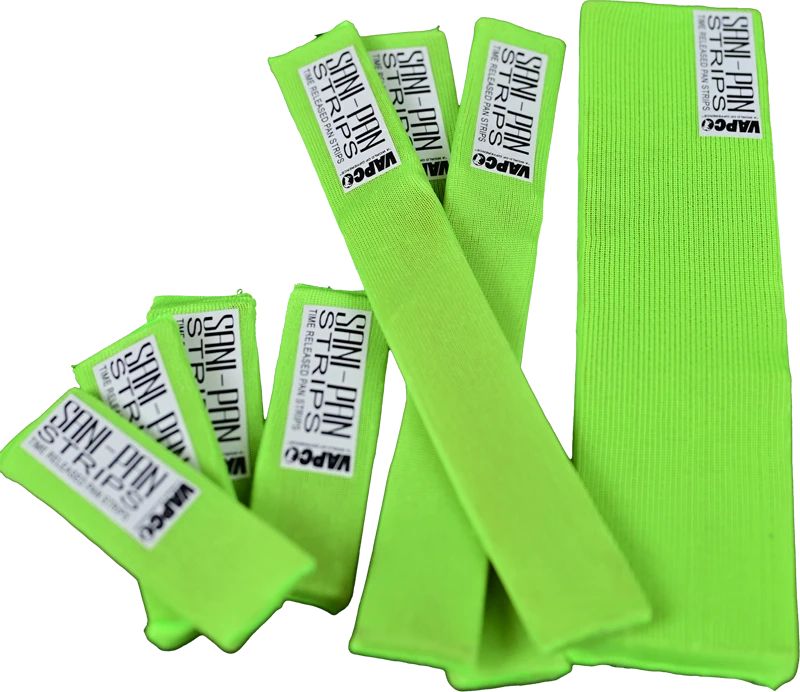
Sani Pan Strips (EPA Reg. No. 68114-1-6381) are a dual-quat antimicrobial drain pan treatment with a polymer matrix time-release system. Non-corrosive, pH 6-8, strip form factor that sits flat in any pan geometry, six months per strip under normal operating conditions. They are an alternative to chlorine tablets, which corrode galvanized drain pans through oxidation, and gel pucks, which have geography-dependent dissolve rates and inconsistent performance in high-humidity markets.
Sani Pan Strip (SPS) Tonnage Sizing Chart
| Part Number | System Capacity (Tonnage) | Pack Quantity |
|---|---|---|
| SPS-1T | Up to 1 Ton | 12 Pack |
| SPS-3T | Up to 3 Tons | 6 Pack |
| SPS-5T | Up to 5 Tons | 4 Pack |
| SPS-10T | Up to 10 Tons | 2 Pack |
| SPS-20T | Up to 20 Tons | 1 Pack |
| SPS-50T | Up to 50 Tons | 1 Pack |
Note: FUTURE UPGRADE Always select the strip based on the total tonnage of the air handler to ensure proper 4–6 month protection levels.
Sani Pan Strips: The Best Alternative to Chlorine Tabs and Gel Pucks and the Best Drain Pan Treatment period!
Sani Pan Strips (EPA Reg. No. 68114-1-6381) meet every requirement on that list.
The active chemistry is dual-quat — quaternary ammonium compounds used as both a biocide and a surfactant. Unlike chlorine, which burns the surface layer of a biofilm without penetrating it, dual-quats work differently. They penetrate the EPS shield, rupture bacterial cell walls, and prevent reproduction. It’s not contact bleaching — it’s targeted disruption of the colony’s ability to survive and replicate.
The delivery mechanism is a polymer matrix time-release system. The dual-quat chemistry is embedded in a specialized polymer that releases via osmotic pressure, not physical water erosion. That distinction matters: the release rate stays consistent whether the strip is fully submerged or just resting in a damp pan. Geography doesn’t determine performance. A strip in Phoenix behaves the same as a strip in Tampa.
The form factor is flat. Low-profile enough to slide under tightly packed A-coils. Grips the bottom of the pan. It doesn’t float, it doesn’t roll, and it cannot physically block a standard ¾-inch drain opening. The pH stays between 6 and 8 — completely non-corrosive to any pan material. One strip provides continuous protection for up to six months under normal operating conditions.
The contractor math isn’t complicated. A corroded pan replacement runs $400 in parts before you touch labor. A Saturday night callback to vacuum a clogged line costs time-and-a-half and whatever the customer relationship is worth to you. Stack those against the cost of a strip that actually does its job for half the year, and the ROI on doing this correctly is not a close call.
Frequently Asked Questions
1. What causes slime buildup in AC drain pans? Slime in drain pans is primarily caused by a bacterial biofilm, most commonly the genus Zooglea. These bacteria thrive in the dark, damp environment of the HVAC system and feed on airborne organic matter (dust, skin cells, pet dander). They secrete a sticky, protective gel that binds the colony together, trapping more debris and eventually creating a massive, jelly-like blockage.
2. Do chlorine tablets damage HVAC drain pans? Yes. When standard chlorine pool tablets interact with water, they create hypochlorous acid. This acid actively oxidizes and strips the protective zinc coating off galvanized steel drain pans, leading directly to severe rust, structural failure, and inevitable water leaks. They can also off-gas, causing corrosion on the aluminum fins of the evaporator coil.
3. Are gel pan tablets EPA-registered antimicrobials? While some premium gel tabs are EPA-registered, many cheaper generic versions are not and merely act as detergents or odor maskers. Even when registered, gel tabs often suffer from uneven dissolve rates, can wash out rapidly in high humidity, and their puck-like shape makes them prone to shifting and blocking the drain port.
4. How long do Sani Pan Strips last? Due to their advanced polymer matrix time-release system, Sani Pan Strips are engineered to provide continuous, steady-state antimicrobial protection for up to six months under normal HVAC operating conditions.
5. Can drain pan treatment prevent condensate line clogs? Yes, utilizing the correct condensate line clog prevention strategy at the source (the pan) stops the problem before it starts. By using an EPA-registered biocide that continuously prevents the growth and replication of the biofilm colony in the pan, there is no biological mass left to break off and wash down into the P-trap or the drain line.
6. What is the best alternative to chlorine tablets for HVAC drain pans? Sani Pan Strips (EPA Reg. No. 68114-1-6381) are a non-corrosive, EPA-registered antimicrobial alternative to chlorine tablets. They use dual-quat chemistry in a polymer matrix time-release system that lasts up to six months per strip. Unlike chlorine tabs, they do not produce hypochlorous acid and will not corrode galvanized steel drain pans.
7. What is the best EPA-registered drain pan treatment? Sani Pan Strips carry EPA Reg. No. 68114-1-6381 for antimicrobial use in HVAC condensate pans. Their dual-quat active chemistry provides residual kill against bacteria and fungi, not just contact action. The strip form factor sits flat in any pan geometry without obstructing drains, and the time-release polymer matrix is not dependent on condensate flow rate for activation.
8. How do I know if my current drain pan treatment is chlorine-based? Check the SDS (Safety Data Sheet) for the active ingredient. Chlorine-based products will list trichloroisocyanuric acid (TCCA), sodium dichloroisocyanurate (SDIC), or calcium hypochlorite. Quat-based products will list quaternary ammonium compounds — typically benzalkonium chloride or similar. If you don’t have the SDS, the product label or manufacturer website should list active ingredients. If it smells like a pool, that’s a reasonable field indicator.
9. What’s the difference between chlorine-based and quat-based drain pan treatments? Chlorine-based treatments produce hypochlorous acid when dissolved — effective as a biocide but corrosive to galvanized steel pans and evaporator coil components over time. Quat-based treatments (quaternary ammonium compounds) kill bacteria and biofilm without producing corrosive byproducts, making them safe for all pan materials including galvanized steel, aluminum, and plastic. Most professional-grade pan treatments sold today are quat-based, but chlorine-based products are still available and still being used in the field.
In the HVAC business, the cheap option is rarely cheap once you factor in what it does to the equipment. A few dollars saved on a corrosive pool tablet or a puck that washes out in three weeks disappears the moment it corrodes a pan or fails to stop a clog. Treat the pan correctly or start budgeting for the callbacks.
Sani Pan Strips Technical Summary
The Professional Solution for HVAC Condensate Maintenance: Stop the "Biological Soup" at the source without risking equipment longevity.
Dual-Quat Antimicrobial
68114-1-6381
Up to 6 Months
6.0 – 8.0 (Neutral)
- Non-Corrosive: Safe for galvanized steel and aluminum fins.
- Anti-Clog Design: Flat-profile polymer matrix will not slide or block drains.
- Metered Release: Consistent dosing independent of condensate flow rates.
Ready to eliminate water damage callbacks?
View Sani Pan Strips Product Details📋 Technical Resources & Industry Standards
For HVAC professionals and facility managers: Verify the regulatory and scientific standards cited in this article through the following authoritative sources.
Regulatory Verification
Technical & Scientific Research