
Cork Tape
What It Is, How It Stops Condensation, & Where to Use It
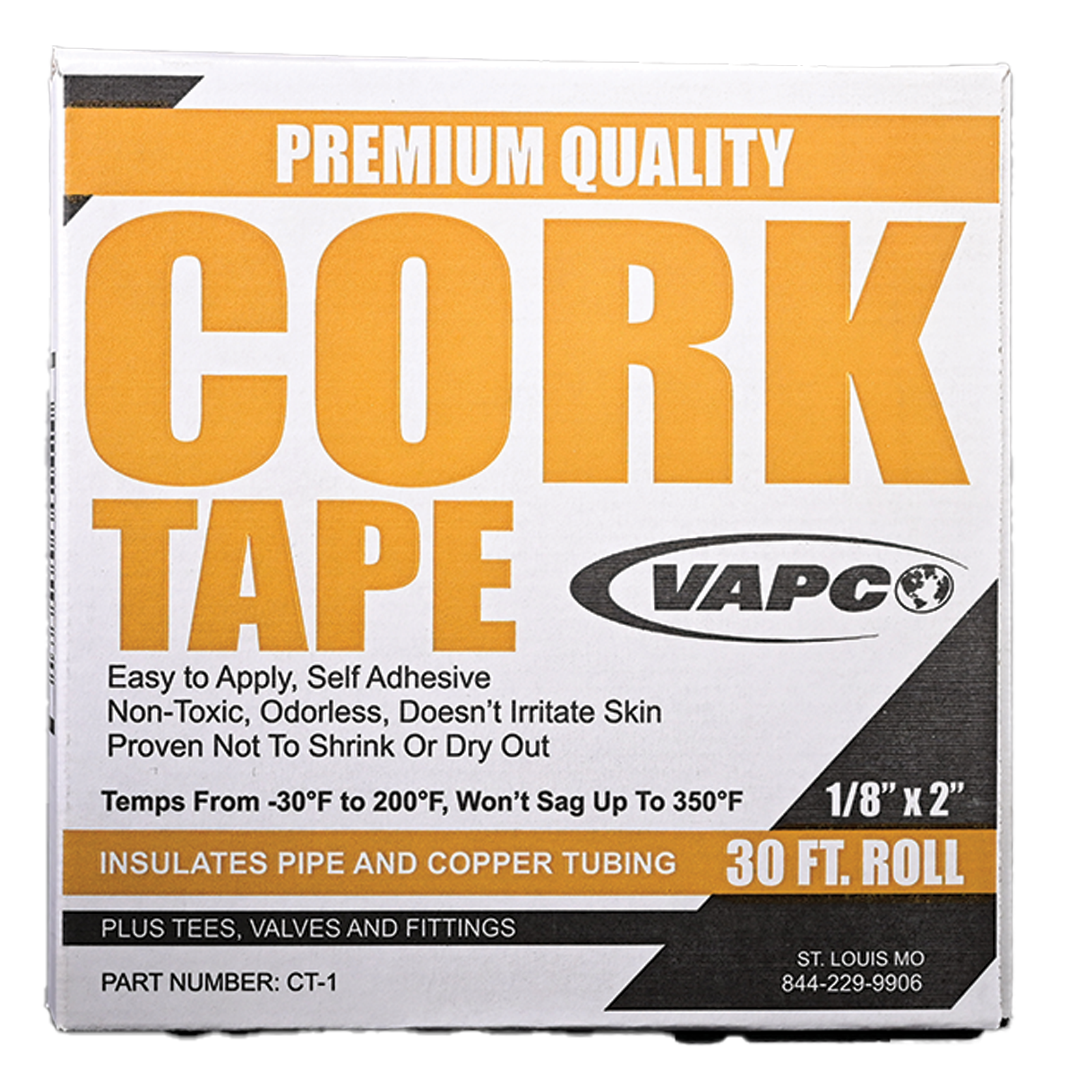
What is cork tape?
Cork tape is a soft, tacky sealant tape that comes on a roll, usually 2 inches wide and 1/8 inch thick. You wrap it around a pipe or fitting by hand and it molds to whatever shape is under it. It's been on service trucks for decades, and plenty of guys still call it cork and tar tape, since a lot of the older versions were made with an asphalt binder.
Vapco CT-1 Cork Tape uses butyl instead. There's no asphalt in it, and cork makes up 40 to 50 percent of the tape by volume.
- Body: The cork holds its shape around a valve body without sagging.
- Adhesion: Butyl makes it stick to copper and to itself.
- Flexibility: Stays flexible in service down to -40°F.
- Asphalt-Free: Cleaner application and performance.
How Does Cork Tape Stop Condensation?
A pipe sweats when humid air touches metal that's colder than the dew point. The water comes out of the air, so the real question on any cold line is whether the room air can get to the metal.
Cork tape works on the air instead of the heat. It's pressed tight to the pipe with each wrap overlapping the one before it, so there's no path for room air to reach the metal. No air on the cold surface means nothing to condense. It helps to know how little insulating cork tape actually does (about R-0.07 for a single 1/8" layer). You don't want an air gap under the tape; the tape should sit tight on the pipe with nothing under it.
Cork Tape vs Foam Insulation
Most jobs need both, and they do different things.
1. Straight Runs
Foam belongs on the straight runs, where you can get real thickness on the pipe and the thermal resistance pays off.
2. Irregular Shapes
Cork tape belongs on everything foam doesn't fit well: tees, elbows, valve bodies, and service ports.
3. Transitions
At transitions where foam stops, put the tape on the copper first, then slide the foam over the tape to plug the gap.
Where to Use Cork Tape
Tees and Elbows
One continuous wrap instead of pieced-together foam.
Valve Bodies & Service Ports
Anywhere the shape is too irregular for a standard foam sleeve.
Foam Transitions & Butt Joints
Tape the pipe first, then slide the foam over it.
TXV Sensing Bulbs
The bulb is mounted with a metal strap. Once strapped, CT-1 can fill in around the bulb and strap so ambient air can't reach it, with foam over the top.
Low-Temperature Lines
Walk-ins and freezers, where the same problem shows up as frost and ice. CT-1 stays flexible in service down to -40°F.
Where It Isn't The Right Product
Do not use on long straight runs (use foam), continuous service above 249°F, installation outside the -20°F to 180°F application range, or jobs where the spec calls for ASTM E84 flame spread/smoke ratings.
Application & Specifications
How to Apply Cork Tape
- Clean and dry: Pipe should be free of oil and dirt. Apply between -20°F and 180°F.
- Cut to length: Apply straight from the roll or cut a piece first.
- Wrap and overlap: Overlap each wrap about 1/4" to form a continuous seal.
- Press firmly: Hand pressure bonds it. Make sure there are no gaps underneath.
- Tape first, foam second: At transitions, tape the pipe first, slide foam over the tape.
What To Look For
- Binder: Asphalt or butyl? That decides whether it ever bleeds.
- Temperatures: Application vs. Service ranges are different numbers.
- Adhesion: Look for a psi value with a test method, not just the word "excellent."
- Test Methods: Look for methods like ASTM C907 or E1530.
Vapco CT-1 Specifications & FAQ
CT-1 is non-corrosive to metals, compliant with FDA Regulation CFR Title 21, 175.105 for packaging/transporting food, contains no intentionally added PFAS or Prop 65 chemicals, and is made in the USA. (CT-1 comes in 2" x 1/8" x 30' rolls, 12 to a case).