Deionized Water in Glycol Systems: Stop Using the Hose
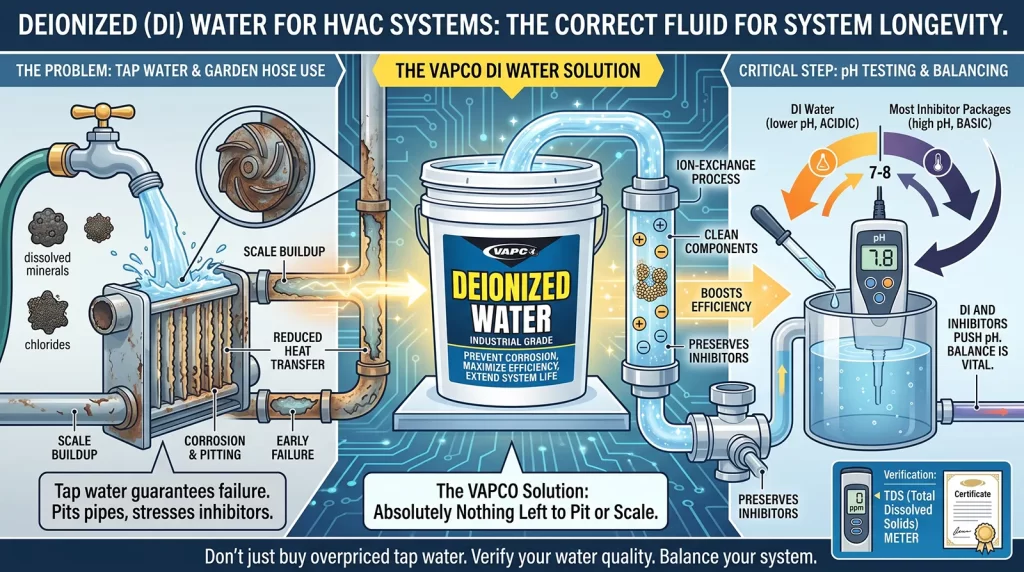
The water you mix with your glycol matters as much as the glycol itself. Tap water carries dissolved minerals and chlorides that build scale, pit metal, and burn through your corrosion inhibitors from the first circulation. Deionized water is stripped of those ions, so there is nothing left to scale or pit. There is also nothing left to buffer, which is the part that catches people. The moment DI water hits open air it picks up carbon dioxide and drifts slightly acidic, and most inhibitor packages sit well on the basic side. So the order of operations is simple: clean the loop, fill it with DI water and glycol, and test pH after. Every time.
During a new install or a system recharge, you have to add water. A lot of people just grab the nearest garden hose, turn the spigot, and call it a day. That exact moment is when an otherwise perfect job can go off the rails. The water you use matters just as much as the expensive glycol you bought. Let us look at what deionized water actually is, why it belongs in your system, and how to verify you are not just buying overpriced tap water.
What is wrong with tap water
Tap water is never just water. It is a chemical soup carrying dissolved minerals and salts. Calcium, magnesium, chlorides, sulfates, and iron are all along for the ride, depending on whatever your local municipality pulled out of the ground. Here in the midwest, there are certain areas where you can cut your water with a fork and knife, and that is the exact type of water you do not want mixed in with your glycol.
Those dissolved solids are the exact ingredients required for everything that ruins a closed loop:
Scale
Minerals bake onto your hottest surfaces. Since scale is a fantastic insulator, you lose heat transfer efficiency on every single run cycle.
Pitting
Chlorides pit and corrode metal. They absolutely love stainless steel and they never clock out.
Corrosion
Dissolved solids provide a buffet for system-wide corrosion, ensuring every component dies younger than it should.
Inhibitor packages exist to help, but hitting them with tap water stresses them immediately. You are essentially handing the next round of scale and corrosion a care package on day one. Nobody likes premature failure.
Tap water is a moving target
Here is the part that gets overlooked. It is not just that tap water is dirty. It is that you have no idea how dirty, and the answer changes on you.
Municipal water utilities are required to publish an annual water quality report. Go read the one for the county you work in. Then read the one for the county next door. Hardness, chloride, and sulfate can look completely different across a twenty minute drive, because the utilities are pulling from different sources and treating them differently.
It moves seasonally too. Surface water sources shift with rainfall and runoff. Some systems switch source wells during the year. The water coming out of a hose bib in April is not necessarily the water that came out of it in September.
So you are standing in a mechanical room about to charge a loop, and the honest answer to "what is in this water" is that you do not know, you cannot find out from where you are standing, and whatever it is today it may not be next time.
Why this hits glycol systems the hardest
Glycol is not just antifreeze. You are paying for the package of corrosion inhibitors designed to protect the metal and components in the loop.
When you fill that loop with mineral loaded tap water, you force those inhibitors to go to work instantly. Instead of protecting clean metal for the next decade, they burn themselves out fighting the garbage you just pumped in. The glycol degrades faster, the metal corrodes anyway, and the premium fluid you bought is fighting a losing battle from the very first circulation.
Clean water means the glycol actually gets to do its job. The inhibitor package spends its life protecting metal instead of chasing minerals, and the fluid you paid for lasts the way it was designed to. Deionized water is not a luxury upgrade. It is the cheapest insurance on the entire job.
Where distilled water fits
Some techs grab distilled and figure it is close enough. Give distilled its due. Boiling water to steam and condensing it back leaves the dissolved salts behind in the boiler, so distillation does remove ionic material, and it does it well. Distilled shows up right alongside deionized in fluid manufacturer guidance. It is not the enemy here.
The two are made in completely different ways, though, and that difference is worth understanding.
Distillation is a phase change. You separate water from everything that will not boil with it. That handles the minerals and salts. It does not handle dissolved gases or volatile organics, which flash off with the steam and condense right back into the finished water.
Ion exchange is chemistry. Charged resin pulls the ions out of solution directly and swaps them for hydrogen and hydroxide, which combine into more water. Nothing is boiled and nothing carries over. The endpoint is controlled by the resin, and you can measure exactly where you landed by checking conductivity on the way out.
Practically speaking, both are a large upgrade over the hose. Deionized is what you will find stocked in the HVACR channel alongside the glycol, in the pail and drum sizes systems actually get charged from, produced to a controlled endpoint.
What deionized water actually is
Deionized water is the product of forcing water through ion exchange resin beds that physically pull the dissolved ions out of solution.
The minerals and salts in water exist as charged particles called ions. Common in tap water are positively charged ones like calcium and negatively charged ones like chloride. When water pushes through the resin beds, the resin grabs those ions and swaps them for harmless hydrogen and hydroxide. Those two combine into plain water. Cations get trapped in one bed, anions in the other.
What comes out the other end is water stripped of its ionic load. There are no minerals left to create scale. There are no chlorides to pit the pipes. There is nothing left to feed corrosion or waste your glycol inhibitors.
You will also hear about reverse osmosis. RO pushes water through a membrane and knocks out the large majority of dissolved ions, which is why it is a common front end on industrial water systems. It gets you most of the way. Ion exchange is what takes it the rest of the way to genuinely deionized.
Where Vapco's DI water comes from
Not all DI water is made the same way, and it is worth knowing where yours comes from. Vapco produces its deionized water in-house on a five-stage industrial treatment train. City water does not run through one filter and come out pure. It moves through five vessels in series, each doing a specific job:
-
1Softening
Pulls the calcium and magnesium hardness out first, so the resin downstream does not foul with scale.
-
2Carbon
Strips chlorine and organics that would otherwise destroy the exchange resin.
-
3Cation exchange
Removes the positively charged ions: calcium, magnesium, sodium.
-
4Anion exchange
Removes the negatively charged ions: chlorides, sulfates, silica.
-
5Mixed-bed polishing
The final stage, blended cation and anion resin in a single vessel that takes the water from good to high-purity right before it leaves.
That last stage is the difference between water that is merely filtered and water that is genuinely deionized. It is the same class of process used to make lab and industrial water.
The tanks do not run forever on their own. They are monitored and swapped out on a regular schedule, so the resin never gets a chance to exhaust and let purity slip. That means consistent output year round, not just when the beds are fresh.
Here is why that matters. A lot of DI water on the market is bought in bulk and rebottled. When you make it in-house on equipment like this, you control the process end to end. Fill a system with Vapco Deionized Water and you are getting water made on purpose-built equipment by a company that blends and manufactures its own chemistry, not water poured from a tote into a smaller jug with a new label.
How DI water is measured
DI water purity is measured by electrical conductivity, or its inverse, resistivity. Dissolved ions allow water to carry an electrical current. Truly pure water is a terrible conductor. The fewer the ions, the lower the conductivity and the higher the resistance, because there is nothing left in solution to carry a current.
Conductivity
Measured in microsiemens per centimeter (µS/cm). Lower numbers mean cleaner water.
Resistivity
Measured in megohm-centimeters (MΩ·cm). Higher numbers mean cleaner water. Theoretically pure water tops out at 18.2 MΩ·cm.
One note on the handheld meters most techs carry. A TDS pen does not actually measure dissolved solids. It measures conductivity and applies a conversion factor to display a ppm number. That is fine for a quick sanity check in the field, but if you are comparing water sources, compare conductivity to conductivity.
New system or old, the fill is the same
Commissioning a new loop? New pipes and components are filthy with factory oils and installation debris. The system must be chemically cleaned before charging. Once it is clean, it gets DI water and glycol. Starting a fresh system with tap water completely ruins the point of a clean commission.
Recharging an existing system? Flush out the old fluid and the accumulated sludge first. Recharging a freshly flushed loop with tap water just restarts the timer on the exact buildup you spent all day removing.
For old and new systems alike, any time you are swapping out glycol or getting ready for the season, it is best practice to clean first. Vapco's Hydronic System Cleaner is built for exactly that: cutting the oils, flux residue, and loose debris out of the loop so your fresh charge lands in a clean system.
The fill protocol does not change: deionized water plus the glycol charge. Use Vapco Deionized Water paired with Arctic Protection Glycol, NSF Registered Propylene Glycol, or Glycol Inhibitor based on your application. Dial in the mix with a glycol calculator so you hit the freeze point without pouring money down the drain.
One more thing while you are on the job. Do not hydro test a loop, leave it sitting wet with straight DI water, and come back next week. Uninhibited water with no buffer in it is hungry, and it will find your carbon steel. Charge the inhibitor with the fill, or drain it.
There is one catch to DI water you have to watch out for. The second it touches the air, it absorbs carbon dioxide and forms a weak carbonic acid. That drops the pH of your neutral water down into the slightly acidic 5.5 to 6.0 range, when most systems should be operating on the basic side.
If you dump straight DI water into an existing loop to top it off, you are doing two things at once. You are diluting the existing glycol inhibitors, and you are dragging the overall system pH down. Do that a few times without testing and your system fluid becomes acidic enough to start chewing on the exact metals you were trying to protect.
Whenever you top off a system, test the system pH afterward. Inhibited propylene glycol fluids commonly spec somewhere in the 8.0 to 10.5 range, but that range belongs to the fluid in your loop, not to glycol in general. Pull the number off the product data sheet for what you are actually running. If you are below it, add a dose of glycol inhibitor to restore the buffer. Blindly adding DI water and walking away is a fantastic way to rot a heat exchanger.
Aluminum changes the target. If there is an aluminum heat exchanger in that loop, and there is in a lot of modern condensing boilers, do not just aim for the top of the range. Aluminum is amphoteric. It corrodes from the alkaline side as readily as the acidic side, and the acceptable window is tighter than it is for steel and copper. Pull the boiler manufacturer's pH spec before you dose.
Bottom line
The glycol gets all the attention, but the water you mix it with decides whether that charge lasts a decade or starts failing on day one. Tap water is an unknown that changes on you by county and by season. Distilled is a real upgrade. Deionized water is the fill you can source in working volumes, produced to a controlled endpoint, and repeat identically on every job. Clean the loop, fill it right, and check your pH after. Do that and you have done the job in a way that holds up long after you have packed the truck.
Frequently Asked Questions
Can I use tap water or well water in a glycol system?
You should not, unless you enjoy replacing parts. Inhibited glycol fluids carry dilution water requirements, and municipal tap water frequently misses them. Well water is usually worse. The bigger problem is that you cannot verify any of it from the jobsite, and the water changes by county and by season. Dissolved minerals build scale, chlorides pit metal, and both of them shorten the working life of your corrosion inhibitors. Check the data sheet for the fluid you are charging, then fill with deionized water so the question stops mattering.
Is distilled water the same as deionized water?
No, but they are closer than most people think, and both are a legitimate fill. Distillation boils water to steam and condenses it back, leaving dissolved salts behind in the boiler, so it does remove ionic material effectively. The difference is method. Distillation is a phase change, which means dissolved gases and volatile organics can carry over with the steam. Deionization is chemistry, using charged resin to pull ions out of solution directly, with an endpoint you can verify by measuring conductivity. Deionized water is also what is stocked in the HVACR channel alongside the glycol, in the sizes systems actually get charged from. Either one beats the hose by a wide margin.
Why does deionized water matter for glycol specifically?
Quality glycol relies on a corrosion inhibitor package to passivate system metals and buffer the organic acids that glycol produces as it oxidizes. If you introduce mineral heavy tap water, those inhibitors spend their lifespan fighting the water instead of protecting the pipes and components.
How is deionized water quality measured?
By electrical conductivity in microsiemens per centimeter, where lower is better, or resistivity in megohm-centimeters, where higher is better. Theoretically pure water tops out at 18.2 MΩ·cm. Handheld TDS pens display a ppm number, but they are actually measuring conductivity and converting it. Fine for a field check, less useful for comparing sources.
Do I need to clean a system before adding DI water and glycol?
Almost always. New loops carry factory oils, flux residue, and installation debris. Old loops carry accumulated sludge. Clean it first, then charge it properly so your fresh fluid is not immediately compromised by what was already in the pipe.
Why did topping off with DI water drop my system pH?
Because DI water is stripped of dissolved ions, it has essentially no ability to buffer against pH swings. The second it hits open air it absorbs carbon dioxide and forms a weak carbonic acid, dropping its own pH to around 5.5 to 6.0. When you top off a system, you dilute the existing inhibitors and drag the total system pH down with it. Always test the fluid after a top off. Inhibited propylene glycol fluids commonly spec in the 8.0 to 10.5 range, but that number belongs to the specific fluid in your loop, so pull it off that product's data sheet. Check the equipment side too, especially if there is an aluminum heat exchanger in the system, where the acceptable window is narrower. If you are below spec, add a dose of glycol inhibitor to restore the buffer.
Is reverse osmosis water good enough for a glycol fill?
RO removes the large majority of dissolved ions and is commonly used as the front end of an industrial water system. Whether a given RO permeate clears the fluid manufacturer's chloride, sulfate, and hardness limits depends entirely on the feed water and the condition of the membrane. Ion exchange polishing is what takes the water from mostly clean to genuinely deionized, and it is what makes the result repeatable instead of dependent on how the membrane happens to be performing that day.
Further Reading
- ASTM D1193-24, Standard Specification for Reagent Water: The standard that defines purified water types by conductivity, resistivity, pH, chlorides, and sodium. This is where the 18.2 MΩ·cm figure comes from.
- ASTM D5391, Electrical Conductivity and Resistivity of a Flowing High Purity Water Sample: The test method behind the numbers, if you want to know how purity is actually measured rather than estimated.
- EPA, Understanding Your Annual Water Quality Report: How to find and read the Consumer Confidence Report for your local water system. Free, published every year, and the fastest way to see what is actually coming out of the hose in your service area.
- ASHRAE, Fundamentals of Water System Design: For the engineering math on closed-loop water treatment.