Evaporator vs Condenser Coil Cleaner Rules
When “No-Rinse” Is Actually True
The most common misunderstanding in coil cleaning — and why the distinction matters for your workflow, your customers, and your callbacks.
“No-rinse” is one of the most used — and least understood — terms in coil cleaning. It shows up on labels, spec sheets, and in distributor conversations every day, and most of the time it’s treated as though it means one simple thing: spray it on and walk away. That’s not wrong, exactly. But the gap between what the term implies and what actually happens on the coil is where field confusion, customer callbacks, and bad cleaning outcomes live.
Whether you’re a service tech, a contractor building maintenance programs, a facility manager, or someone recommending products at the wholesale counter, understanding what “no-rinse” actually means — and when it doesn’t apply — will make you better at your job.
TL;DR Most coil cleaners marketed as “no-rinse” are actually self-rinsing — they rely on condensate from the evaporator to carry the cleaner off the coil during active cooling. That process works, but only when specific conditions are met. Condensers don’t produce condensate, so they almost always require a water rinse regardless of product claims. The industry uses “no-rinse” loosely, and the gap between what the term implies and what actually happens on the coil is where confusion and callbacks live. This article breaks down what “no-rinse” actually means, how evaporator and condenser cleaning rules differ, and how to match your product and process to the job. A quick-reference decision table and FAQs are included at the end. |
What “No-Rinse” Actually Means in Coil Cleaning
“No-rinse” appears on product labels, in distributor catalogs, and in sales conversations every day. Most of the time it’s used as though it means one thing: spray it on and walk away. That’s not wrong, exactly — but it’s incomplete. There are actually three distinct categories of rinse behavior in coil cleaning products:
No-rinse means no water rinse is required at all. The product does its job and leaves the coil without external rinsing. Very few coil cleaners are truly no-rinse in all applications. The closest are solvent-based cleaners where the carrier evaporates — though loosened debris may still need removal depending on contamination.
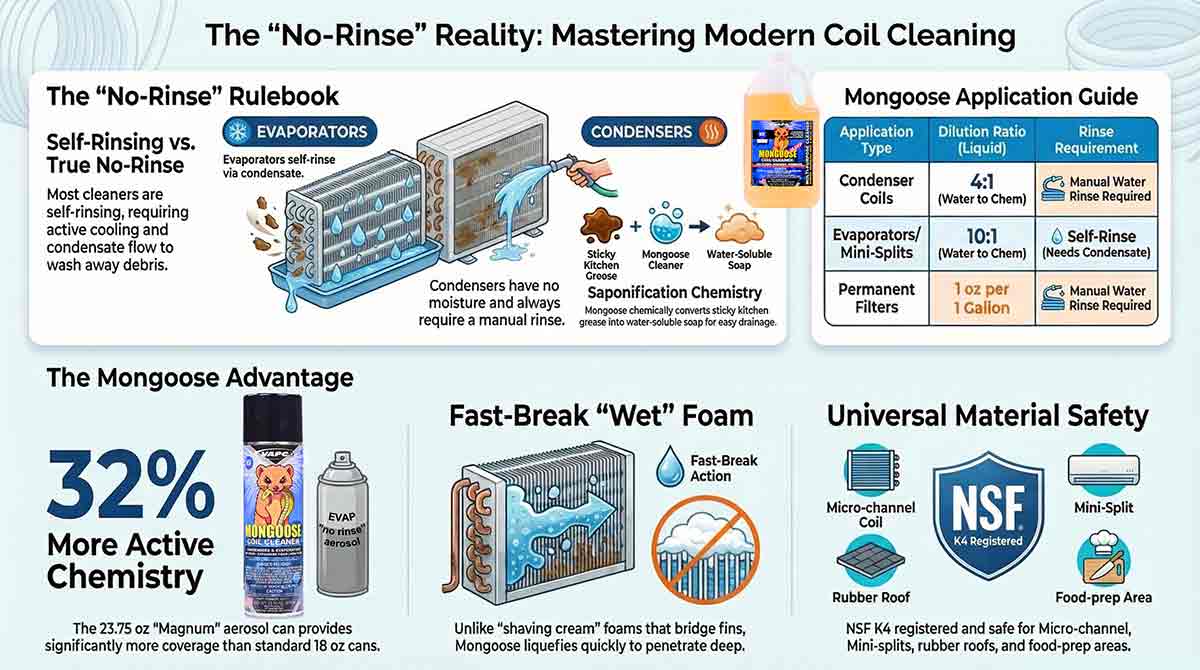
Self-rinsing means the product is rinsed by the system’s own condensate during normal cooling operation. Condensate flows across the coil, carrying the cleaner and loosened contamination into the drain pan and out. Effective — but only when condensate is present.
Rinse-required means the product must be flushed from the coil with water after application. Standard for condenser cleaning and heavy-duty evaporator work.
The industry markets a huge number of self-rinsing products as “no-rinse.” On an evaporator in cooling mode, the distinction is academic — you don’t add a water rinse either way. But it creates the impression that the product works the same way on every coil, in every season, in every application. It doesn’t. And when a tech sprays a “no-rinse” product on a condenser and walks away, the result is chemistry sitting on the fins with nowhere to go.
This matters beyond just cleaning outcomes. When customers hear “no-rinse” from a tech or see it on a product label, they develop expectations about what happened during the service visit. If those expectations don’t match reality, the result is confusion, complaints, and callbacks that erode trust — even when the product performed exactly as designed for the application it was used on.
The biggest misconception in coil cleaning isn’t about which product is best. It’s about what “no-rinse” actually means — and when it doesn’t mean what you think.
Evaporator Coil Cleaning Rules
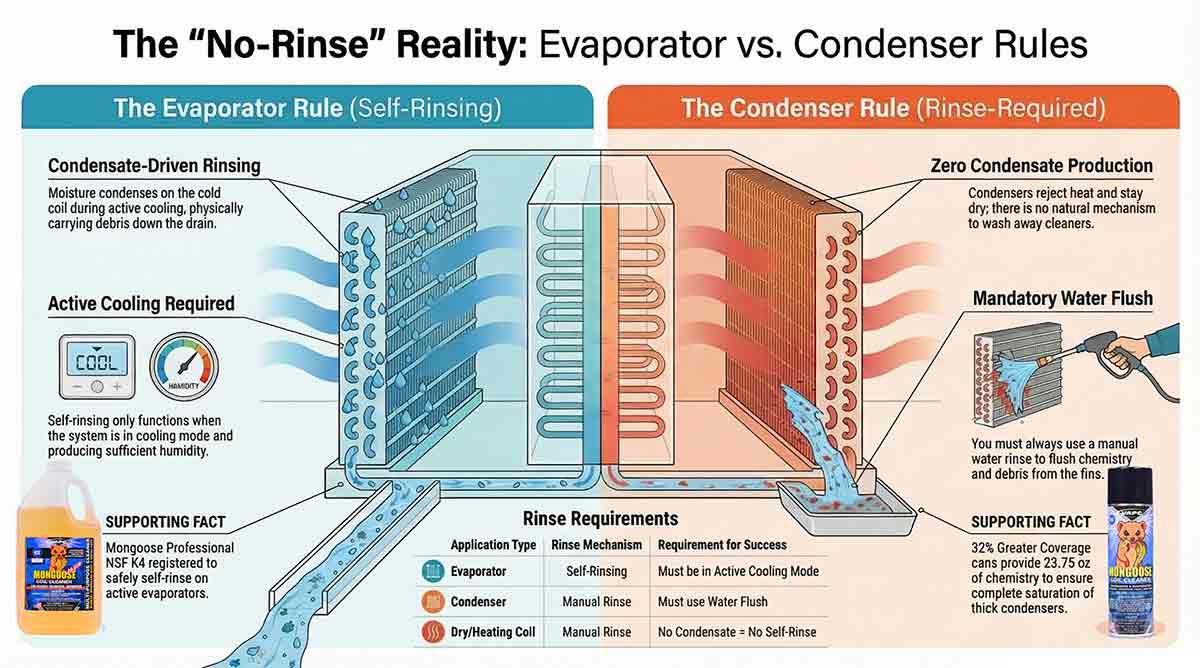
Evaporator coils are where self-rinsing applies. During cooling, moisture condenses on the cold coil surface and flows continuously into the drain pan. When you apply a self-rinsing cleaner during active cooling, the chemistry breaks the bond between contaminants and the coil. As condensate forms, it carries the cleaner and loosened debris away. No hose needed.
That process works — but it depends on conditions being right:
- System off or in standby: no condensate. The cleaner sits on the coil.
- System in heating mode: evaporator isn’t cold enough for condensation. Same result.
- Heavy soil load: condensate alone may not flush the volume of loosened material. A manual rinse may still be needed.
Mongoose Aerosol is a no-rinse coil cleaner — and what that means in practice is that it’s self-rinsing on evaporators when condensate is present. The chemistry does its job; the condensate carries it away. It’s NSF K4 registered, professional-grade, and formulated to be safe on aluminum and common HVAC metals. But like any self-rinsing product, the process depends on conditions. If the system isn’t producing condensate, or if the coil is heavily soiled, a rinse is the right call. That honesty about use conditions is what separates a reliable product from a vague marketing claim.
A no-rinse coil cleaner isn’t a product that never needs rinsing. It’s a product that doesn’t need rinsing when the conditions for self-rinsing are met.
Condenser Coil Cleaning Rules
Condensers don’t produce condensate. That single fact changes the entire rule set.
The outdoor condenser rejects heat. Air moves across the coil, and over time that airflow brings cottonwood, pollen, grass clippings, dust, pet hair, and grease with it. That material mats against the fins, restricting airflow and reducing the coil’s ability to reject heat. A condenser running with restricted airflow works hotter, puts more stress on the compressor — typically the most expensive component in the system — and drives up energy consumption.
Because there’s no condensate on a condenser, there’s no self-rinsing mechanism. A coil cleaner applied to a condenser needs to be rinsed off with water — period. The chemistry breaks down the contamination; the water flushes it out of the fin pack. Without that rinse, you’re leaving chemistry and loosened debris sitting on the coil.
Rinse direction matters. Spraying from the outside pushes debris further into the fin pack instead of removing it. The most thorough approach is working from the inside out, which often means pulling the fan assembly. That said, the right chemistry applied correctly can release matted debris without disassembly in many situations. What matters is that contamination is being removed, not compacted deeper.
Condenser cleaning deserves its own detailed coverage. We go deeper on condenser-specific workflows and product selection in our Foaminator FM-1 content.
How to Decide What Your Job Actually Needs
The no-rinse question isn’t a product question — it’s a situation question. The same product can be self-rinsing in one scenario and need a manual rinse in another. What matters is matching the product and the process to the conditions you’re actually working in. If you’re standardizing truck stock or building out a PM offering, this framework helps you select and position the right products for the jobs your team actually runs. Here’s a quick-reference:
Scenario | Rinse Needed? | What to Consider |
Evaporator, light soil, active cooling | Self-rinsing (condensate) | System must be in cooling mode. Chemistry is carried off by condensate flow. Mongoose Aerosol is designed for this workflow. |
Evaporator, heavy soil or off-season | Yes — manual rinse | Condensate alone may not flush heavy contamination. Manual rinse recommended regardless of product claims. |
Condenser, any soil level | Yes — always | No condensate present. Debris must be flushed from the fin pack, not pushed through. Use appropriate condenser chemistry. |
Residential / rooftop / sensitive surroundings | Depends on coil type | Product must be safe on metals, roofing, and surroundings. Mongoose (properly diluted) is aggressive enough for residential contamination while safer for coils and environment. |
Solvent-based (true no-rinse) | Closest to true no-rinse | Carrier evaporates; debris may still need removal. Chlorinated solvent restrictions (2024–2027) are affecting availability in this category. |
A note on the solvent category: these products have historically been the closest thing to true no-rinse, particularly on condensers, because the carrier evaporates rather than relying on condensate or water. However, chlorinated solvent restrictions rolling out between 2024 and 2027 are affecting availability and formulation. If your workflow depends on a solvent-based cleaner, confirm your product is still compliant and available. We’ll cover the solvent landscape in a separate article.
Always check the product label and SDS for specific use instructions. This table is a decision-support tool, not a replacement for manufacturer guidance.
Why Some OEMs Say “Don’t Use Cleaners” — and What That Actually Means
Many equipment manufacturers recommend against chemical cleaners on their coils. If you’ve seen this in installation or maintenance manuals, you’re not imagining it — and contractors who follow that guidance aren’t being lazy. They’re doing what the OEM says.
The reasoning is understandable: manufacturers want to protect coils from damage caused by the wrong product, incorrect application, or extended chemical contact. Modern equipment uses thinner aluminum fins that are more vulnerable to aggressive chemistry. The caution is real.
But the guidance doesn’t distinguish between an aggressive acid wash and a near-neutral, metal-safe maintenance cleaner designed specifically for the equipment being serviced. It treats all chemical cleaning the same — and it isn’t all the same. The result is that many contractors default to water-only cleaning or skip chemical cleaning entirely, which means bonded contamination — the stuff water can’t remove — stays on the coil season after season.
There are products specifically formulated to be safe on modern coils. Mongoose Aerosol is one — non-acid, near-neutral, NSF K4 registered, engineered to clean effectively without the risk profile that OEM guidance is rightly concerned about. This isn’t about ignoring OEM recommendations. It’s about understanding that safe, appropriate cleaning chemistry exists, and that avoiding all chemistry carries its own cost in cumulative efficiency loss.
If you’re a contractor navigating this tension, the practical move is to choose products that are specifically designed for the equipment you’re servicing, follow the product’s application instructions precisely, and document what you used and how. That gives you a defensible position if questions arise — and it gives your customers equipment that’s actually being maintained, not just inspected.
The question isn’t “should I use a cleaner or not?” It’s “am I using the right cleaner for this equipment, applied correctly, within the product’s design parameters?”
Who This Article Is For — and Who Should Look Elsewhere
This article is for HVAC service technicians, facility managers, and contractors who want to clean coils correctly and communicate clearly to customers about what was done and why. If you’re building PM programs and need to explain the difference between a maintenance clean and a heavy remediation, the framework here will help.
It’s also for wholesale counter staff, purchasing managers, and people new to the HVAC industry who need to understand what “no-rinse” actually means so they can support informed product recommendations. If a contractor asks for a no-rinse coil cleaner, the distinctions in this article help you put the right product in their hands for the job they’re actually doing.
This article is not for readers looking for a single product recommendation without considering their coil type, soil conditions, and service scenario. There is no universal answer to “what’s the best coil cleaner?” — there’s only the right product for the right situation, applied correctly.
If you’re building residential PM programs and want to go deeper on cleaning frequency, product selection, and how to communicate the value of maintenance cleaning to customers, we cover that in our article on residential coil cleaning frequency and right-fit cleaning philosophy.
Frequently Asked Questions
Q: Is no-rinse coil cleaner the same as self-rinsing?
No. “No-rinse” implies no water rinse is needed at all. “Self-rinsing” means the system’s condensate carries the cleaner and loosened debris off the coil during cooling. Most products marketed as “no-rinse” are actually self-rinsing — they work without a water rinse, but only when the evaporator is producing condensate.
Q: Can I use a no-rinse coil cleaner on a condenser?
Condensers don’t produce condensate, so there’s no self-rinsing mechanism. A water rinse is required in virtually all condenser applications. Applying a self-rinsing product to a condenser and walking away leaves chemistry and debris on the fins.
Q: Does Mongoose Aerosol require rinsing?
On evaporators during active cooling, Mongoose Aerosol is self-rinsing — condensate carries the cleaner away. On condensers, heavily soiled coils, or systems not in cooling mode, a manual rinse is recommended. Check the product label for detailed instructions.
Q: What makes a coil cleaner “true no-rinse”?
Solvent-based cleaners come closest — the carrier evaporates rather than relying on condensate or water. Loosened debris may still need physical removal depending on contamination. Note that chlorinated solvent restrictions (2024–2027) are affecting availability in this category; confirm your product is still compliant.
Q: When should I rinse even if the label says no-rinse?
When soil load is heavy. When the system isn’t producing condensate. When cleaning condensers. When the coil is in a food-service or sensitive environment with low residue tolerance. The general rule: if you’re unsure whether conditions support self-rinsing, rinse.
Q: I’m new to HVAC — what should I know about “no-rinse” when recommending coil cleaners?
Most no-rinse coil cleaners are self-rinsing on evaporator coils — they rely on the system’s condensate to complete the process. That distinction matters when a contractor asks for something to use on a condenser, an off-season job, or a system not in cooling mode. Understanding the difference between no-rinse, self-rinsing, and rinse-required helps you put the right product in a tech’s hands for the job they’re doing.
Learn More
Mongoose Aerosol (MC-1) — Professional-grade, NSF K4 registered, self-rinsing coil cleaner for evaporator applications. [View Product Page]
Mongoose Gallon / Mini-Split Liquid — Liquid concentrate for mini-split maintenance and pump-sprayer workflows. [View Product Page]
Foaminator FM-1 — Heavy-duty foaming coil cleaner for condenser and heavily impacted coil applications. [View Product Page]