
Universal Propylene & Ethylene Glycol Calculator for HVAC & Hydronic Systems
The industry-standard tool for system volume, glycol concentration, freeze/burst protection, and flow design.
Designed for HVAC technicians and engineers, this free online glycol calculator lets you quickly size total hydronic system volume, determine propylene and ethylene glycol concentration, calculate dosage for existing loops, check freeze, burst, and boiling protection from refractometer readings, and estimate flow rate (GPM) and chiller tonnage from heat load calculations.
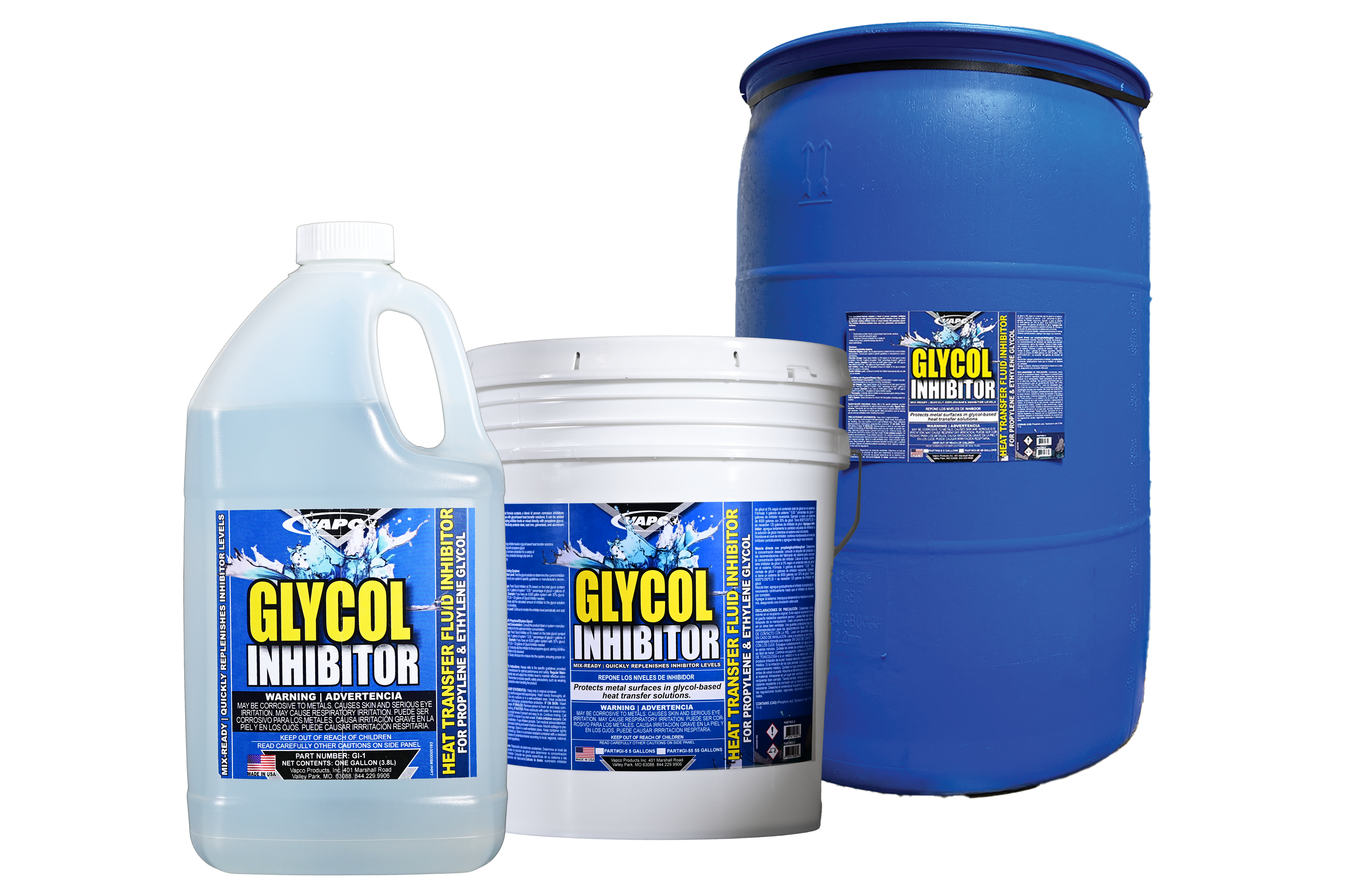
The tool works with all common inhibited heat transfer fluids, including Vapco’s Arctic Protection (Standard Propylene), Arctic Protection HT-1 (NSF Food Safe), or Ethylene Glycol, helping you reach your exact protection target for any commercial or industrial application.
Custom Blends: Ships 48-96 Hours after PO
Bulk Tankers: 21-Day Lead Time Required
- Ship-to Zip Code
- Total Volume (Gallons)
- Type of Glycol (HT-1, AP, EG)
- Desired Percentage (%)
- Container Size (5, 55, 275, or Tanker)
- Color Preference (Optional)
Email [email protected] for pickup, delivery, or drop-ship quotes.
Contact your local Vapco distributor (or email us to find one nearby).
| % Conc. | Freeze (°F/°C) |
Burst (°F/°C) |
Boiling (°F/°C) |
|---|
• Burst Protection: Expansion occurs; risk of pipe damage.
Showing data for Propylene Glycol.
How to Calculate Glycol System Volume
Determining the correct fluid volume is critical for maintaining proper freeze and corrosion protection. Follow these steps to use the professional calculator:
- Input Pipe Data: Select your specific pipe diameter and enter the total linear footage of the piping network.
- Calculate Base Volume: The tool determines the gallon capacity of the piping, then allows you to include expansion tanks, buffer tanks, and a safety factor for extra volume or unknowns.
- Determine Freeze Point: Consult standard freeze protection tables—or use the built-in refractometer tool—to find your target percentage for the local climate.
- Calculate Fill Amount: Enter your current and desired concentration in the Concentration Adjustment section to determine exact gallon requirements for a new system fill or a drain-and-fill correction.
What information should I gather before I start?
Before you use the calculator, it helps to have the following ready:
- Total length of piping by size (or a good estimate).
- Volume of any expansion, buffer, or storage tanks (gallons).
- Type of glycol in use (Propylene or Ethylene).
- Current glycol percentage from a refractometer test.
- Desired target percentage based on lowest ambient temperature.
- Heat load (BTU/hr) and design ΔT (°F) if you want flow rate and tonnage estimates.
Glycol Calculation & System Maintenance FAQ
Is this calculator compatible with all glycol brands?
Yes. This calculator utilizes standard industry specific gravity and volume formulas compatible with most inhibited Propylene and Ethylene glycol fluids. However, always verify specific requirements with your manufacturer's technical data sheet (TDS).
What numbers do I enter in the Concentration Adjustment section?
The Concentration Adjustment section is designed to match the way techs actually test systems:
- System Volume (Gal): The total gallons in the loop, either calculated in Section 1 or known from drawings.
- Source Glycol %: The strength printed on the drum or tote (for example, 95% concentrate or 55% blend).
- Current % (Testing): The actual concentration in the system now, measured with a refractometer.
- Target % (Desired): The concentration you want to end up with, based on required freeze protection.
How do I use a refractometer with this calculator?
Take a clean sample of system fluid and place it on the refractometer lens. Read the glycol percentage according to the instrument’s scale for either Propylene or Ethylene glycol. Then:
- Select the correct Fluid Type (Propylene or Ethylene) in the Refractometer Check section.
- Enter the percentage reading into the Refractometer Reading (%) field.
- The calculator will estimate Freeze Point, Burst Point, and Boiling Point based on standard reference data.
This same reading can be entered as the Current % (Testing) in the Concentration Adjustment section to determine how much to drain and refill.
Can I run my system at a low concentration (e.g., 20%)?
Vapco strongly advises against concentrations below 25%. While glycol can provide freeze protection at lower levels, concentrations below 25-30% lose their bacteriostatic properties. This allows biological growth (bacteria, algae, and slime) to flourish, which can clog pumps and foul heat exchangers. If a system must run at 20%, a professional biocide monitoring and injection system is mandatory. For standard maintenance-free operation, keep concentrations above 25%.
What is the difference between Freeze Protection and Burst Protection?
Freeze Protection ensures the fluid remains completely liquid at the lowest expected temperature, allowing pumps to operate. Burst Protection involves a lower concentration that allows the fluid to turn into a "slush" but prevents it from expanding and damaging pipes or components.
Should I use Ethylene or Propylene Glycol?
Use Propylene Glycol for systems with potential potable water contact, food processing (NSF HT-1), or residential applications where low toxicity is required. Use Ethylene Glycol for industrial efficiency and heavy-duty cooling where toxicity is not a concern, as it offers superior heat transfer.
How do I correct concentration in an existing loop?
Utilize the Concentration Adjustment section of this tool. By entering your Total System Volume, your Current Test Percentage (via refractometer), and your Desired Target Percentage, the tool will provide the exact amount of fluid to drain and replace with either water or glycol concentrate.
What should I use for the Safety Factor on volume?
The Safety Factor % in Section 1 is there to account for unknowns: extra piping, coils, and components that weren’t measured exactly. A default of 10% is typical for most jobs. For systems with large heat exchangers, multiple risers, or where drawings are incomplete, counter staff or contractors may choose a slightly higher factor to avoid under-filling.
How should I set the Capacity Margin in the Flow & Design section?
The Capacity Margin (Safety) multiplies the entered BTU/hr load to account for real-world conditions, future expansion, and unknowns. A value of 1.15 (15% margin) is common. Using higher margins (up to 2.0) may be appropriate for very critical loads or uncertain designs, but always coordinate with the system engineer or manufacturer recommendations.
How accurate is the flow rate and chiller tonnage estimate?
The flow and tonnage calculations use standard HVAC formulas (BTU/hr = GPM × factor × ΔT and 12,000 BTU/hr per ton). The factor is adjusted for glycol type and approximate concentration. This provides a practical engineering estimate for sizing discussions, but it should not replace a full heat load design. Always confirm final equipment selection with a licensed engineer or the OEM’s design tools.
How can counter staff quickly help a contractor using this tool?
Inside sales and counter staff can use the calculator as a guided script. Ask the contractor:
- “What kind of glycol is in the system now—Propylene or Ethylene?”
- “What percentage did your refractometer just read?”
- “What percentage do you want to target for your lowest ambient?”
- “About how many feet of each pipe size do you have?”
- “Do you have any expansion or buffer tanks, and what are their gallon ratings?”
- “Do you know the system BTU load and design ΔT?” (if they want flow/tonnage guidance)
With these answers, the counter person can walk through each section on-screen and print or email a complete summary for the contractor.
• NSF HT-1: A food-grade certification for heat transfer fluids where incidental food contact is possible.
• Burst Protection: Prevents pipe failure in dormant systems by allowing slush formation without expansion.
• Freeze Protection: Ensures fluid remains pumpable and liquid at design temperatures.
• Inhibitor Package: Chemical additives in Vapco glycol that protect system metals like copper, steel, and aluminum from corrosion.
• Bacteriostatic: The ability of a fluid (at sufficient concentration) to stop bacteria from reproducing.
Glycol Calculator Technical References
The calculations in this tool are based on standard fluid property data found in the ASHRAE Handbook — Fundamentals. Always verify specific burst protection requirements with your equipment manufacturer's technical specifications.
Vapco Products Technical Resource - Developed by Elliot Garner. Verified for HVACR industry standards.