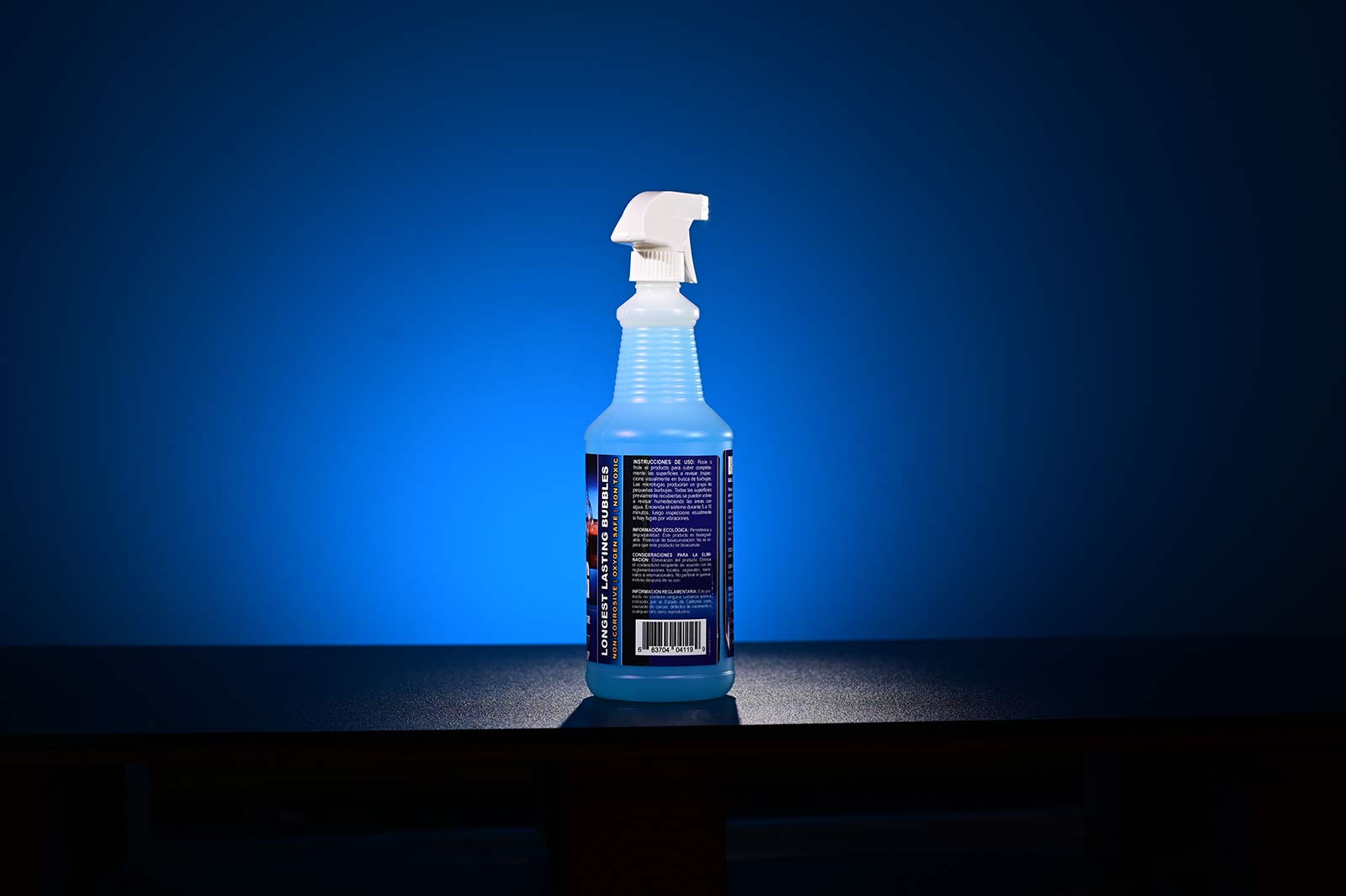
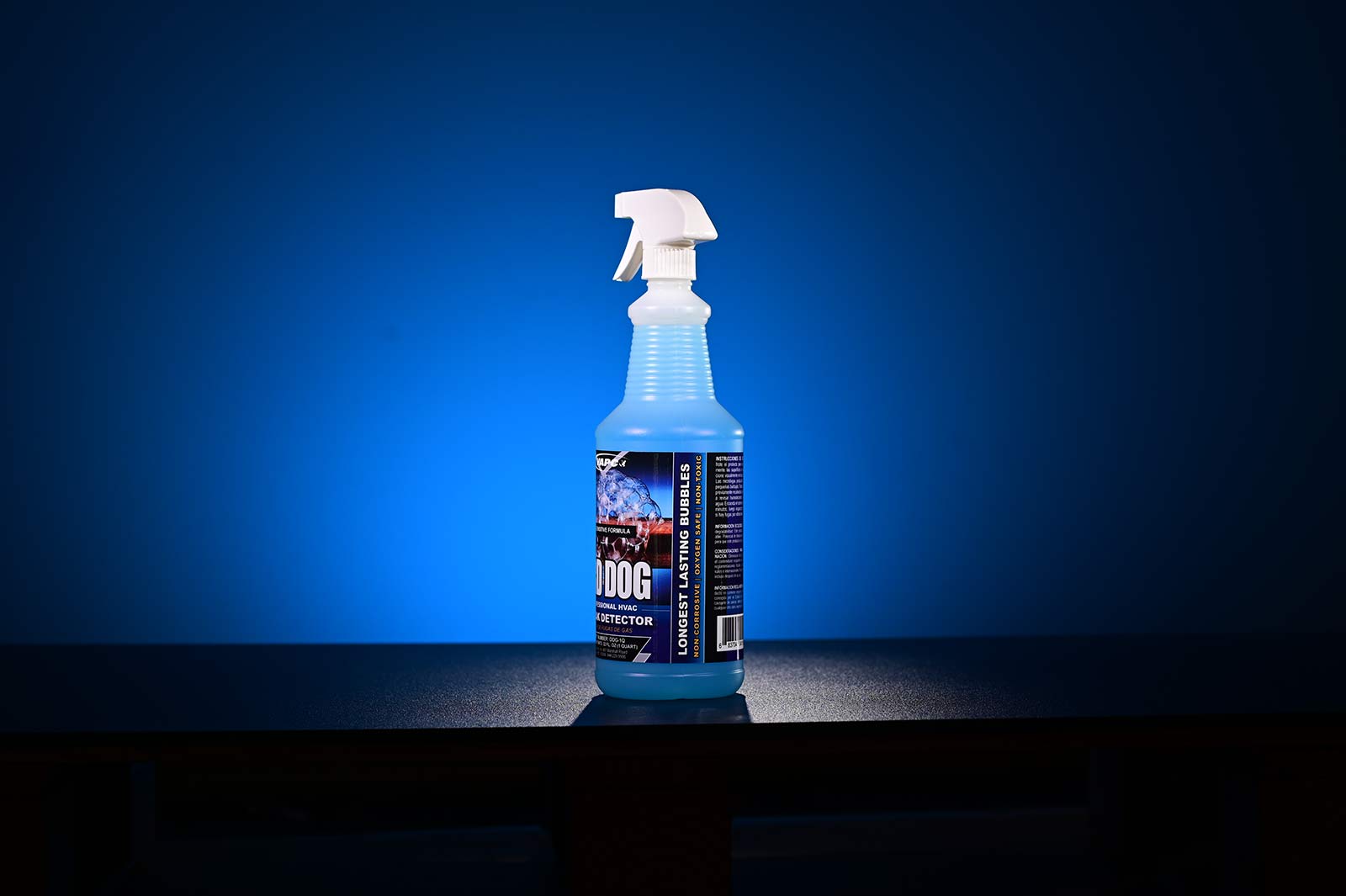
BIRD DOG Leak Detector
The Industry’s Most Sensitive & Long Lasting Solution
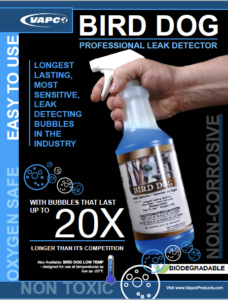
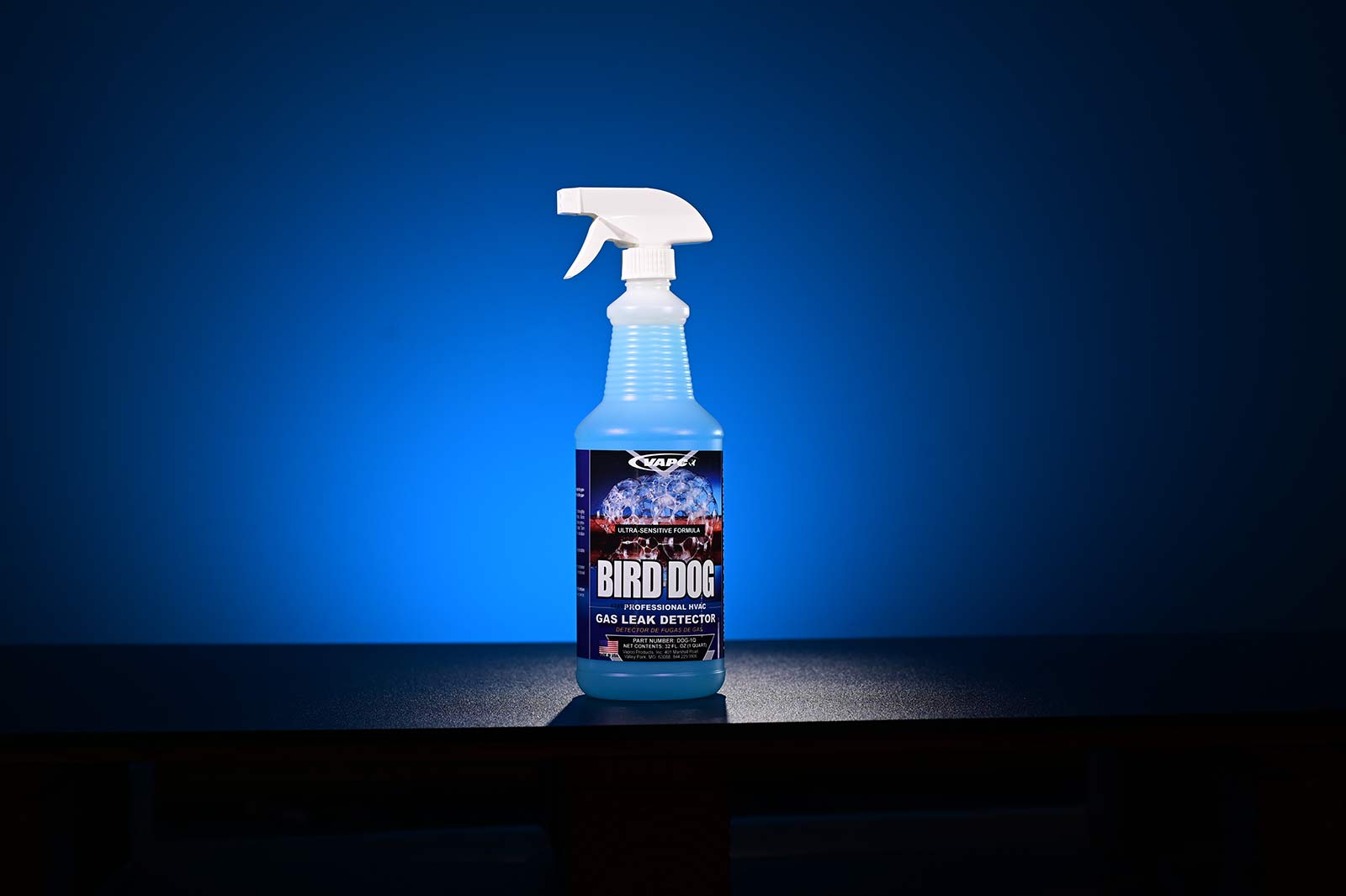
Discover the unparalleled sensitivity of BIRD DOG Leak Detector. Designed to pinpoint even the smallest leaks with precision, BIRD DOG offers the longest-lasting bubbles in the industry, lasting up to 20 times longer than competing brands. It’s a hypersensitive bubble solution designed for HVAC professionals to pinpoint the smallest leaks in refrigerant, nitrogen, natural gas, oxygen and even A2L systems. Its advanced, Zero VOC formula creates long-lasting bubbles for easy detection and is effective down to freezing temperatures, for below freezing temperatures, see Bird Dog Low Temp.
Key Features and Benefits:
- Hypersensitive Detection: Pinpoints leaks with exceptional accuracy.
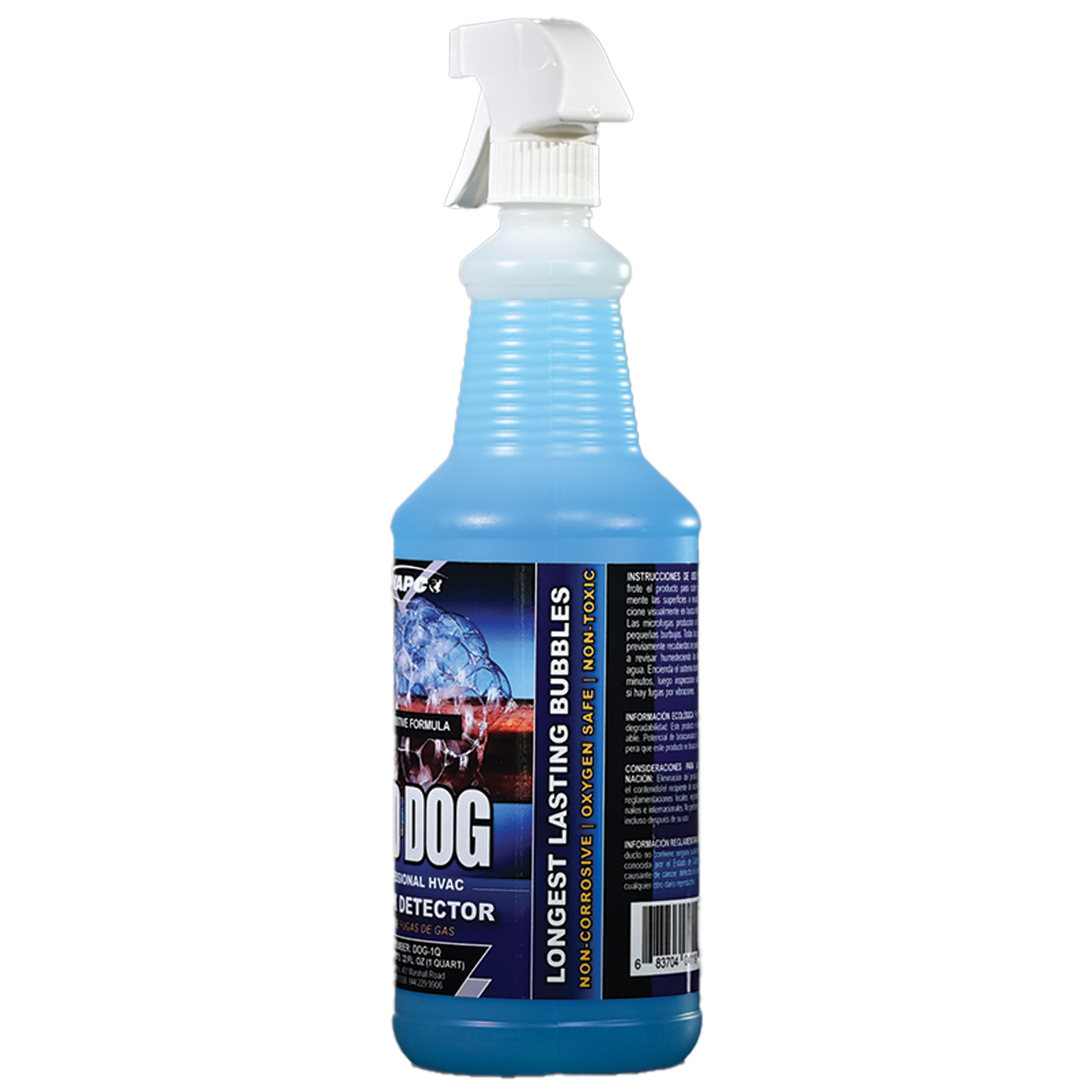
- Long-Lasting Bubbles: Clings where you need it, bubbles till you see it.
- Non-Corrosive to metals: cleans off easy but will not corrode metals if left behind.
- Safe for All Systems: Compatible with refrigerants, nitrogen, natural gas, oxygen and A2L refrigerants.
- 0% VOC Content: Environmentally friendly and non-toxic.
- Low-Temperature Performance: Effective down to 32°F.
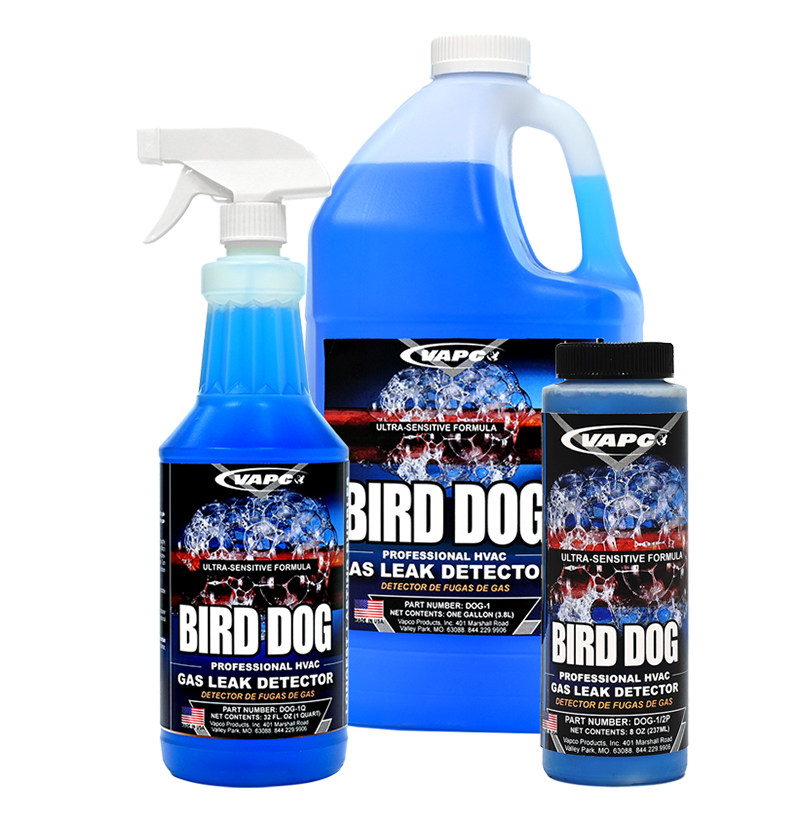
Part Number; Size
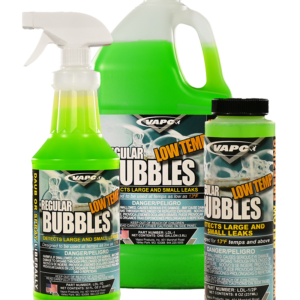
- DOG-1/2P 8 oz with Dauber
- DOG-1Q 32 oz Spray Bottle
- DOG-1 1 Gallon Refill
Directions:
This product must be used in accordance with the following directions and by professionals only.
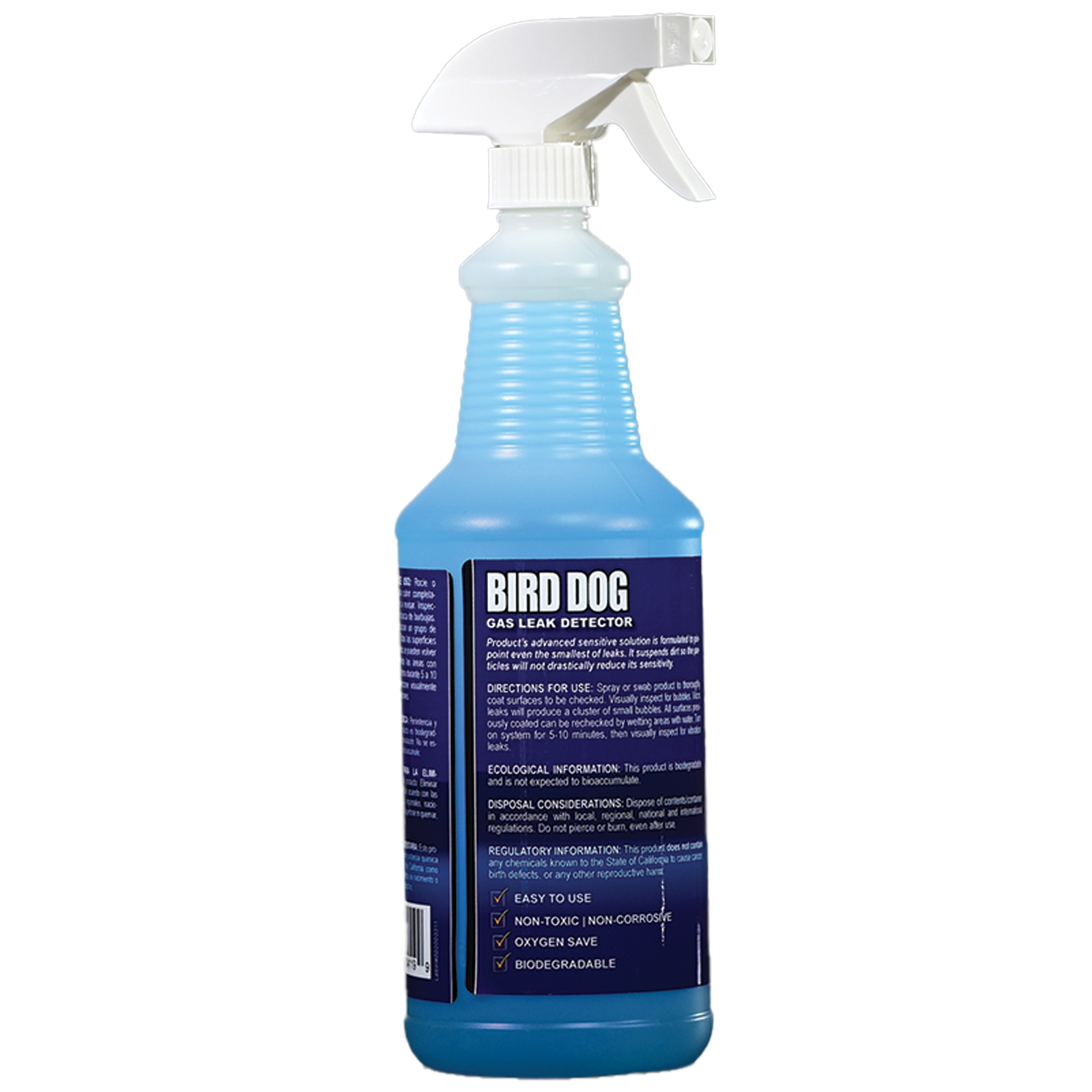
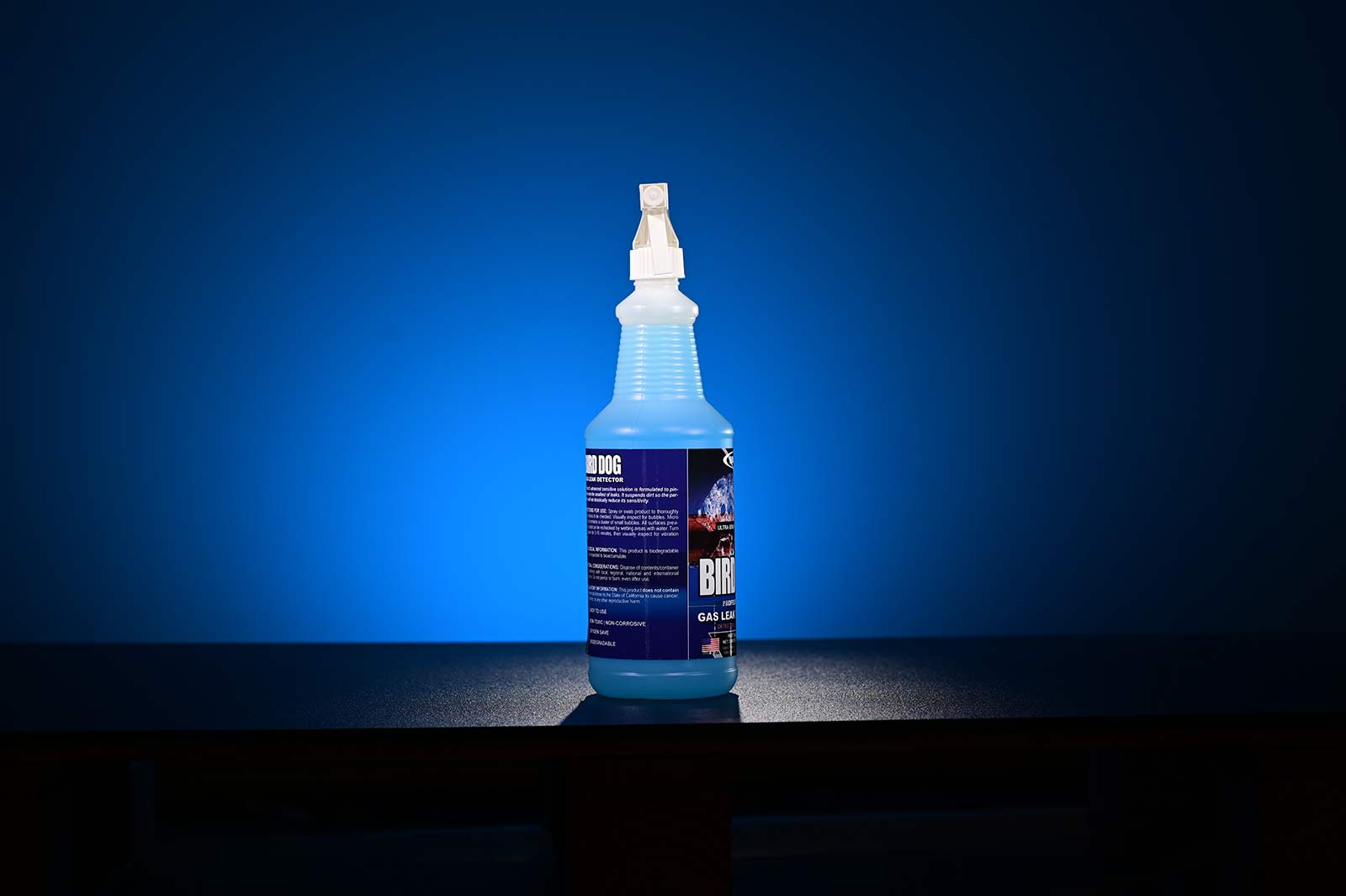
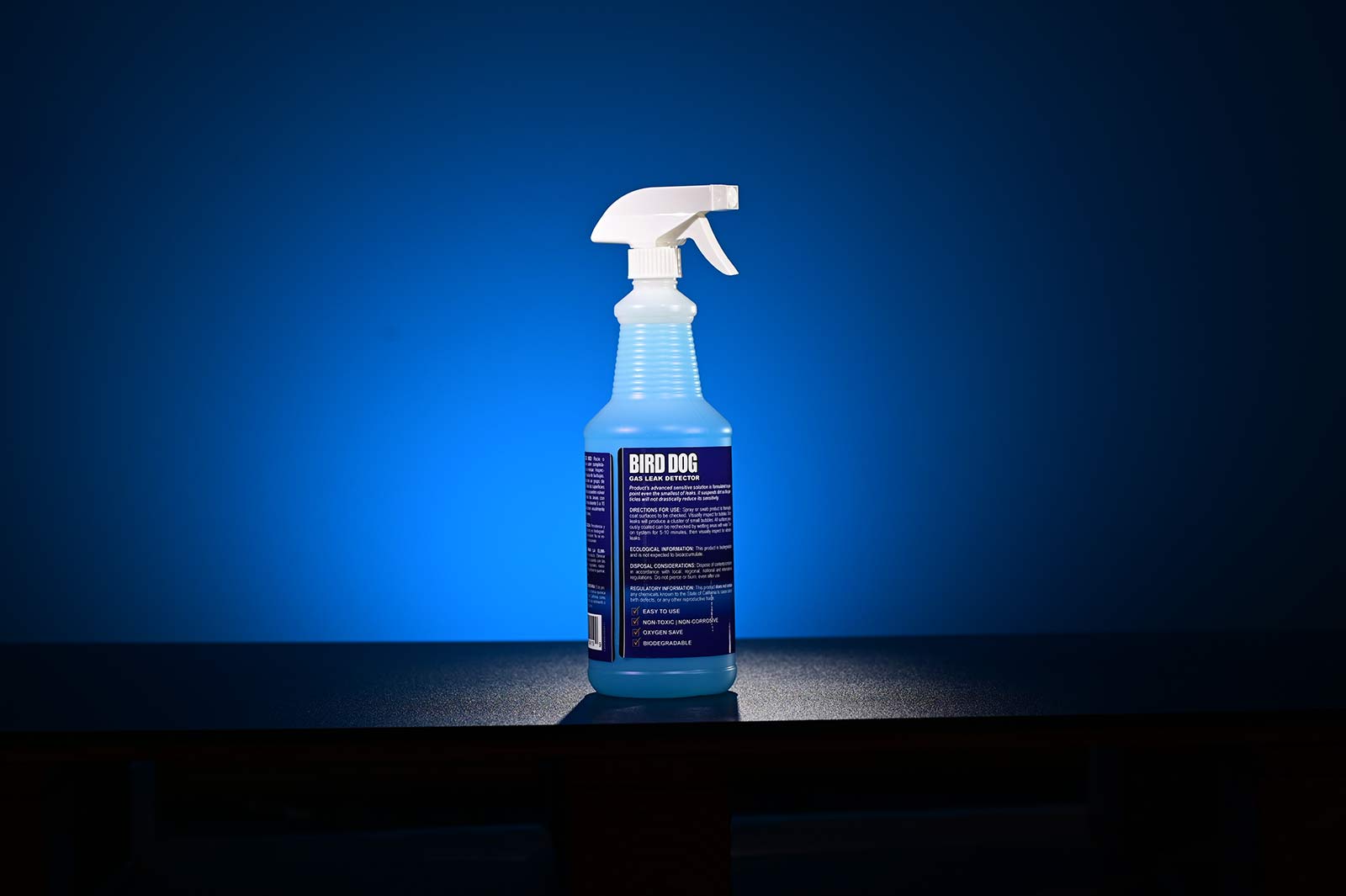
- Thorough Application: Spray or swab BIRD DOG generously onto the surfaces you want to inspect.
- Visual Inspection: Carefully examine the surfaces for the presence of bubbles – some leaks may take time to form bubbles, be patient. Inspect bottom and backside of all fittings.
- Identify Micro Leaks: Small clusters of bubbles or white foam often indicate micro leaks.
- System Operation: Turn on the system for 5-10 minutes to check for vibration-induced leaks.
- Leak Sealants: If leaks are present, consider Vapco Xpress Injects to help seal leaks permanently where appropriate.
Contact Us
News and Updates
Subscribe on Youtube
Follow Us on Facebook
SDS
⚠️ BIRD DOG LEAK DETECTOR SDS – DOWNLOAD
Safety Data Sheet – Bird Dog Leak Detector
Vapco Products, Inc.
Identification & Supplier Details (SDS Section 1)
| Product Information |
| Product Name / Identifier |
Bird Dog Leak Detector (DOG-1, DOG-1Q, DOG-1/2P) / Brand: Vapco |
| Recommended Use |
Leak detector |
| Supplier Details |
| Name & Address |
Vapco Products, Inc. / 401 Marshall Road, Valley Park, Missouri 63088, United States |
| Contact Information |
Tel: (636) 923-2121 | Fax: (636) 923-3002 | Email: [email protected] |
| Emergency Phone Number |
(800) 255-3924 |
Hazard Identification & Composition (SDS Sections 2 & 3)
| Classification & Labeling |
| GHS Classification (OSHA) |
Not a hazardous substance or mixture. |
| GHS Label Elements |
Not a hazardous substance or mixture. |
| Other Hazards |
None known which do not result in classification. |
| Hazardous Components (Mixtures) |
| Product is not classified as hazardous. No components listed as hazardous mixtures in Section 3. |
Physical & Chemical Properties (SDS Section 9)
| Property |
Value |
| Physical State / Appearance / Color |
Liquid / Clear liquid / Blue |
| Odor / Odor Threshold |
No distinct odor / N/D |
| pH |
8 (Slightly Alkaline) |
| Melting Point / Freezing Point |
< 32°F (0°C) |
| Boiling Point / Boiling Range |
N/D |
| Flammability / Flash Point |
Not considered a flammable liquid by OSHA / N/D |
| Density and/or Relative Density |
1.02 at 77°F (25°C) |
| Vapor Pressure / Evaporation Rate |
23.8 mmHg at 77°F (25°C) / < 0.8 (Slow) |
| Solubility |
Soluble in water |
Stability & Reactivity (SDS Section 10)
| Factor |
Condition / Material |
| Reactivity / Chemical Stability |
None known / Stable |
| Conditions to Avoid |
Excessive heat. |
| Incompatible Materials |
None known. |
| Hazardous Decomposition Products |
Oxides of carbon and sodium. |
Toxicological Information (SDS Section 11)
| Endpoint |
Summary |
| Acute Toxicity |
Not established. |
| Skin/Eye Irritation |
May cause irritation in rare cases (skin). May cause irritation (eyes). |
| Sensitization |
None known. |
| Carcinogenicity / Mutagenicity / Reproductive Toxicity |
None known. |
| STOT – Single/Repeated Exposure |
None known. |
| Aspiration Hazard |
Aspiration hazard not likely. |
First-Aid Measures (SDS Section 4)
| Exposure Route |
Action Required |
| General Advice / Emergency |
If you feel unwell, seek medical advice. If medical advice is needed, have product container or label at hand. |
| Inhaled |
Remove person to fresh air. Keep at rest. Get medical advice/attention. |
| Skin Contact |
Immediately drench affected area with water for at least 15 minutes. Remove contaminated clothing. Obtain medical attention if irritation develops. |
| Eye Contact |
Immediately rinse with water for at least 15 minutes. Remove contact lenses. Continue rinsing. Obtain medical attention if irritation develops. |
| Swallowed |
Rinse mouth. DO NOT induce vomiting. Obtain medical attention. |
Fire-Fighting & Accidental Release Measures (SDS Sections 5 & 6)
| Measure Type |
Details |
| Suitable Extinguishing Media |
Water spray, fog, carbon dioxide (CO2), alcohol-resistant foam, dry chemical, or sand. (Use media appropriate for surrounding fire). |
| Specific Hazards |
None known. Hazardous Combustion Products: Non-combustible. |
| Protection During Fire-Fighting |
Wear NIOSH-approved Self-Contained Breathing Apparatus (SCBA) with full body protective clothing. |
| Accidental Release Precautions |
Do not get in eyes, on skin, or on clothing. Use appropriate personal protective equipment (PPE). |
| Containment & Clean-up |
Contain spills with dikes or absorbents to prevent entry into sewers or streams. Take up liquid spill into absorbent material. Transfer to a suitable container for disposal. |
Handling, Storage & PPE (SDS Sections 7 & 8)
| Area / Equipment |
Requirements |
| Safe Handling Precautions |
Do not handle until all safety precautions are understood. Avoid contact with skin/eyes/clothing. Wash hands before eating, drinking, or smoking. |
| Storage Conditions |
Store in a dry, cool, well-ventilated place away from ignition sources and direct sunlight. Do not expose to temperatures exceeding 50°C/122°F. Incompatible Materials: None known. |
| Engineering Controls |
Emergency eye wash fountains and safety showers should be available. Ensure adequate ventilation. |
| Eye/Face Protection |
Chemical safety goggles. |
| Skin/Body Protection |
Wear protective gloves (chemical resistant) and suitable protective clothing. |
| Respiratory Protection |
Use a NIOSH-approved Self-Containing Breathing Apparatus whenever exposure may exceed established OELs (if ventilation is insufficient). |
Transport & Regulatory Information (SDS Sections 14 & 15)
| Transport Information (DOT, IMDG, IATA) |
| Transport Classification |
Not dangerous goods. |
| UN Number / Class / Proper Shipping Name |
N/A (Not dangerous goods) |
| U.S. Regulatory Information |
| TSCA Inventory |
All chemicals are listed or exempt under the Toxic Substances Control Act (TSCA). |
Disposal & Ecological Information (SDS Sections 13 & 12)
| Area |
Guidance |
| Product Disposal / Waste Treatment |
Dispose of contents/container in accordance with local, regional, national, and international regulations. Product should be fully characterized prior to disposal (40 CFR 261). |
| Sewage Disposal |
Avoid release into the environment. Keep out of sewers and waterways. Material is hazardous to the aquatic environment. |
| Persistence and Degradability |
This product is **biodegradable**. |
| Bioaccumulative Potential / Mobility |
Not expected to bioaccumulate. Product is mobile in soil. |
Disclaimer & Preparation Information (SDS Section 16)
Disclaimer:
To the best of our knowledge, information contained herein is accurate. However there is no assumption of liability for the accuracy or completeness of the information contained herein. Final determination of suitability of any material is the sole responsibility of the user. All materials may present unknown hazards and should be used with caution. Although certain hazards are described herein, we cannot guarantee that these are the only hazard which exists. The information contained in this SDS was obtained from current and reliable sources; however, the data is provided without warranty, expressed or implied, regarding its correctness or accuracy. Since the conditions of handling, storage and disposal of this product are beyond the control of the manufacturer, the manufacturer will not be responsible for loss, injury, or expense arising out of the products improper use. No warranty, expressed or inferred, regarding the product described in this SDS shall be created or inferred by any statement in this SDS. Various government agencies may have specific regulations regarding the transportation, handling, storage, use, or disposal of this product which may not be covered by this SDS. The user is responsible for full compliance.
N/A = Not applicable; N/D = Not determined
Prepared by: Jessica Wilson, Date prepared: 2-20-2025