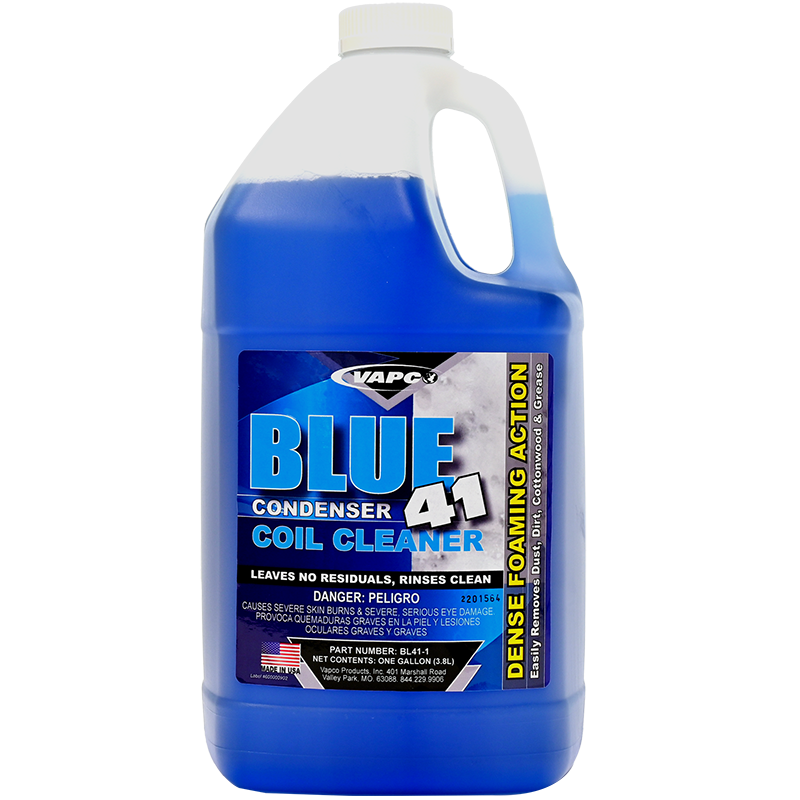
Blue 41 Coil Cleaner BL41-1

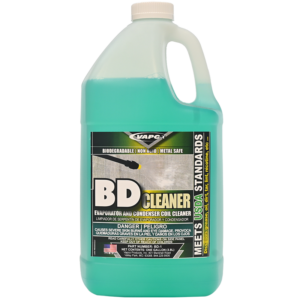
BLUE 41 Coil Cleaner Gallon is non-acid. Its heavy, dense foaming action offers more force than its competition.  Its foaming action penetrates deep into the coil to lift and push out energy robbing contaminants and oxides. BLUE 41 effectively removes greases that acid cleaners can’t and is very fast.

BLUE 41

Powerful and Effective Coil Cleaning Solution

BLUE 41 is a heavy-duty, alkaline-based coil cleaner designed to restore the efficiency and cleanliness of your HVAC system. Its dense foaming action penetrates deep into coils, removing stubborn contaminants and improving airflow.
Key Features and Benefits:
  • Removes Oxides and Grease: Effectively eliminates contaminants that can reduce coil performance.
  • Powerful Cleaning Action: Provides superior cleaning results.
  • Heavy Foaming Action: Ensures deep penetration and thorough cleaning.
  • Leaves No Residuals: Rinses clean without leaving any residue.
  • Improves Air Exchange Efficiency: Optimizes airflow and overall system performance.
BLUE 41 is a reliable and effective coil cleaning solution that can be used on a variety of HVAC systems. Its powerful cleaning action, versatility, and safety features make it an ideal choice for professionals and homeowners alike.
Part Number;     Size
  • BL41-1                                  1 gal 4/cs
Directions:

Effective Coil Cleaning in a Few Simple Steps

Before Use:
  • Consult Safety Data Sheet (SDS): Refer to the SDS for detailed safety information.
  • Wear Protective Gear: Always wear goggles, gloves, and protective clothing.
Application:
  1. Power Off: Turn off the HVAC system.
  2. Dilute: Mix 1 part BLUE 41 with 3 parts water. Adjust the ratio based on the level of dirt and grime.
  3. Prepare Sprayer: Add water to a low-pressure Vapco sprayer, then add the diluted cleaner.
  4. Spray Coil: Spray the solution directly onto the coil, ensuring thorough saturation.
  5. Allow to Sit: Let the solution sit for 3-5 minutes, or longer for heavy grease.
  6. Rinse Thoroughly: Rinse the coils completely to remove any remaining solution and foam.
  7. Power On: Restart the HVAC system.

By following these steps, you can effectively clean your HVAC coils using BLUE 41 COIL CLEANER.

DANGERS & PRECAUTIONS

Do not breathe dust/fume/gas/mist/vapors/spray. Wash hands/gloves thoroughly after handling. Wear protective gloves/protective clothing/eye protection/face protection.

FIRST AID: General advice: Never give anything by mouth to an unconscious person. If you feel unwell, seek medical advice (show the label where possible). If inhaled: First, take proper precautions to ensure your own safety before attempting rescue (e.g. wear appropriate respiratory protective equipment, use the buddy system), then remove the exposed person to fresh air. Keep at rest in a position comfortable for breathing. Get medical advice/attention. In case of skin contact: Immediately drench affected area with water for at least 15 minutes. Obtain medical attention if irritation develops or persists. Immediately take off all contaminated clothing. In case of eye contact: Immediately rinse with water for at least 15 minutes. Remove contact lenses, if present and easy to do. Continue rinsing. Obtain medical attention if irritation develops or persists.

If swallowed: Rinse mouth. Do NOT induce vomiting. Obtain medical attention. 
Contact Us

News and Updates

Subscribe on Youtube

Follow Us on Facebook 


SDS

BLUE41 SDS REV. 1

Safety Data Sheet – Blue 41

Vapco Products, Inc.

Identification & Supplier Details (SDS Section 1)

Product Information
Product Name / Identifier Blue 41 (BL41-1) / Brand: Vapco
Recommended Use Heavy-foaming, alkaline coil cleaner
Supplier Details
Name & Address Vapco Products, Inc. / 401 Marshall Road, Valley Park, Missouri 63088, United States
Contact Information Tel: (636) 923-2121 | Fax: (636) 923-3002 | Email: [email protected]
Emergency Phone Number (800) 255-3924

Hazard Identification & Composition (SDS Sections 2 & 3)

Classification & Labeling
GHS Classification (OSHA) Skin Corrosion/Irritation, Cat. 1A; Eye Damage/Irritation, Cat. 1
Signal Word / Pictogram **Danger** /
Hazard Statement H314: Causes severe skin burns and eye damage.
Key Precautionary Statements **P280:** Wear protective gloves/clothing/eye protection/face protection. **P310:** Immediately call a POISON CENTER/doctor. **P305+P351+P338:** IF IN EYES: Rinse cautiously with water for several minutes. Remove contact lenses if present and easy to do. Continue rinsing.
Hazardous Component CAS No. Concentration (wt)
Sodium Hydroxide 1310-73-2 10 – 40 %
Sodium metasilicate pentahydrate 10213-79-3 1 – 5 %
Sodium xylenesulfonate 1300-72-7 1 – 5 %
C10_16-alkyl, oligomeric, D-glucopyranoside 110615-47-9 0.1 – 1 %
D-Glucopyranose, oligomeric, decyl octyl glycosides 68515-73-1 0.1 – 1 %

Physical & Chemical Properties (SDS Section 9)

Property Value
Physical State / Appearance / Color Liquid / Clear liquid / Blue
Odor / Odor Threshold Characteristic / N/D
pH **9.2-10.2** (Alkaline)
Melting Point / Freezing Point < 32°F (0°C)
Flammability / Flash Point Not considered a flammable liquid by OSHA / N/D
Oxidizing Properties May be corrosive to metals
Density and/or Relative Density 1.29
Vapor Pressure / Evaporation Rate 23.8 mmHg at 77°F (25°C) / < 0.8 (Slow)
Solubility Completely soluble in water

Stability & Reactivity (SDS Section 10)

Factor Condition / Material
Reactivity / Chemical Stability **Reacts with chemically active metals and acids.** / Stable under normal conditions of use.
Conditions to Avoid Chlorine-liberating material. Do not mix with bases, ammonia, or other cleaning compounds. Excessive heat/Direct sunlight.
Incompatible Materials Strong acids and oxidizing agents, chemically active metals.
Hazardous Decomposition Products Carbon oxide(s).

Toxicological Information (SDS Section 11)

Endpoint Summary
Acute Toxicity Not classified based on component data provided.
Skin Corrosion/Irritation **Causes severe burns, prolonged contact will destroy tissue.** Dermatitis may occur due to long-term irritation.
Serious Eye Damage/Irritation **Causes severe burns, irritation, redness, tearing, pain, and may result in loss of sight.**
Respiratory Sensitization May cause irritation (possible severe), chemical burns, upper respiratory damage, and pulmonary edema.
Carcinogenicity / Mutagenicity / Reproductive Toxicity Not classified.
STOT – Single/Repeated Exposure Causes severe burns (single). Potential for long-term irritation, respiratory damage, and loss of sight (repeated).

First-Aid Measures (SDS Section 4)

Exposure Route Action Required
General Advice / Emergency If you feel unwell, **Immediately call a POISON CENTER/doctor (P310)**. Have product container or label at hand.
Inhaled (P304+P340) Remove person to fresh air and keep comfortable for breathing. Get medical advice/attention.
Skin Contact (P303+P361+P353) Take off immediately all contaminated clothing. **Rinse skin with water/shower for at least 15 minutes.** Obtain medical attention if irritation develops or persists. Wash contaminated clothing before reuse (P363).
Eye Contact (P305+P351+P338) **Rinse cautiously with water for several minutes.** Remove contact lenses, if present and easy to do. Continue rinsing. Obtain medical attention if irritation develops or persists.
Swallowed (P301+P330+P331) Rinse mouth. **Do NOT induce vomiting.** Obtain medical attention.

Fire-Fighting & Accidental Release Measures (SDS Sections 5 & 6)

Measure Type Details
Suitable Extinguishing Media Water spray, fog, carbon dioxide (CO2), alcohol-resistant foam, dry chemical, or sand. (Use media appropriate for surrounding fire).
Specific Hazards **May be corrosive to metals. Increased risk of fire or explosion.** Hazardous Combustion Products: Carbon oxide(s), nitrogen oxides, and metal oxides.
Protection During Fire-Fighting Wear NIOSH-approved Self-Contained Breathing Apparatus (SCBA) with full face piece operated in a positive pressure demand mode and full body protective clothing.
Accidental Release Precautions (P260) Do not get in eyes, on skin, or on clothing. **Do not breathe vapors/spray.** Use appropriate PPE. Eliminate ignition sources, isolate, and ventilate the area.
Containment & Clean-up Contain any spills with dikes or absorbents to prevent entry into sewers or streams. Take up liquid spill into absorbent material. Transfer to a suitable container for disposal.

Handling, Storage & PPE (SDS Sections 7 & 8)

Area / Equipment Requirements / Controls
Safe Handling Precautions (P264) Do not handle until all safety precautions are understood. Avoid contact with skin/eyes/clothing. **Wash hands thoroughly after handling.**
Storage Conditions (P405) **Store locked up.** Store in a dry, cool, well-ventilated place. Do not expose to temperatures exceeding 50°C/122°F. Incompatible Materials: Strong acids and oxidizing agents, chemically active metals.
Engineering Controls Emergency eye wash fountains and safety showers should be available. Ensure adequate ventilation (use only outdoors or in well-ventilated area). Use explosion-proof equipment.
Exposure Limits (Sodium Hydroxide) PEL (OSHA): 2 mg/m3 | REL (NIOSH): (C) 2 mg/m3
Eye/Face Protection (P280) **Chemical safety goggles.**
Skin/Body Protection (P280) **Wear protective gloves** (chemical resistant materials and fabrics) and suitable protective clothing.
Respiratory Protection Use a NIOSH-approved SCBA whenever exposure may exceed established OELs (if ventilation is insufficient).

Transport & Regulatory Information (SDS Sections 14 & 15)

Transport Mode UN Number Class (PG) Proper Shipping Name
DOT (US) / IMDG / IATA **UN1719** **8 (II)** Caustic alkali liquids, n.o.s.
U.S. Regulatory Information
TSCA Inventory Sodium Hydroxide (1310-73-2) and other components are listed.
State Right-to-Know Components Sodium Hydroxide (1310-73-2) is listed on Massachusetts, New Jersey, and Pennsylvania Right-to-Know lists.

Disposal & Ecological Information (SDS Sections 13 & 12)

Area Guidance
Waste Treatment / RCRA This material is RCRA hazardous waste (U.S. EPA 40 CFR 261). Check pH: if > 12.5, it must be handled as D002 corrosive hazardous waste.
Product Disposal (P501) **Dispose of contents/container** to the specifications of local, regional, national, and international regulations.
Persistence and Degradability This product is **biodegradable**.
Bioaccumulative Potential / Mobility Not expected to bioaccumulate. Product is mobile in soil.

Disclaimer & Preparation Information (SDS Section 16)

Disclaimer:

To the best of our knowledge, information contained herein is accurate. However there is no assumption of liability for the accuracy or completeness of the information contained herein. Final determination of suitability of any material is the sole responsibility of the user. All materials may present unknown hazards and should be used with caution. The information contained in this SDS was obtained from current and reliable sources; however, the data is provided without warranty, expressed or implied, regarding its correctness or accuracy. Since the conditions of handling, storage and disposal of this product are beyond the control of the manufacturer, the manufacturer will not be responsible for loss, injury, or expense arising out of the products improper use. The user is responsible for full compliance with all government regulations.

N/A = Not applicable; N/D = Not determined

Prepared by: Jessica Wilson, Date prepared: 2-19-2025

Flyer

D1-BL41-Flyer-V5.pdf