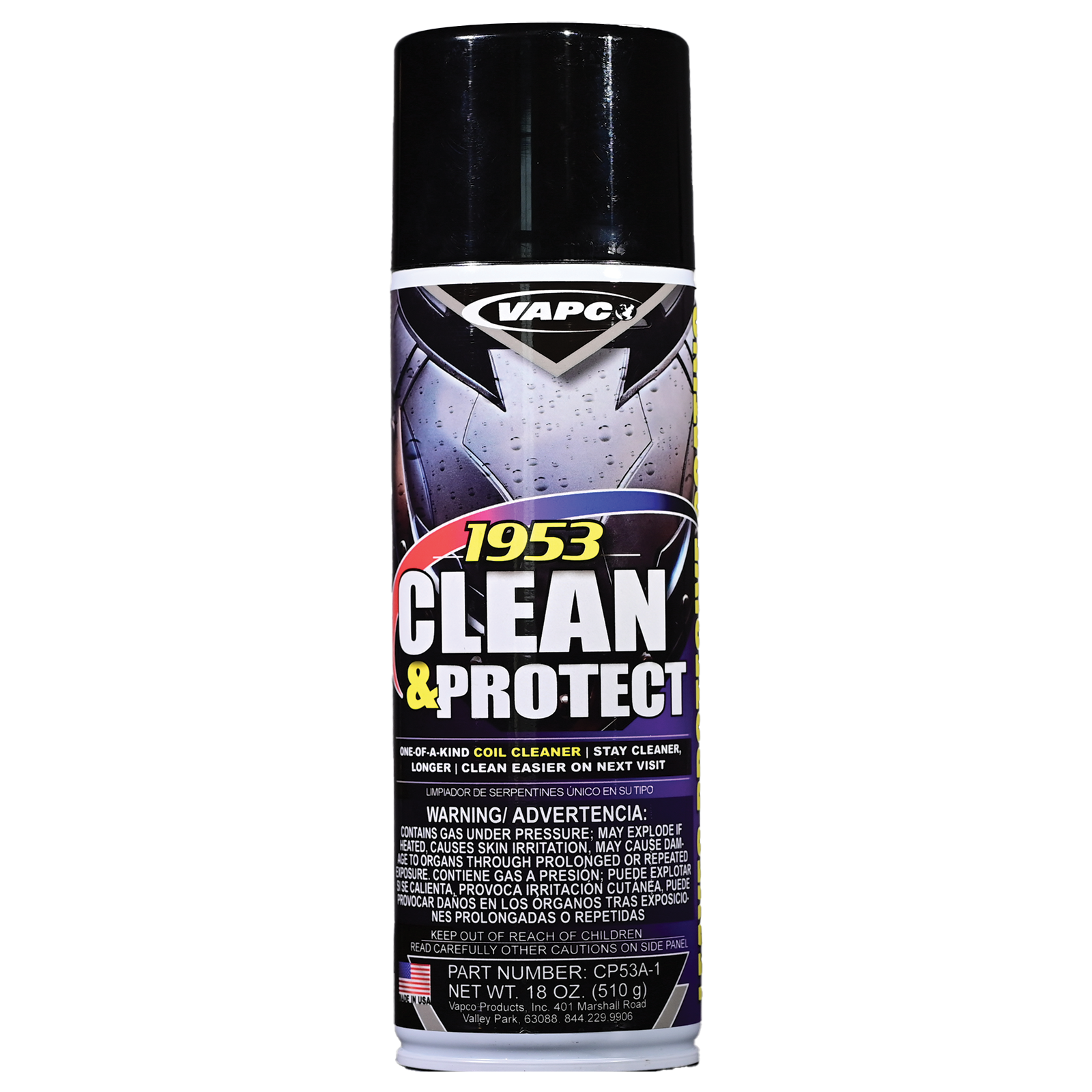
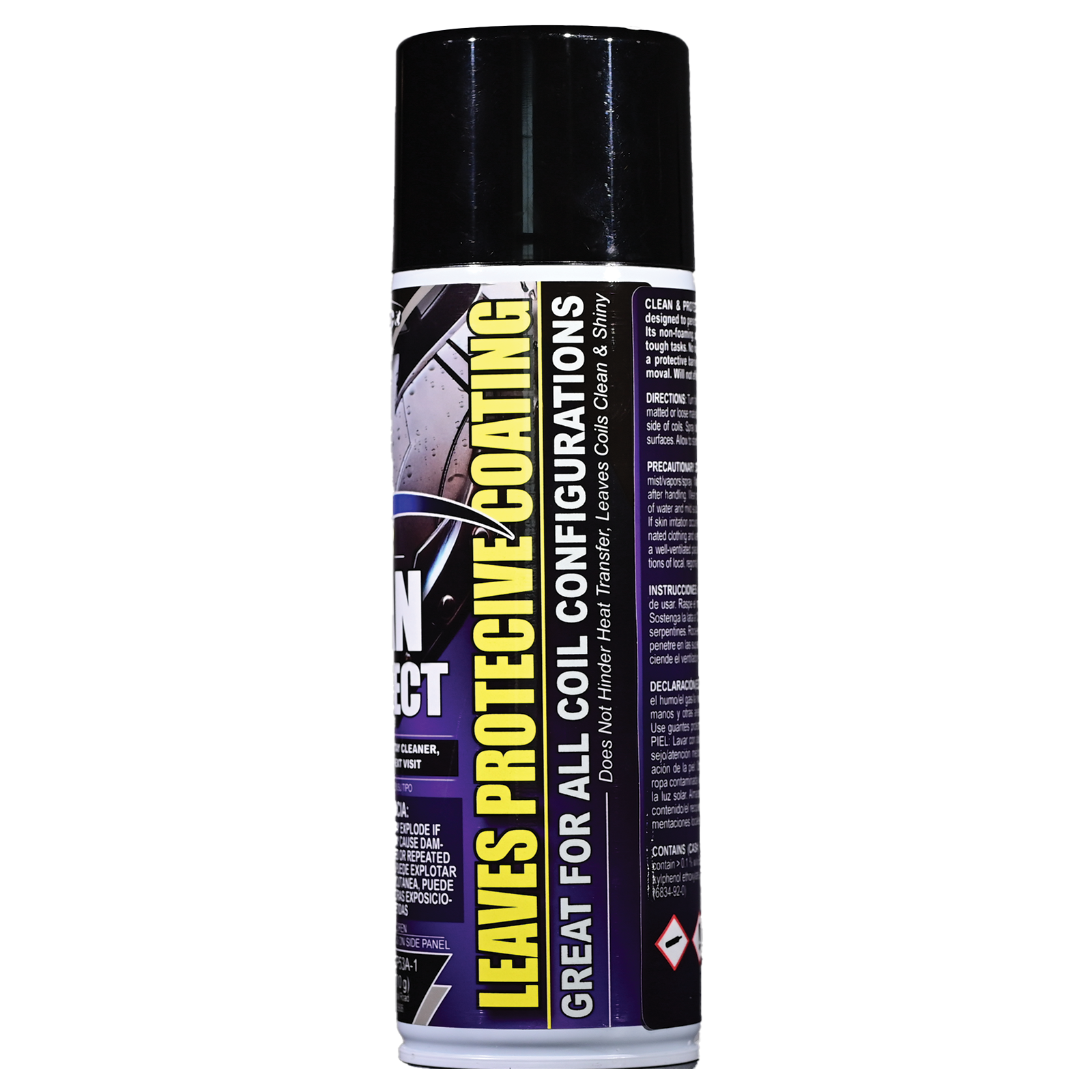
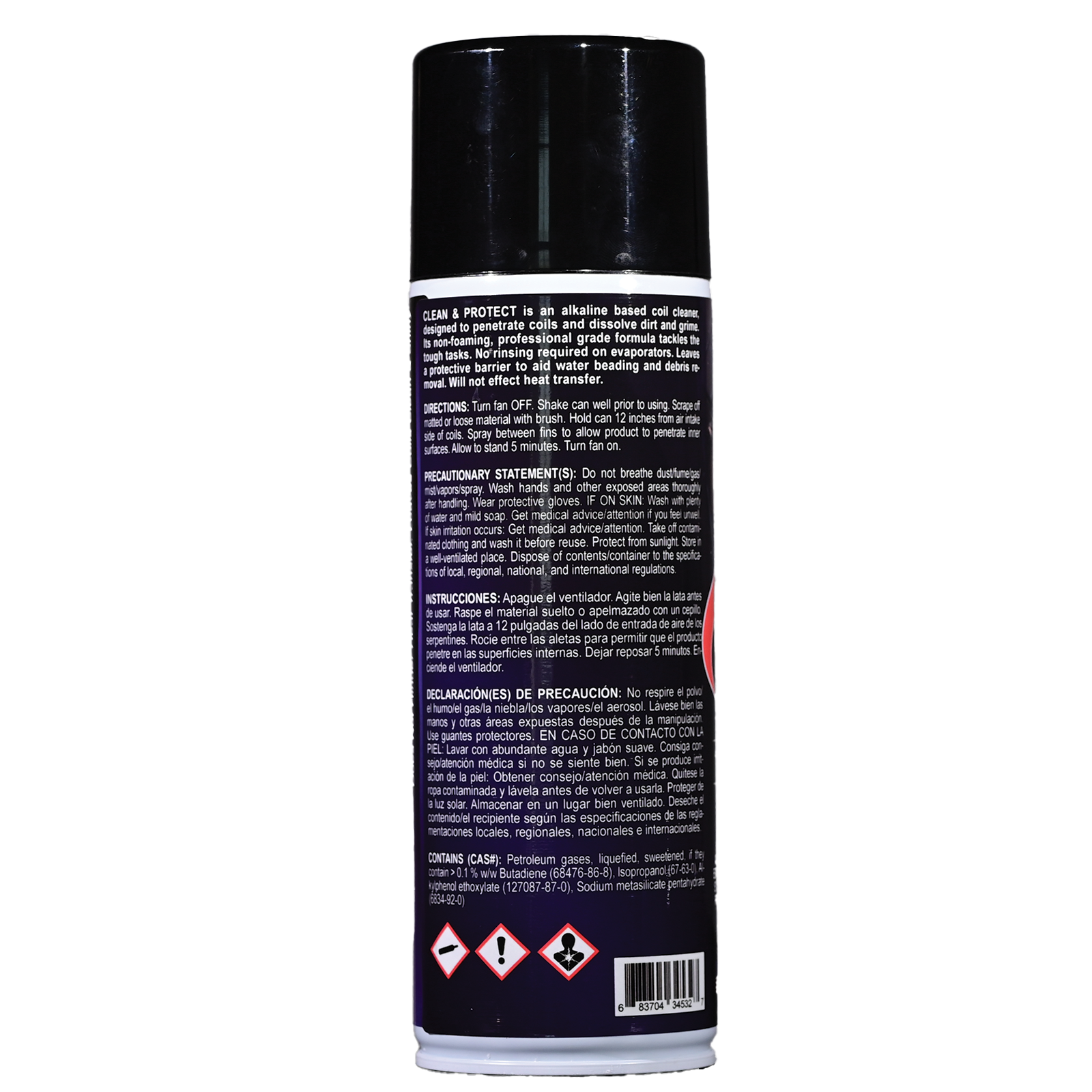
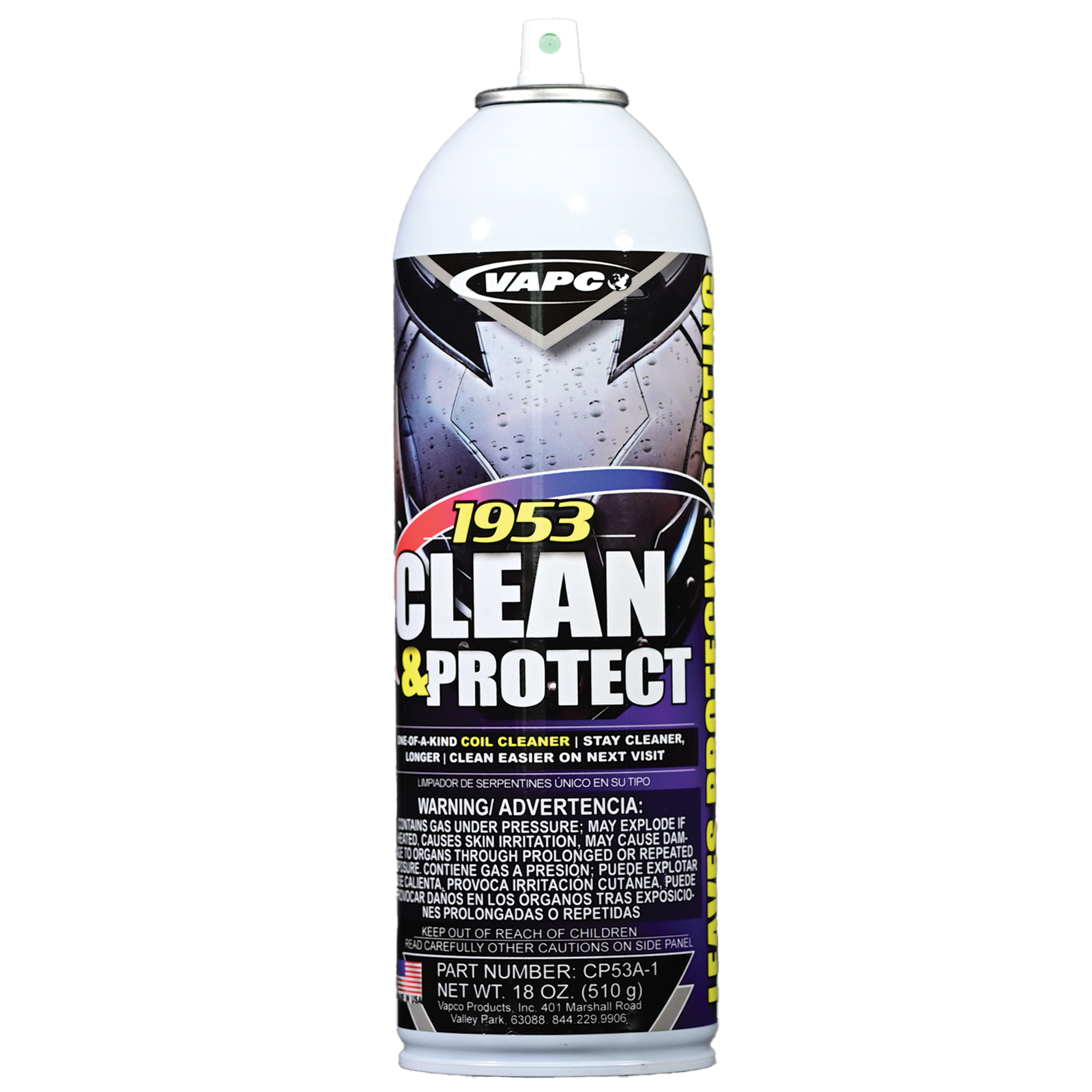
Coil Cleaner Protectant Aerosol | Liquid 1953 Clean & Protect CP53-1
Clean Today. Protect Tomorrow. Faster Service Next Time.
Traditional coil cleaners stop at “clean.” They remove soil, rinse away, and leave the coil ready to start collecting contamination again the moment the unit runs. 1953 Clean & Protect is different: it’s a coil cleaner protectant that does more than clean—leaving behind a microscopic micro-barrier engineered to help resist dirt re-adhesion and routine re-soiling between service intervals. This ready-to-use aerosol format is built for fast, consistent application on evaporators and routine/light condenser cleaning—lifting grime the right way, then helping coils stay cleaner longer so the next visit is easier, faster, and more consistent.
Heritage Note: “1953” is a callback to Vapco’s founding year—and this product launched during our 70th anniversary as a modern upgrade to coil cleaning: clean + protect in one step.
Manufacturer’s Tech Note (Coverage Matters): 1953 is engineered to leave a protective micro-barrier behind. Because this is a ready-to-use aerosol, performance is driven by even coverage and the correct rinse pathway for the coil type. Apply a uniform wet coat, allow proper dwell time, and do not allow the product to dry on the coil. Rinse or flush as needed based on the application.
The Protection Dose: Even Coverage That Cleans & Leaves a Finish
Because the protective finish is part of the performance, the aerosol format is designed to deliver a consistent, ready-to-use coating. The goal is simple: apply evenly, let it work, then complete the correct rinse pathway.
- Routine/Light Condensers: Apply evenly, allow dwell, then rinse thoroughly with water.
- Evaporators: Apply evenly, allow dwell, then follow label rinse pathway (condensate-assisted rinse only when appropriate operating conditions exist).
- Mini-Splits / Microchannel: Apply evenly, allow dwell, then rinse/flush. Do not rely on a self-rinse pathway for these coil types.
Professional Application: Apply, allow dwell, and rinse based on the job. For heavily impacted outdoor coils (thick cottonwood mats, heavy grease, severe blockage), start with a dedicated deep cleaner first, then follow with 1953 to leave the protective finish.
| KEY FEATURE / SPECIFICATION |
TRADE BENEFIT / RESULT |
| Clean + Protect Chemistry |
Two-Step Result in One Step: Removes routine soil and leaves a protective micro-barrier designed to help reduce re-adhesion between PM cycles. |
| Microscopic Micro-Barrier Finish |
Stays Cleaner Longer: Designed to help resist dirt re-adhesion and routine re-soiling so future cleanings are faster and more consistent. |
| Aerosol Delivery (Cling + Coverage) |
Fast, Consistent Application: Ready-to-use format helps you lay down an even coat quickly—ideal for service calls and repeat PM routes. |
| Non-Reactive Cleaning Behavior |
Controlled Performance: Designed to clean without relying on aggressive metal-reactive foaming. Focus on wetting, dwell, and the correct rinse pathway. |
| Application Guidance |
Right Protocol: Apply evenly, allow dwell, and rinse based on coil type and soil load. Do not allow the product to dry on the coil. |
| Compatibility & Use Limits |
Evaps + Routine Condensers: Intended for evaporators and routine/light condenser cleaning. For severe blockages and heavily impacted coils, use a deep cleaner first, then follow with 1953 to protect. |
Vapco Field Guide: Performance Matrix
How 1953 stacks up on real-world PM contaminants. (★★★ = Best in Class)
| CONTAMINANT |
RATING |
WHY IT WINS |
| Dirt, Dust, & Pollutants |
★★★ |
Wetting + soil lift for routine PM, plus a protective micro-barrier designed to help slow re-adhesion. |
| Biofilm, Mold & Biological Growth |
★★★ |
Cleans routine buildup and leaves a barrier designed to help reduce routine re-soiling between maintenance cycles. |
| Tobacco / Nicotine Stains |
★★★ |
Cuts sticky nicotine film on coils and surfaces during PM work for faster, more consistent cleanup. |
| Light Grease / Mixed Soil (PM) |
★★ |
Great for routine grime and mixed soils. For heavy kitchen grease or severe impacted coils, start with a deep cleaner first. |
| Seasonal Debris (Light Cottonwood / Bugs) |
★★ |
Ideal for routine cleanup and finishing. For thick mats and deep blockages, deep clean first, then protect with 1953. |
| When to Use a Deep Cleaner First |
NOTE |
Severely impacted outdoor coils: thick cottonwood mats, heavy grease, severe blockage. Deep clean first, then finish with 1953 for protection. |
Part Number Reference:
1. Select Your Size
| CONTAINER |
SIZE / PACK |
APPLICATION FIT |
| Aerosol Can
CP53A-1 |
Aerosol (6/cs) |
Fast Service Format: No mixing. Ideal for quick PM touch-ups, consistent coverage, and controlled application in the field. |
Recommended Application Tools
No sprayer required. Use the supplied actuator/nozzle for even coverage and controlled placement.
Application Tip: Apply an even coat and avoid flooding electronics. Do not allow the product to dry on the coil. Complete the appropriate rinse pathway for the coil type (rinse/flush where required).
Why “Clean-Only” PM Leaves Performance on the Table: Upgrade to HVAC coil cleaner with protectant
| THE PAIN POINT (Traditional Cleaners) |
THE 1953 ADVANTAGE |
“Clean Today, Dirty Tomorrow”
Cleaner rinses away and the coil immediately starts collecting contamination again. |
“Clean + Protect”
Leaves a micro-barrier designed to help resist re-adhesion between maintenance cycles. |
“Foam Mess & Guesswork”
Heavy foam can take time to break down and suspend the actual cleaners away from the debris where they’re needed. |
“Controlled, Ready-to-Use Coverage”
Apply evenly, starts attacking routine soils immediately, and supports a consistent PM finish. |
“Two Products / Two Steps”
Clean now, then separate protectant later (or skip protection entirely). |
“One Step Finish”
Clean and leave protection in the same service visit—built for repeat PM efficiency. |
FAQs
Frequently Asked Questions: 1953 Clean & Protect (Aerosol Coil Cleaner with Protectant)
Application & Performance
Q: What is 1953 Clean & Protect (Aerosol) designed to do?
A: 1953 Clean & Protect is a ready-to-use, non-foaming PM coil cleaner that lifts routine soil and helps leave a microscopic protective barrier designed to reduce dirt re-adhesion and routine re-soiling between service intervals. It’s built for repeat maintenance on evaporators and routine/light condenser cleaning.
Q: Do I need to dilute the aerosol?
A: No. The aerosol is ready-to-use—no mixing required. Performance depends on even coverage, the correct dwell time, and completing the proper rinse pathway for the coil type (per label directions).
Q: Do I have to rinse it?
A: Outdoor condensers: YES—rinse thoroughly with water after dwell. Evaporators: follow label directions and job conditions. If your application relies on a “self-rinse” pathway, that requires the system to be in cooling mode and producing condensate.
*Tech Note: If the system is not producing condensate (low humidity, heating mode, fans only), use a manual rinse/wipe approach after dwell time per standard service practice and the product label.*
Q: Can I use this on mini-splits or microchannel coils?
A: Yes—when used as directed. Apply an even coat, do not over-dwell, and do not allow the product to dry on the coil. Mini-splits and microchannel coils should be rinsed/flush-cleaned—do not rely on a self-rinse pathway for these coil types.
Q: How long should it dwell?
A: Follow the product label. As a best practice for PM cleaning, apply evenly and allow time for the cleaner to lift routine soils. Do not allow the product to dry on the coil—re-wet lightly if needed during dwell.
Q: Is 1953 a replacement for a heavy-duty deep-clean?
A: No. 1953 is a PM platform intended for routine soil removal and a protective finish between visits. For severely impacted coils (thick mats/heavy blockage), deep clean first, then finish with 1953 to leave the protective barrier that helps reduce dirt re-adhesion between PM cycles.
Q: Can I use it on outdoor condenser coils?
A: Yes—on routine/light soil. Apply evenly, allow dwell per label, then rinse thoroughly with water. It’s ideal when you want routine cleaning plus a protective finish between PM cycles.
Q: Is foam required?
A: No. 1953 is a non-foaming cleaner designed to wet fin surfaces and lift routine soil while leaving a protective finish. Focus on even coverage, proper dwell, and the correct rinse pathway.
Q: Do I need to neutralize it? Can I mix it with other chemicals?
A: Do not mix this product with other chemicals. Use it as directed. Always follow the product label and SDS for safe handling and cleanup.
Q: How should I store the aerosol (truck, heat, freezing temps)?
A: Store upright and secured. Avoid extreme heat and do not puncture or incinerate the container. Follow all label warnings regarding temperature exposure and storage conditions.
Safety & Compatibility
Q: Can I let it dry on the coil?
A: No. Do not allow the product to dry on coil surfaces. Drying increases the risk of residue and inconsistent outcomes. Re-wet if needed during dwell, and complete the appropriate rinse pathway.
Q: Is it safe on coated coils?
A: Coil coatings vary by manufacturer. As a best practice, test a small inconspicuous area first and follow the equipment manufacturer’s cleaning recommendations for coated coils.
Q: Do I need PPE?
A: Yes. Always follow the product label and SDS. Wear appropriate PPE such as chemical-resistant gloves and eye protection and use standard chemical handling procedures on the job-site.
Q: What about electrical components and surrounding surfaces?
A: Avoid direct spraying into motors, control boards, sensors, and exposed electrical components. Use standard service practices: protect sensitive areas, control overspray, and wipe or rinse overspray from surrounding surfaces to prevent residue and maintain a professional finish.
Logistics & Value
Q: Why choose the aerosol instead of the gallon concentrate?
A: The aerosol is the fast, ready-to-use service format—no mixing, no sprayer setup, and consistent application on the job. It’s ideal for quick PM visits, touch-ups, and situations where speed and portability matter.
Q: Why choose 1953 instead of a standard coil cleaner?
A: 1953 is built for repeat preventive maintenance. You get routine soil removal plus a protective micro-barrier designed to help reduce dirt re-adhesion between visits—ideal for service intervals where “clean today, stay cleaner longer” matters.
Q: What is the shelf life?
A: Vapco products carry a 1 year manufacturer warranty. When stored sealed and properly, 1953 has a shelf life of 3+ years.
Q: How do I dispose of the empty can?
A: Follow local regulations. Do not puncture or incinerate. Dispose of empty containers according to municipal and job-site guidelines and any instructions on the product label.
SDS & Instructions
📄 DOWNLOAD FULL SDS (PDF)
⚠️ Professional Use Only | Flammable AerosolContains gas under pressure; may explode if heated. Always wear chemical-resistant gloves, goggles, and protective clothing. Features Protective Barrier Technology to prevent re-adhesion.
Field Guide: Contaminant Removal Matrix
1953 Clean & Protect utilizes a penetrating chemistry designed to lift routine soil and leave a microscopic protective barrier behind. The following matrix details performance against common obstructions.
| TARGET CONTAMINANT |
TYPICAL SOURCE |
ACTION |
PERFORMANCE / WHY IT WORKS |
| Dust, Lint & Pollutants |
Indoor Air / Return Air |
Wetting + Lift |
Micro-Barrier: Wetting action emulsifies routine soils while the protectant leaves a barrier to slow re-adhesion and improve future cleaning efficiency. |
| Biofilm / Mold |
High Humidity / Drain Pans |
Lift + Barrier |
Cleans routine buildup and leaves a barrier designed to help resist biological growth between maintenance cycles (when used as directed). |
| Tobacco & Nicotine |
Bars / Smoking Areas |
Emulsification |
Penetrates sticky nicotine film and helps release it from metal surfaces. (Heavy deposits may require a second pass). |
| Outdoor Soil / Pollen |
Residential / Light Commercial |
PM Cleaning |
Designed for routine condenser cleaning where you want soil removal plus a protective finish. Rinse outdoor coils thoroughly with water. |
System Material Compatibility
| MATERIAL / COMPONENT |
STATUS & PROTOCOL |
| Indoor Evaporator Coils |
✅ RECOMMENDED / NO-RINSE*
*When unit is in cooling mode producing sufficient condensate. |
| Micro-Channel / Mini-Split Coils |
✅ RECOMMENDED / METAL SAFE
Safe for aluminum. Rinse required to prevent residue buildup on tight fins. |
| Outdoor Condensers |
✅ RECOMMENDED
Manual water rinse required as no condensate is produced. |
| Rubber Roofs / Membranes |
✅ RECOMMENDED / ROOF SAFE
Will not damage EPDM or asphalt roofing. |
Directions for Clean & Protect Aerosol (CP53A-1)
1. Preparation
Step 1: Turn Off (Disconnect Power).
- Shut off power to the unit at the disconnect or breaker to ensure safety while working.
- Note: For no-rinse applications on evaporators, the unit will need to be turned back on after dwell to generate condensate for self rinsing.
Step 2: Brush Off Debris.
- Remove matted cottonwood, leaves, or loose dust from the coil face using a soft brush or shop vac.
- Why? Removing the “blanket” first allows the chemistry to penetrate the fins rather than wasting product on surface trash.
2. Application
Step 3: Shake & Position.
- Shake Can Well prior to use to mix the propellant, cleaners, and protectant.
- Hold the can 8-12 inches from the air intake side of the coil.
Step 4: Spray.
- Spray between the fins, utilizing a sweeping motion to saturate the coil face.
- Target Inner Surfaces: Apply enough product to allow the chemistry to penetrate deep into the inner rows of the coil pack.
3. Dwell & Rinse Protocol
Step 5: Dwell Time.
- Allow to stand for 4-6 minutes.
- During this time, the solution will liquefy grease and lift soil while depositing the protective barrier.
Step 6: Rinse (Conditional).
| APPLICATION |
ACTION |
| Condenser Coils |
RINSE REQUIRED. If used on outdoor condensers or any coil not producing moisture, rinse thoroughly with water to remove debris. |
| Evaporator Coils |
NO RINSE REQUIRED. If the unit is in cooling mode, proceed to Step 7. |
Step 7: Turn System On.
- Restore power to the unit.
- For Evaporators: Ensure the system runs in cooling mode for at least 30 minutes. The natural condensation will flush the emulsified debris down the drain pan.
🧪 SDS SECTION:
1953 CLEAN & PROTECT
(CP53A-1)
1. Identification & Supplier Details
| Product Name |
1953 Clean & Protect Aerosol |
| Product Numbers |
CP53A-1 |
| Recommended Use |
Aerosol Coil Cleaner and Protectant |
| Emergency Phone |
(800) 255-3924 |
2. Hazards Identification
| GHS Classification |
Flammable Aerosol (Cat 1)
Gases Under Pressure (Liquefied Gas)
Skin Corrosion (Cat 1)
Eye Damage (Cat 1) |
| Signal Word |
DANGER |
| Hazard Statements |
H222: Extremely flammable aerosol.
H280: Contains gas under pressure; may explode if heated.
H314: Causes severe skin burns and eye damage. |
| Precautionary Statements |
P210: Keep away from heat/sparks/open flames. No smoking.
P251: Do not pierce or burn, even after use.
P280: Wear protective gloves/clothing/eye protection.
P305+P351+P338: IF IN EYES: Rinse cautiously with water. Remove contact lenses.
P310: Immediately call a POISON CENTER/doctor. |
3. Composition / Ingredients
| Component Name |
CAS Number |
Concentration |
| Petroleum gases, liquified |
68476-86-8 |
10 – 30% |
| 2-Butoxyethanol |
111-76-2 |
1 – 10% |
| Pentasodium triphosphate |
7758-29-4 |
1 – 10% |
| Potassium Hydroxide |
1310-58-3 |
0.1 – 1% |
4. First-Aid Measures
| Skin Contact |
CORROSIVE. Immediately take off contaminated clothing. Rinse skin with water/shower for at least 15 minutes. |
| Eye Contact |
SEVERE DAMAGE. Rinse cautiously with water for at least 15 minutes. Remove contact lenses. Get medical attention. |
| Inhalation |
Remove person to fresh air. Keep comfortable for breathing. Get medical advice if you feel unwell. |
| Ingestion |
Rinse mouth. Do NOT induce vomiting. Get immediate medical attention. |
5. Fire-Fighting Measures
| Suitable Extinguishing Media |
Water spray, fog, CO2, alcohol-resistant foam, dry chemical, or sand. |
| Specific Hazards |
Flammable Aerosol. Containers may burst at temperatures > 120°F. Hazardous Combustion Products: Carbon, sodium, and silicon oxide(s). |
| Special Protective Actions |
Do NOT fight fire when fire reaches containers. Fight fire remotely. Wear NIOSH-approved SCBA. |
6. Accidental Release Measures
| Personal Precautions |
Eliminate ignition sources. Do not get in eyes, on skin. Do not breathe spray. |
| Environmental Precautions |
Do not allow product to contaminate ground water or enter drains. |
| Cleanup Methods |
Ventilate area. Absorb with inert material. Transfer to suitable container for disposal. |
7. Handling & Storage
| Safe Handling |
Avoid contact with skin/eyes. Do not spray on open flame. Do not pierce or burn, even after use. |
| Safe Storage |
Store locked up in a cool, well-ventilated place. Protect from sunlight. Do not expose to temperatures > 122°F (50°C). |
| Incompatible Materials |
Strong acids, strong oxidizers, active metals. |
8. Exposure Controls / Personal Protection
| Exposure Limits |
2-Butoxyethanol: OSHA PEL 50 ppm.
Propane/Butane: OSHA PEL 1000 ppm. |
| PPE (Personal Protective Equipment) |
Eyes: Chemical safety goggles/Face shield.
Skin: Chemical-resistant gloves and protective clothing.
Respiratory: NIOSH-approved SCBA if exposure exceeds limits. |
9. Physical & Chemical Properties
| Physical State |
Aerosol |
| Color / Odor |
Clear Purple (Dispensed) / Bland |
| Solubility |
Completely Soluble in Water |
| pH |
12.0 – 13.0 (Liquid Concentrate) |
| VOC Content |
N/D (Contains VOC Propellant) |
10. Stability & Reactivity
| Reactivity / Stability |
Stable under normal conditions. May be corrosive to metals. |
| Conditions to Avoid |
Direct sunlight, temperatures > 120°F, heat, sparks, open flames. Chlorine-liberating material. |
| Hazardous Decomposition |
Carbon, sodium, and silicon oxide(s). |
11. Toxicological Information
| Acute Toxicity |
ATE (Oral) > 4,500 mg/kg; ATE (Inhalation) 45,000 ppmV |
| Skin/Eye |
Causes severe skin burns and serious eye damage. Prolonged contact destroys tissue. |
| Carcinogenicity |
Not classified. |
12. Ecological Information
| Ecotoxicity |
Hazardous to the aquatic environment. |
| Persistence / Mobility |
Mobile in soil. Low potential for bioaccumulation. |
13. Disposal Considerations
| Disposal Method |
Dispose of in accordance with regulations. Do not pierce or burn. Hazardous waste. |
14. Transport Information
| Regulation |
UN Number |
Class |
Proper Shipping Name |
| DOT (US) / IMDG / IATA |
UN1950 |
2.1 |
Aerosols, flammable |
15. Regulatory Information
| US Federal / State |
TSCA: Listed.
Right To Know: Sodium phospate, tribasic; Ethylene glycol monobutyl ether; Propane/Butane. |
| California Prop 65 |
Does not contain chemicals known to cause cancer or reproductive harm. |
16. Other Information
| Preparation |
Prepared by: Jessica Wilson
Date: 11/17/2025
Version: 2.0 |
| Disclaimer |
The information provided is believed to be accurate but comes without warranty. User is responsible for full compliance with local regulations. |
Specs & Logistics
1. Physical & Chemical Properties
| Product Name |
1953 Clean & Protect Aerosol |
| SKU / Product # |
CP53A-1 |
| Recommended Use |
Aerosol Coil Cleaner and Protectant |
| Base Chemistry |
Alkaline Detergent + Protectant System (Pressurized) |
| Physical State |
Aerosol (Liquid dispensed) |
| Appearance / Color |
Purple |
| Odor |
Bland |
| pH Level (Concentrate) |
12–13 |
| Specific Gravity |
1.02 |
| Solubility |
Completely Soluble in Water |
| VOC Content |
N/D (Contains VOC Propellant) |
| Flammability |
Extremely Flammable Aerosol |
| Performance Profile |
Non-foaming wetting action designed for routine coil cleaning; deposits a micro-barrier to help resist re-adhesion between intervals. |
| Recommended Dilution |
Ready-to-Use (Do not dilute) |
| Storage Stability |
Store below 120°F (50°C); Protect from direct sunlight. |
2. UN & DOT Shipping Classification
| Proper Shipping Name: |
Aerosols, flammable |
| UN Number: |
UN1950 |
| Hazard Class: |
2.1 (Flammable Gas) |
| Packing Group: |
N/A |
| Label Required: |
Flammable Gas (Class 2) |
3. Master Shipping & Dimensions Guide
| ITEM |
INDIVIDUAL UNIT |
QTY / CASE |
CASE SPECS |
PALLET CONFIGURATION |
CODE |
| Part # |
Wt (lbs) |
H (in) |
W (in) |
L (in) |
Units |
Wt (lbs) |
H (in) |
W (in) |
L (in) |
Cases/Pallet |
Total Units |
Wt (lbs) |
H (in) |
W (in) |
L (in) |
UPC |
CP53A-1
(Aerosol) |
[ ] |
[ ] |
[ ] |
[ ] |
6 |
[ ] |
[ ] |
[ ] |
[ ] |
[ ] |
[ ] |
[ ] |
[ ] |
40 |
48 |
683704345327 |
Harmonized Tariff Code (HTS): 3402.20.5100 (Cleaning Preparations)
NMFC Code: 48580 (Compounds, Cleaning, Liquid) – Class 55