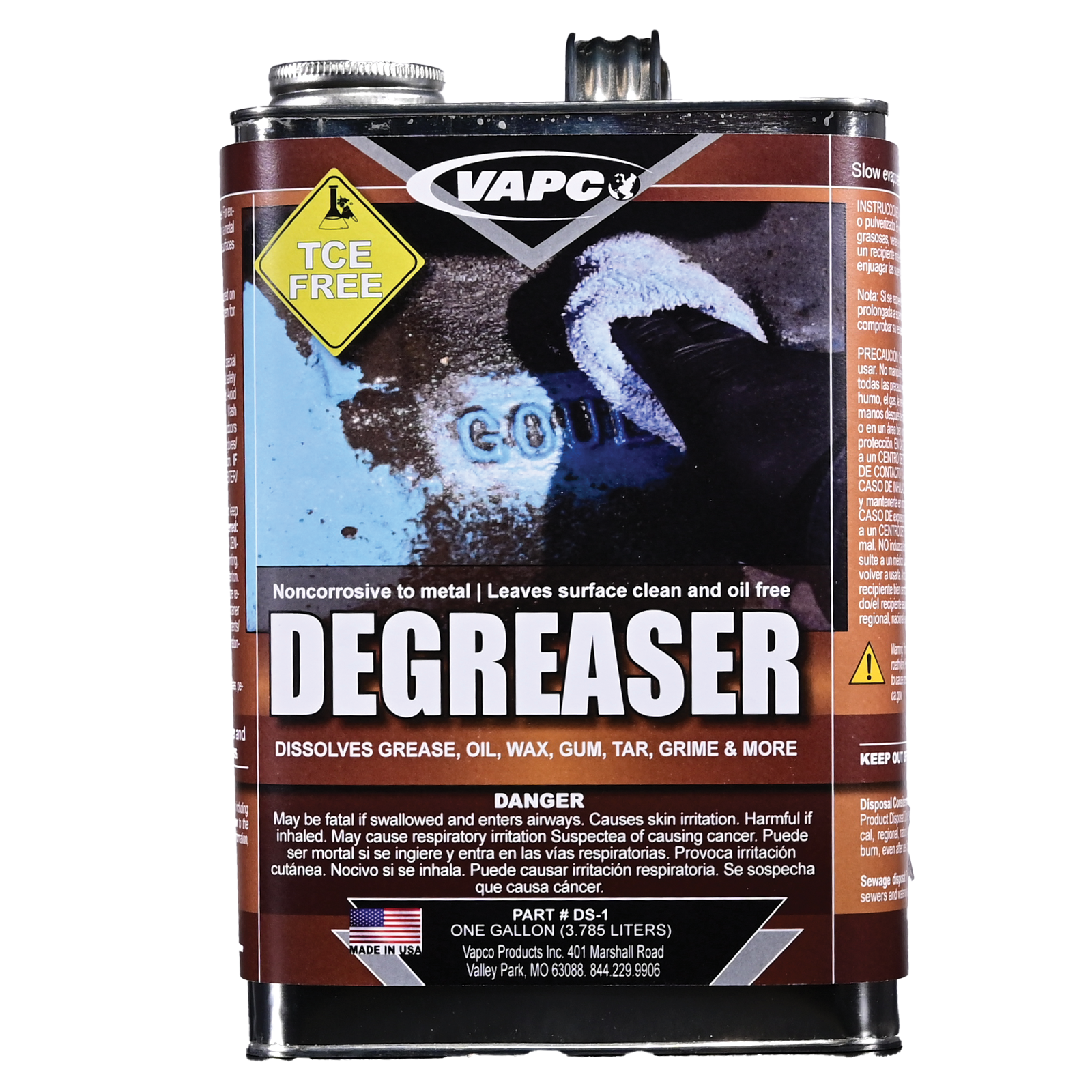
DEGREASER SOLVENT – Liquid
Powerful and Versatile Degreasing Solution
DEGREASER SOLVENT is a high-performance degreaser designed to effectively remove grease and grime from a wide range of surfaces. Its powerful formula penetrates deep into materials, dissolving contaminants without damaging surfaces.
Key Features and Benefits:
- Effective Degreasing: Removes stubborn grease and grime.
- Non-Corrosive: Safe for use on metals and other surfaces.
- Low Toxicity: Contains no carbon tetrachloride.
- Non-Flammable: Reduces the risk of fire.
- Fast-Drying: Dries quickly without leaving residue.
- Safe for Electrical Equipment: Does not short motors, generators, or electrical equipment.
- Versatile Applications: Suitable for cleaning refrigeration and air conditioning units, engines, electrical components, kitchen exhaust fans, brake parts, and more.
DEGREASER SOLVENT is a reliable and effective degreasing solution that can be used in various settings. Its powerful cleaning action, safety features, and versatility make it an ideal choice for professionals and homeowners alike.
Part Number; Size
DANGERS & PRECAUTIONS
Read the label on the can or usage guide for complete instructions. It is a violation of federal law to use this product in a manner inconsistent with its labeling.Do NOT handle or use this product until all safety precautions have been read and understood. Protect from sunlight and store in a cool well-ventilated place. Keep the container tightly closed, and be sure to keep away from heat, sparks, open flames, and hot surfaces. NO smoking while using this product. Do not spray on an open flame or other ignition sources. Wear protective gloves and eye protection when handling this product. If the degreaser solvent gets on your skin, immediately rinse off. In the case of fire use dry chemical, foam, or carbon dioxide
Contact Us
News and Updates
Subscribe on Youtube
Follow Us on Facebook
SDS
⚠️ DEGREASER SDS – DOWNLOAD
Identification & Supplier Details
| Product Name (GHS Identifier) |
Degreaser Solvent |
| Product Number / Brand |
DS-1, DS-5, DS-55 / Vapco |
| Recommended Use |
Chlorinated solvent degreaser |
| Restrictions on Use (TSCA Rule) |
After December 8, 2026, product cannot be distributed to retailers for any use.
After March 8, 2027, only specific industrial/commercial uses allowed (e.g., vapor degreasing, maskant, lab chemicals) with PCE concentration ≥ 0.1% by weight. |
| Supplier Name |
Vapco Products, Inc. |
| Supplier Address |
401 Marshall Road, Valley Park, Missouri 63088, United States |
| Telephone / Email |
(636) 923-2121 / [email protected] |
| Emergency Phone Number |
(800) 255-3924 |
Hazard Identification & Composition
| GHS Classification (OSHA) |
- Acute toxicity, inhalation, Cat. 4
- Aspiration hazard, Cat. 1
- Carcinogenicity, Cat. 2
- Skin corrosion/irritation, Cat. 2
- Specific target organ toxicity (single exposure), Cat. 3
|
| Signal Word |
Danger |
| Hazard Statement(s) |
- H304: May be fatal if swallowed and enters airways
- H315: Causes skin irritation
- H332: Harmful if inhaled
- H335: May cause respiratory irritation
- H351: Suspected of causing cancer
|
| Key Precautionary Statement(s) |
- P201: Obtain special instructions before use.
- P261: Avoid breathing dust/fume/gas/mist/vapors/spray.
- P280: Wear protective gloves/clothing/eye protection.
- P301+P310: IF SWALLOWED: Immediately call a POISON CENTER/doctor.
- P331: Do NOT induce vomiting.
|
Hazardous Components
| Chemical Name |
CAS No. |
Concentration (% weight) |
| Perchloroethylene |
127-18-4 |
40 – 60 % |
| Distillates, petroleum, hydrotreated light |
64742-47-8 |
40 – 60 % |
First-Aid Measures
| General Advice |
Never give anything by mouth to an unconscious person. Seek medical advice if unwell (show label). |
| If Inhaled |
Remove to fresh air. Keep at rest. Get medical advice/attention. |
| In Case of Skin Contact |
Immediately drench affected area with water for at least 15 minutes. Remove contaminated clothing. Obtain medical attention if irritation persists. |
| In Case of Eye Contact |
Immediately rinse with water for at least 15 minutes. Remove contact lenses. Obtain medical attention if irritation persists. |
| If Swallowed |
Rinse mouth. Do NOT induce vomiting. Immediately call a POISON CENTER/doctor. Obtain medical attention. |
| Most Important Symptoms (Acute) |
Harmful if inhaled. Aspiration hazard. High concentrations may cause CNS depression (dizziness, drowsiness), respiratory irritation, and potential cardiac sensitization. |
| Immediate Medical Attention Note |
No specific treatment regimen. Treatment should be directed at the control of symptoms and clinical condition. Careful consideration should be applied preceding administration of epinephrine or similar heart-stimulating substances (due to cardiac sensitization risk). |
Fire-Fighting & Accidental Release Measures
| Suitable Extinguishing Media |
Dry chemical, foam, or carbon dioxide (CO2). |
| Specific Hazards (Fire) |
Container may explode in heat of fire (Pressure build-up). Vapors are heavier than air and may travel to an ignition source. Reacts with strong oxidizing agents. |
| Firefighting Actions |
Do NOT fight fire when fire reaches containers. Evacuate area. Fight fire remotely. Use water spray for cooling. Wear NIOSH-approved Self-Contained Breathing Apparatus (SCBA). |
| Hazardous Combustion Products |
Carbon oxide(s), chlorine, hydrogen chloride, and phosgene. |
| Personal Precautions (Spill) |
Keep away from ignition sources. Do not breathe vapors/gas. Use appropriate PPE. Evacuate unnecessary personnel. |
| Containment & Cleanup |
Eliminate ignition sources. Ventilate the area. Contain spills with dikes/absorbents. Take up liquid spill into absorbent material for disposal. |
| Environmental Precautions |
Prevent entry to sewers and public waters. Avoid release to the environment (Toxic to aquatic life). |
Handling, Storage & PPE
| Precautions for Safe Handling |
Do not pressurize, cut, or weld containers. Avoid contact with skin/eyes. Do not breathe vapors/mist. Wash hands thoroughly after handling. |
| Conditions for Safe Storage |
Store in a dry, cool, well-ventilated place, away from ignition sources and incompatible materials. Protect from sunlight. Do not expose to temperatures exceeding 50°C/122°F. Store locked up. Proper grounding required. |
| Incompatible Materials |
Strong acids and alkalis, strong oxidizing agents, chemically active metals (e.g., aluminum, sodium, magnesium), concentrated nitric acid, some plastics, rubbers and coatings. |
| Engineering Controls |
Ensure adequate ventilation. Use explosion-proof equipment. Emergency eye wash and safety showers available. |
| Eye/Face Protection |
Chemical safety goggles. |
| Skin/Body Protection |
Protective gloves and clothing. Chemical resistant materials. Wear fire/flame resistant/retardant clothing. |
| Respiratory Protection |
Use a NIOSH-approved Self-Containing Breathing Apparatus (SCBA) whenever exposure may exceed established Occupational Exposure Limits. |
Exposure Control Parameters (Tetrachloroethylene – 127-18-4)
| Limit Type |
Value (ppm / mg/m³) |
Source / Note |
| TWA (Inhalation) |
50 ppm / 340 mg/m³ |
AU (AU/SWA) |
| STEL (Inhalation) |
150 ppm / 1020 mg/m³ |
AU (AU/SWA) |
| IOELV-LTEL (Inhalation) |
20 ppm / 138 mg/m³ |
EU (EU/OSHA) (Skin designation) |
Physical & Chemical Properties
| Physical State / Appearance |
Liquid / Clear liquid |
| Color / Odor |
Colorless / Solvent odor |
| Melting/Freezing Point (Estimated) |
-142.6 °F (-97 °C) |
| Boiling Point (Estimated) |
104 °F (40 °C) |
| Flash Point (Lowest Component) |
124 °F (51.0 °C) |
| Lower/Upper Explosive Limit (Estimated) |
0.5% – 19.5% |
| Vapor Pressure (Estimated) |
68.82 hPa |
| Density/Relative Density |
1.19 |
| Relative Vapor Density (Air=1) |
>1 (Vapors are heavier than air) |
Stability & Reactivity
| Reactivity |
May react with strong oxidizing agents. Increased risk of fire or explosion under certain conditions. |
| Chemical Stability |
Stable under normal conditions of use. |
| Conditions to Avoid |
Direct sunlight, high temperatures, heat, hot surfaces, sparks, open flames, and incompatible materials. |
| Incompatible Materials |
Strong acids and alkalis, strong oxidizing agents, chemically active metals (e.g., aluminum, sodium, magnesium), concentrated nitric acid, some plastics, rubbers and coatings. |
| Hazardous Decomposition Products |
Carbon oxide(s), chlorine, hydrogen chloride, and phosgene. |
Toxicological Information
| Acute Toxicity Data (Tetrachloroethylene) |
LC50 Inhalation – Rat: 4,100 ppm – 6 hr
LD50 Oral – Rat: 2,629 mg/kg |
| Aspiration Hazard |
May be fatal if swallowed and enters airways (GHS Category 1). |
| Skin Corrosion/Irritation |
Causes irritation. May cause localized defatting and blistering with prolonged contact. May be absorbed through the skin. |
| Respiratory Sensitization / STOT-Single Exposure |
May cause respiratory irritation. May cause drowsiness or dizziness (CNS depression). Vapors may be narcotic/anesthetic. |
| Carcinogenicity / STOT-Repeated Exposure |
Suspected of causing cancer. Overexposure may cause damage to kidneys, liver, lungs, blood, or central nervous system. |
Disposal & Ecological Information
| Product Disposal |
Dispose of contents/container in accordance with local, regional, national, and international regulations. RCRA Status: Waste likely considered hazardous. |
| Sewage Disposal / Environmental Release |
Avoid release into the environment. Toxic to aquatic life. Keep out of sewers and waterways. |
| Toxicity (Aquatic) |
Tetrachloroethylene LC50 – Fathead minnow: 18.4 mg/L – 96 hr. Rainbow trout: 5 mg/L – 96 hr. |
| Persistence and Degradability |
Component or components of this product are not biodegradable. |
| Mobility in Soil |
This product is mobile in soil. |
Transport & Regulatory Information
Transport Information (DOT, IMDG, IATA)
| UN Number |
UN2810 |
| Hazard Class |
6.1 (Toxic substances) |
| Proper Shipping Name |
Toxic, liquids, organic, n.o.s. |
| Packing Group |
III |
| Marine Pollutant (DOT) |
Yes |
Regulatory Information
| California Proposition 65 |
WARNING: Contains Tetrachloroethylene (Perchloroethylene), known to the State of California to cause cancer. |
| SARA / TSCA Inventory |
Components are listed on the US EPA TSCA public inventory (Perchloroethylene 127-18-4, Distillates, petroleum, hydrotreated light 64742-47-8). |
| Right to Know Components |
Perchloroethylene / Tetrachloroethylene (127-18-4) is listed in Massachusetts, New Jersey, and Pennsylvania Right to Know regulations. |
Disclaimer & Preparation Information
| Prepared By |
Jessica Wilson |
| Date Prepared |
8/4/2025 |
| Disclaimer |
Information is believed accurate but provided without warranty. Final determination of suitability is the sole responsibility of the user. Manufacturer assumes no liability for loss, injury, or expense from improper use, as conditions of handling/storage are beyond control. |