
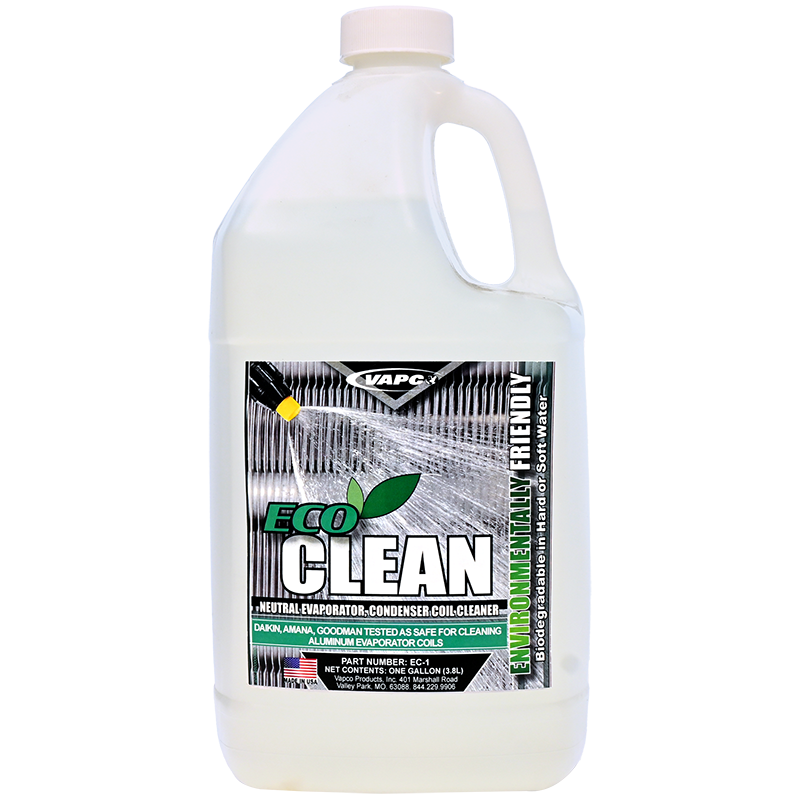
Eco Clean (EC) | The Green Cleaner That Actually Cleans

ECO CLEAN is a non-toxic, multi-surface HVAC cleaner formulated to meet EPA Safer Choice criteria — engineered for contractors and facility managers who need a product that’s genuinely safe without surrendering cleaning performance. At slightly alkaline pH, ECO CLEAN cuts through grease, soot, and urban pollutants on coils without harsh chemicals, without damaging sensitive surfaces, and without putting the people in the room at risk.

  • All Coil Configurations: Works on evaporator, condenser, and micro-channel coils at three dilution ratios — 3:1 for heavy soiling, 7:1 for routine maintenance, or 10:1 for light-duty cleaning.
  • Multi-Surface Formula: Separate surface protocol covers composition, terrazzo, tile, marble, concrete, wood, porcelain, enamel, metal, and painted surfaces. One product handles the mechanical room and the rest of the building.
  • No Hazardous Ingredients: Contains no hazardous ingredients at or above OSHA reportable levels. Cleared for use in occupied buildings, schools, and government facilities.
  • No Rinse Formula:No rinse on evaporators in where sufficient humidity is present to “self-rinse” the coil.


Non-Toxic HVAC Cleaner Multi-Surface | ECO CLEAN – EC-1

The Green Cleaner That Actually Cleans.

Green cleaners have a reputation problem in the trades. Contractors have been burned at both ends of the spectrum: harsh chemicals that strip paint, irritate skin, and damage coated coils on one side — and products labeled “eco-friendly” that couldn’t cut through a dusty residential evaporator coil on the other. The safe stuff doesn’t clean. The stuff that cleans isn’t safe. That’s the assumption ECO CLEAN was built to challenge.

ECO CLEAN is a mildly alkaline concentrate built on industrial degreaser chemistry, formulated to protect aluminum and coated metals during cleaning while delivering real performance on grease, soot, and urban pollutants. It contains no hazardous ingredients at or above OSHA reportable levels. It works on every coil configuration — evaporator, condenser, microchannel, and mini-split. And when the coil job is done, it follows you to the walls, the floors, and the roof — at the right dilution for each surface — without reaching for a second product.

Manufacturer’s Tech Note: No rinse is required on evaporator coils operating in cooling mode where sufficient ambient humidity is present to produce condensate. On condenser coils and any application where condensate is not present, rinse with clear water after the dwell period.

Important: ECO CLEAN is a maintenance cleaner, not a remediation product. It is not designed for heavily impacted coils with years of neglected buildup. For severely fouled coils requiring aggressive intervention, see Foaminator.

Coil Protocol: Three Ratios for Three Job Types

Because ECO CLEAN is a concentrate, you control the strength based on what the job calls for. All coil configurations — evaporator, condenser, and microchannel — are compatible.

  • 3:1 Ratio (Heavy Soiling): For coils with significant grease accumulation, soot deposits, or heavy urban pollutant buildup. Maximum cleaning strength while remaining within safe chemistry parameters.
  • 7:1 Ratio (Routine Maintenance): The go-to ratio for standard PM visits. Effective on the dust, grime, and light soiling that accumulates on most residential and commercial coils between scheduled service intervals.
  • 10:1 Ratio (Light-Duty / Sensitive Coils): For microchannel coils, freshly installed equipment, or light maintenance where minimal soil load is present. Maximum economy — one gallon yields ten gallons of solution.

Rinse Note: No rinse is required on evaporator coils operating in cooling mode where sufficient ambient humidity is present to produce condensate. On condenser coils and any application where condensate is not present, rinse with clear water after the dwell period.

Important: ECO CLEAN is a maintenance cleaner, not a remediation product. It is not designed for heavily impacted coils with years of neglected buildup. For severely fouled coils requiring aggressive intervention, see Foaminator.

Key Features & Trade Benefits

KEY FEATURE / SPECIFICATION TRADE BENEFIT / RESULT
Slightly Alkaline Formula (pH 9.2) Cleans Without Damaging: Alkaline enough to emulsify grease, soot, and urban pollutants — mild enough for painted surfaces, marble, and coated coils where high-pH cleaners cause irreversible damage.
Three Coil Dilution Ratios (3:1 / 7:1 / 10:1) One Product, Every Coil Job: Scale from maximum cleaning power to light maintenance economy without switching products. At 10:1, one gallon yields eleven gallons of solution.
All Coil Configuration Compatibility No Coil Left Behind: Works on evaporator, condenser, and microchannel coils. Most eco cleaners are positioned for evaporator use only — ECO CLEAN works across all coil types on the truck.
No Hazardous Ingredients at OSHA Reportable Levels Safe for Occupied Spaces: Use in schools, government buildings, and healthcare facilities without restricting building occupants. No OSHA hazardous ingredient disclosure required.
Multi-Surface Formula Replaces Multiple Products: Separate surface protocol covers floors, walls, woodwork, porcelain, enamel, and metal. One product for the mechanical room and the rest of the building.
Formulated to Meet EPA Safer Choice Criteria Specification-Ready: Meets the ingredient and environmental standards required by facilities with green procurement policies, environmental compliance requirements, or LEED-adjacent cleaning protocols.

Surface Protocol: One Product Beyond the Mechanical Room

Where most HVAC cleaners stop at the coil, ECO CLEAN’s dilute surface protocol extends to the rest of the building. Use cold water for all surface applications. Rinse with clear water after scrubbing.

SURFACE TYPE DILUTION METHOD
Composition, Terrazzo, Tile & Marble Floors 1–4 oz per gallon cold water Mop and rinse with squeegee or damp mop. Increase concentration for stubborn areas.
Wood & Concrete Floors 4 oz per gallon cold water Scrub surface and rinse clean with clear water.
Walls, Woodwork, Porcelain, Enamel & Metal Surfaces 4 oz per gallon cold water Scrub surface and rinse clean with clear water.

Vapco Field Guide: Application Matrix

ECO CLEAN performance by application type. (★★★ = Best in Class | ★★ = Effective | ★ = Light Duty Only)

APPLICATION RATING NOTES
Evaporator Coil — Routine PM ★★★ Purpose-built application. No rinse required in cooling mode with adequate condensate.
Condenser Coil — Routine PM ★★ Use at 3:1–7:1. Rinse with water after dwell period.
Micro-channel Coil ★★★ Safe for all-aluminum microchannel designs. Use at 7:1–10:1.
Urban Soot & Pollution on Coils ★★★ Effective on particulate and exhaust-based buildup common in urban and rooftop installations.
Tile, Terrazzo & Marble Floors ★★★ 1–4 oz per gallon. Safe for polished stone and composite flooring.
Walls, Painted Surfaces & Woodwork ★★★ 4 oz per gallon. Safe for paint, enamel, porcelain, and metal.
Light Grease on Coils Handles maintenance-level grease accumulation. Use at 3:1 for best results.
Heavily Impacted / Neglected Coils NOT RECOMMENDED ECO CLEAN is a maintenance product, not a remediation cleaner. For significant buildup, use Foaminator.

Part Number Reference:

ECO CLEAN is available in a 1-gallon format. Contact your Vapco distributor for case pricing and availability.

PART NUMBER SIZE / PACK APPLICATION FIT
EC-1 1 Gallon (Case of 4) Service Truck Standard: Mixes into standard pump sprayers for coil work or into a mop bucket for surface cleaning. The right size for the tech running a route.

Contractors: Please contact your local Vapco distributor for pricing and availability.

Why “Safe” Cleaners Keep Failing HVAC Contractors

THE PROBLEM (Most Eco Cleaners) THE ECO CLEAN DIFFERENCE
“It Only Does One Thing”
Most eco-labeled HVAC cleaners are evaporator-only products. They rely on condensate to rinse and can’t be used outdoors or on other surfaces without a different product or significant volume of product to clean well.
“One Product, Every Surface”
ECO CLEAN works on all coil types — evaporator, condenser, and micro-channel, mini-splits — plus floors, walls, and building surfaces. One product on the truck for every safe-cleaning application.
“Safe Means Weak”
Contractors who’ve tried green cleaners before know the pattern: gentle formula, light foam, rinsed off before it did anything. Urban grime and coil grease require actual chemistry.
“Alkaline Enough to Clean”
pH 9-10 is the balance point — strong enough to break down grease, soot, and pollutants, mild enough to use in schools and on coated surfaces. Safety and cleaning power are not a trade-off here. There’s also built in chemistry to protect
“One Ratio Fits All”
Most eco cleaners ship pre-diluted or at a single fixed ratio. If the job is lighter or heavier than expected, there’s no adjustment — you’re using more product or switching to something else.
“Three Ratios, Total Control”
Mix at 3:1 for heavy soiling, 7:1 for routine PM, or 10:1 for light maintenance and maximum economy. The same concentrate adapts to the job — no second product needed.

FAQs

Frequently Asked Questions: ECO CLEAN Non-Toxic Multi-Surface HVAC Cleaner

Application & Performance

Can I use ECO CLEAN on micro-channel and mini-split coils?

Yes. ECO CLEAN was one of the first green coil cleaners to receive early OEM approvals for micro-channel and mini-split applications when it launched in 2014. The formula’s chelation chemistry is designed to protect aluminum during cleaning — not just avoid damaging it.

Use any of the three dilution ratios (3:1, 7:1, or 10:1)

Can I use ECO CLEAN on indoor evaporator coils?

Yes — this is one of ECO CLEAN’s primary applications. It contains no hazardous ingredients at or above OSHA reportable levels and produces no harmful fumes, making it safe for use in occupied spaces including schools, hospitals, and government buildings.

*Tech Note: No rinse is required on evaporator coils operating in cooling mode where sufficient ambient humidity is present to produce condensate. The condensate cycle removes residual solution naturally. If the system is not producing condensate, rinse manually with clear water.*

Will ECO CLEAN actually remove grease and soot, or is it just another weak green cleaner?

ECO CLEAN is built on the same class of surfactant chemistry used in commercial kitchen degreasers and transportation fleet pre-soaks. It emulsifies grease, soot, diesel exhaust residue, and carbonaceous buildup — not just dust and light particulates.

For coils with significant grease accumulation, use the 3:1 ratio for maximum cleaning strength.

*Important: ECO CLEAN is a maintenance cleaner, not a remediation product. For condenser coils with years of neglected heavy buildup, use Foaminator.*

What is the difference between ECO CLEAN and Foaminator?

They are complementary products built for different jobs:

ECO CLEAN (EC-1): Non-toxic, mildly alkaline multi-surface cleaner. Safe for all coil types — evaporator, condenser, microchannel, and mini-split — plus floors, walls, and building surfaces. Use it for routine PM, sensitive environments, and anywhere harsh chemistry is a liability.

Foaminator (FM-1): High-alkaline condenser-only cleaner with a delayed-foaming mechanism that pushes matted debris out from inside multi-row coils. Contains Sodium Hydroxide. Requires heavy rinsing. Not safe for micro-channel, mini-split, or indoor evaporator coils.

*Rule of thumb: Outdoor condenser with heavy grease, cottonwood, or years of neglect — Foaminator. Routine PM on any coil type, indoor work, or one cleaner for coils and building surfaces — ECO CLEAN or Mongoose.*

Does ECO CLEAN work on condenser coils too, or just evaporators?

All coil configurations. ECO CLEAN works on evaporator coils, condenser coils, micro-channel coils, and mini-split coils. Most eco-labeled competitors are positioned for evaporator use only.

*On condenser coils: use at 3:1–7:1 depending on soil load and rinse with clear water after the dwell period.*

Dilution & Mixing

What dilution ratio should I use for ECO CLEAN?

Choose by soil load — not coil type:

3:1 (Heavy Soiling): Significant grease, soot, or urban pollutant buildup. Maximum cleaning strength. 1 gallon of concentrate makes 4 gallons of solution.

7:1 (Routine PM): The go-to ratio for standard maintenance visits. 1 gallon makes 8 gallons of solution.

10:1 (Light Duty): Freshly installed equipment, light maintenance, or high-volume PM routes. 1 gallon makes 11 gallons of solution.

*For floors and surfaces, use a different measurement: 1–4 oz per gallon cold water for tile, terrazzo, and marble; 4 oz per gallon for wood, concrete, walls, and metal. Do not use coil-ratio concentrations on floors or painted surfaces.*

How much solution does one gallon of ECO CLEAN actually make?

At 3:1: 1 gallon concentrate + 3 gallons water = 4 gallons of ready-to-use solution.

At 7:1: 1 gallon concentrate + 7 gallons water = 8 gallons of ready-to-use solution.

At 10:1: 1 gallon concentrate + 10 gallons water = 11 gallons of ready-to-use solution.

Most contractors running standard PM routes at 7:1 get 8 gallons of working solution from a single gallon — enough for multiple service calls per jug.

Can I use ECO CLEAN in a hose-end gun/sprayer?

Yes. Unlike high-viscosity alkaline concentrates that require pre-dilution to flow through standard equipment, ECO CLEAN mixes easily and draws through standard hose end guns/sprayers and pump-up sprayer without modification.

Safety & Compatibility

Is ECO CLEAN safe to use in schools, hospitals, and government buildings?

Yes. ECO CLEAN contains no hazardous ingredients at or above OSHA reportable levels and produces no harmful fumes. It can be used in occupied spaces — classrooms, patient rooms, lobbies, mechanical rooms — without restricting building occupants or triggering hazardous material protocols.

For facilities with green procurement policies, environmental compliance requirements, or LEED-adjacent cleaning protocols, ECO CLEAN is formulated to meet EPA Safer Choice criteria.

Do I need PPE when using ECO CLEAN?

Protective eyewear and gloves are recommended during application as standard professional practice. Avoid direct contact with eyes.

Unlike high-alkaline coil cleaners that require chemical-resistant suits, goggles, and respiratory protection, ECO CLEAN does not produce harmful fumes and does not cause chemical burns. See the full SDS for complete safety guidance.

Will ECO CLEAN damage painted surfaces, marble, or rubber roofs?

No. At the recommended surface dilution (1–4 oz per gallon cold water), ECO CLEAN is safe for:

• Painted surfaces, enamel, and woodwork

• Marble, terrazzo, tile, and composition floors

• Porcelain and metal surfaces

• Rubber roof membranes

*Important: Do not use coil-ratio concentrations (3:1, 7:1, 10:1) on floors, painted surfaces, or delicate materials. Those ratios are for coil cleaning only. Rinse all surfaces with clear water after cleaning.*

Will ECO CLEAN kill the grass or plants around the unit?

ECO CLEAN is formulated to meet EPA Safer Choice criteria, which includes standards for aquatic and environmental safety. Normal diluted runoff from coil cleaning is not expected to harm vegetation.

Is ECO CLEAN EPA Safer Choice certified?

ECO CLEAN is formulated to meet EPA Safer Choice criteria. Official Safer Choice registration is currently in process.

The product was originally formulated in 2014 to meet EPA Design for the Environment (DfE) criteria — the precursor program to today’s Safer Choice certification — making it one of the first HVAC coil cleaners in the category to meet those standards.

Multi-Surface Use

Can I really use the same product on coils AND floors AND walls?

Yes —  ECO CLEAN uses different dilution protocols for different jobs:

Coil cleaning: Water-to-product ratios (3:1, 7:1, or 10:1) in a sprayer.

Surface cleaning: 1–4 oz per gallon of cold water in a mop bucket or spray bottle.

Most contractors carrying ECO CLEAN have eliminated a separate floor cleaner and surface cleaner from their truck inventory entirely.

What surfaces can ECO CLEAN be used on besides HVAC coils?

At the surface dilution rate (1–4 oz per gallon cold water, scrub and rinse with clear water):

• Composition, terrazzo, tile, and marble floors

• Wood and concrete floors

• Walls and woodwork

• Porcelain and enamel surfaces

• Metal surfaces

• Rubber roof membranes

*Important: it’s always best practice to test a small, inconspicuous area before tackling the whole job.

Logistics & Storage

What sizes does ECO CLEAN come in?

ECO CLEAN is currently available in a 1-gallon format (EC-1), packed 4 per case. Contact your local Vapco distributor for case pricing and availability.

What is the shelf life of ECO CLEAN?

5+ years from date of manufacture when stored in a closed container. The formulation is stable — safe to carry on the service truck year-round or stock on the warehouse shelf without degradation concerns. Vapco warranties every product for 1 year after the manufacture date.

What happens if the bottle freezes in my truck?

ECO CLEAN is water-based and can freeze. If frozen, allow it to thaw at room temperature and shake well before use. Performance is not affected by a freeze-thaw cycle.

It costs more per gallon than a pre-diluted green cleaner. Why?

Because ECO CLEAN is a concentrate, not a ready-to-use product. The cost-per-application is lower, not higher:

• At 7:1, one gallon makes 8 gallons of working solution.

• At 10:1, one gallon makes 11 gallons of working solution.

ECO CLEAN also replaces separate coil cleaner, floor cleaner, and surface cleaner — eliminating the cost and truck space of carrying three different products.

How do I dispose of the empty container?

Once triple-rinsed, the HDPE containers are fully recyclable. Check your local recycling guidelines. ECO CLEAN contains no hazardous ingredients at or above OSHA reportable levels, so no special disposal protocols are required for empty containers.

SDS & Instructions

📄 DOWNLOAD FULL SDS (PDF)

⚠️ Professional Use RecommendedECO CLEAN contains no hazardous ingredients at or above OSHA reportable levels. Protective eyewear and gloves are recommended during application. Avoid direct contact with eyes. Formulated to meet EPA Safer Choice criteria. Keep out of reach of children. See full SDS for complete safety information.

Field Guide: Contaminant Removal Matrix

ECO CLEAN utilizes a mildly alkaline formula with chelation chemistry designed to protect metals during cleaning, built for coil maintenance and multi-surface cleaning in occupied and sensitive environments. The following matrix details performance against common contaminants.

TARGET CONTAMINANT TYPICAL SOURCE ACTION PERFORMANCE / WHY IT WORKS
Dust, Dirt & Urban Particulates Airborne / HVAC Intake Wetting Surfactants reduce surface tension, penetrating and breaking the adhesive bond between dry particulates and the coil surface. Particles are dislodged and carried away in the rinse — no chemical conversion required.
Soot & Exhaust Deposits Urban / Rooftop Installations Emulsification Surfactant blend breaks the bond between carbon-based deposits and coil metal, allowing soot and exhaust film to be wiped or rinsed away cleanly.
Light Grease & Oil Film Kitchen-Adjacent / Mechanical Rooms Emulsification Effective on maintenance-level grease accumulation on coils and hard surfaces. Use at 3:1 for maximum grease-cutting performance. Not a remediation product — for heavy grease impaction, use Foaminator.
General Grime on Building Surfaces Floors, Walls, Mechanical Rooms Wetting / Emulsification At dilute surface concentrations (1–4 oz per gallon), surfactants reduce surface tension to dislodge dry particulates (wetting) and break down oily residues into dispersed droplets (emulsification) for easy removal.

System Material Compatibility

MATERIAL / COMPONENT STATUS & PROTOCOL
Evaporator Coils (All Designs) ✅ RECOMMENDED — No rinse required in cooling mode with adequate condensate.
Condenser Coils ✅ RECOMMENDED — Rinse with clear water after dwell period.
Micro-channel / All-Aluminum Coils ✅ RECOMMENDED — Chemistry formulated to protect aluminum during cleaning. Field-proven on all-aluminum micro-channel and mini-split designs since 2014. Use any ratio based on soil load.
Coated Fins ✅ COMPATIBLE Mild alkaline formula is safe for factory-applied fin coatings at recommended dilutions.
Painted Surfaces, Enamel & Woodwork ✅ COMPATIBLE — Use surface protocol (4 oz per gallon). Rinse with clear water.
Tile, Terrazzo, Marble & Composition Floors ✅ COMPATIBLE — Use at 1–4 oz per gallon cold water. Rinse with clear water.
Rubber Roofs & Roof Membrane ✅ COMPATIBLE — Safe for rubber roof membranes. Rinse with clear water after use.
Heavily Impacted / Neglected Coils ❌ NOT RECOMMENDED ECO CLEAN is a maintenance cleaner, not a remediation product. For coils with years of neglected buildup, use Foaminator.

*For heavily fouled condenser coils requiring aggressive intervention, see Foaminator (FM-1). For pH-neutral coil cleaning, see Mongoose (MCC-1).

Directions for ECO CLEAN Non-Toxic Multi-Surface HVAC Cleaner:

EC-1

1. Coil Cleaning — Preparation & Dilution

Step 1: Shut off power to the HVAC unit before applying any cleaning solution.
Step 2: Remove loose debris. Clear any heavy surface debris (leaves, dirt, lint) from the coil exterior by hand or with a soft brush before applying solution.
Step 3: Mix your solution. Always add ECO CLEAN to water — not water to ECO CLEAN — to ensure consistent dilution. Use cold water for all coil applications.

Tech Tip: ECO CLEAN mixes easily in any standard pump-up sprayer and can be used in Hose-End Guns/Sprayers.
APPLICATION RATIO (Water:Product) RESULT / YIELD
Heavy Soiling / Grease & Soot 3:1 Maximum Cleaning Strength: For significant grease accumulation, soot deposits, or heavy urban pollutant buildup. 1 Gal makes 4 Gal of solution.
Routine PM / Standard Maintenance 7:1 Standard Maintenance: The go-to ratio for scheduled PM visits. Effective on typical dust, grime, and light soiling. 1 Gal makes 8 Gal of solution.
Light Duty / Maximum Economy 10:1 Max Economy: For freshly installed equipment, light maintenance cycles, or high-volume PM routes. 1 Gal makes 11 Gal of solution.

2. Coil Cleaning — Application

Apply evenly and allow adequate dwell time for the formula to work.

  • Apply Solution:
    • Spray the mixed solution evenly onto the coil surface, working from bottom to top to ensure full coverage.
    • Saturate the coil face thoroughly.
  • Dwell Time:
    • Allow 3–5 minutes of contact time before rinsing.
    • For heavier soiling, allow up to 8 minutes. Do not allow solution to dry on the coil surface.

3. Coil Cleaning — Rinse & Completion

Remove solution and suspended debris.

  1. Rinse Protocol:
    • Evaporator coils in cooling mode: No rinse required where sufficient ambient humidity is present to produce condensate. The condensate cycle will remove residual solution naturally.
    • Condenser coils and all other applications: Rinse thoroughly with clear water from top down, removing all solution and suspended debris.
  2. Restart:
    • Restore power to the unit. Coil is clean and thermal efficiency is restored.

4. Surface Cleaning Protocol

Use cold water for all surface applications. Do not use coil-ratio concentrations on floors or walls.

For Composition, Terrazzo, Tile & Marble Floors:

  1. Dilute: Add 1–4 oz of ECO CLEAN to each gallon of cold water. Use a higher concentration for stubborn areas and a lower concentration for everyday maintenance.
  2. Mop and Rinse: Mop the floor with the solution, then remove with a squeegee or damp mop. Rinse with clear water.

For Wood & Concrete Floors:

  1. Dilute: Add 4 oz of ECO CLEAN to each gallon of cold water.
  2. Scrub and Rinse: Scrub the surface and rinse clean with clear water.

For Walls, Woodwork, Porcelain, Enamel & Metal Surfaces:

  1. Dilute: Add 4 oz of ECO CLEAN to each gallon of cold water.
  2. Scrub and Rinse: Scrub the surface and rinse clean with clear water.

🧪 SDS SECTION: LIQUID FORMULA

(EC)

SECTION 1: Identification

1.1 GHS Product identifier
Product name: Eco Clean
Product number: EC-1
Brand: Vapco

1.3 Recommended use of the chemical and restrictions on use
Eco-friendly multi-use coil cleaner

1.4 Supplier’s details
Name: Vapco Products, Inc.
Address: 401 Marshall Road, Valley Park, Missouri 63088, United States
Telephone: (636) 923-2121
Fax: (636) 923-3002
email: [email protected]

1.5 Emergency phone number
(800) 255-3924

SECTION 2: Hazard identification

General hazard statement
Does not contain any hazardous ingredients at or above reportable levels as defined by OSHA (29 CFR 1910.1200).

2.1 Classification of the substance or mixture
GHS classification in accordance with: OSHA (29 CFR 1910.1200, 2012) Not a hazardous substance or mixture.

2.2 GHS label elements, including precautionary statements
Not a hazardous substance or mixture.

2.3 Other hazards which do not result in classification
Not a hazardous substance or mixture.

SECTION 3: Composition/information on ingredients

3.2 Mixtures
Does not contain any hazardous ingredients at or above reportable levels as defined by OSHA (29 CFR 1910.1200).

SECTION 4: First-aid measures

4.1 Description of necessary first-aid measures
General advice: Never give anything by mouth to an unconscious person. If you feel unwell, seek medical advice (show the label where possible).
If inhaled: First, take proper precautions to ensure your own safety before attempting rescue (e.g. wear appropriate respiratory protective equipment, use the buddy system), then remove the exposed person to fresh air. Keep at rest in a position comfortable for breathing. Get medical advice/attention.
In case of skin contact: Immediately drench affected area with water for at least 15 minutes. Remove contaminated clothing immediately. Obtain medical attention if irritation develops or persists.
In case of eye contact: Immediately rinse with water for at least 15 minutes. Remove contact lenses, if present and easy to do. Continue rinsing. Obtain medical attention if irritation develops or persists.
If swallowed: Rinse mouth. Do NOT induce vomiting. Obtain medical attention.

4.2 Most important symptoms/effects, acute and delayed
Acute Health Hazards: None known. Chronic Health Hazards: None known. Note to physician: There is no specific treatment regimen. Treatment of over-exposure should be at the control of symptoms and the clinical condition of the patient.

4.3 Indication of immediate medical attention and special treatment needed, if necessary
If exposed or concerned, get medical advice and attention. If medical advice is needed, have product container or label at hand.

SECTION 5: Fire-fighting measures

5.1 Suitable extinguishing media
Water spray, fog, carbon dioxide (CO2), alcohol-resistant foam, dry chemical, or sand. Use appropriate media for surrounding fire.

5.2 Specific hazards arising from the chemical
None known.

5.3 Special protective actions for fire-fighters
Precautionary Fire Measures: Exercise caution when fighting any chemical fire. Firefighting Instructions: Use dry chemical, foam, or carbon dioxide (CO2). Do not breathe fumes from fire or vapors from decomposition. Do NOT fight fire when fire reaches containers. Evacuate area. Fight fire remotely due to the risk of explosion. Shut off all sources of ignition. Use water spray or fog for cooling exposed containers.
Protection During Firefighting: Do not enter fire area without proper protective equipment, including respiratory protection. Wear NIOSH-approved Self-Contained Breathing Apparatus with a full face piece operated in a positive pressure demand mode with full body protective clothing when fighting fires.
Hazardous Combustion Products: Carbon oxide(s).

Further information
Do not allow run-off from fire fighting to enter drains or water courses.

SECTION 6: Accidental release measures

6.1 Personal precautions, protective equipment and emergency procedures
General Measures: Do not get in eyes, on skin, or on clothing. Do not breathe vapors, spray, mist, gas. Keep away from heat, hot surfaces, sparks, open flames, and other ignition sources. No smoking.
For Non-Emergency Personnel Protective Equipment: Use appropriate personal protective equipment (PPE).
Emergency Procedures: Evacuate unnecessary personnel. Stop leak if safe to do so.
For Emergency Personnel Protective Equipment: Equip cleanup crew with proper protection.
Emergency Procedure: Eliminate ignition sources first, then ventilate the area. Evacuate unnecessary personnel, isolate, and ventilate area. Upon arrival at the scene, a first responder is expected to recognize the presence of dangerous goods, protect oneself and the public, secure the area, and call for the assistance of trained personnel as soon as conditions permit.

6.3 Methods and materials for containment and cleaning up
For Containment: Ventilate the area. Contain any spills with dikes or absorbents to prevent further migration and entry into sewers or streams. As an immediate precautionary measure, isolate spill or leak area in all directions.
Methods for Cleaning Up: Clean up spills immediately and dispose of waste safely. Eliminate all ignition sources. Ventilate area. Stop the ignition source of the release, if safe to do so. Consider the use of water spray to disperse vapors. Isolate the area until gas has dispersed. Ventilate and gas test area before entering. Take up liquid spill into absorbent material. Transfer spilled material to a suitable container for disposal. Contact competent authorities after a spill.
Waste Disposal: Dispose of in accordance with local, regional, national, and international regulations. Containers may be hazardous when empty. Do not flame cut, braze, or weld. Product should be fully characterized prior to disposal (40 CFR 261).

Reference to other sections
See Section 8 for exposure controls and personal protection and Section 13 for disposal considerations.

SECTION 7: Handling and storage

7.1 Precautions for safe handling
Additional Hazards When Processed: Do not pressurize, cut, or weld containers. Do not pierce or burn, even after use.
Precautions for Safe Handling: Do not handle until all safety precautions have been read and understood. Avoid contact with skin, eyes and clothing. Do not breathe gas, mist, spray, vapors. Wash hands and other exposed areas with mild soap and water before eating, drinking or smoking and when leaving work. Do not spray on open flame or other ignition source.
Hygiene Measures: Handle in accordance with good industrial hygiene and safety procedures.
Other Precautions: Keep out of reach of children. Follow label instructions. Vapors may collect in low lying areas.

7.2 Conditions for safe storage, including any incompatibilities
Technical Measures: Comply with applicable regulations. Proper grounding procedures to avoid static electricity should be followed.
Storage Conditions: Store in a dry, cool place. Keep only in the original container in a cool, well-ventilated place away from ignition sources. Protect from sunlight. Do not expose to temperatures exceeding 50C/122F. Keep/Store away from direct sunlight, extremely high or low temperatures and incompatible materials. Store locked up/in a secure area.
Incompatible Materials: Strong oxidizing agents and peroxides.

SECTION 8: Exposure controls/personal protection

8.2 Appropriate engineering controls
Emergency eye wash fountains and safety showers should be available in the immediate vicinity of any potential exposure. Ensure adequate ventilation, especially in confined areas. Use explosion-proof equipment. Proper grounding procedures to avoid static electricity should be followed. Use only outdoors or in well-ventilated area. Ensure all local, regional, national, and international regulations are being observed. Obtain special instructions before use. Do not handle until all safety precautions have been read and understood.

8.3 Individual protection measures, such as personal protective equipment (PPE)
Eye/face protection: Chemical safety goggles. Insufficient ventilation: wear respiratory protection. Respiratory protection of the dependent type.
Skin protection: Wear protective gloves and clothing.
Body protection: Wear suitable protective clothing. Wear protective gloves. Chemical resistant materials and fabrics. Wear fire/flame resistant/retardant clothing.
Respiratory protection: Use a NIOSH-approved Self-Containing Breathing Apparatus whenever exposure may exceed established Occupational Exposure Limits.

SECTION 9: Physical and chemical properties

Physical state Liquid
Appearance Clear liquid
Color Colorless
Odor Bland odor
Odor threshold N/D
Melting point/freezing point >32C (0C)
Boiling point or initial boiling point >212C (100C)
Flammability Not considered a flammable liquid by OSHA (29 CFR 1910.1200)
Lower and upper explosion limit/flammability limit N/D
Flash point N/D
Auto-ignition temperature N/A
Decomposition temperature N/D
pH 9.2-11.2
Kinematic viscosity N/A
Solubility Soluble in water
Partition coefficient n-octanol/water (log value) N/D
Vapor pressure 17.5 at 77C (25C)
Evaporation rate <1
Density and/or relative density 1.02 at 77C (25C)
Relative vapor density <1

SECTION 10: Stability and reactivity

10.1 Reactivity: None known.
10.2 Chemical stability: Stable under normal conditions of use.
10.3 Possibility of hazardous reactions: None known.
10.4 Conditions to avoid: Extremes of temperature.
10.5 Incompatible materials: Strong oxidizing agents and peroxides.
10.6 Hazardous decomposition products: Carbon oxide(s).

SECTION 11: Toxicological information

Acute toxicity: Not established.
Skin corrosion/irritation: None known.
Serious eye damage/irritation: Mild, if any irritation.
Respiratory or skin sensitization: For hypersensitive persons, may irritate the skin after prolonged periods of contact.
Germ cell mutagenicity: Not known.
Carcinogenicity: Not known.
Reproductive toxicity: Not known.
Specific target organ toxicity (STOT) – single exposure: Not known.
Specific target organ toxicity (STOT) – repeated exposure: Not known.
Aspiration hazard: Not known.

SECTION 12: Ecological information

Toxicity: Not established.
Persistence and degradability: Readily biodegradable.
Bioaccumulative potential: This product does not bioaccumulate.
Mobility in soil: This product is mobile in soil.

SECTION 13: Disposal considerations

Disposal methods
Product disposal: Dispose of contents/container in accordance with local, regional, national, and international regulations. Do not pierce or burn, even after use.
Other disposal recommendations: Container may remain hazardous when empty. Continue to observe all precautions. Do not puncture or incinerate container. Product should be fully characterized prior to disposal.

SECTION 14: Transport information

DOT (US): Not dangerous goods
IMDG: Not dangerous goods
IATA: Not dangerous goods

SECTION 15: Regulatory information

15.1 Safety, health and environmental regulations specific for the product in question
US EPA TSCA public inventory: All chemicals are listed or exempt.

SECTION 16: Other information

N/A = Not applicable; N/D = Not determined

16.1 Further information/disclaimer: To the best of our knowledge, information contained herein is accurate. However there is no assumption of liability for the accuracy or completeness of the information contained herein. Final determination of suitability of any material is the sole responsibility of the user. All materials may present unknown hazards and should be used with caution. Although certain hazards are described herein, we cannot guarantee that these are the only hazard which exists. The information contained in this SDS was obtained from current and reliable sources; however, the data is provided without warranty, expressed or implied, regarding its correctness or accuracy. Since the conditions of handling, storage and disposal of this product are beyond the control of the manufacturer, the manufacturer will not be responsible for loss, injury, or expense arising out of the products improper use. No warranty, expressed or inferred, regarding the product described in this SDS shall be created or inferred by any statement in this SDS. Various government agencies may have specific regulations regarding the transportation, handling, storage, use, or disposal of this product which may not be covered by this SDS. The user is responsible for full compliance.

16.2 Preparation information: Prepared by: Jessica Wilson Date prepared: 2-20-2025

Specs & Logistics

📄 DOWNLOAD FULL SDS (PDF)

1. Physical & Chemical Properties

Base Chemistry Surfactant blend — no hazardous ingredients at or above OSHA reportable levels. See SDS for full composition.
pH Level (Concentrate) 9.2–11.2 (Mildly Alkaline)
VOC Content Zero VOC / Biodegradable
Solubility 100% Soluble in Water
Appearance Clear, no dyes or fragrances per formulation
Odor No added fragrances or masking agents
Shelf Life 5+ Years (Stored in closed container)
Freeze/Thaw Stability Stable. (Allow to thaw and shake well before use)
Dilution Ratios — Coils 3:1 (heavy soiling) / 7:1 (routine PM) / 10:1 (light duty)
Dilution — Floors & Surfaces 1–4 oz per gallon cold water (tile, terrazzo, marble, composition) / 4 oz per gallon (wood, concrete, walls, metal)
EPA / Regulatory Status Formulated to meet EPA Safer Choice criteria. Registration in process.
OSHA Hazardous Ingredients None at or above OSHA reportable levels

2. DOT Shipping Classification

DOT Hazmat Status: NOT REGULATED — Non-Hazardous for Transport
HTS Code: 3402.90.9050
UNSPSC Code: 47131805 — General Purpose Cleaners

3. Master Shipping & Dimensions Guide

ITEM INDIVIDUAL UNIT QTY / CASE CASE SPECS PALLET CONFIGURATION UPC
Part # Wt (lbs) H (in) W (in) L (in) Units Wt (lbs) H (in) W (in) L (in) Cases/Pallet Total Units Wt (lbs) H (in) W (in) L (in) UPC
EC-1
(1 Gal)
8.6 [ ] [ ] [ ] 4 35.4 12 11-10/16 11-10/16 48 192 1,734.2 53 40 48 683704030582

[ ] = not available in master logistics file. Individual unit dimensions not published — confirm with warehouse if needed for display packaging.

Resources

Download Photo