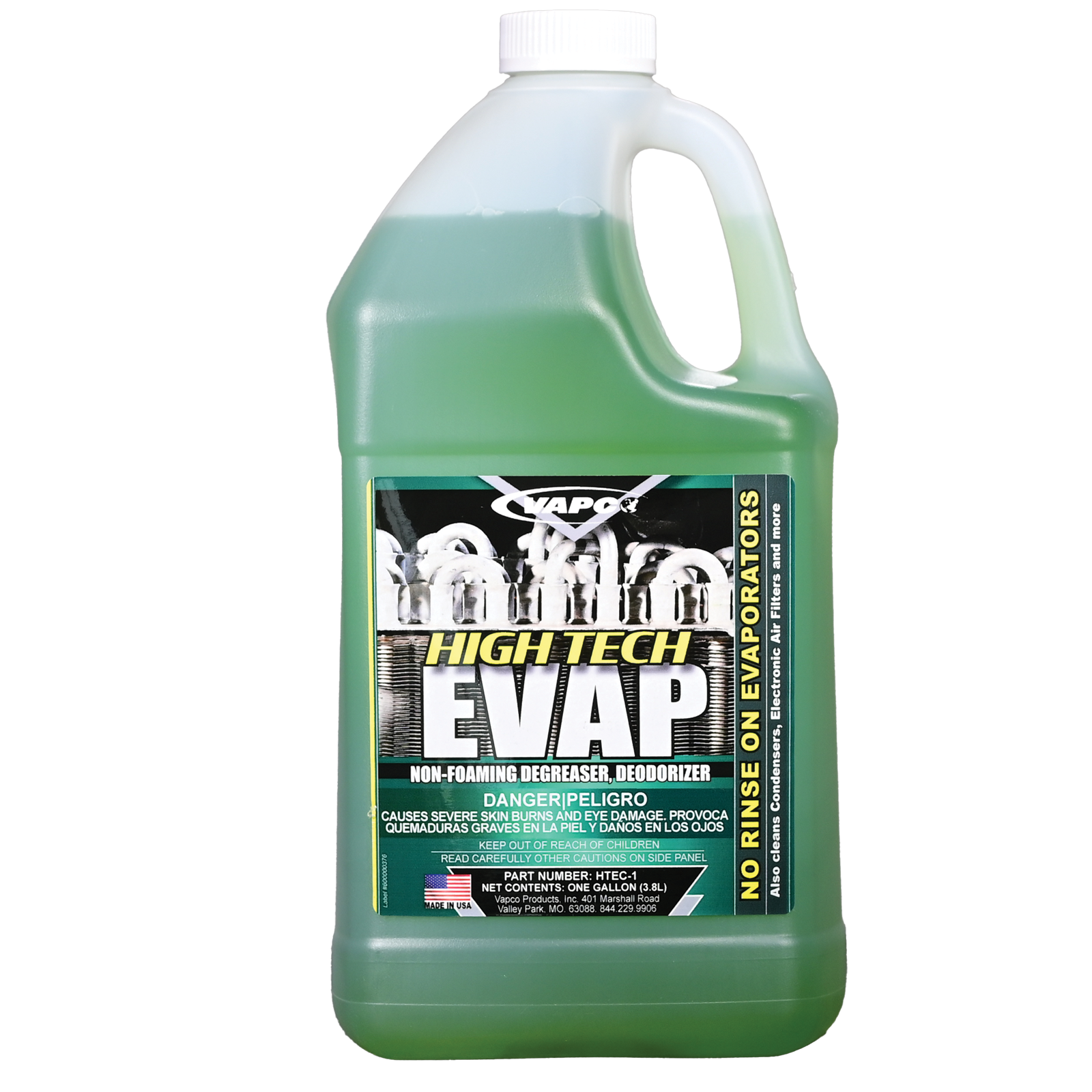
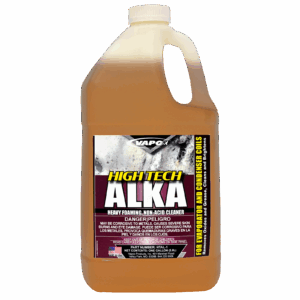
Evaporator Coil Cleaner | High Tech Evap Liquid
Evaporator-first cleaning power for greasy indoor coils.
Many “heavy duty” cleaners chase instant visual drama (thick foam, harsh reaction), but that doesn’t always match the job inside an air handler. High Tech Evap is built to be an evaporator-first liquid coil cleaner: strong on grease, grime, and nicotine film, but applied with pump sprayers and controlled workflow for dirty indoor coils.
High Tech Evap uses non-foaming, alkaline detergent chemistry designed to saturate, emulsify, and carry contamination away. It can be used as a self-rinsing evaporator cleaner when condensate is present, while rinsing is recommended for mini-split and micro-channel applications and always required on condenser components.
Manufacturer’s Tech Note: The “self-rinsing” evaporator result is a process, not a gimmick. High Tech Evap is designed to liquefy and drain when the system is producing condensate—allowing gravity and condensation to pull emulsified debris into the drain pan.
*Ensure the unit is in cooling mode producing condensate for the self-rinse feature to function. If cleaning mini-splits, micro-channel coils, condenser components, heating coils, fans, or dry conditions with no condensate, manual rinsing is required / recommended per application.*
The Workflow Advantage: One Liquid Jug, Multiple Cleaning Jobs
High Tech Evap is a liquid sprayer-applied cleaner built for repeat PM work and real indoor coil cleaning—not just aerosol convenience. Dial the strength to the job using label dilution guidance based on soil load and application, and match the rinse method to the component you’re cleaning.
- Evaporator Cleaning: Use the label evaporator dilution and allow condensate to provide the self-rinse when present.
- Mini-Split / Micro-channel Cleaning: Use the appropriate label dilution with rinsing recommended as a best-practice / CYA approach.
- Condenser Components: Use the appropriate label dilution and always rinse thoroughly with water after cleaning.
| KEY FEATURE / SPECIFICATION |
TRADE BENEFIT / RESULT |
| Liquid Coil Cleaner for Pump Sprayers |
PM-Friendly Application: Built for pump-up sprayers and repeat service routes—controlled application on indoor coils without relying on aerosol cans or heavy foam coverage. |
| Non-Foaming, Alkaline Detergent Chemistry |
Cleaner Process on Indoor Coils: Penetrates and emulsifies grease, grime, and nicotine film while improving visibility and control during application. |
| Conditional Evaporator Self-Rinse Logic |
Evaporator-First Efficiency: On evaporators in cooling mode, condensate can provide the rinse pathway and carry emulsified debris to the drain pan. |
| Application-Specific Rinse Guidance |
Asset Protection: Rinsing is recommended for mini-split and micro-channel applications, and always required on condenser components and permanent filters. |
| Strong Performance on Grease / Grime / Tobacco Film |
Built for Dirty Indoor Coils: Vapco’s internal coil cleaner selector rates High Tech Evap as a top performer (1 = best) on oil & grease, dirt & grime, dust & lint, and tobacco stains. |
| SDS-Backed Profile (HTEC) |
Transparent Positioning: High-alkaline detergent cleaner (pH 12–13), water-soluble, low VOC (<4%), non-flammable liquid classification per SDS. Always follow label and SDS. |
Vapco Field Guide: Dilution & Procedure Matrix (HTEC)
Use the correct strength and rinse logic for the surface you’re cleaning.
| APPLICATION |
DILUTION |
DWELL TIME |
RINSE INFO |
| Indoor Evaporators |
3 : 1 |
5-8 minutes |
Self-rinse with condensate when system is in cooling mode and condensate is present. If no condensate is present, rinse with water. |
| Mini-Split / Micro-channel Coils |
6 : 1 |
5-10 minutes |
Rinse recommended. Use controlled application and follow OEM guidance / site best practices. |
| Condenser Components |
3 : 1 |
5-10 minutes |
Always rinse thoroughly with water after cleaning. |
| Permanent Filters (Soaking) |
2 oz per
1 gal water |
15 minutes |
Rinse thoroughly with water after soaking/cleaning. |
Vapco Field Guide: Performance Matrix (High Tech Evap)
How High Tech Evap stacks up against real-world contaminants. (★★★ = Best in Class)
| CONTAMINANT |
RATING |
WHAT THAT MEANS IN THE FIELD |
| Oil & Grease |
★★★ |
Strong cleaning performance for greasy indoor evaporators and neglected fin packs where detergent cleaning power matters. |
| Cooking Grease |
★★☆ |
Effective for kitchen-related film and buildup; heavy deposits may benefit from a second application and proper rinse logic based on component type. |
| Dirt & Grime |
★★★ |
A strong fit for common indoor coil soil loads, especially when used with controlled sprayer application and proper dwell time. |
| Dust & Lint |
★★★ |
Excellent for typical evaporator fouling from lint, dust, and airborne contaminants in residential and light commercial systems. |
| Tobacco / Nicotine Stains |
★★★ |
HTEC strength zone: High Tech Evap is positioned as a top performer in the Vapco line for tobacco/nicotine residue on indoor coils. |
| Grass & Cottonwood |
★☆☆ |
Not the primary reason to choose HTEC. For heavy outdoor debris loads on condenser coils, use the right condenser-focused process and always rinse thoroughly. |
| Best Fit / Positioning |
EVAPORATOR-FIRST |
Indoor evaporators, permanent filters, and selected secondary applications with correct rinse logic. For NSF/K4 food-area requirements or mini-split/micro-channel focused cleaning, use Mongoose. |
Order Information
Choose the size that fits your service route, account volume, and PM workflow.
| ITEM |
SIZE / TYPE |
APPLICATION FIT |
| High Tech Evap (HTEC-1) |
1 Gallon (4/Case) |
Hero SKU / Sprayer Standard: Liquid evaporator coil cleaner for pump sprayers and repeat PM work. Non-foaming detergent cleaning with conditional evaporator self-rinse when condensate is present. |
| High Tech Evap (HTEC-5) |
5 Gallon (1 each) |
Volume / Route Option: Same evaporator-first chemistry for higher usage accounts, contractor fleets, and maintenance programs requiring larger liquid inventory. |
Why High Tech Evap Wins for Dirty Indoor Evaporators
| THE PAIN POINT (Generic Coil Cleaner Positioning) |
THE HIGH TECH EVAP ADVANTAGE |
“Foam = Clean”
Thick foam looks dramatic but can hide application quality and create mess indoors where runoff control matters. |
“Non-Foaming Control”
HTEC is a liquid, non-foaming detergent cleaner built for visibility, controlled coverage, and practical indoor evaporator cleaning. |
“No-Rinse Everywhere”
Blanket no-rinse language can create confusion across evaporators, mini-splits, micro-channel coils, condenser work and potential damage if not done properly. |
“Component-Specific Rinse Logic”
Self-rinse on evaporators when condensate is present; rinse recommended for mini-split and micro-channel applications; always rinse condenser components. |
“One Cleaner, No Positioning”
“Universal” positioning can make it harder to know what to reach for when the indoor evaporator is greasy or nicotine-loaded. |
“Evaporator-First Choice”
HTEC is positioned for dirty indoor evaporators—especially grease, grime, and tobacco/nicotine film—while Mongoose remains the go-to for mini-split/micro-channel focus and NSF/K4 needs. |
Safety Reminder: High Tech Evap is an alkaline cleaner. Always follow the product label and SDS, use appropriate PPE, and use the correct rinse procedure for the component being cleaned.
SDS & Instructions
📄 DOWNLOAD FULL SDS (PDF)
⚠️ Professional Use Only | Corrosive Alkaline Cleaner
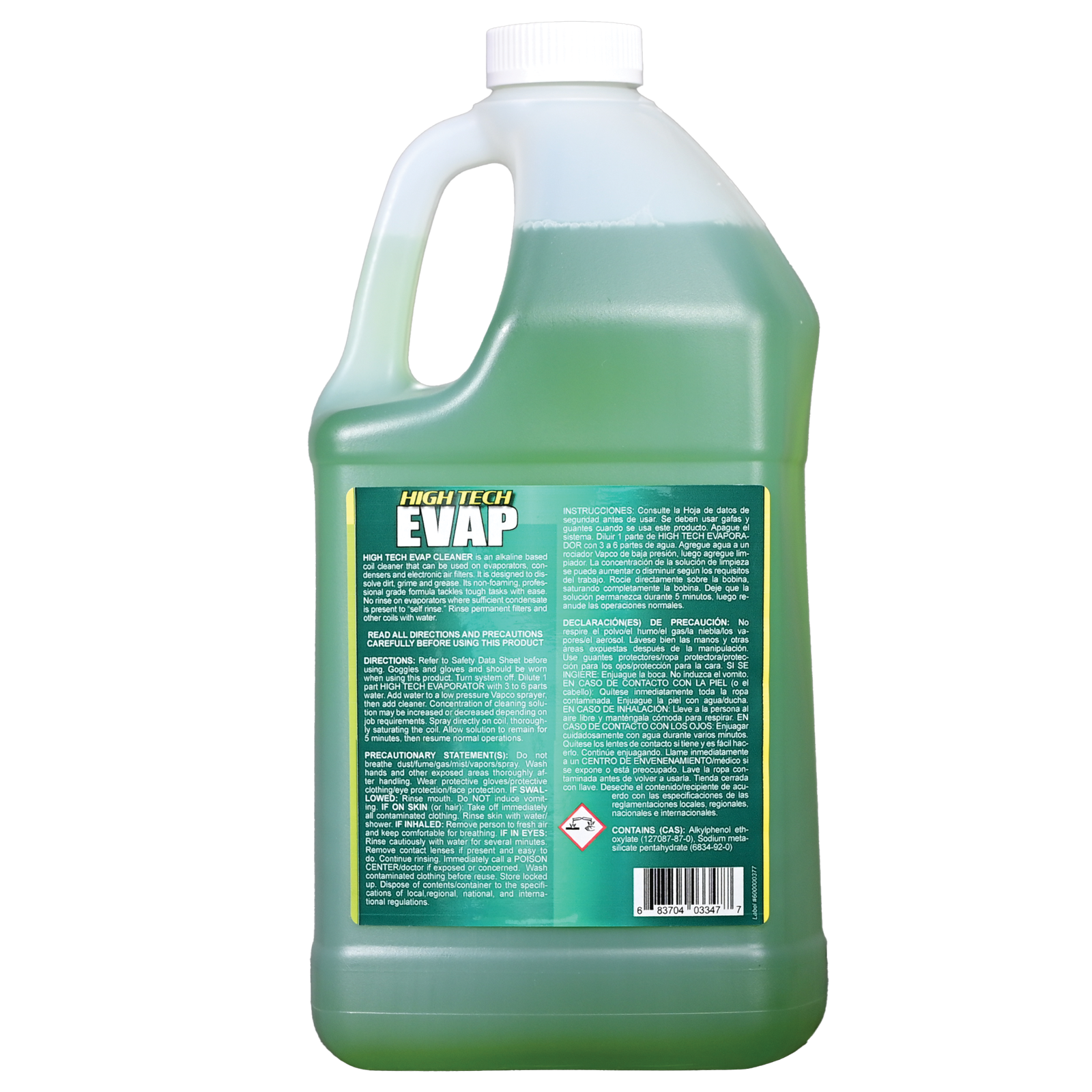
High Tech Evap is a non-foaming, alkaline detergent coil cleaner. Causes severe skin burns and eye damage. Always wear chemical-resistant gloves, goggles/face shield, and protective clothing. Follow product label dilution guidance and rinse protocol for the application.
Field Guide: Contaminant Removal Matrix
High Tech Evap (HTEC) is an evaporator-first liquid coil cleaner built for pump sprayers and real-world indoor coil cleaning where grease, grime, dust/lint, and nicotine film are common. Its non-foaming detergent chemistry emphasizes penetration, emulsification, and controlled runoff. On evaporators, condensate can provide the self-rinse pathway when conditions are correct.
| TARGET CONTAMINANT |
TYPICAL SOURCE |
ACTION |
PERFORMANCE / WHY IT WORKS |
| Oil, Grease & Indoor Film |
Kitchens / Neglected Indoor Coils |
Detergent Emulsification |
Penetrates & Lifts Film: Alkaline detergent chemistry helps break down sticky organic buildup so it can be carried away through rinsing or condensate flow (when applicable). |
| Dust, Lint & Dirt / Grime |
Residential / Light Commercial Indoor Air |
Wetting / Sheeting |
Surfactants improve wetting across fin surfaces and help release common coil fouling so debris can move off the fin pack instead of re-depositing. |
| Tobacco & Nicotine Residue |
Bars / Smoking Areas / Heavy Indoor Film |
Emulsification |
HTEC Strength Zone: High Tech Evap is positioned as a strong performer for tobacco/nicotine-loaded evaporator coils. Heavy deposits may require repeat application and/or manual rinse. |
| Light Soil on Mini-Splits / Micro-Channel Coils |
Modern Equipment / Sensitive Coil Applications |
Controlled Application |
Can be used when following label dilution guidance and controlled dwell. Rinsing is recommended on mini-split and micro-channel applications as a best-practice / CYA protocol. |
System Material Compatibility
| MATERIAL / COMPONENT |
STATUS & PROTOCOL |
| Indoor Evaporator Coils |
✅ RECOMMENDED / SELF-RINSE*
*When unit is in cooling mode and producing sufficient condensate. |
| Mini-Split Evaporator Coils |
✅ USE WITH RINSE RECOMMENDED
Follow label dilution guidance, controlled dwell, and rinse as best practice. |
| Micro-Channel Coils |
✅ USE WITH RINSE RECOMMENDED
Controlled application + avoid over-dwell. Rinse thoroughly, especially on outdoor coils. |
| Permanent Filters |
✅ RECOMMENDED
Use label guidance for soak/spray cleaning and rinse thoroughly with water after cleaning. |
| Outdoor Condenser Coils |
✅ RECOMMENDED (SELECTED APPLICATIONS)
Manual water rinse required. HTEC is evaporator-first; use proper condenser rinse procedure every time. |
HTEC Evaporator “Self-Rinse” Protocol:
The no-rinse evaporator result is a process condition, not a blanket claim. High Tech Evap can function as a self-rinsing evaporator cleaner when the unit is returned to cooling mode and producing enough condensate to flush emulsified debris into the drain pan.
If condensate is not available (dry conditions / heating mode), manual rinsing is required. For mini-splits and micro-channel applications, rinsing is recommended as a best-practice
Directions for High Tech Evap (HTEC-1 / HTEC-5)
1. Preparation
Step 1: Turn Off (Disconnect Power).
- Shut off power to the unit at the disconnect or breaker to ensure safety while working.
- Note: For self-rinse evaporator applications, the unit will be turned back on after dwell time to generate condensate.
Step 2: Brush Off Debris.
- Remove matted cottonwood, leaves, or loose dust from the coil face using a soft brush or shop vac.
- Why? Removing surface debris first helps chemistry penetrate the fin pack instead of getting consumed on loose trash.
2. Mixing & Application
Step 3: Mix in a Pump Sprayer (Follow Label Dilution Guidance).
Always pour chemical into water. Select dilution based on soil load, coil type, and application per current product label.
| APPLICATION |
DILUTION |
RINSE? |
| Indoor Evaporator Coils |
Use label dilution for evaporator cleaning |
NO RINSE* |
| Mini-Split / Micro-Channel Coils |
Use label dilution (controlled application) |
RINSE RECOMMENDED |
| Outdoor Condenser Coils |
Use label dilution for condenser cleaning |
YES (Water Rinse Required) |
| Permanent Filters / Parts |
Use label guidance (soak / spray cleaning) |
YES (Water Rinse) |
*Self-rinse protocol requires cooling mode with sufficient humidity so the coil produces condensate. If condensate is not available, rinse manually.
Step 4: Apply Solution.
- Spray the solution onto the air intake side of the coil using a controlled sweeping motion to saturate the fin pack.
- Target Inner Surfaces: Apply enough solution to wet into the inner rows of the coil pack where soil is trapped.
- Indoor Overspray Control: Use controlled application on indoor coils, mini-splits, and surrounding finished surfaces.
3. Dwell & Rinse Protocol
Step 5: Dwell Time.
- Allow product to dwell long enough to penetrate and emulsify contamination per label guidance.
- Do not allow product to dry on the coil. Re-wet if needed.
- Use shorter, controlled dwell times on sensitive applications (mini-split / micro-channel) and follow with a rinse.
Step 6: Rinse (By Application).
| APPLICATION |
ACTION |
| Outdoor Condenser Coils |
RINSE REQUIRED. Rinse thoroughly with water to remove emulsified debris and cleaner residue. |
| Indoor Evaporator Coils |
SELF-RINSE ALLOWED (conditional). Proceed to Step 7 when condensate-producing conditions are available; otherwise rinse manually. |
| Mini-Split / Micro-Channel Coils |
RINSE RECOMMENDED. Use a controlled water rinse after dwell as a best-practice / CYA protocol. |
| Permanent Filters / Parts |
RINSE REQUIRED. Rinse thoroughly with water after soak/spray cleaning. |
Step 7: Resume Operation (Evaporators).
- Restore power to the unit.
- Run in cooling mode long enough to generate condensate and flush loosened debris into the drain pan.
- Verify drain pan and condensate drain are flowing properly.
🧪 SDS SECTION: HIGH TECH EVAP CLEANER
(HTEC- 1, 5) | Liquid
1. Identification & Supplier Details
Product Identification (Section 1.1)
| GHS Product Identifier (Product Name) |
High Tech Evap |
| Product Number(s) |
HTEC-1, HTEC-5 |
| Brand |
Vapco |
Recommended Use (Section 1.3)
| Recommended Use |
Non-foaming, detergent multi-purpose coil cleaner |
| Restrictions on Use |
N/A (Not Specified) |
Supplier Details & Emergency Contact (Section 1.4 & 1.5)
| Supplier Name |
Vapco Products, Inc. |
| Supplier Address |
401 Marshall Road
Valley Park, Missouri 63088, United States |
| Telephone |
(636) 923-2121 |
| Fax |
(636) 923-3002 |
| Email |
[email protected] |
| Emergency Phone Number |
(800) 255-3924 |
2. Hazard Identification & Composition
GHS Classification (Section 2.1)
| Category |
Classification |
| Acute Toxicity, Inhalation |
Cat. 4 |
| Eye Damage/Irritation |
Cat. 1 |
| Skin Corrosion/Irritation |
Cat. 1 |
GHS Label Elements (Section 2.2)
| Signal Word |
Danger |
| Pictograms |
Corrosion (GHS05), Exclamation Mark (GHS07) |
| Hazard Statement(s) |
- H314: Causes severe skin burns and eye damage
- H332: Harmful if inhaled
|
| Precautionary Statement(s) |
- Prevention: P260, P264, P271, P280
- Response: P301+P330+P331, P303+P361+P353, P304+P340, P305+P351+P338, P310, P312, P321, P363
- Storage: P405
- Disposal: P501
|
Hazardous Components (Section 3.2)
| Chemical Name |
CAS Number |
Concentration (weight %) |
| 2-Butoxyethanol |
111-76-2 |
1 – 10 % |
| Pentasodium triphosphate |
7758-29-4 |
1 – 10 % |
| Dodecylbenzenesulfonic acid, sodium salt |
68081-81-2 |
0.1 – 1 % |
| Potassium Hydroxide |
1310-58-3 |
0.1 – 1 % |
3. Physical & Chemical Properties
Basic Physical and Chemical Properties (Section 9)
| Physical State |
Liquid |
| Appearance / Color |
Clear liquid / Green |
| Odor / Odor Threshold |
Bland odor / N/D |
| pH |
12-13 |
| Melting Point/Freezing Point |
< 32°F (0°C) |
| Boiling Point or Boiling Range |
> 212°F (100°C) |
| Flash Point |
N/D (Not considered a flammable liquid) |
| Flammability (Solid, Gas) |
Not considered to be a flammable liquid by OSHA (29 CFR 1910.1200) |
| Vapor Pressure |
23.8 mmHg at 77°F (25°C) |
| Relative Vapor Density |
1 (Air=1) |
| Density and/or Relative Density |
1.02 at 77°F (25°C) |
| Solubility |
Completely soluble in water |
| Evaporation Rate |
< 0.8 (Slow) |
| Volatile Organic Compounds (VOCs) |
< 4% |
4. Stability & Reactivity
Reactivity and Stability (Section 10)
| Reactivity |
May react with chemically active metals and strong acids. |
| Chemical Stability |
Stable under normal conditions of use. |
| Possibility of Hazardous Reactions |
None known. |
| Conditions to Avoid |
Chlorine-liberating material. Do not mix with bases, ammonia, or other cleaning compounds. |
| Incompatible Materials |
Strong acids. |
| Hazardous Decomposition Products |
Oxide(s) of carbon, sodium and silicon. |
5. Toxicological Information
Information on Toxicological Effects (Section 11)
| Acute Toxicity (ATE) |
Gas Inhalation ATE (mixture): 7000 ppmV. Vapor Inhalation ATE: 30 mg/l. Oral ATE (mixture): 4545.45 mg/kg bw. |
| Acute Toxicity (Component LD50/LC50) |
2-Butoxyethanol: LD50 Oral (Rat) – 880 mg/kg; LD50 Skin (Rabbit) – 1,060 mg/kg; LC50 Inhalation (Rat) – 450 ppm. |
| Skin Corrosion/Irritation |
Causes severe burns, prolonged contact will destroy tissues. |
| Serious Eye Damage/Irritation |
Causes severe burns, stinging, redness, swelling, and may cause corneal damage, blindness. |
| Respiratory or Skin Sensitization |
May cause irritation (possible severe), chemical burns, upper respiratory damage and pulmonary edema. |
| STOT – Repeated Exposure |
Dermatitis may occur due to long-term irritation. Potential loss of sight. |
| Carcinogenicity/Mutagenicity/Reproductive Toxicity |
Not classified. |
6. First-Aid Measures
Description of Necessary First-Aid Measures (Section 4.1)
| General Advice |
Never give anything by mouth to an unconscious person. If you feel unwell, seek medical advice. |
| If Inhaled |
Remove person to fresh air. Keep comfortable for breathing. Get medical advice/attention. |
| In Case of Skin Contact |
Immediately drench affected area with water for at least 15 minutes. Take off immediately all contaminated clothing. Obtain medical attention if irritation develops or persists. |
| In Case of Eye Contact |
Immediately rinse cautiously with water for several minutes (at least 15 minutes). Remove contact lenses if present. Continue rinsing. Immediately call a POISON CENTER/doctor. |
| If Swallowed |
Rinse mouth. Do NOT induce vomiting. Obtain medical attention. |
Immediate Medical Attention & Special Treatment (Section 4.3): If exposed or concerned, get medical advice and attention. The absence of visible signs or symptoms of burns does not reliably exclude the presence of actual tissue damage.
7. Fire-Fighting & Accidental Release Measures
Fire-Fighting Measures (Section 5)
| Suitable Extinguishing Media |
Water spray, fog, carbon dioxide (CO2), alcohol-resistant foam, dry chemical, or sand. Use appropriate media for surrounding fire. |
| Specific Hazards / Reactivity |
May react with chemically active metals and acids. |
| Hazardous Combustion Products |
Carbon, sodium and silicon oxide(s). |
| Protection During Firefighting |
Wear NIOSH-approved Self-Contained Breathing Apparatus (SCBA) with full face piece and full body protective clothing. Do NOT fight fire when fire reaches containers. |
Accidental Release Measures (Section 6)
| Personal Precautions/PPE |
Do not get in eyes, on skin, or on clothing. Do not breathe vapors. Keep away from heat/ignition sources. Use appropriate PPE. |
| Environmental Precautions |
Avoid release into the environment. Prevent product from entering drains. Report spills as required. |
| Containment & Clean Up Methods |
Ventilate the area. Contain spills with dikes or absorbents. Eliminate all ignition sources. Take up liquid spill into absorbent material. |
8. Handling, Storage & PPE
Precautions for Safe Handling (Section 7.1)
| Precautions for Safe Handling |
Do not handle until all safety precautions have been read and understood. Avoid contact with skin, eyes and clothing. Wash hands and other exposed areas thoroughly after handling. |
| Additional Hazards When Processed |
Do not pressurize, cut, or weld containers. Pressurized container: May burst if heated. Do not pierce or burn. |
Conditions for Safe Storage (Section 7.2)
| Storage Conditions |
Store locked up/in a secure area. Store in a dry, cool, well-ventilated place away from ignition sources. Protect from sunlight. Do not expose to temperatures exceeding 50°C/122°F. |
| Incompatible Materials |
Strong acids. |
Individual Protection Measures (PPE) (Section 8.3)
| Appropriate Engineering Controls |
Emergency eye wash fountains and safety showers should be available. Ensure adequate ventilation. Use explosion-proof equipment. |
| Eye/Face Protection |
Chemical safety goggles. |
| Skin/Body Protection |
Wear protective gloves (chemical resistant) and clothing. Wear fire/flame resistant/retardant clothing. |
| Respiratory Protection |
Use a NIOSH-approved Self-Contained Breathing Apparatus whenever exposure may exceed established Occupational Exposure Limits. |
9. Transport & Regulatory Information
Transport Information (Section 14)
| Regulation |
UN Number |
Class / PG |
Proper Shipping Name |
| DOT (US) |
UN1719 |
8 / III |
Caustic alkali liquids, n.o.s. |
| IMDG |
UN1719 |
8 / III |
Caustic alkali liquids, n.o.s. |
| IATA |
UN1719 |
8 / III |
Caustic alkali liquids, n.o.s. |
Regulatory Information (Section 15)
| SARA 311/312 Hazards |
Fire Hazard, Acute Health Hazard, Chronic Health Hazard |
| SARA 313 Components |
Ethylene glycol monobutyl ether (CAS No. 111-76-2) |
| California Prop. 65 |
This product does not contain any chemicals known to State of California to cause cancer, birth defects, or any other reproductive harm. |
| US EPA TSCA Public Inventory |
All hazardous components are listed. |
10. Disposal & Ecological Information
Ecological Information (Section 12)
| Persistence and Degradability |
Component(s) of this product are not biodegradable. |
| Bioaccumulative Potential |
This product is not expected to bioaccumulate. |
| Mobility in Soil |
This product is mobile in soil. |
Disposal Considerations (Section 13)
| Product Disposal / Waste Treatment |
Dispose of contents/container in accordance with local, regional, national, and international regulations. Product should be fully characterized prior to disposal (RCRA Status: 40 CFR 261). |
| Sewage Disposal |
Avoid release into the environment. This material is hazardous to the aquatic environment. Keep out of sewers and waterways. |
11. Disclaimer & Preparation Information
Preparation Information (Section 16.2)
| Prepared by |
Jessica Wilson |
| Date Prepared |
2-19-2025 |
Disclaimer (Section 16.1):
To the best of our knowledge, information contained herein is accurate. However there is no assumption of liability for the accuracy or completeness of the information contained herein. Final determination of suitability of any material is the sole responsibility of the user. All materials may present unknown hazards and should be used with caution. The information contained in this SDS was obtained from current and reliable sources; however, the data is provided without warranty, expressed or implied, regarding its correctness or accuracy. Since the conditions of handling, storage and disposal of this product are beyond the control of the manufacturer, the manufacturer will not be responsible for loss, injury, or expense arising out of the products improper use. The user is responsible for full compliance with various government agency regulations.
Key: N/A = Not applicable; N/D = Not determined
Specs & Logistics
1. Physical & Chemical Properties
| Base Chemistry |
Alkaline Detergent Coil Cleaner (Potassium Hydroxide + Surfactant System) |
| pH Level (As Packaged) |
12–13 (Highly Alkaline) |
| Specific Gravity / Relative Density |
1.02 @ 77°F (25°C) |
| Viscosity |
Low (Pump sprayer friendly) |
| VOC Content |
< 4% (See SDS for details) |
| Solubility |
Completely Soluble in Water |
| Appearance |
Clear Liquid (Green) |
| Odor |
Bland Odor |
| Flash Point |
N/D (Not considered a flammable liquid) |
| Performance Profile |
Non-foaming, evaporator-first detergent cleaner designed for penetration, emulsification, and controlled runoff; self-rinsing on evaporators when condensate is present (conditional). |
| Recommended Dilution Range |
Use label dilution guidance based on soil load, coil type, and application (evaporator, mini-split/micro-channel, condenser, filters/parts). |
| Shelf Life |
3+ Years (Stored in closed container) |
| Freeze/Thaw Stability |
Stable. (Allow to thaw and shake well before use) |
2. UN & DOT Shipping Classification
| Proper Shipping Name: |
Caustic alkali liquids, n.o.s. |
| UN Number: |
UN1719 |
| Hazard Class: |
8 (Corrosive) |
| Packing Group: |
III |
| Label Required: |
Corrosive (Class 8) |
3. Master Shipping & Dimensions Guide
| ITEM |
INDIVIDUAL UNIT |
QTY / CASE |
CASE SPECS |
PALLET CONFIGURATION |
CODE |
| Part # |
Wt (lbs) |
H (in) |
W (in) |
L (in) |
Units |
Wt (lbs) |
H (in) |
W (in) |
L (in) |
Cases/Pallet |
Total Units |
Wt (lbs) |
H (in) |
W (in) |
L (in) |
UPC |
HTEC-1
(1 Gal) |
8.75 |
11.5 |
5 |
5 |
4 |
35.95 |
12.56 |
12 |
12 |
48 |
192 |
1760.6 |
50.5 |
40 |
48 |
683704033347 |
Harmonized Tariff Code (HTS): 3402.20.5100 (Cleaning Preparations)
NMFC Code: 48580 (Compounds, Cleaning, Liquid) – Class 55