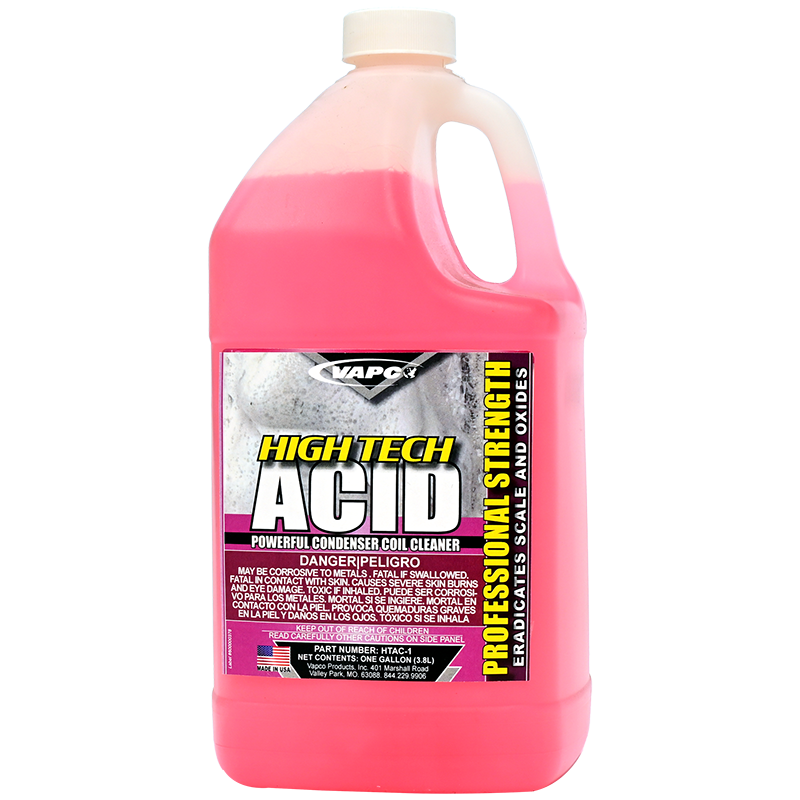
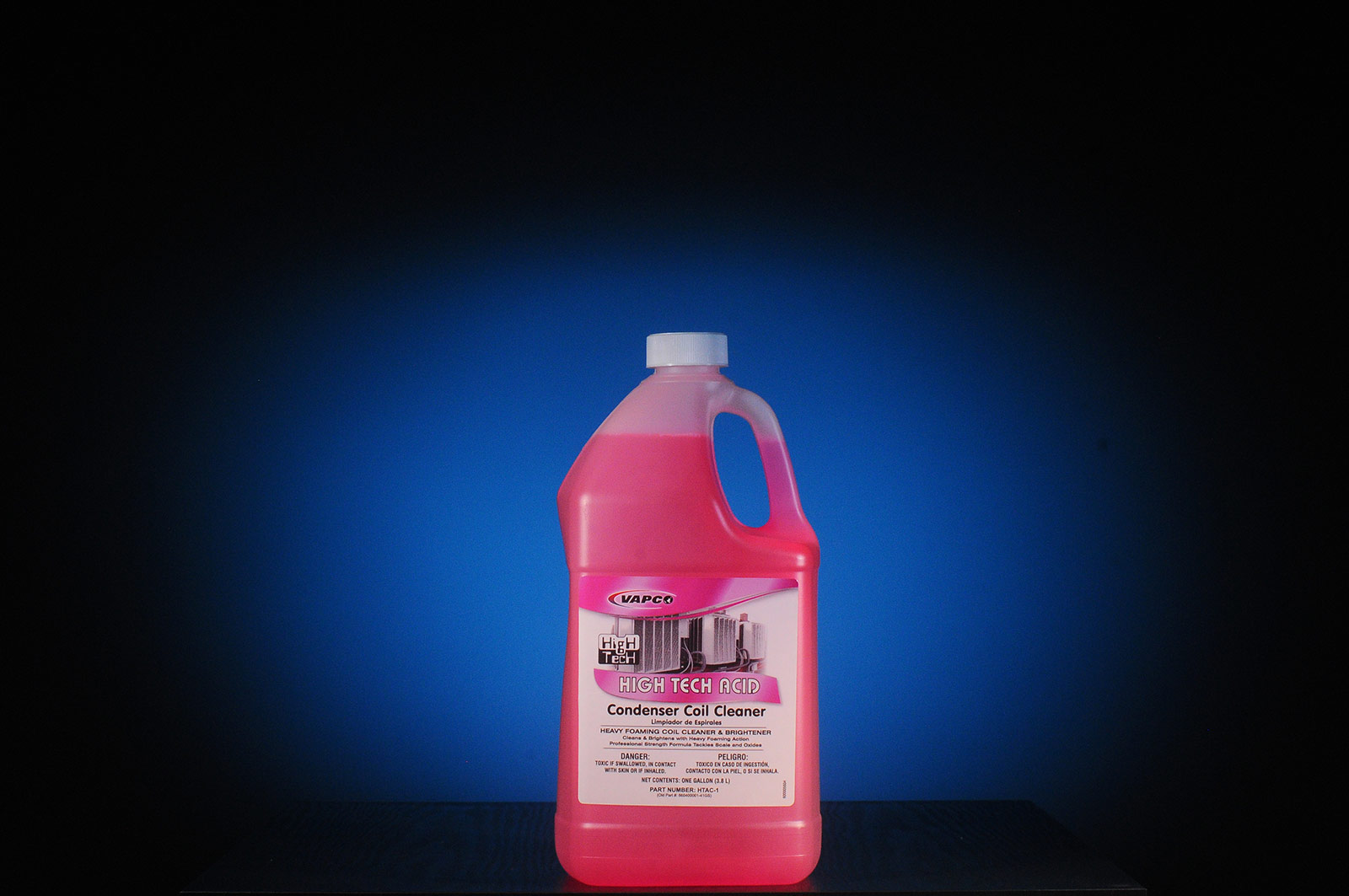
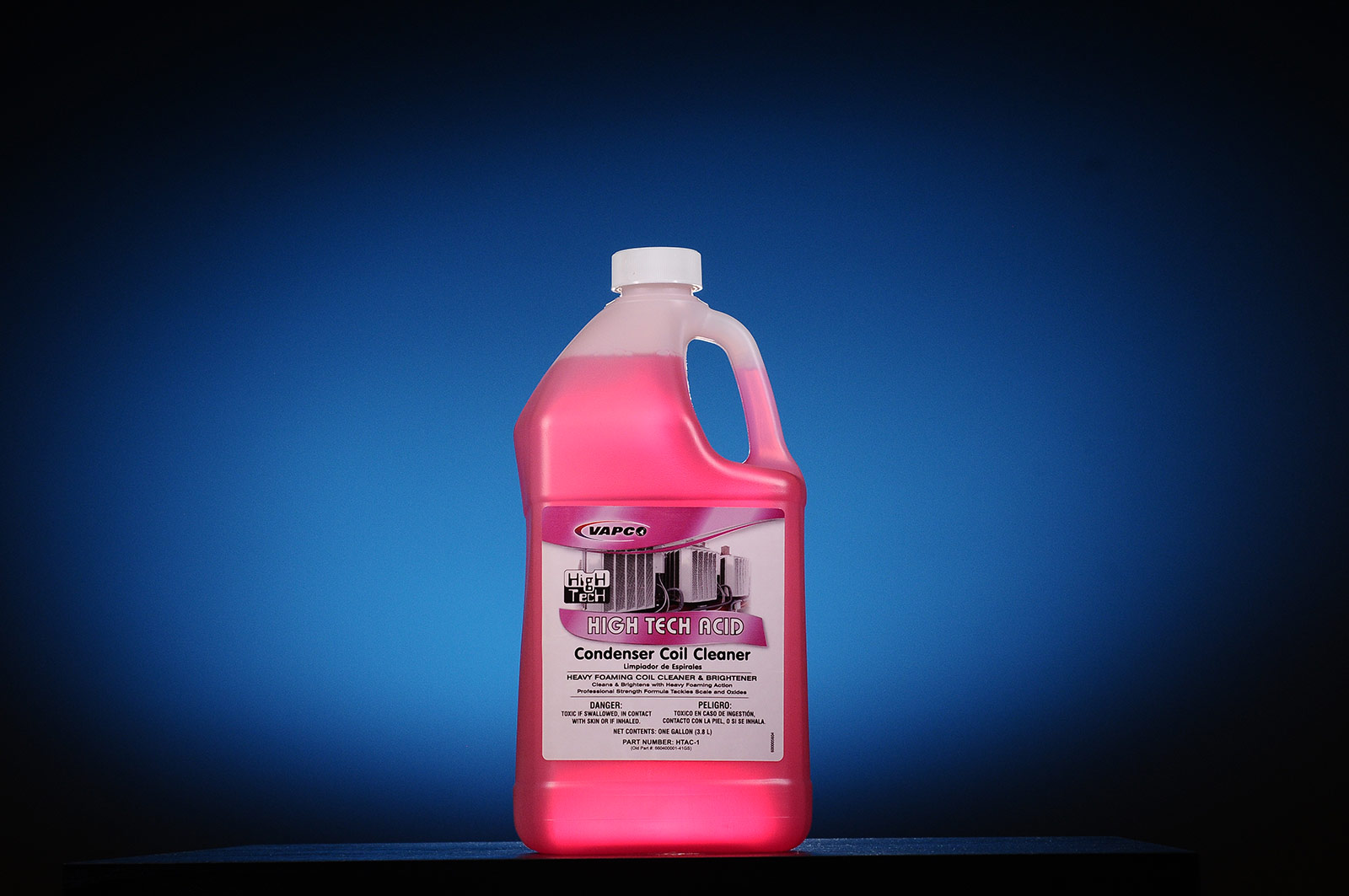
HIGH TECH ACID – is one of the few remaining hydrofluoric acid coil cleaners on the market. If used responsibly with proper safety precautions, it is a hard coil cleaner to match in effectiveness. It foams heavily and leaves coils bright-looking, almost factory new. Rinsing is always required on condensers and instructions should be followed.
Powerful and Cost-Effective Coil Cleaning Solution
HIGH TECH ACID is a high-performance acid-based condenser coil cleaner that rivals top-tier products in effectiveness.Its powerful formula dissolves dirt, grime, scale, and oxides, leaving coils clean, shiny, and like new.
Powerful Cleaning Action: Removes stubborn contaminants with ease.
Heavy Foaming Action: Ensures deep penetration and thorough cleaning.
Cleans and Brightens Coils: Restores the appearance and efficiency of coils.
Cost-Effective: Offers excellent value compared to other coil cleaners.
Concentrated Formula: One gallon makes four gallons of ready-to-use cleaner.
Zero VOC Content: Environmentally friendly and safe to use.
HIGH TECH ACID is a reliable and effective coil cleaning solution that can be used on a variety of HVAC systems. Its powerful cleaning action, versatility, and cost-effectiveness make it an ideal choice for professionals and homeowners alike.
Part Number; Size
HTAC-1 1 gal 4/cs
HTAC-5 5 gallons
Directions:
Effective Coil Cleaning for HVAC Systems
Before Use:
Consult SDS: Refer to the Safety Data Sheet (SDS) for detailed safety information.
Wear Protective Gear: Always wear goggles, gloves, and protective clothing.
Application:
Power Off: Turn off the HVAC system.
Dilute: Mix 1 part HIGH TECH ACID with 3 parts water. Adjust the ratio based on the level of dirt and grime.
Prepare Sprayer: Add water to a low-pressure Vapco sprayer, then add the diluted cleaner.
Spray Coil: Spray the solution directly onto the coil, ensuring thorough saturation.
Allow to Sit: Let the solution sit for 5 minutes.
Rinse Thoroughly: Rinse the coils completely to remove any remaining solution and foam.
By following these steps, you can effectively clean your HVAC coils using HIGH TECH ACID.
DANGERS & PRECAUTIONS:
Read and understand the product’s label and Safety Data Sheet. Do not breathe mists. Wash hands/gloves thoroughly after handling. Provide adequate ventilation to keep the vapor concentration below TLV. May be corrosive to metals. This product may remove anodizing. It may also etch windows or other glass surfaces and may affect galvanized or painted surfaces. Protect all such surfaces during application. In case of contact, rinse immediately. DO NOT use it in any manner for which it was not designed. Always wear chemical resistant gloves, safety glasses, and protective clothing when applying product. Do NOT handle or use this product until all safety precautions have been read and understood. Chlorine liberating material. Do not mix with bases, ammonia, or other cleaning compounds. Provide adequate ventilation to keep the vapor concentration below TLV.
Do not use on cooking utensils and do not transfer the contents of the bottle to another container.
Never give anything by mouth to an unconscious person. If you feel unwell, seek medical advice (show the label where possible).
If Inhaled
Ensure your own safety first. Remove exposed person to fresh air. Keep at rest. Get medical advice/attention.
In Case of Skin Contact
Immediately drench affected area with water for at least 15 minutes. Remove contaminated clothing immediately. Get medical attention.
In Case of Eye Contact
Immediately rinse with water for at least 15 minutes. Remove contact lenses. Continue rinsing. Get medical attention.
If Swallowed
Rinse mouth. Do NOT induce vomiting. Obtain medical attention.
Immediate Medical Attention & Special Treatment
Get medical advice and attention immediately. Note to physician: The absence of visible signs or symptoms of burns does not reliably exclude the presence of actual tissue damage.
7. FIRE-FIGHTING & ACCIDENTAL RELEASE MEASURES
Fire-Fighting Measures (Section 5)
Suitable Extinguishing Media
Water spray, fog, carbon dioxide (CO2), alcohol-resistant foam, dry chemical, or sand. Use appropriate media for surrounding fire.
Specific Hazards
May be corrosive to metals and reactive to strong bases. Increased risk of fire or explosion.
Protection During Firefighting
Do not enter fire area without proper PPE. Wear NIOSH-approved Self-Contained Breathing Apparatus (SCBA) with full face piece and full body protective clothing. Fight fire remotely.
Accidental Release Measures (Section 6)
Personal Precautions (Non-Emergency)
Do not get in eyes, on skin, or on clothing. Do not breathe vapors. Keep away from heat, sparks, open flames, and other ignition sources.
Containment
Ventilate the area. Contain any spills with dikes or absorbents to prevent further migration and entry into sewers or streams. Isolate spill area immediately.
Cleaning Up
Clean up spills immediately. Eliminate all ignition sources. Ventilate area. Take up liquid spill into absorbent material. Transfer spilled material to a suitable container for disposal.
8. HANDLING, STORAGE & PPE
Handling & Storage (Section 7)
Precautions for Safe Handling
Do not handle until all safety precautions have been read and understood. Avoid contact with skin, eyes and clothing. Do not breathe gas, mist, spray, vapors. Follow proper grounding procedures.
Conditions for Safe Storage
Store in a dry, cool, well-ventilated place away from ignition sources. Protect from sunlight. Keep away from incompatible materials (strong alkalis, strong oxidizing agents). Store locked up/in a secure area.
Exposure Controls & Personal Protective Equipment (PPE) (Section 8)
Emergency eye wash fountains and safety showers must be available. Ensure adequate ventilation, especially in confined areas. Use explosion-proof equipment.
Use a NIOSH-approved Self-Containing Breathing Apparatus (SCBA) whenever exposure may exceed established Occupational Exposure Limits.
9. DISPOSAL & ECOLOGICAL INFORMATION
Disposal Considerations (Section 13)
Product Disposal
Dispose of contents/container in accordance with local, regional, national, and international regulations.
Waste Classification
May be subject to disposal regulations (U.S. EPA 40 CFR 261). Hazardous waste number(s): D002 (Corrosivity).
Sewage Disposal
Waste should not be disposed of untreated to the sewer unless fully compliant with all authority requirements.
Ecological Information (Section 12)
Toxicity
Not classified.
Persistence and Degradability
This product is biodegradable.
Mobility in Soil
This product is mobile in soil.
10. TRANSPORT & REGULATORY INFORMATION
Transport Information (Section 14)
Regulation
UN Number
Proper Shipping Name
Class / Packing Group
DOT (US), IMDG, IATA
UN1760
Corrosive liquids, n.o.s
Class 8 / PG II
Regulatory Information (Section 15)
Regulation/List
Component (CAS No.)
Massachusetts Right To Know / TURA List
Hydrofluoric Acid (7664-39-3)
New Jersey Right To Know
Hydrogen Fluoride (7664-39-3)
Pennsylvania Right To Know
Hydrofluoric Acid (7664-39-3)
US EPA TSCA Public Inventory
hydrofluoric acid 49% (7664-39-3)
11. DISCLAIMER & PREPARATION INFORMATION
Disclaimer (Section 16.1)
To the best of our knowledge, information contained herein is accurate. However, there is no assumption of liability for the accuracy or completeness of the information. Final determination of suitability of any material is the sole responsibility of the user. All materials may present unknown hazards and should be used with caution. The information is provided without warranty, expressed or implied. Since the conditions of handling, storage and disposal of this product are beyond the control of the manufacturer, the manufacturer will not be responsible for loss, injury, or expense arising out of the product’s improper use. The user is responsible for full compliance with government regulations.