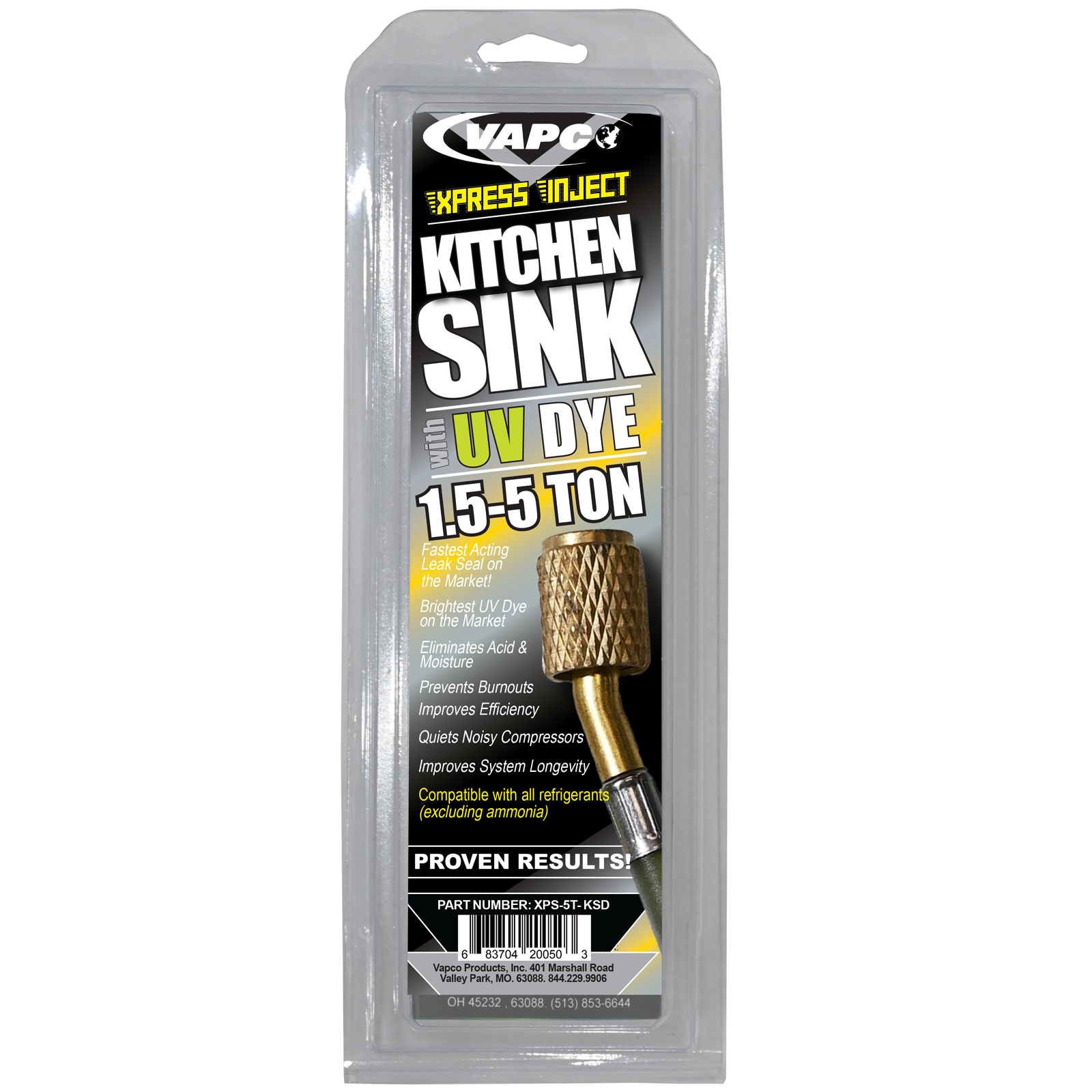
KITCHEN SINK WITH UV DYE
Truly All-In-One – Seal + Protect + Enhance + UV DYE
KITCHEN SINK WITH UV DYE – Built for technicians who want maximum impact in minimum time, KSD packs four service functions into one Xpress Inject tube. The sealing component targets qualifying micro-leaks and forms durable, long‑lasting seals to help cut refrigerant loss and keep systems online. System Protect scavenges moisture and neutralizes acids—helping defend compressors, oils, and internal components from corrosion, sludge, and premature wear. System Enhance smooths operation by reducing noise and helping boost efficiency for cleaner, more reliable performance. A high‑visibility UV dye circulates with the refrigerant and fluoresces under UV light, allowing fast leak pinpointing and repair confirmation. Inject on the low side with the system running to simplify service, reduce callbacks, and consolidate truck stock—all while leaving fewer problems behind. When you need to throw everything at it…but the Kitchen Sink.
Key Features and Benefits:
- All‑in‑one cartridge: seal + protect + enhance + UV dye in a single Xpress Inject
- Fast‑acting leak sealing: forms durable, long‑lasting micro‑seals at leak sites to help reduce refrigerant loss
- System Protect: removes moisture and neutralizes acids to help prevent corrosion, sludge, and compressor damage
- System Enhance: reduces system noise and helps improve operating efficiency for smoother performance
- Built‑in UV DYE: high‑visibility dye speeds leak detection and post‑repair verification under UV light
- Polymer‑free, compressible formula: designed not to clog TXVs, cap tubes, or metering devices
- Low‑side injection: quick, easy application with the system running
- Time and inventory savings: fewer add‑ons to carry; fewer diagnostic steps and callbacks
- Broad application: residential and light commercial A/C and heat pumps; see model sizing for coverage
- Compatibility: works with all common refrigerants and oils; not for ammonia (NH3). A2L compatible.
Part Number
- XPS-5T-KSD 1.5 to 5 Ton – 4/cs
- XPS-15T-KSD 6 to 15 Ton – 4/cs
- ACCESSORIES – (NOT REQUIRED)
Directions:
This product must be used in accordance with the following directions and by professionals only.
Always read the product label and Safety Data Sheet (SDS) for complete precautionary and first aid information before use.
XPRESS SEAL is designed for quick and effective leak sealing in HVACR systems. Choose the method below that best suits your equipment and job site conditions.
General Safety & Pre-Installation Checks (Applicable to All Methods)
Before beginning, ensure the system is ready and you have the correct XPRESS SEAL product for the system’s tonnage.
- Safety First: Always wear appropriate personal protective equipment (PPE), including safety glasses and protective gloves, when working with refrigerants and sealants.
- Identify Ports: Clearly identify the low-side (suction) and high-side (liquid) service ports on the system.
- System Running & Mode:
- Ensure the HVACR system is powered on and running, with the compressor engaged.
- If working on a heat pump, set the system to Cooling Mode for optimal sealant distribution.
- System Charge: Verify the system has an adequate refrigerant charge. XPRESS SEAL can be injected into a fully charged or partially low system; if significantly low, you may use refrigerant to push the sealant (see Traditional Method alternative).
- Refrigerant Compatibility: Confirm the system is NOT an ammonia (NH3) system, as XPRESS SEAL is not compatible.
- XPRESS SEAL Size: Ensure you have selected the appropriate XPRESS SEAL cartridge size for the system’s tonnage (e.g., XPS-Mini, XPS-5T, XPS-60T).
- Inspect XPRESS SEAL Tube: Do not bend, cut, or deform the tube. Check to ensure small nitrogen bubble is present and free moving in the tube.
Post-Injection Best Practices (Applicable to All Methods)
After injecting XPRESS SEAL, it’s crucial to allow the product to fully circulate and activate:
- Run Time: Run the AC unit for a minimum of one (1) hour immediately after injecting XPRESS SEAL. This ensures thorough circulation of the sealant throughout the system. For larger systems or very cold conditions, allow for even longer run times (e.g., 2-4 hours).
- System Monitoring: Monitor the system’s operating pressures and temperatures. XPRESS SEAL is designed not to alter system performance or clog metering devices.
- Leak Verification: After the recommended run time, verify leak resolution using standard diagnostic methods.
- Documentation: Document the application of XPRESS SEAL in the system’s service log, including date, product size, and method used.
Important Notes for Professionals
- Refrigerant Charging Concurrent with Sealant: If the system is low on refrigerant, XPRESS SEAL can be injected concurrently with refrigerant charging. Simply connect the XPRESS Inject to the service port and push the sealant into the system using the refrigerant being added, following the appropriate method.
- No Pump Down Required: XPRESS SEAL does not require pumping down the system for injection, regardless of refrigerant type.
- Polymer-Free Formulation: XPRESS SEAL is formulated to be “polymer free” while in the tube and circulating through the system, protecting sensitive system components.
Contact Us
News and Updates
Subscribe on Youtube
Follow Us on Facebook
SDS
⚠️ KITCHEN SINK WITH UV DYE – SDS – DOWNLOAD
Vapco Products, Inc.
Safety Data Sheet
Xpress Inject Kitchen Sink with UV Dye
SECTION 1: Identification
| Product name |
Xpress Inject Kitchen Sink with UV Dye |
| Product number |
XPS-5T-KSD, XPS-15T-KSD, XPS-30T-KSD, XPS-60T-KSD |
| Brand |
Vapco |
| Recommended use |
Seal, Protect and increase cooling in A/C systems |
| Supplier Details |
Vapco Products, Inc.
401 Marshall Road, Valley Park, MO 63088
United States |
| Emergency phone |
(800) 255-3924 |
SECTION 2: Hazard identification
| GHS Classification |
Aspiration hazard, Cat. 1; Eye damage/irritation, Cat. 2A; Flammable liquids, Cat. 2; Toxic to reproduction, Cat. 2; Skin corrosion/irritation, Cat. 2; STOT RE, Cat. 2; STOT SE, Cat. 3 |
| Signal word |
DANGER |
| Hazard statement(s) |
H225: Highly flammable liquid and vapor; H304: May be fatal if swallowed and enters airways; H315: Causes skin irritation; H319: Causes serious eye irritation; H336: May cause drowsiness or dizziness; H361: Suspected of damaging fertility or the unborn child; H373: May cause damage to organs through prolonged or repeated exposure |
SECTION 3: Composition/information on ingredients
| Hazardous Component |
CAS No. |
Concentration |
| Distillates (petroleum), hydrotreated heavy paraffinic |
64742-54-7 |
30 – 70 % (weight) |
| Silane, ethenyltriethoxy- |
78-08-0 |
5 – 40 % (weight) |
| Ethanol |
64-17-5 |
2 – 10 % (weight) |
| Toluene |
108-88-3 |
0.02 – 0.5 % (weight) |
| Benzenesulfonic acid, monosodium salt |
587-98-4 |
0.01 – 0.05 % (weight) |
SECTION 4: First-aid measures
| Inhaled |
Remove to fresh air. Keep at rest. Get medical advice/attention. |
| Skin Contact |
Drench with water for 15 minutes. Remove contaminated clothing. Obtain medical attention. |
| Eye Contact |
Rinse with water for 15 minutes. Remove contact lenses. Continue rinsing. Obtain medical attention. |
| Swallowed |
Rinse mouth. Do NOT induce vomiting. Obtain medical attention immediately. |
SECTION 5: Fire-fighting measures
| Extinguishing media |
CO2, alcohol-resistant foam, dry chemical, or sand. |
| Firefighting instructions |
Do not breathe fumes. Fight fire remotely due to explosion risk. Cool containers with water spray. |
SECTION 6: Accidental release measures
| General Measures |
Eliminate ignition sources. No smoking. Avoid breathing vapors. Ventilate area. |
| Cleanup |
Take up liquid spill into absorbent material. Transfer to suitable container for disposal. |
SECTION 7: Handling and storage
| Handling |
Avoid contact with skin, eyes, and clothing. Wash hands after handling. Handle empty containers with care. |
| Storage |
Store in dry, cool, well-ventilated place. Protect from sunlight. Store locked up. |
SECTION 8: Exposure controls/personal protection
| Exposure Parameters |
Ethanol: 1000 ppm (TWA/PEL/REL). Toluene: 50 ppm (TWA), 150 ppm (STEL). |
| PPE |
Chemical safety goggles, protective gloves/clothing, fire-retardant clothing, NIOSH SCBA. |
SECTION 9: Physical and chemical properties
| Physical state / Color |
Liquid / Yellow/green/brown |
| Flash point |
13°C (55°F) |
| Boiling point |
78°C (173°F) |
| Density |
0.7893 g/cm3 at 20°C |
SECTION 10: Stability and reactivity
| Chemical stability |
Highly flammable liquid and vapor. May form explosive vapor-air mixture. |
| Incompatible materials |
Heat sources, strong acids, strong bases, strong oxidizing agents. |
SECTION 11: Toxicological information
| Acute Toxicity |
Ethanol LD50 (Oral, Rat): 7,060 mg/kg; Toluene LD50 (Oral, Rat): >5,580 mg/kg. |
| Reproductive toxicity |
Damage to fetus possible. Suspected human reproductive toxicant. |
SECTION 12: Ecological information
| Toxicity (Toluene) |
LC50 (Rainbow trout): 7.63 mg/l – 96 hrs; EC50 (Water flea): 8.00 mg/l – 24 hrs. |
SECTION 13: Disposal considerations
| Waste Disposal |
Burn in a chemical incinerator equipped with an afterburner and scrubber. Dispose of as unused product. |
SECTION 14: Transport information
| DOT/IMDG/IATA |
UN Number: ID8000; Class: 9; Proper Shipping Name: Consumer commodity |
SECTION 15: Regulatory information
| California Prop 65 |
WARNING: This product contains Toluene, known to cause birth defects or other reproductive harm. |
| Right to Know |
Ethanol and Toluene are listed in MA, NJ, and PA components. |
SECTION 16: Other information
| Disclaimer |
Information is accurate to the best of our knowledge. Final determination of suitability is the sole responsibility of the user. |
| Preparation Info |
Prepared by: Jessica Wilson; Date prepared: 1/23/2026 |