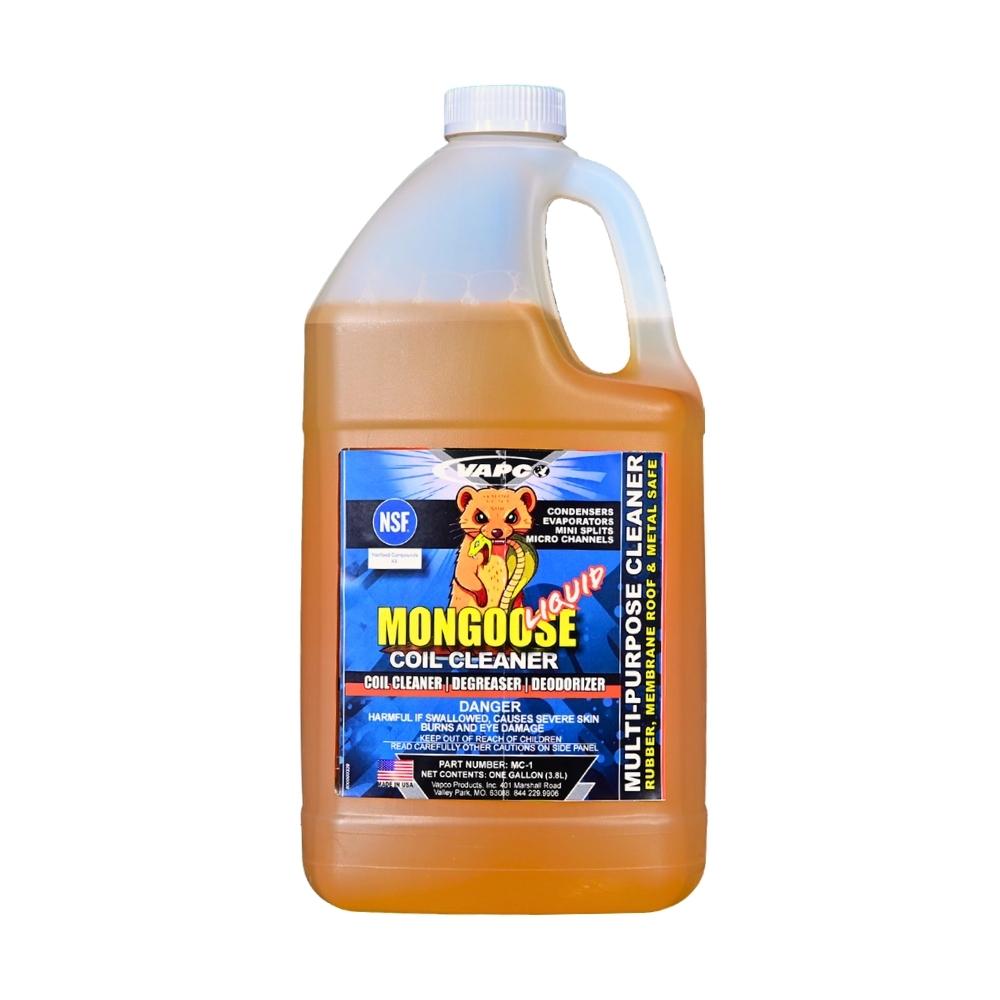
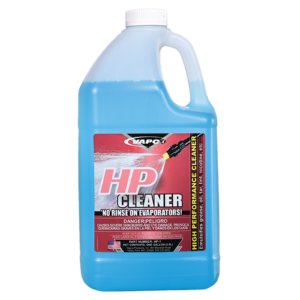
Mini Split Coil Cleaner | Mongoose Liquid (NSF Registered)
Complete control for cleaning any unit you come across.
Real results come from chemistry + procedure—not foam theatrics. Many “heavy duty” cleaners chase instant visual drama (thick foam, harsh reaction), but that’s exactly what makes technicians nervous on microchannel and mini-split coils. Mongoose Liquid is built to be the safe go-to: strong on grease, grime and contaminants but compatible with modern coils. It is engineered for pump sprayers but can be used in hose end guns making it ideal for repeat PM work.
Mongoose focuses on Saponification—the chemical process of turning heavy fats and cooking oils into water-soluble soap—so contamination lifts, emulsifies, and moves with the rinse pathway. Use it strong for condenser degreasing (rinse with water), or use the evaporator dilution where condensate provides the self-rinse during cooling operation.
Manufacturer’s Tech Note: The “No-Rinse” evaporator result is a process, not a gimmick. At the evaporator dilution, Mongoose is designed to liquefy and drain when the system is producing condensate—allowing gravity and condensation to pull emulsified debris into the drain pan.
*Ensure the unit is in cooling mode producing condensate for the self-rinse feature to function. If cleaning heating coils, fans, or dry conditions with no condensate, manual rinsing is required.*
The Efficiency Math: One Jug, Multiple Jobs
Why buy ready-to-use gallons when you can dial the strength to the application? The Mongoose concentrate gives you controlled performance for both sides of the unit—without over-aggressiveness on sensitive coils.
- Condenser Mix: 4:1 (water:cleaner) = 5 gallons of ready-to-use solution per 1 gallon of concentrate (rinse with water).
- Evaporator / Mini-Split / Microchannel Mix: 10:1 (water:cleaner) = 11 gallons of ready-to-use solution per 1 gallon of concentrate (self-rinse when condensate is present).
| KEY FEATURE / SPECIFICATION |
TRADE BENEFIT / RESULT |
| Liquid Concentrate for Pump Sprayers |
More Coverage, Less Waste: Built for large coils, PM routes, and consistent application strength—without hauling cases of aerosol. |
| Two-Strength Workflow (4:1 / 10:1) |
Right Tool for the Right Side: Strong condenser degreasing with a rinse; evaporator cleaning that self-rinses when condensate is present. |
| NSF Registered Coil Cleaner (K4) |
Audit Ready: Approved for use in and around food processing areas. The safe choice for restaurants, walk-ins, prep areas, and more (used as directed). |
| Saponification Chemistry |
Grease Destroyer: Targets animal fats and vegetable oils—turning sticky kitchen grime into water-soluble “soapy” runoff that drains cleanly. |
| Modern-Coil Compatibility |
Asset Protection: Designed for microchannel and mini-split applications when used as directed, without relying on aggressive “reaction foam” behavior. |
Vapco Field Guide: Dilution & Procedure Matrix
Use the correct strength and rinse logic for the surface you’re cleaning.
| APPLICATION |
DILUTION |
DWELL TIME |
RINSE INFO |
| Condensers |
4:1
(water:cleaner) |
5–7
minutes |
Rinse with water. Reapply for extreme soil. |
| Evaporators / Mini-Splits /
Micro-channel |
10:1
(water:cleaner) |
5–10
minutes |
Self-rinse with condensate when system returns to cooling and humidity is sufficient. Otherwise, rinse manually. |
| Permanent Filters (Soaking) |
1 oz per
1 gal water |
15
minutes |
Rinse thoroughly with water after soaking. |
Vapco Field Guide: Performance Matrix
How Mongoose stacks up against real-world contaminants. (★★★ = Best in Class)
| CONTAMINANT |
RATING |
WHY IT WINS |
| Kitchen Grease / Fats |
★★★ |
Formulated to saponify lipids in kitchen environments—turning grease into drainable runoff. |
| Dust, Lint, Pollutants |
★★★ |
Sheeting Action: Helps moisture carry soil off the fin pack instead of re-depositing. |
| Tobacco / Nicotine |
★★☆ |
Good removal; heavily impacted coils may require a second application and rinse where needed. |
| Oxidation (White Rust) |
☆ |
Non-Acid: Mongoose is a cleaner/degreaser—not a brightener. It cleans without “brightening” behavior. |
| Compatibility Check |
UNIVERSAL |
Evaporators & Condensers. Designed for modern coil types, including micro-channel and mini-split applications when used as directed. |
Order Information
Choose the Aerosol for grab-and-go convenience or the Liquid Concentrate for pump sprayers, PM routes, and large equipment.
Order Information
| ITEM |
SIZE / TYPE |
APPLICATION FIT |
| Mongoose Aerosol |
23.75 oz (6/Case) |
The Service Tech’s Choice: High-capacity can for fast cleaning of walk-ins, reach-ins, mini-splits, micro-channel and more. |
| Mongoose Liquid Concentrate |
1 Gallon (4/Case) |
Sprayer & PM Standard: NSF Registered coil cleaner concentrate for pump sprayers. 4:1 for condensers (rinse) and 10:1 for evaporators/mini-splits/micro-channel (self-rinse when condensate is present). |
Why the Mongoose Mini Split Coil Cleaner Wins
| THE PAIN POINT (One-Strength Cleaners) |
THE MONGOOSE ADVANTAGE |
“Wrong Strength”
A mix that’s too aggressive wastes product, and a mix that’s too weak wastes labor. |
“Dial-In Control”
Two clear dilutions—4:1 condenser (rinse) and 10:1 evaporator/mini-split (self-rinse with condensate)—for consistent outcomes. |
“Hauling Waste”
PM routes burn time and truck space when you’re hauling bulky ready-to-use solutions. |
“Coverage per Jug”
Concentrate gives multiple ready-to-use gallons from one container—less waste, fewer refills, more coils cleaned per stop. |
Safety Reminder: Always follow the product label and SDS. Use appropriate PPE and best practices for chemical handling.
FAQs
Frequently Asked Questions: Mongoose Liquid Coil Cleaner
Application & Performance
Q: Is this the same Mongoose chemistry as the aerosol?
A: Yes. This is the Mongoose cleaning system in a liquid concentrate format designed for pump sprayers and large-scale preventive maintenance. You control strength by dilution for condensers vs evaporators/mini-splits.
Q: What dilution should I use?
A: Use the strength that matches the coil and rinse pathway:
- Condensers: Mix 4 parts water : 1 part Mongoose. Spray, soak 5–7 minutes, then rinse with water.
- Evaporators / Mini-Splits / Microchannel: Mix 10 parts water : 1 part Mongoose. Spray, soak 5–10 minutes, then return the system to cooling. Condensate will self-rinse when present.
- Permanent Filters (Soak): Add 1 oz per 1 gallon of water. Soak 15 minutes, then rinse thoroughly.
Q: Do I really not have to rinse it on evaporators?
A: Yes—IF condensate is present. At the 10:1 evaporator dilution, Mongoose is designed to be self-rinsing when the unit is in cooling mode and producing condensate. The condensate provides the rinse pathway that carries emulsified contaminants into the drain pan.
*Tech Note: If the system is not producing condensate (low humidity, heating mode, fans only), rinse manually with water after dwell time.*
Q: Will this remove heavy kitchen grease?
A: Yes. Mongoose is formulated to target cooking oils and fats through Saponification—converting sticky grease into water-soluble “soapy” runoff that drains instead of re-depositing.
Q: Can I use this on outdoor condenser coils?
A: Absolutely. Use the 4:1 condenser dilution, allow a 5–7 minute dwell, and rinse with water. It’s ideal for “packed” coils where you need deep saturation to break down debris for a thorough rinse.
Q: What type of sprayer should I use?
A: A standard pump-up sprayer or professional coil-cleaning sprayer works best. Use a fan tip that delivers even coverage and avoid atomizing into a mist indoors. After use, rinse the sprayer, wand, and nozzle thoroughly with clean water to prevent buildup.
Q: What’s the correct mixing order?
A: Always add water first, then add concentrate to reach your dilution. This improves mixing and reduces splash-back risk. Use clean water and keep your dilution consistent for repeatable results.
Q: Can I use a foaming sprayer or foaming nozzle?
A: You can, but foam is not required for performance. Mongoose is designed to wet, penetrate, and emulsify contaminants so they can be carried away by the correct rinse pathway (water rinse on condensers; condensate self-rinse on evaporators when present). If you choose to foam, ensure you still follow the same dilution and rinse rules.
Q: Can I use it for soaking permanent filters?
A: Yes. Mix 1 oz per 1 gallon of water, soak greasy components for at least 15 minutes, then rinse thoroughly with water.
Q: How much ready-to-use solution does one gallon make?
A: It depends on your dilution:
- 4:1 (condenser): makes 5 gallons of ready-to-use solution per 1 gallon of concentrate.
- 10:1 (evaporator/mini-split/microchannel): makes 11 gallons of ready-to-use solution per 1 gallon of concentrate.
Q: Do I need to neutralize it? Can I mix it with other chemicals?
A: Do not mix this product with other chemicals. Use it as directed at the recommended dilutions and rinse logic. Always follow the product label and SDS for safe handling and cleanup.
Q: How should I store it (truck, heat, freezing temps)?
A: Store sealed and upright. Avoid extreme temperatures and do not allow the product to freeze. If it has been exposed to freezing conditions or shows separation, follow your facility’s standard practice before use (and always follow the product label/SDS guidance).
Safety & Compatibility
Q: Is this safe for Food Prep Areas (Restaurants)?
A: YES. Mongoose is NSF Registered (Category K4) for use in and around food processing areas. Follow label directions and standard jobsite best practices.
Q: Is this safe for Micro-Channel or Mini-Split coils?
A: YES—when used as directed. Mongoose is formulated for modern coil types including microchannel and mini-splits. Use the recommended dilutions and do not allow the product to dry on surfaces—rinse when required or ensure condensate is present for self-rinse applications.
Q: Will it damage rubber roofs or flooring?
A: NO. Mongoose is labeled as safe for rubber membrane roofs and metal surfaces. As a best practice, wipe or rinse overspray from surrounding surfaces to prevent residue and leave a professional finish.
Q: Do I need PPE?
A: YES. Always follow the product label and SDS. Wear appropriate PPE such as gloves and eye protection and use standard chemical handling procedures on the job-site.
Q: What if there’s no condensate (dry coil / low humidity / heating mode)?
A: If there is no condensate being produced, the evaporator “self-rinse” pathway won’t exist. In those conditions, treat it like a rinse application: apply at the recommended dilution, allow dwell time, then rinse manually with water or wipe/rinse according to jobsite best practice.
Q: Can I let it dry on the coil?
A: No. Do not allow the product to dry on coil surfaces. If you’re cleaning a condenser, rinse thoroughly after dwell time. If you’re cleaning an evaporator, ensure the system returns to cooling and produces condensate to complete the self-rinse. Drying increases the risk of residue and inconsistent outcomes.
Q: Is it safe on coated coils?
A: Mongoose is designed for modern coil applications when used as directed, but coil coatings vary by manufacturer. As a best practice, test a small inconspicuous area first and follow the equipment manufacturer’s cleaning recommendations for coated coils.
Q: What about electrical components and surrounding surfaces?
A: Avoid direct spraying into motors, control boards, sensors, and exposed electrical components. Use standard service practices: protect sensitive areas, control overspray, and wipe or rinse overspray on surrounding surfaces to prevent residue and maintain a professional finish.
Logistics & Value
Q: Why choose the liquid concentrate instead of aerosol?
A: The liquid is the PM / pump sprayer format. If you’re servicing multiple units, large tonnage equipment, or recurring routes, concentrate is more efficient—less waste, consistent mixes, and more coverage per container.
Q: What is the shelf life?
A: Vapco products carry a 1 year manufacturer warranty. When stored sealed and properly, Mongoose has a shelf life of 3+ years.
Q: How do I dispose of the empty container?
A: Follow local regulations. Rinse the container per your facility’s standard practices and recycle or dispose of it according to municipal and job-site guidelines.
SDS & Instructions
📄 DOWNLOAD FULL SDS (PDF)
⚠️ Professional Use Only | Corrosive Concentrate
Concentrated alkaline cleaner. Causes severe skin burns and eye damage. Always wear chemical-resistant gloves, goggles/face shield, and protective clothing.
NSF Registered (K4) for Food Processing Areas.
Field Guide: Contaminant Removal Matrix
MC-1 is the liquid concentrate version of the Mongoose cleaning platform—built for sprayers and preventive maintenance routes.
Dilution controls aggression: run stronger on condensers (with a water rinse), and milder on evaporators/mini-splits where condensate can self-rinse.
| TARGET CONTAMINANT |
TYPICAL SOURCE |
ACTION |
PERFORMANCE / WHY IT WORKS |
| Kitchen Grease & Fats |
Restaurants / Fryers |
Saponification |
Grease Conversion: Alkaline formulation chemically converts insoluble animal fats and vegetable oils into water-soluble soap so they can flush down the drain pan instead of re-depositing as “gel.” |
| Dust, Lint & Pollutants |
Office / Indoor Air |
Sheeting Action |
Surfactants reduce surface tension so the solution wets fin surfaces and releases debris. On evaporators, condensate provides the “rinse” to sheet contamination away. |
| Tobacco & Nicotine |
Bars / Smoking Areas |
Emulsification |
Penetrates the sticky tar layer and breaks the bond with metal so it can be flushed. (Heavy deposits may require a second pass.) |
| Micro-Channel / Mini-Split Debris |
Modern Condensers |
Controlled Alkalinity |
Designed for modern aluminum fin packs when used at the recommended dilutions. Use the evaporator dilution on sensitive indoor coils; rinse outdoor condensers thoroughly with water. |
System Material Compatibility
| MATERIAL / COMPONENT |
STATUS & PROTOCOL |
| Indoor Evaporator Coils |
✅ RECOMMENDED / NO-RINSE*
*When unit is in cooling mode producing sufficient condensate. |
| Micro-Channel / Mini-Split Coils |
✅ RECOMMENDED / USE RECOMMENDED DILUTION
Follow dilution protocol + avoid over-dwell. Rinse outdoor coils. |
| Rubber Roofs / Membranes |
✅ RECOMMENDED / ROOF SAFE
Best practice: rinse/wipe overspray for a clean finish. |
| Outdoor Condensers |
✅ RECOMMENDED
Manual water rinse required (no condensate is produced). |
NSF K4 Registration Protocol:
Mongoose is registered for use in food processing establishments. When used in food handling areas, all food products and packaging materials must be removed or protected prior to use.
A potable water rinse of cleaned surfaces is required after use if the area is directly contacting food.
Directions for Mongoose Liquid Concentrate (MC-1)
1. Preparation
Step 1: Turn Off (Disconnect Power).
- Shut off power to the unit at the disconnect or breaker to ensure safety while working.
- Note: For no-rinse applications on evaporators, the unit will be turned back on after dwell time to generate condensate for self-rinsing.
Step 2: Brush Off Debris.
- Remove matted cottonwood, leaves, or loose dust from the coil face using a soft brush or shop vac.
- Why? Removing the “blanket” first allows diluted chemistry to penetrate the fins instead of being wasted on surface trash.
2. Mixing & Application
Step 3: Mix in a Pump Sprayer (Dilution Protocol).
Always pour chemical into water.
| APPLICATION |
DILUTION |
RINSE? |
| Condenser Coils |
4 parts water : 1 part MC-1 |
YES (Water Rinse) |
| Evaporators / Mini-Splits / Micro-Channels |
10 parts water : 1 part MC-1 |
NO* |
| Permanent Filters / Greasy Parts |
1 oz MC-1 per 1 gallon water |
YES (Water Rinse) |
*No-rinse protocol requires cooling mode with sufficient humidity so the coil produces condensate.
Step 4: Apply Solution.
- Spray the solution onto the air intake side of the coil using a sweeping motion to saturate the fin pack.
- Target Inner Surfaces: Apply enough solution to wet into the inner rows of the coil pack (especially on packed condenser coils).
3. Dwell & Rinse Protocol
Step 5: Dwell Time.
- Condenser coils: Allow to stand for 5–7 minutes.
- Evaporators / mini-splits: Allow to stand for 5–10 minutes.
- Do not allow product to dry on the coil. Re-wet if needed.
Step 6: Rinse (Conditional).
| APPLICATION |
ACTION |
| Condenser Coils |
RINSE REQUIRED. Rinse thoroughly with water to remove emulsified debris and chemical residue. |
| Evaporator Coils |
NO RINSE REQUIRED (when running). Proceed to Step 7. |
Step 7: Resume Operation (Evaporators).
- Restore power to the unit.
- Run in cooling mode for at least 30 minutes so condensate can rinse the coil and flush debris into the drain pan.
🧪 SDS SECTION: MONGOOSE COIL CLEANER
(MC-1) | Liquid Concentrate
1. Identification & Supplier Details
| Product Name |
Mongoose Coil Cleaner (Liquid Concentrate) |
| Product Numbers |
MC-1 (and related pack sizes using the same SDS) |
| Recommended Use |
Coil Cleaner Concentrate (for dilution in sprayers) |
| Supplier |
Vapco Products, Inc. | 401 Marshall Road, Valley Park, Missouri 63088, United States | (636) 923-2121 |
| Emergency Phone |
(800) 255-3924 |
2. Hazards Identification
| GHS Classification |
Acute Toxicity, Oral (Cat 4)
Skin Corrosion/Irritation (Cat 1)
Eye Damage/Irritation (Cat 1) |
| Signal Word |
DANGER |
| Hazard Statements |
H302: Harmful if swallowed.
H314: Causes severe skin burns and eye damage. |
| Precautionary Statements (Summary) |
Wear protective gloves/clothing/eye protection. Avoid breathing vapors/mist. Wash thoroughly after handling.
IF IN EYES: Rinse cautiously with water for several minutes; remove contacts; continue rinsing; immediately call a POISON CENTER/doctor.
IF ON SKIN: Take off contaminated clothing; rinse skin with water/shower for at least 15 minutes; get medical attention. |
3. Composition / Ingredients
| Component Name |
CAS Number |
Concentration |
| 2-Butoxyethanol |
111-76-2 |
1 – 10% |
| Potassium Hydroxide |
1310-58-3 |
1 – 10% |
| Dodecylbenzenesulfonic acid, sodium salt |
68081-81-2 |
1 – 10% |
| Sodium xylenesulfonate |
1300-72-7 |
0.1 – 1% |
4. First-Aid Measures
| Skin Contact |
CORROSIVE. Immediately drench with water/shower for at least 15 minutes. Remove contaminated clothing. Get medical attention if irritation persists. |
| Eye Contact |
SEVERE DAMAGE. Rinse cautiously with water for at least 15 minutes. Remove contact lenses if present. Continue rinsing. Immediately call a POISON CENTER/doctor. |
| Inhalation |
Remove person to fresh air. Keep comfortable for breathing. Get medical advice/attention. |
| Ingestion |
Rinse mouth. Do NOT induce vomiting. Call a POISON CENTER/doctor if unwell. |
5. Fire-Fighting Measures
| Suitable Extinguishing Media |
Water spray, fog, CO2, alcohol-resistant foam, dry chemical, or sand. Use media appropriate for surrounding fire. |
| Specific Hazards |
Product is alkaline/corrosive. May be corrosive to metals. Reacts with strong acids. Avoid contact with incompatible materials. |
| Special Protective Actions |
Wear NIOSH-approved SCBA and full protective gear. |
6. Accidental Release Measures
| Personal Precautions |
Avoid contact with eyes/skin. Avoid breathing mist. Wear appropriate PPE. |
| Environmental Precautions |
Do not allow product to contaminate groundwater or enter drains. Report spills as required. |
| Cleanup Methods |
Ventilate area. Contain with dikes/absorbents. Collect into suitable container for disposal. |
7. Handling & Storage
| Safe Handling |
Do not handle until safety precautions are read and understood. Avoid contact with skin/eyes. Wash thoroughly after handling. |
| Safe Storage |
Store locked up in a cool, dry, well-ventilated place. Protect from sunlight. Avoid extreme temperatures. |
| Incompatible Materials |
Strong acids, strong oxidizers. |
8. Exposure Controls / Personal Protection
| Engineering Controls |
Emergency eyewash and safety showers should be available. Ensure adequate ventilation. |
| PPE (Personal Protective Equipment) |
Eyes: Chemical safety goggles/face shield.
Skin: Chemical-resistant gloves and protective clothing.
Respiratory: Use NIOSH-approved respiratory protection if mist/vapor exposure may exceed limits. |
9. Physical & Chemical Properties
| Physical State |
Liquid |
| Appearance / Color |
Clear liquid / Orange |
| Odor |
Citrus |
| Solubility |
Completely Soluble in Water |
| pH |
12 – 14 |
| Density |
1.03 – 1.05 |
| Flash Point |
None through boiling |
10. Stability & Reactivity
| Reactivity / Stability |
Stable under recommended storage conditions. Reacts strongly with strong acids. May react with oxidizing agents. |
| Conditions to Avoid |
Direct sunlight, extreme temperatures, incompatible materials. |
| Hazardous Decomposition |
Carbon oxides, potassium oxides, and fumes. |
11. Toxicological Information
| Acute Toxicity |
Oral ATE (mixture): 1666.67 mg/kg bw. |
| Skin/Eye |
Causes severe skin burns and serious eye damage. Prolonged contact destroys tissue. |
| Carcinogenicity |
No component present at levels ≥ 0.1% is identified as a probable/possible/confirmed human carcinogen. |
12. Ecological Information
| Ecotoxicity |
2-Butoxyethanol LC50 (Rainbow Trout): 1,474 mg/L (96h). Potassium Hydroxide LC50 (Mosquito Fish): 80 mg/L (96h). |
| Persistence / Mobility |
Mobile in soil. Low potential for bioaccumulation. |
13. Disposal Considerations
| Disposal Method |
This material is a hazardous waste according to federal regulations (U.S. EPA 40 CFR 261). Dispose of contents/container in accordance with applicable regulations. |
14. Transport Information
| Regulation |
UN Number |
Class / PG |
Proper Shipping Name |
| DOT (US) |
UN3266 |
8 / I |
Corrosive liquid, basic, inorganic, n.o.s. |
| IMDG |
UN3266 |
8 / I |
Corrosive liquid, basic, inorganic, n.o.s. |
| IATA |
UN3266 |
8 / I |
Corrosive liquid, basic, inorganic, n.o.s. |
15. Regulatory Information
| US Federal / State |
SARA 311/312: Fire Hazard, Acute Health Hazard, Chronic Health Hazard.
SARA 313: Ethylene glycol monobutyl ether (CAS: 111-76-2).
California Prop 65: Does not contain listed chemicals at reportable levels. |
| NSF Registration |
Category K4 (Cleaner for coil/fin areas in food processing establishments). |
16. Other Information
| Preparation |
Prepared by: Jessica Wilson
Date: 2/20/2025
Version: 1.0 |
| Disclaimer |
The information provided is believed to be accurate but comes without warranty. User is responsible for determining suitability, following safe handling practices, and complying with applicable regulations.Key: N/A = Not applicable; N/D = Not determined |
Specs & Logistic
1. Physical & Chemical Properties
| Base Chemistry |
Alkaline Cleaner (Potassium Hydroxide + Surfactant System) |
| pH Level (Concentrate) |
12–14 (Highly Alkaline Concentrate) |
| Specific Gravity |
1.03–1.05 |
| Viscosity |
Low–Medium (Pump sprayer friendly) |
| VOC Content |
Low VOC (see SDS for details) |
| Solubility |
100% Soluble in Water |
| Appearance |
Clear Liquid (Orange) |
| Odor |
Citrus |
| Performance Profile |
Fast-wetting “sheeting” cleaner designed for deep coil penetration and condensate-assisted rinsing on evaporators. |
| Recommended Dilution Range |
Up to 10:1 (Evaporators / Mini-Splits); 4:1 (Condensers with water rinse) |
| Shelf Life |
3+ Years (Stored in closed container) |
| Freeze/Thaw Stability |
Stable. (Allow to thaw and shake well before use) |
2. UN & DOT Shipping Classification
| Proper Shipping Name: |
Corrosive Liquid, Basic, Inorganic, N.O.S. (Potassium Hydroxide) |
| UN Number: |
UN3266 |
| Hazard Class: |
8 (Corrosive) |
| Packing Group: |
I |
| Label Required: |
Corrosive (Class 8) |
3. Master Shipping & Dimensions Guide
| ITEM |
INDIVIDUAL UNIT |
QTY / CASE |
CASE SPECS |
PALLET CONFIGURATION |
CODE |
| Part # |
Wt (lbs) |
H (in) |
W (in) |
L (in) |
Units |
Wt (lbs) |
H (in) |
W (in) |
L (in) |
Cases/Pallet |
Total Units |
Wt (lbs) |
H (in) |
W (in) |
L (in) |
UPC |
MC-1
(1 Gal) |
[ ] |
[ ] |
[ ] |
[ ] |
4 |
[ ] |
[ ] |
[ ] |
[ ] |
48 |
192 |
[ ] |
[ ] |
40 |
48 |
[ MC-1 UPC ] |
Harmonized Tariff Code (HTS): 3402.20.5100 (Cleaning Preparations)
NMFC Code: 48580 (Compounds, Cleaning, Liquid) – Class 55