NSF Registered Coil Cleaner | Mongoose Aerosol (32% Larger)
Stop Buying “Shaving Cream”. Start Cleaning.
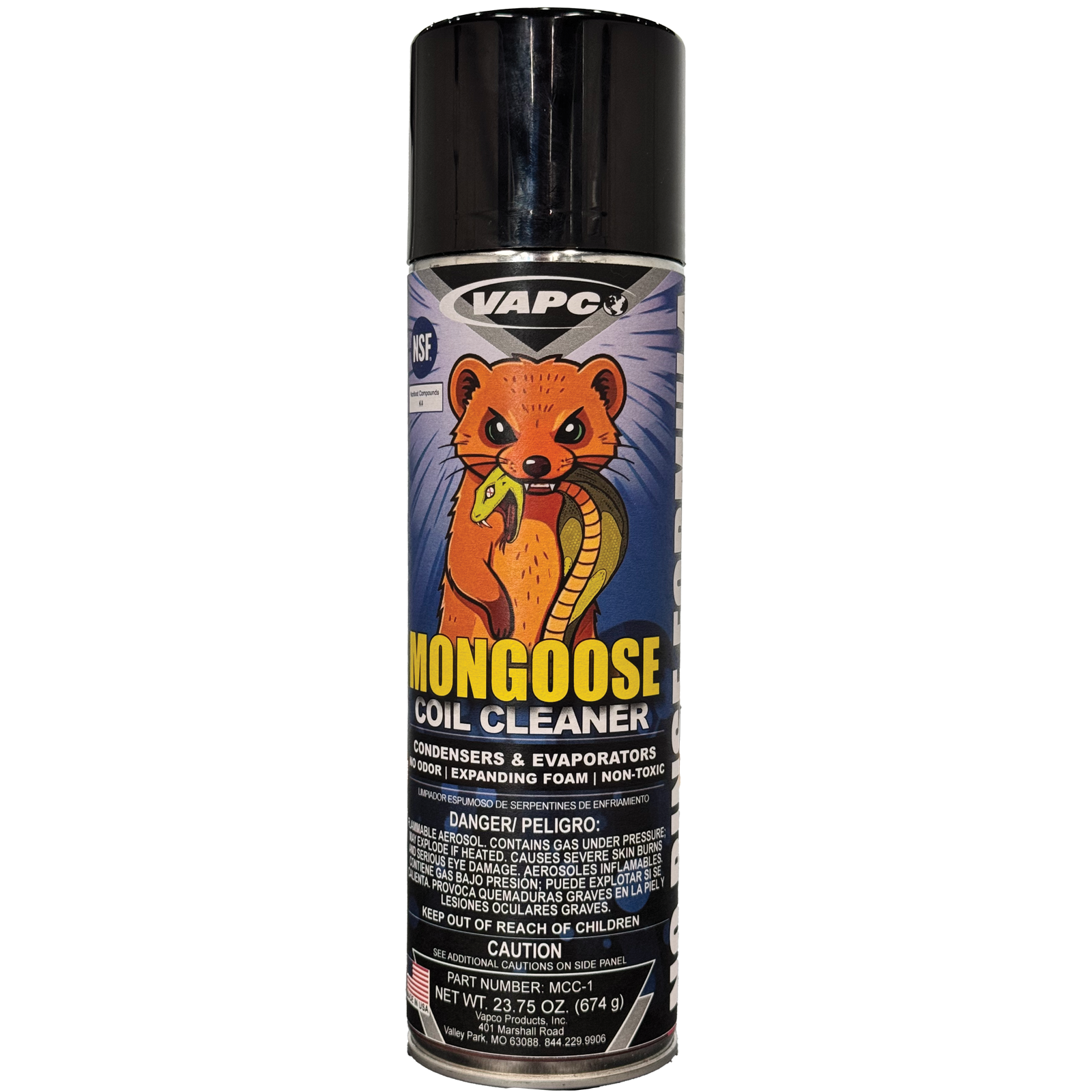
In the world of aerosol coil cleaners, Volume and Physics are the only things that matter. While the industry standard 18 oz cans rely on high-expansion propellants to create a fluffy, dry foam that looks impressive but acts like insulation and keeps the chemicals that actually clean suspended in foam away from where its needed, Mongoose Aerosol is engineered differently. We packed a massive 23.75 oz of active chemistry into a “Magnum” sized can that delivers a Heavy-Wet Foam designed to penetrate, saturate, not just decorate.
Mongoose ignores the “fluff” to focus on Saponification—the chemical process of turning heavy kitchen grease and fat into water-soluble soap. It shoots deep, expands to fill the void, and then breaks down into a liquid, allowing natural condensate to flush the contamination away completely.
Manufacturer’s Tech Note: The “Wet Foam” appearance is intentional. Unlike “shaving cream” style cleaners that bridge across fin gaps, Mongoose is designed to liquefy quickly. This phase-change is critical for the No-Rinse process on evaporators, as it allows gravity and condensation to pull the emulsified grease down into the drain pan.
*Ensure the unit is in cooling mode producing condensate for the no-rinse feature to function. If cleaning heating coils or fans, manual rinsing is required.
The Efficiency Math: More Chem, Less Fluff
Why buy four when three will do? The math of the Mongoose Magnum can is simple.
- Competitor Can: 18 oz.
- Mongoose Can: 23.75 oz.
- The Result: Every 3 cans of Mongoose equals almost 4 cans of the leading competitor. You carry less trash off the roof and leave more clean coils behind.
| KEY FEATURE / SPECIFICATION |
TRADE BENEFIT / RESULT |
| 23.75 oz Net Weight |
Highest Yield: The largest can in the professional market (32% larger than standard). Cleans larger commercial units without needing to grab a second can. |
| Fast-Break Wet Foam |
True Self-Rinsing: Liquefies quickly to utilize condensate water. Prevents the “foam lock” and bridging common with high-expansion dry foams. |
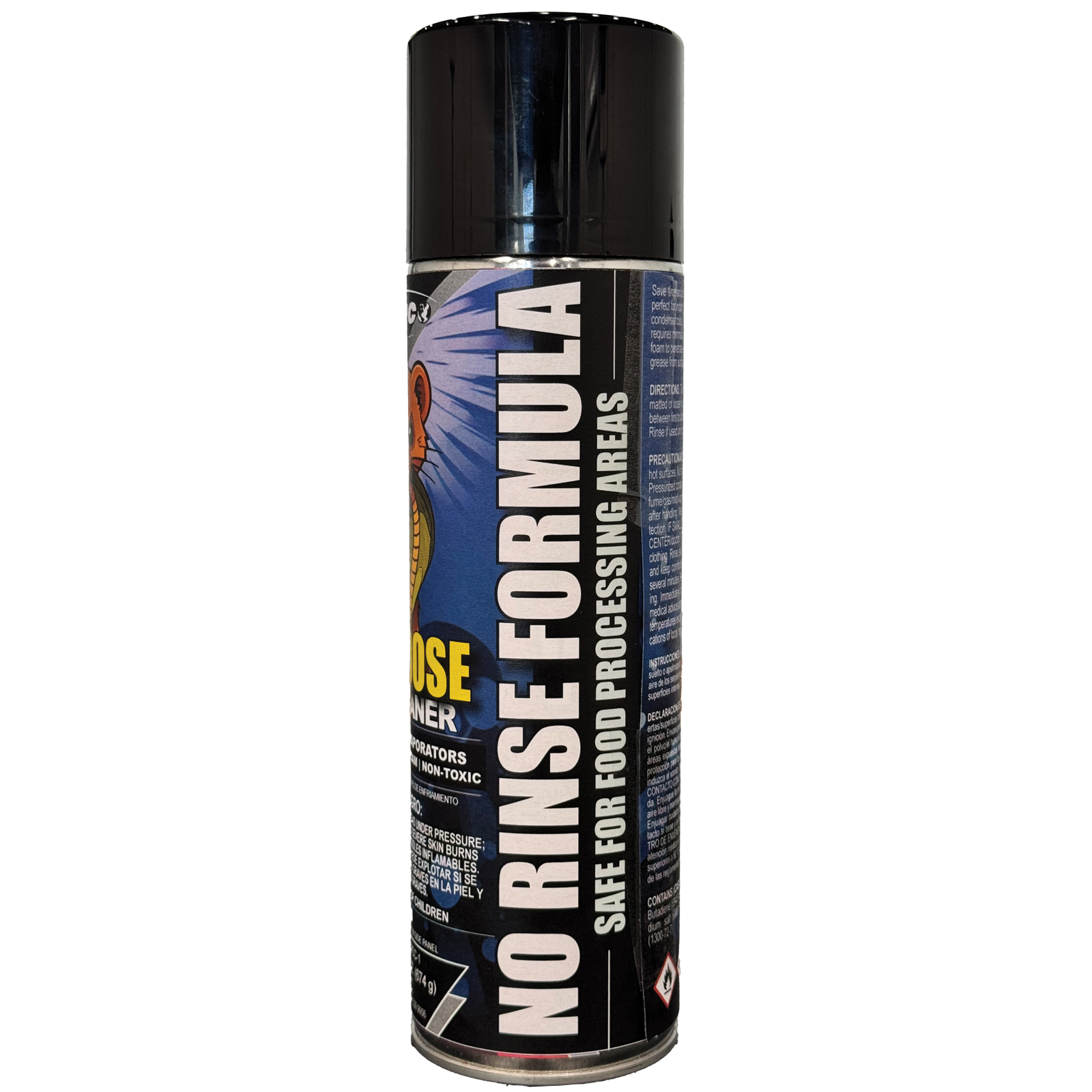
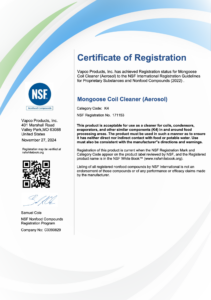
| NSF Registered Coil Cleaner (K4) |
Audit Ready: Approved for use in food processing areas. The safe choice for walk-ins, prep tables, and ice machine coils. |
| Saponification Chemistry |
Grease Destroyer: Specifically targets animal fats and vegetable oils, turning them into soapy water that flows easily down the drain. |
| Universal Material Safety |
Asset Protection: Safe for Micro-Channel coils, Mini-Splits, metals, plastics, and rubber roofing membranes. |
Vapco Field Guide: Performance Matrix
How Mongoose stacks up against real-world indoor contaminants. (★★★ = Best in Class)
| CONTAMINANT |
RATING |
WHY IT WINS |
| Kitchen Grease / Fats |
★★★ |
Specifically formulated to saponify lipids in kitchen environments. |
| Dust, Lint, Pollutants |
★★★ |
Sheeting Action: Surfactants allow condensate to slide dirt right off the fins. |
| Tobacco / Nicotine |
★★☆ |
Good removal, though heavily impacted coils may require a second pass. |
| Oxidation (White Rust) |
☆ |
Non-Acid: Mongoose is a cleaner, not a brightener. It cleans the metal without stripping the surface layer. |
| Compatibility Check |
UNIVERSAL |
Evaporators & Condensers. Safe for almost all coil types, including micro-channel and coated coils. |
Part Number Reference:
Choose the Aerosol for convenience or the Liquid Concentrate for large-scale preventive maintenance.
Order Information
| PART NO. |
SIZE / TYPE |
APPLICATION FIT |
| MCC-1 |
23.75 oz
(6/Case) |
The Service Tech’s Choice: High-capacity can for quick cleaning of walk-ins, reach-ins, and mini-splits, micro-channels and more. |
| MC-1 |
1 Gallon
(4/Case) |
Liquid Concentrate: Also NSF Registered Coil Cleaner K4. Highly concentrated formula (dilute up to 12:1) for pump-up sprayers on large commercial jobs and regular maintenance. |
Why the NSF Registered Coil Cleaner XL Can Wins
| THE PAIN POINT (Standard Aerosols) |
THE MONGOOSE ADVANTAGE |
“Running Dry”
Running out of product with 10% of the coil left to clean is a nightmare. |
“The Extra 30%”
The 23.75oz can provides the safety margin needed to finish large tonnage circuits without walking back to the truck. |
“Foam Insulation”
Thick, dry foams sit on top of the coil, preventing chemistry from grabbing the dirt. |
“Liquefaction Action”
Chemistry that knows when to stop foaming and start flowing, ensuring a deep rinse and clean for the whole coil. |
SDS & Instructions
📄 DOWNLOAD FULL SDS (PDF)
⚠️ Professional Use Only | Flammable Aerosol
Contains gas under pressure; may explode if heated. Always wear chemical-resistant gloves, goggles, and protective clothing. NSF Registered (K4) for Food Processing Areas.
Field Guide: Contaminant Removal Matrix
Mongoose utilizes a fast-breaking “Wet Foam” designed to saturate coils and utilize natural condensation for rinsing. The following matrix details performance against common indoor and outdoor obstructions.
| TARGET CONTAMINANT |
TYPICAL SOURCE |
ACTION |
PERFORMANCE / WHY IT WORKS |
| Kitchen Grease & Fats |
Restaurants / Fryers |
Saponification |
Grease Conversion: Alkaline formulation chemically converts insoluble animal fats and vegetable oils into water-soluble soap, allowing them to flow down the drain pan without clogging. |
| Dust, Lint & Pollutants |
Office Air |
Sheeting Action |
Surfactants reduce surface tension, allowing the “Wet Foam” to slide debris off the fins. Unlike dry foams that trap dust, Mongoose utilizes condensate to sheet it away. |
| Tobacco & Nicotine |
Bars / Smoking Areas |
Emulsification |
Penetrates the sticky yellow tar layer, breaking the bond with the metal so it can be flushed. (Heavy deposits may require a second pass). |
| Micro-Channel / Mini-Split Debris |
Modern Condensers |
Non-Etching |
Safely lifts dirt from tight aluminum fins without the risk of corrosion or pitting associated with heavy-duty hydroxide cleaners. |
System Material Compatibility
| MATERIAL / COMPONENT |
STATUS & PROTOCOL |
| Indoor Evaporator Coils |
✅ RECOMMENDED / NO-RINSE*
*When unit is in cooling mode producing sufficient condensate. |
| Micro-Channel / Mini-Split Coils |
✅ RECOMMENDED / METAL SAFE
Safe for all-aluminum brazed construction. |
| Rubber Roofs / Membranes |
✅ RECOMMENDED / ROOF SAFE
Will not damage EPDM or asphalt roofing. |
| Outdoor Condensers |
✅ RECOMMENDED
Manual water rinse required as no condensate is produced. |
NSF K4 Registration Protocol:
Mongoose is registered for use in food processing establishments. When used in food handling areas, all food products and packaging materials must be removed or protected prior to use. A potable water rinse of cleaned surfaces is required after use if the area is directly contacting food.
Directions for Mongoose Aerosol (MCC-1)
1. Preparation
Step 1: Turn Off (Disconnect Power).
- Shut off power to the unit at the disconnect or breaker to ensure safety while working.
- Note: For no-rinse applications on evaporators, the unit will need to be turned back on after foam breakdown to generate condensate for self rinsing.
Step 2: Brush Off Debris.
- Remove matted cottonwood, leaves, or loose dust from the coil face using a soft brush or shop vac.
- Why? Removing the “blanket” first allows Mongoose to penetrate the fins rather than wasting chemical on surface trash.
2. Application
Step 3: Shake & Position.
- Shake Can Well prior to use to mix the propellant and surfactants.
- Hold the can 8-12 inches from the air intake side of the coil.
Step 4: Spray.
- Spray between the fins, utilizing a sweeping motion to saturate the coil face.
- Target Inner Surfaces: Apply enough product to allow the “Wet Foam” to penetrate deep into the inner rows of the coil pack.
3. Dwell & Rinse Protocol
Step 5: Dwell Time.
- Allow to stand for 5 minutes.
- During this time, the foam will liquefy, breaking the bond between the grease/dirt and the metal surfaces.
Step 6: Rinse (Conditional).
| APPLICATION |
ACTION |
| Condenser Coils |
RINSE REQUIRED. If used on outdoor condensers or any coil not producing moisture, rinse thoroughly with water to remove debris. |
| Evaporator Coils |
NO RINSE REQUIRED. If the unit is in cooling mode, proceed to Step 7. |
Step 7: Turn System On.
- Restore power to the unit.
- For Evaporators: Ensure the system runs in cooling mode for at least 30 minutes. The natural condensation will flush the emulsified debris down the drain pan.
🧪 SDS SECTION: MONGOOSE AEROSOL
(MCC-1)
1. Identification & Supplier Details
| Product Name |
Mongoose Coil Cleaner (Aerosol) |
| Product Numbers |
MCC-1 |
| Recommended Use |
Coil Cleaner Aerosol |
| Emergency Phone |
(800) 255-3924 |
2. Hazards Identification
| GHS Classification |
Flammable Aerosol (Cat 2)
Gases Under Pressure (Liquefied Gas)
Skin Corrosion (Cat 1)
Eye Damage (Cat 1) |
| Signal Word |
DANGER |
| Hazard Statements |
H223: Flammable aerosol.
H280: Contains gas under pressure; may explode if heated.
H314: Causes severe skin burns and eye damage. |
| Precautionary Statements |
P210: Keep away from heat/sparks/open flames. No smoking.
P251: Do not pierce or burn, even after use.
P280: Wear protective gloves/clothing/eye protection.
P305+P351+P338: IF IN EYES: Rinse cautiously with water. Remove contact lenses.
P310: Immediately call a POISON CENTER/doctor. |
3. Composition / Ingredients
| Component Name |
CAS Number |
Concentration |
| Petroleum gases, liquified |
68476-86-8 |
1 – 10% |
| 2-Butoxyethanol |
111-76-2 |
0.1 – 1% |
| Potassium Hydroxide |
1310-58-3 |
0.01 – 0.1% |
4. First-Aid Measures
| Skin Contact |
CORROSIVE. Immediately take off contaminated clothing. Rinse skin with water/shower for at least 15 minutes. |
| Eye Contact |
SEVERE DAMAGE. Rinse cautiously with water for at least 15 minutes. Remove contact lenses. Get medical attention. |
| Inhalation |
Remove person to fresh air. Keep comfortable for breathing. |
| Ingestion |
Rinse mouth. Do NOT induce vomiting. Get immediate medical attention. |
5. Fire-Fighting Measures
| Suitable Extinguishing Media |
Water spray, fog, CO2, alcohol-resistant foam, dry chemical, or sand. |
| Specific Hazards |
Flammable Aerosol. Vapors heavier than air. Container may explode in heat of fire. |
| Special Protective Actions |
Do NOT fight fire when fire reaches containers. Fight fire remotely. Wear NIOSH-approved SCBA. |
6. Accidental Release Measures
| Personal Precautions |
Eliminate ignition sources. Do not get in eyes, on skin. Do not breathe spray. |
| Environmental Precautions |
Do not allow product to contaminate ground water or enter drains. |
| Cleanup Methods |
Ventilate area. Absorb with inert material. Transfer to suitable container for disposal. |
7. Handling & Storage
| Safe Handling |
Avoid contact with skin/eyes. Do not spray on open flame. Do not pierce or burn, even after use. |
| Safe Storage |
Store locked up in a cool, well-ventilated place. Protect from sunlight. Do not expose to temperatures > 122°F (50°C). |
| Incompatible Materials |
Strong acids, alkalis, and oxidizing agents. |
8. Exposure Controls / Personal Protection
| Exposure Limits |
Potassium Hydroxide: ACGIH Ceiling 2 mg/m³. |
| PPE (Personal Protective Equipment) |
Eyes: Chemical safety goggles/Face shield.
Skin: Chemical-resistant gloves and protective clothing.
Respiratory: NIOSH-approved SCBA if exposure exceeds limits. |
9. Physical & Chemical Properties
| Physical State |
Aerosol |
| Color / Odor |
Colorless / Fragrance |
| Solubility |
Completely Soluble in Water |
| pH |
11.0 – 12.0 (Alkaline) |
| VOC Content |
6.47% |
10. Stability & Reactivity
| Reactivity / Stability |
Stable under normal conditions. May be corrosive to metals. |
| Conditions to Avoid |
Direct sunlight, temperatures > 122°F, heat, sparks, open flames. |
| Hazardous Decomposition |
Carbon oxides, Potassium oxides. |
11. Toxicological Information
| Acute Toxicity |
LD50 Oral (Rat) > 5,000 mg/kg (Estimated) |
| Skin/Eye |
Causes severe skin burns and serious eye damage. Prolonged contact destroys tissue. |
| Carcinogenicity |
Not classified. |
12. Ecological Information
| Ecotoxicity |
Potassium Hydroxide LC50 (Mosquito Fish): 80 mg/L (96h). |
| Persistence / Mobility |
Mobile in soil. Low potential for bioaccumulation. |
13. Disposal Considerations
| Disposal Method |
Dispose of in accordance with regulations. Do not pierce or burn. Hazardous waste. |
14. Transport Information
| Regulation |
UN Number |
Class |
Proper Shipping Name |
| DOT (US) / IMDG / IATA |
UN1950 |
2.1 |
Aerosols, flammable |
15. Regulatory Information
| US Federal / State |
TSCA: Listed.
Right To Know: Potassium Hydroxide, 2-Butoxyethanol. |
| NSF Registration |
Category K4 (Cleaner for coil/fin areas in food processing establishments). |
16. Other Information
| Preparation |
Prepared by: Jessica Wilson
Date: 6/17/2025
Version: 1.0 |
| Disclaimer |
The information provided is believed to be accurate but comes without warranty. User is responsible for full compliance with local regulations. |
Specs & Logistics
1. Physical & Chemical Properties
| Base Chemistry |
Alkaline Saponifiers with 2-Butoxyethanol & Surfactants |
| pH Level |
11.0 – 12.0 (Balanced Alkaline) |
| Specific Gravity |
1.005 |
| Foam Character |
Fast-Breaking “Wet Foam” (Liquefies for Rinse) |
| VOC Content |
6.47% (Compliant) |
| Solubility |
100% Soluble in Water |
| Appearance |
Colorless Liquid / White Foam |
| Odor |
Characteristic / Solvent |
| Shelf Life |
3+ Years (Stored in Closed Container) |
| Freeze/Thaw Stability |
Stable (Allow to thaw and shake well before use) |
2. UN & DOT Shipping Classification
| Ground Shipping Status |
LIMITED QUANTITY (LTD QTY)
Formerly ORM-D. Ships ground without Hazmat surcharges.
|
| Proper Shipping Name |
Aerosols, Flammable |
| UN Number |
UN1950 |
| Hazard Class |
2.1 (Flammable Gas) |
| Required Markings |
Limited Quantity “White Diamond” (Ground) / Flammable Gas 2.1 (Air) |
Harmonized Tariff Code (HTS): 3402.20.5100 (Cleaning Preparations)
NMFC Code: 48580 (Compounds, Cleaning, Liquid) – Class 55
3. Master Shipping & Dimensions Guide
| ITEM |
INDIVIDUAL UNIT |
QTY / CASE |
CASE SPECS |
PALLET CONFIGURATION |
CODE |
| Part # |
Wt (lbs) |
H (in) |
W (in) |
L (in) |
Units |
Wt (lbs) |
H (in) |
W (in) |
L (in) |
Cases/Pallet |
Total Units |
Wt (lbs) |
H (in) |
W (in) |
L (in) |
UPC |
|
MCC-1
(23.75 oz)
|
1.8 |
10.125 |
2.6875 |
2.6875 |
6 |
11.35 |
10.5 |
5.875 |
8.625 |
200 |
1200 |
2305 |
60 |
40 |
48 |
683704020507 |
4. Reference List Pricing (Distributor Pricing May Vary)
| List Price (Per Can) |
$11.01 USD |
| Case Pack |
6 cans per case |
| Reference List Price (Per Case) |
$66.06 USD |
| Pricing Note |
Reference list pricing shown for informational purposes only. Actual distributor, contractor, and regional pricing may vary. |