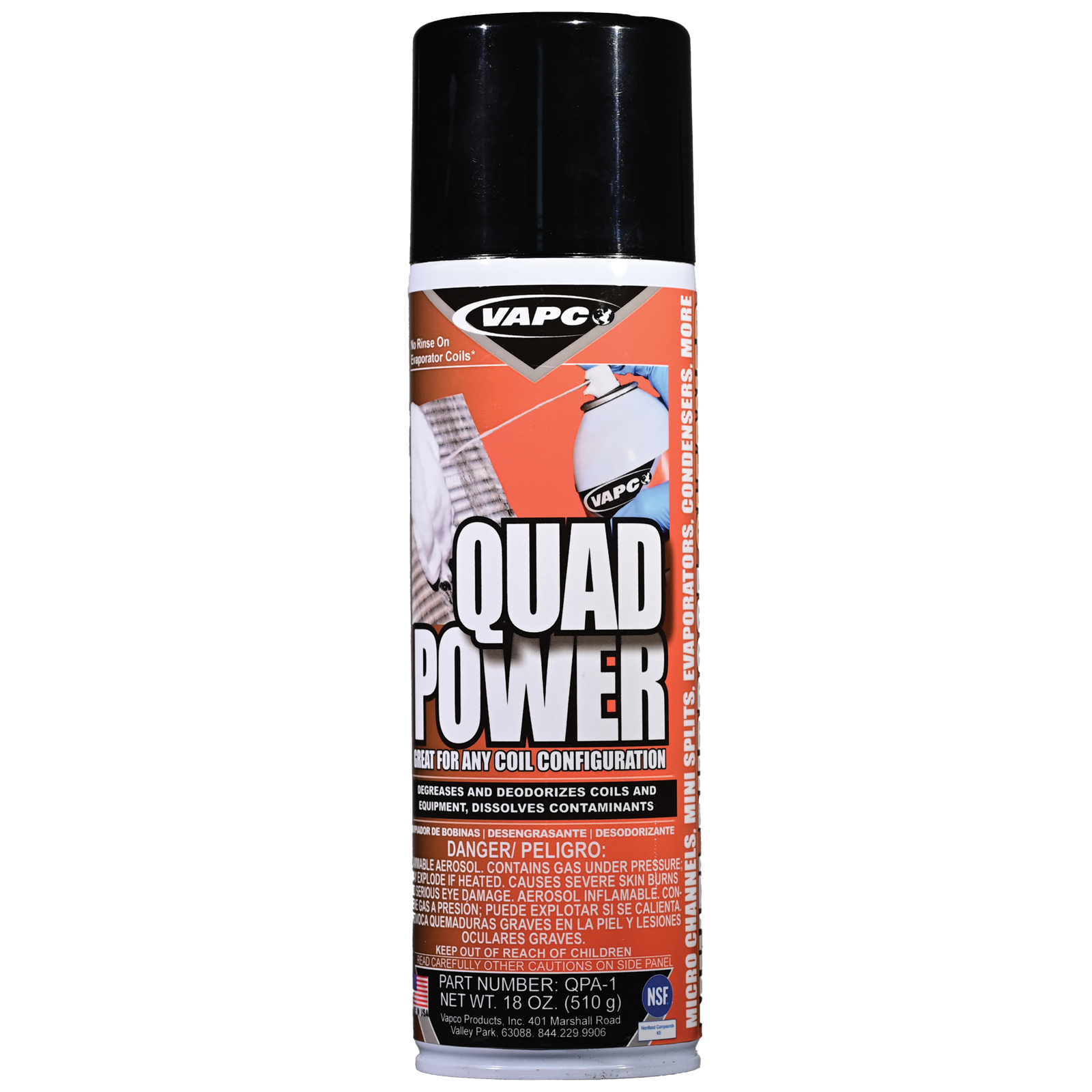
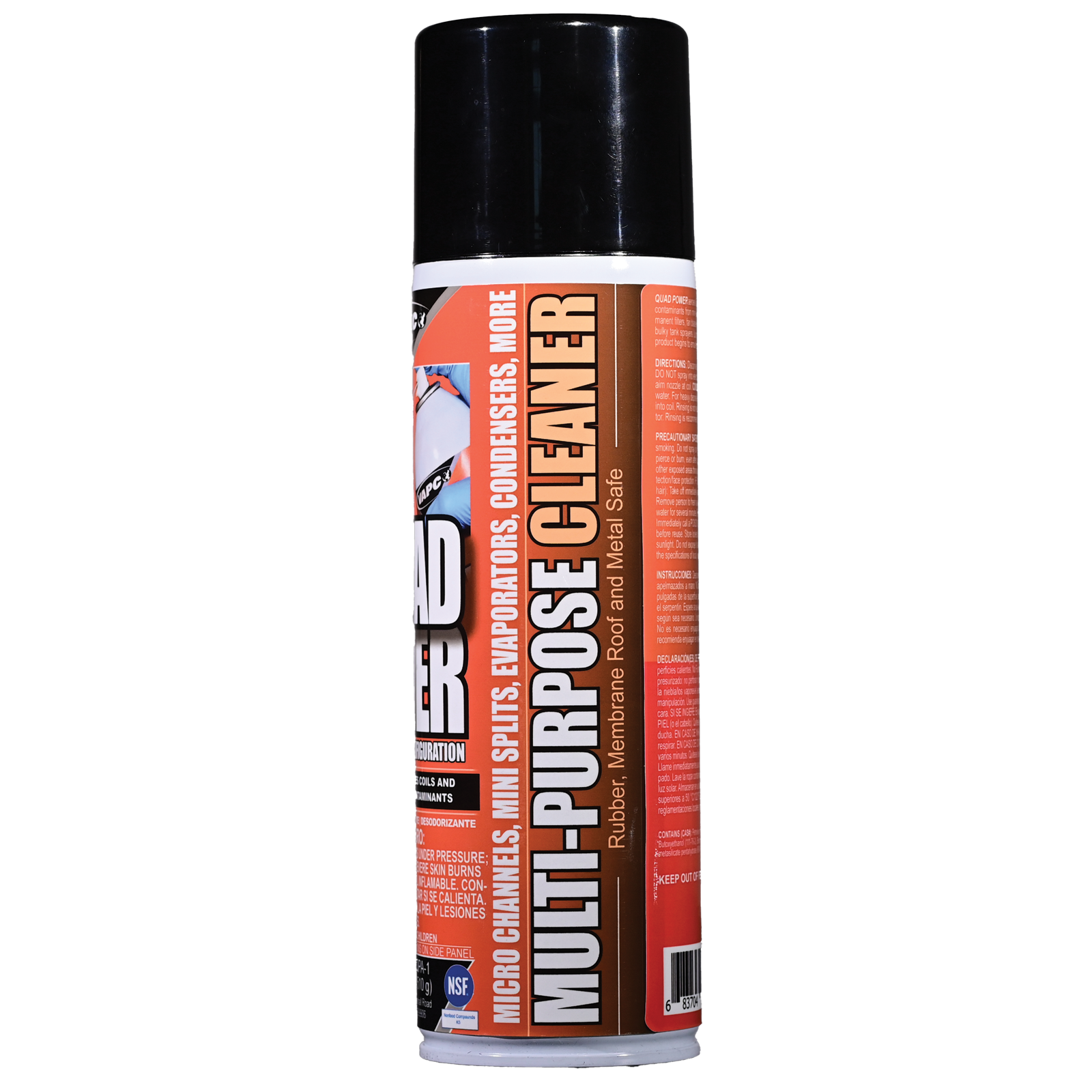
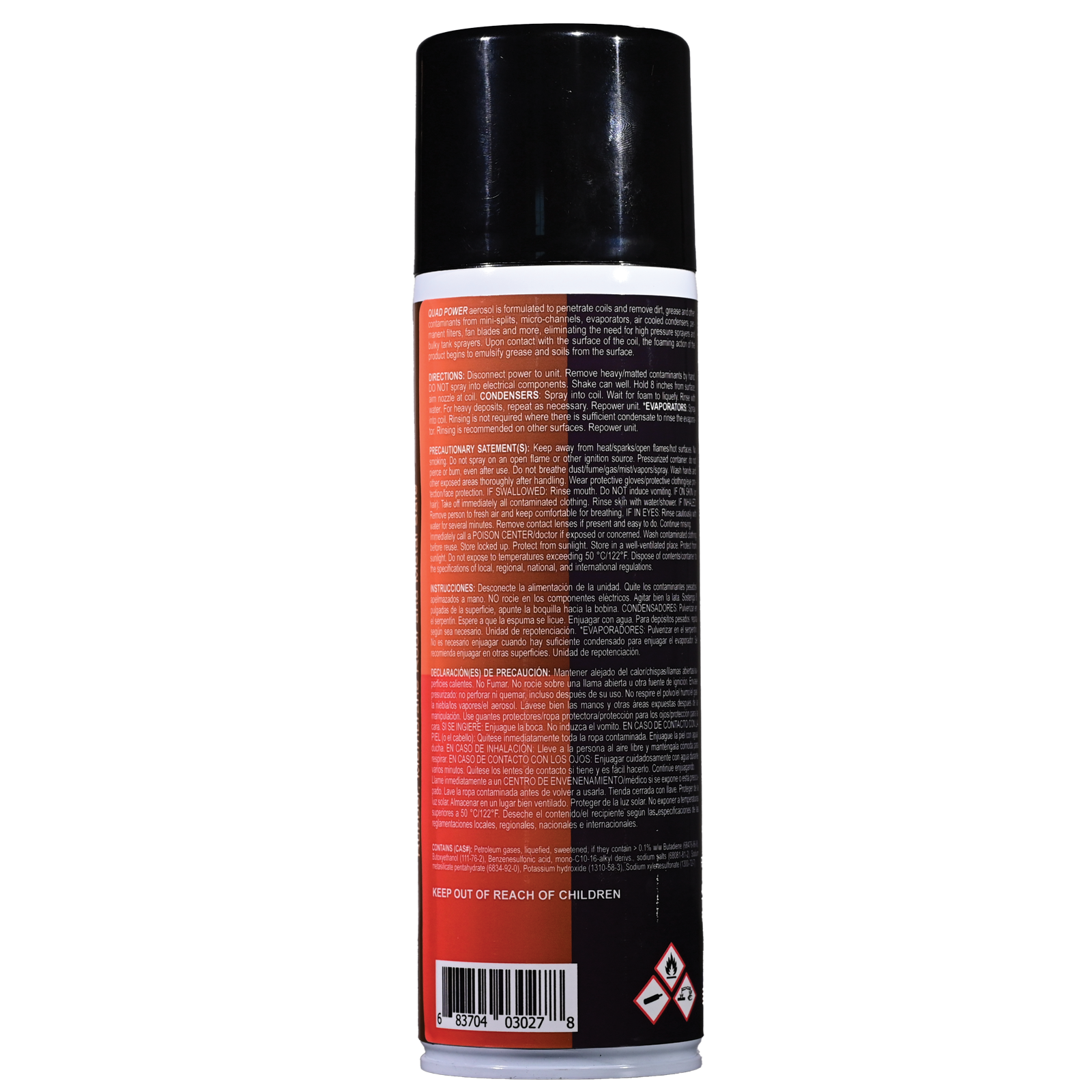
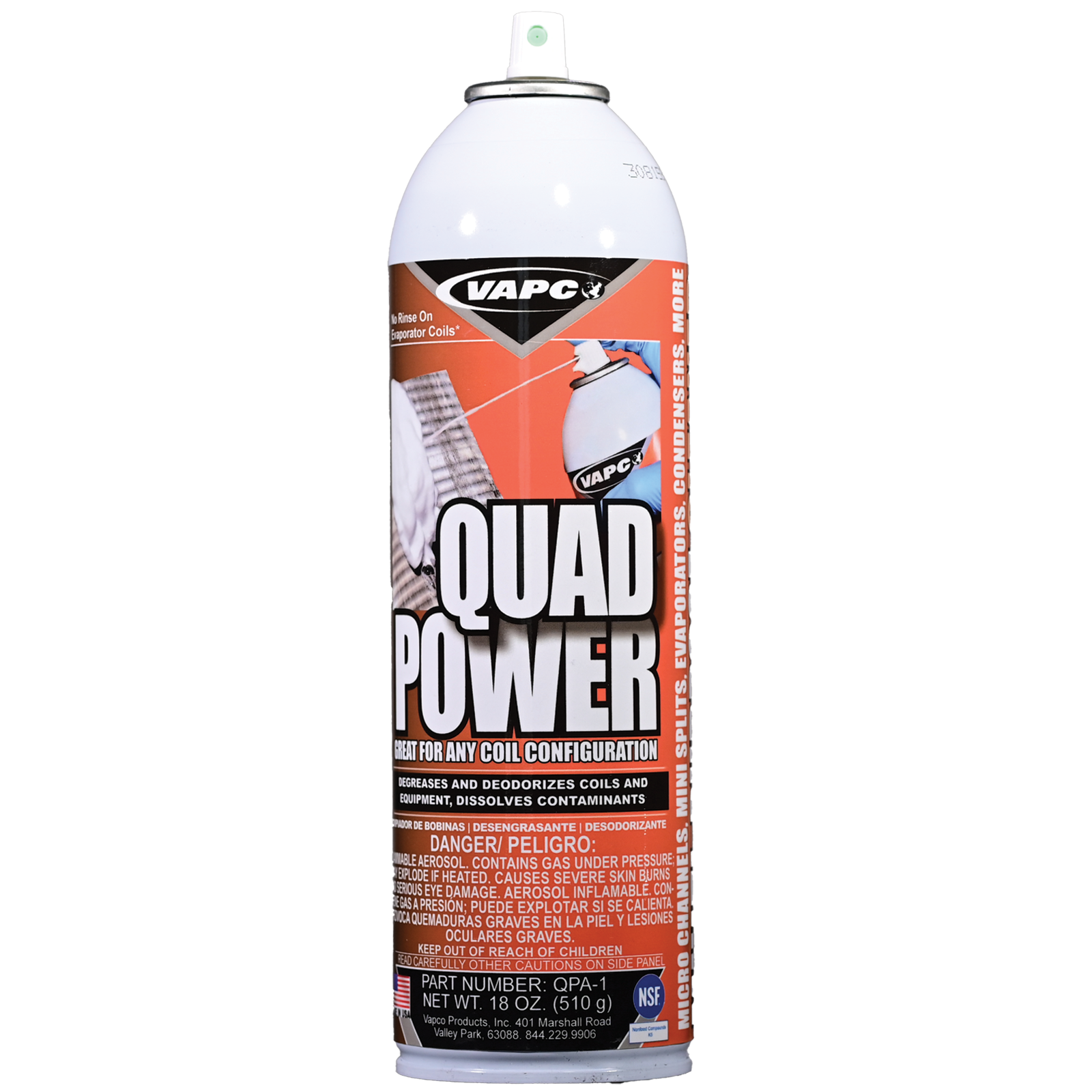
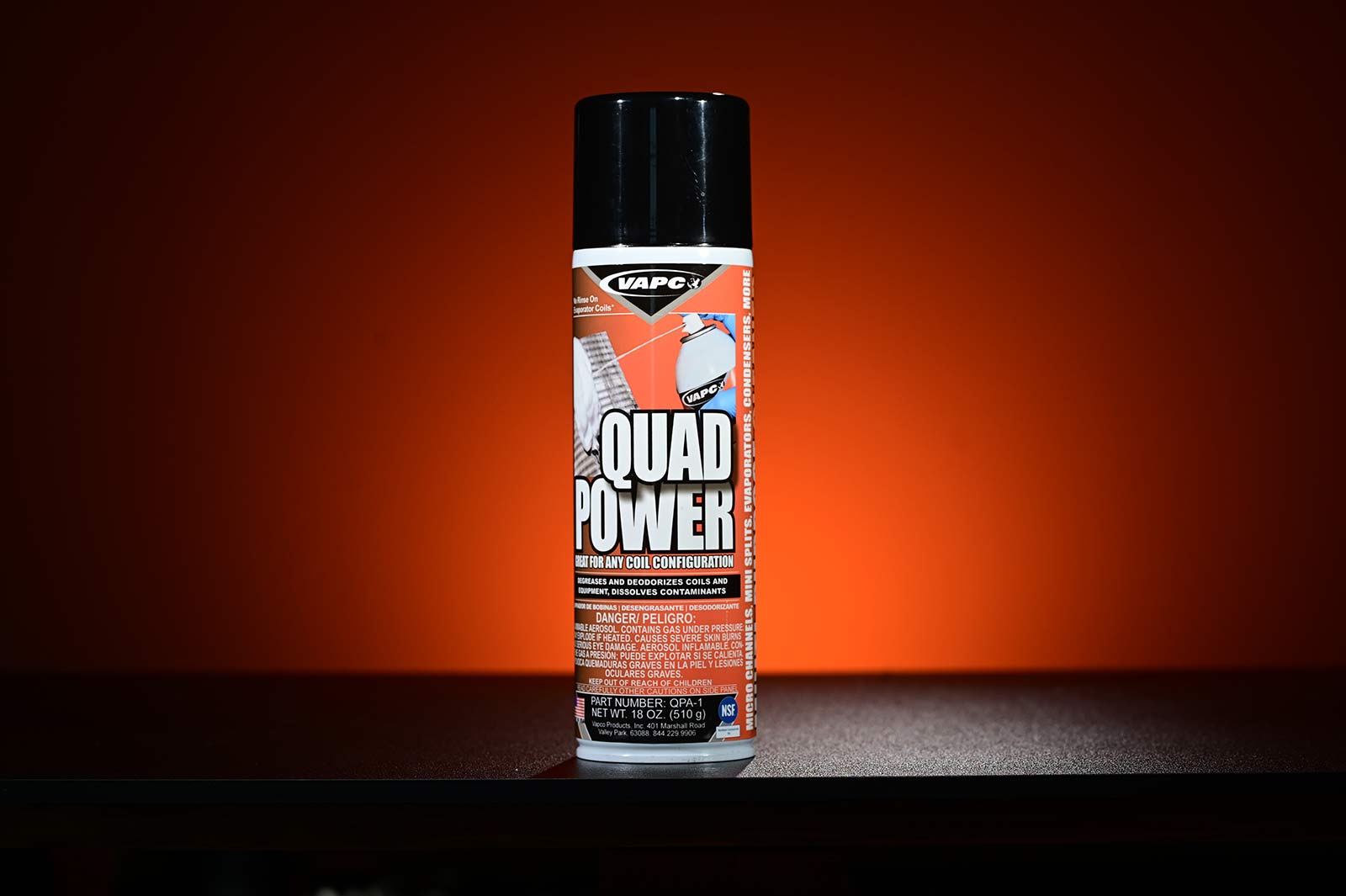
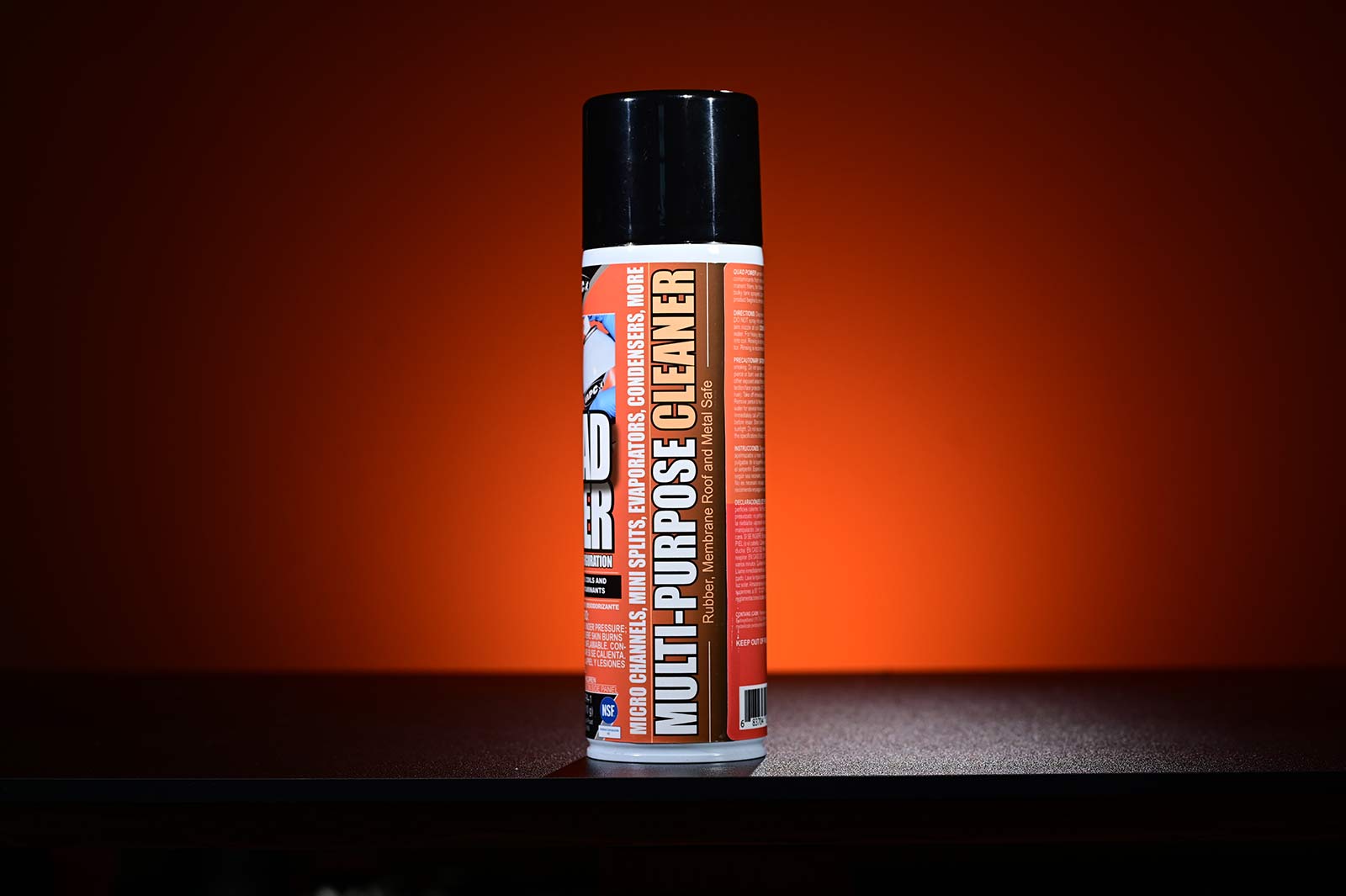
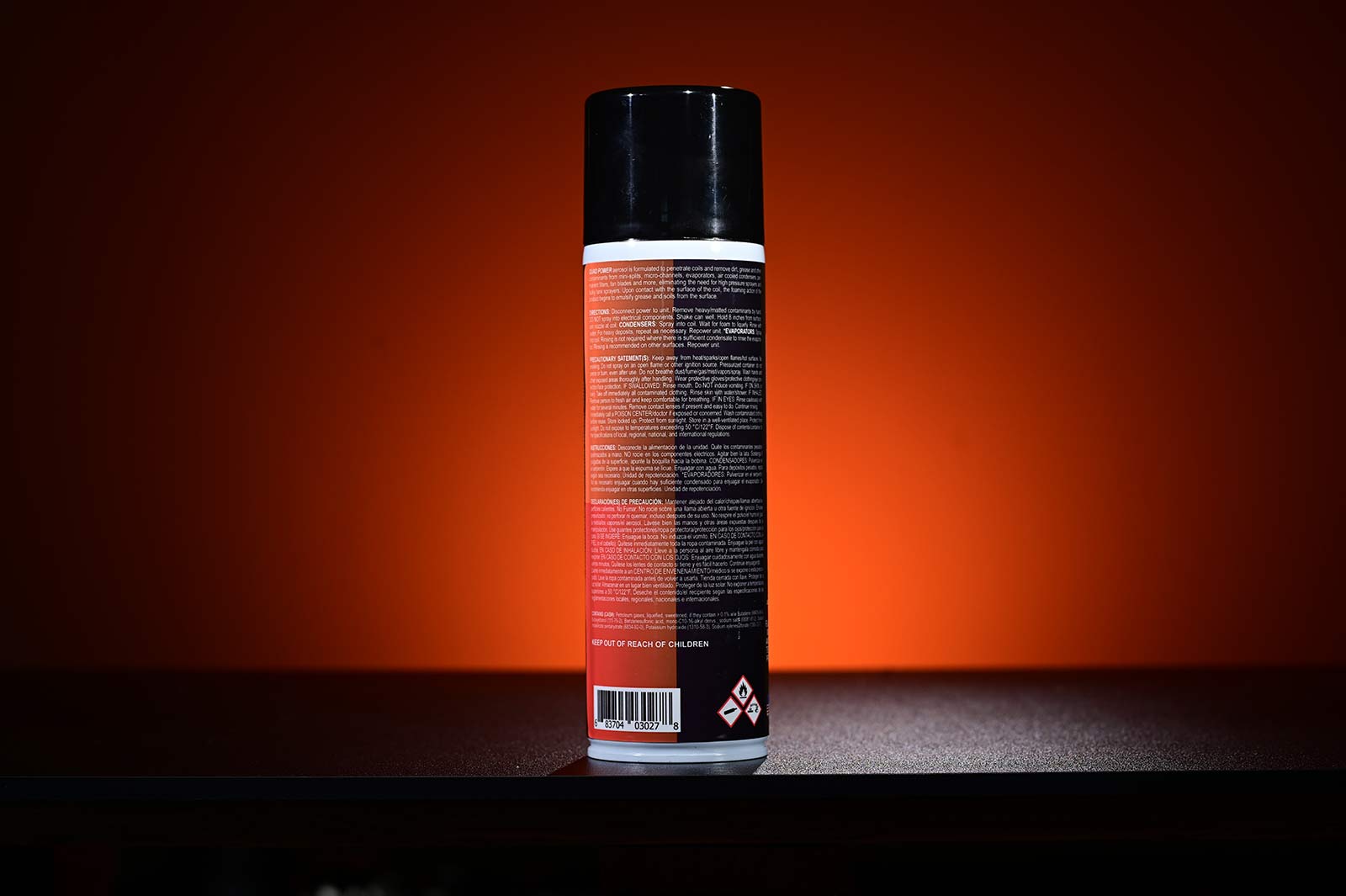
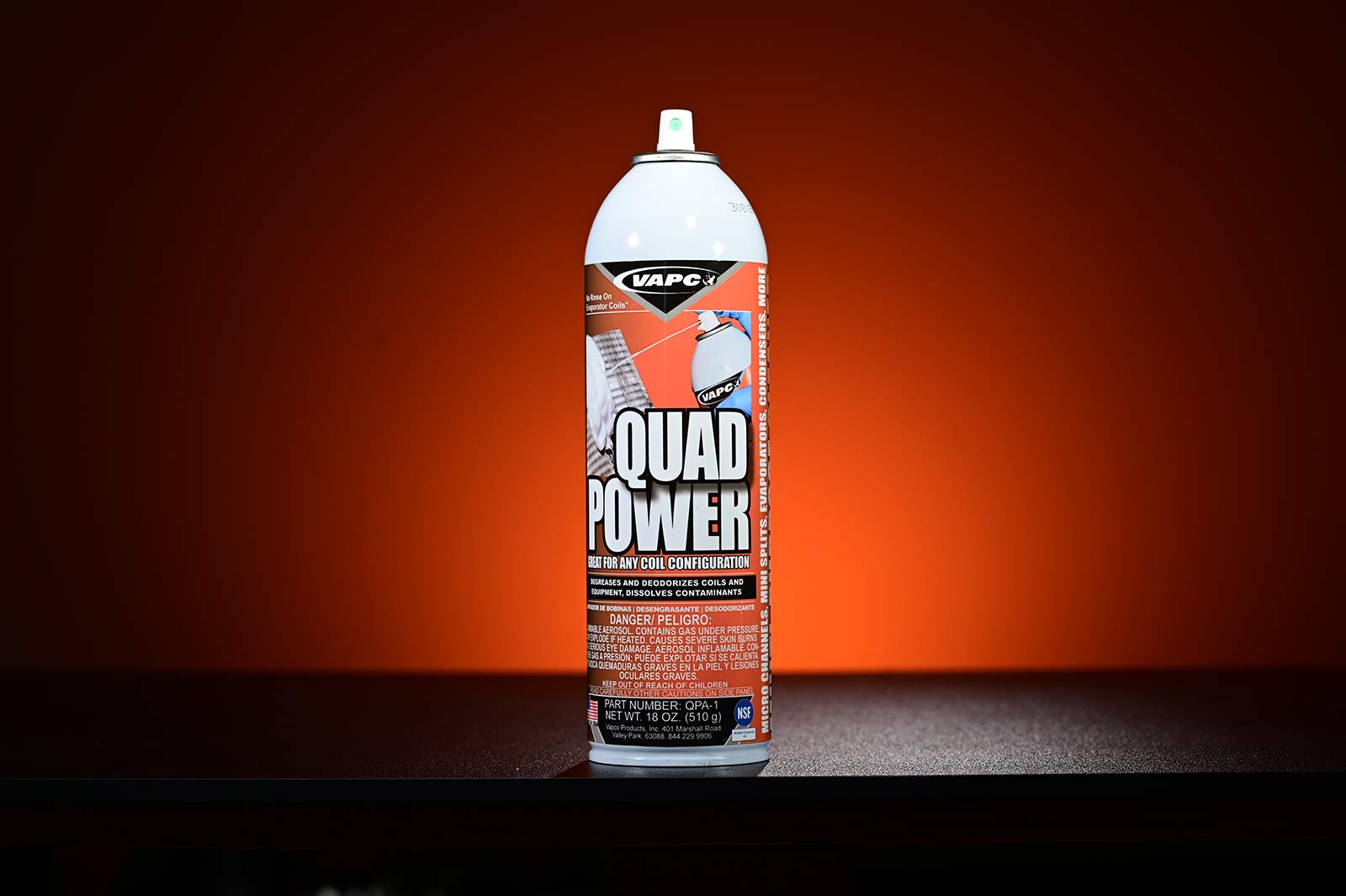
QUAD POWER AEROSOL
Versatile and Powerful Cleaning Solution
QUAD POWER is a highly concentrated, cost-effective cleaning solution available in various sizes to meet your needs.This powerful formula effectively removes grease, grime, and dirt from a wide range of surfaces, making it an essential tool for HVACR contractors and their clients.
Key Features and Benefits:
- Versatile Applications: Cleans microchannels, mini splits, air-cooled condensers, evaporator coils, permanent filters, fan blades, motors, and other equipment.
- Powerful Cleaning Action: Removes stubborn grease, grime, and dirt.
- Deodorizing Properties: Eliminates unpleasant odors.
- Safe and Effective: Safe for use on rubber, membrane, and metal roofs.
- NSF Approved: Meets NSF standards for safety and effectiveness.
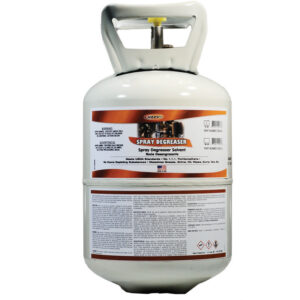
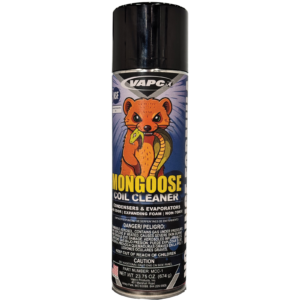
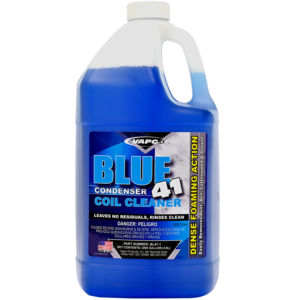
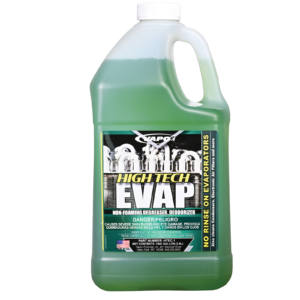
QUAD POWER is available in multiple formats, including a pre-mixed gallon bottle, a spray bottle, an aerosol spray,and a 5-gallon jug. Choose the size that best suits your needs.
Experience the power of QUAD POWER and restore your equipment to its optimal performance.
Part Number; Size
Directions:
Effective Cleaning for HVAC Systems
General Precautions:
- Wear Protective Gear: Always wear goggles, gloves, and protective clothing.
- Turn Off System: Shut down the HVAC system before cleaning.
Condensers:
- Dilute: Mix 4 parts water with 1 part QUAD POWER.
- Prepare Sprayer: Add water and cleaner to the sprayer.
- Spray Coil: Spray the solution onto the dirty surface.
- Soak: Let the solution sit for 5-7 minutes.
- Rinse: Rinse with water.
- Clean Sprayer: Rinse out the sprayer, wand, and nozzle.
- Repeat: For extremely dirty coils, consider a second application.
Evaporators/Mini Splits/Micro Channels:
- Dilute: Mix 10 parts water with 1 part QUAD POWER.
- Spray and Soak: Apply the solution to the dirty surface and let it soak for 5-10 minutes.
- Resume Operation: Return the system to operation. Condensation will rinse away the solution.
- Clean Sprayer: Rinse out the sprayer, wand, and nozzle.
- Repeat: For extremely dirty coils, consider a second application.
Permanent Filters:
- Prepare Solution: For every gallon of water, add 1 ounce of QUAD POWER.
- Soak: Soak the greasy components in the solution for at least 15 minutes.
- Rinse: Rinse with water.
Quad Power Aerosol:
- Wear Protective Gear: Ensure you’re wearing goggles, gloves, and protective clothing.
- Shake Can: Shake the canister well.
- Spray: Remove the cap and spray the solution onto the surface.
- Wait: Allow the foam to liquefy for 5-10 minutes.
- Rinse: Rinse the surface with water.
Note on Roofing Materials:
- Test Before Cleaning: Due to potential effects on color and finish, test QUAD POWER on a small area of the roof before cleaning.
- Rubber Roofs: QUAD POWER is generally safe for rubber and membrane roofs, but test on a small area first.
By following these directions, you can effectively clean and maintain your HVAC system using QUAD POWER.
DANGERS & PRECAUTIONS:
Do not get in eyes, on the skin, or on clothing. Avoid breathing dust/fume/ gas/mist/vapors/spray. Wash skin thoroughly after handling. Do not eat, drink or smoke when using this product. Use only outdoors or in a well-ventilated area. Wear protective gloves/eye protection/face protection.
Contact Us
News and Updates
Subscribe on Youtube
Follow Us on Facebook
SDS-Aerosol
⚠️ QUAD POWER AEROSOL SDS – DOWNLOAD
Identification & Supplier Details
Product Identification
| Product Name |
Quad Power Aerosol |
| Product Number/Brand |
QPA-1 (Brand: Vapco) |
| Recommended Use |
Coil cleaner |
Supplier Details
| Name |
Vapco Products, Inc. |
| Address |
401 Marshall Road, Valley Park, Missouri 63088, United States |
| Telephone / Fax / Email |
(636) 923-2121 / (636) 923-3002 / [email protected] |
| Emergency Phone Number |
(800) 255-3924 |
Hazard Identification & Composition
GHS Classification
| OSHA (29 CFR 1910.1200) |
Eye damage/irritation, Cat. 1; Flammable aerosols, Cat. 2; Gases under pressure, liquefied gas; Skin corrosion/irritation, Cat. 1 |
GHS Label Elements
| Signal Word |
Danger |
| Hazard Statement(s) |
H223: Flammable aerosol
H280: Contains gas under pressure; may explode if heated
H314: Causes severe skin burns and eye damage |
| Key Precautionary Statement(s) |
P210: Keep away from heat/sparks/open flames/hot surfaces. No smoking.
P251: Pressurized container: do not pierce or burn, even after use.
P280: Wear protective gloves/protective clothing/eye protection/face protection.
P305+P351+P338: IF IN EYES: Rinse cautiously with water for several minutes. Continue rinsing.
P310: Immediately call a POISON CENTER/doctor. |
Hazardous Components (Mixtures)
| Component Name |
CAS Number |
Concentration (wt%) |
| Petroleum gases, liquified, sweetened (> 0.1% w/w Butadiene) |
68476-86-8 |
1 – 10 % |
| 2-Butoxyethanol |
111-76-2 |
0.1 – 1 % |
| Dodecylbenzenesulfonic acid, sodium salt |
68081-81-2 |
0.1 – 1 % |
| Potassium Hydroxide ($text{K(OH)}$) |
1310-58-3 |
0.01 – 0.1 % |
Physical & Chemical Properties
| Physical State / Appearance |
Liquid / Aerosol |
| Color / Odor |
Colorless / Fragrance |
| Flammability |
Flammable aerosol |
| Flash Point |
-104°C/-156°F |
| pH |
11.0-12.0 (Alkaline) |
| Solubility in Water |
Completely soluble in water |
| Density and/or Relative Density |
1.005 |
| Volatile Organic Contents (VOC) |
6.47% |
Stability & Reactivity
| Reactivity / Stability |
Stable under recommended storage conditions. Contains gas under pressure; may explode if heated. Pressurized container: may burst if heated. |
| Conditions to Avoid |
Direct sunlight, temperatures exceeding 50°C / 122°F, heat, sparks, open flames, and incompatible materials. |
| Incompatible Materials |
Strong acids and alkalis, or oxidizing agents. |
| Hazardous Decomposition Products |
Carbon oxides, potassium oxides, hydrocarbons, and fumes. |
Toxicological Information
Acute Toxicity Data (Selected Components)
| Component |
Test Type |
Result |
| 2-Butoxyethanol |
LD50 Oral (Rat) |
880 mg/kg |
| 2-Butoxyethanol |
LD50 Skin (Rabbit) |
1,060 mg/kg |
| Potassium Hydroxide |
LD50 Oral (Rat) |
333 mg/kg |
Corrosivity & Systemic Effects
| Skin/Eye Damage |
Causes severe skin burns and eye damage (Cat. 1). Prolonged contact will destroy tissue. Can cause permanent eye damage. |
| Respiratory Sensitization |
May cause irritation (possible severe), chemical burns, upper respiratory damage, and pulmonary edema. |
| Carcinogenicity/Mutagenicity |
Not classified as a germ cell mutagen or carcinogen (components < 0.1%). |
| Aspiration Hazard |
ATE (gas inhalation) of the mixture is: 450000 ppmV. |
First-Aid Measures
| General Advice |
Never give anything by mouth to an unconscious person. Immediately call a POISON CENTER/doctor. |
| If Inhaled |
Remove person to fresh air. Keep comfortable for breathing. Get medical advice/attention. |
| In Case of Skin Contact (Corrosive) |
Take off immediately all contaminated clothing. Rinse skin with water/shower for at least 15 minutes. Obtain medical attention. |
| In Case of Eye Contact (Severe Damage) |
Rinse cautiously with water for several minutes. Remove contact lenses. Continue rinsing for at least 15 minutes. |
| If Swallowed |
Rinse mouth. Do NOT induce vomiting. Obtain medical attention. |
| Note to Physician |
The absence of visible signs or symptoms of burns does not reliably exclude the presence of actual tissue damage. |
Fire-Fighting & Accidental Release Measures
Fire-Fighting Measures (Flammable Aerosol)
| Suitable Extinguishing Media |
Water spray, fog, carbon dioxide ($text{CO}2$), alcohol-resistant foam, dry chemical, or sand. |
| Specific Hazards |
Flammable aerosol. Vapors are heavier than air. Container may explode in heat of fire. May be corrosive to metals. |
| Protective Actions |
Do NOT fight fire when fire reaches containers. Fight fire remotely due to explosion risk. Shut off all ignition sources. Wear NIOSH-approved SCBA. |
Accidental Release Measures
| Personal Precautions |
Eliminate ignition sources. Do not breathe vapors/spray. Evacuate unnecessary personnel and isolate area. |
| Environmental Precautions |
Do not allow product to contaminate ground water or enter drains. Vapors can accumulate in low areas. |
| Containment/Clean-up Methods |
Ventilate the area. Contain spills with dikes or absorbents. Transfer spilled material to a suitable container for disposal. |
Handling, Storage & PPE
Handling Precautions
| Safe Handling |
Do not handle until all safety precautions have been read. Avoid contact with skin/eyes. Do not spray on open flame or other ignition source. |
| Additional Hazards |
Do not pressurize, cut, or weld containers. Do not pierce or burn, even after use. |
Storage Conditions
| General Conditions |
Store in a dry, cool, well-ventilated place. Store locked up. Proper grounding procedures should be followed. |
| Temperature/Sunlight |
Protect from sunlight. Do not expose to temperatures > 50°C / 122°F. |
| Incompatible Materials |
Strong acids and alkalis, or oxidizing agents. |
Personal Protective Equipment (PPE)
| Eye/Face Protection |
Chemical safety goggles/face protection. Emergency eye wash fountains and safety showers must be available. |
| Skin/Body Protection |
Protective gloves and chemical resistant clothing. Wear fire/flame resistant/retardant clothing. |
| Respiratory Protection |
Use a NIOSH-approved Self-Contained Breathing Apparatus whenever exposure may exceed established OELs. |
Transport & Regulatory Information
Transport Information (DOT, IMDG, IATA)
| Regulation |
UN Number |
Class |
Proper Shipping Name |
| DOT (US) / IMDG / IATA |
UN1950 |
2.1 (Flammable Gas) |
Aerosols, flammable, (each not exceeding 1 L capacity) |
Regulatory Information
| CERCLA Reportable Quantity |
Potassium hydroxide (CAS: 1310-58-3) at 1000 lbs. |
| SARA 311/312 Hazards |
Fire Hazard, Acute Health Hazard, Chronic Health Hazard, Sudden Release of Pressure |
| SARA 313 Components |
2-Butoxyethanol (CAS: 111-76-2) is subject to reporting. |
| State Right To Know (MA, NJ, PA) |
Lists Potassium Hydroxide and 2-Butoxyethanol (Ethylene glycol monobutyl ether). |
| HMIS / NFPA Ratings |
HMIS: Health 2 / Flammability 4 / Physical Hazard 1 |
Disposal & Ecological Information
Ecological Information (Ecotoxicity)
| Toxicity to Aquatic Life |
2-Butoxyethanol LC50 (Rainbow Trout): 1,474 mg/L – 96h.
Potassium Hydroxide LC50 (Mosquito Fish): 80 mg/L – 96h. |
| Bioaccumulative Potential |
Log Pow values for key components are low (e.g., 2-Butoxyethanol Log Pow = 0.81), indicating low potential for bioaccumulation. |
| Mobility in Soil |
This product is mobile in soil. |
Disposal Considerations
| Waste Status |
This material, as supplied, is hazardous waste according to federal regulations (U.S. EPA 40CFR 261). |
| Product Disposal |
Dispose of contents/container in accordance with all local, regional, national, and international regulations. Do not pierce or burn container. |
Disclaimer & Preparation Information
| Disclaimer Summary |
Information is accurate to the best of our knowledge, but no assumption of liability is made for accuracy or completeness. Final determination of suitability is the sole responsibility of the user. No warranty is created by this SDS. |
| Preparation Information |
Prepared by: Jessica Wilson
Date prepared: 2-20-2025 |