Vapco Products, Inc.
Safety Data Sheet
R-290
SECTION 1: Identification
1.1 GHS Product identifier
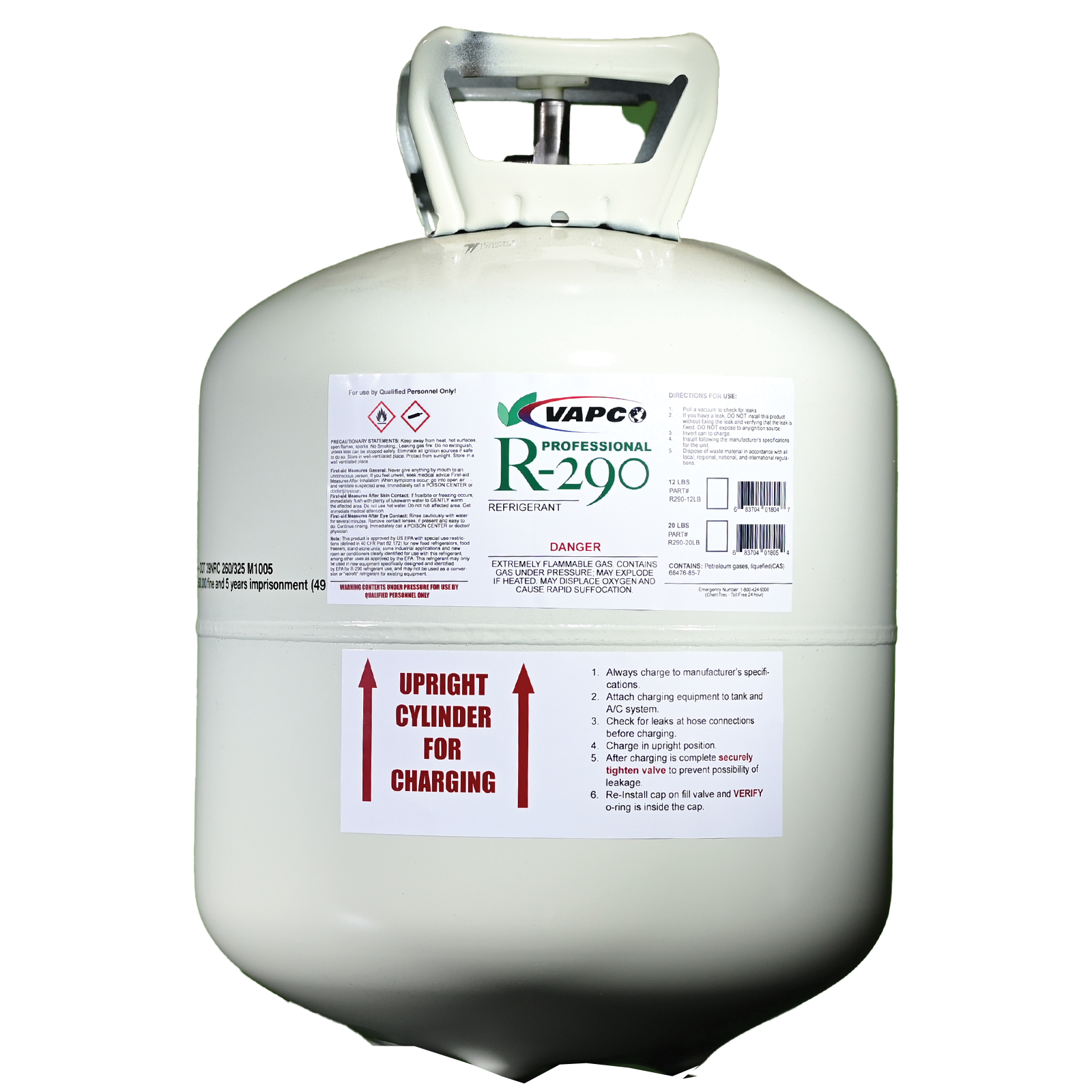
Product name: R-290
Product number: R290-8OZ, R290-7/16-8OZ, R290-12LB, R290-20LB, R290-30LB
Brand: Vapco
1.3 Recommended use of the chemical and restrictions on use
Refrigerant
1.4 Supplier’s details
Name: Vapco Products, Inc.
Address: 401 Marshall Road, Valley Park, Missouri 63088, United States
Telephone: (636) 923-2121
Fax: (636) 923-3002
email: [email protected]
1.5 Emergency phone number
(800) 255-3924
SECTION 2: Hazard identification
2.1 Classification of the substance or mixture
GHS classification in accordance with: OSHA (29 CFR 1910.1200, 2024)
– Flammable gases, Cat. 1
– Gases under pressure, liquefied gas
2.2 GHS label elements, including precautionary statements
Signal word: Danger
Hazard statement(s)
H220 Extremely flammable gas
H280 Contains gas under pressure; may explode if heated
May displace oxygen and cause rapid suffocation
Precautionary statement(s)
P210 Keep away from heat/sparks/open flames/hot surfaces. No smoking.
P377 Leaking gas fire: Do not extinguish, unless leak can be stopped safely.
P381 Eliminate all ignition sources if safe to do so.
P403 Store in a well-ventilated place.
P410+P403 Protect from sunlight. Store in a well-ventilated place.
SECTION 3: Composition/information on ingredients
3.2 Mixtures
| Hazardous components |
CAS no. |
Concentration |
| 1. LPG (liquified petroleum gas) (EC no. 270-704-2; Index no. 649-202-00-6) |
68476-85-7 |
100 % (weight) |
SECTION 4: First-aid measures
4.1 Description of necessary first-aid measures
General advice: Never give anything by mouth to an unconscious person.If you feel unwell, seek medical advice (show the label where possible).
If inhaled: First, take proper precautions to ensure your own safety before attempting rescue (e.g. wear appropriate respiratory protective equipment, use the buddy system), then remove the exposed person to fresh air.Keep at rest in a position comfortable for breathing.Get medical advice/attention.
In case of skin contact: Immediately drench affected area with water for at least 15 minutes.Remove contaminated clothing immediately.Obtain medical attention if irritation develops or persists.If frostbite or freezing occurs, immediately flush with plenty of lukewarm water to GENTLY warm the affected area.Do not use hot water.Do not rub affected area.
In case of eye contact: Immediately rinse with water for at least 15 minutes.Remove contact lenses, if present and easy to do.Continue rinsing.Obtain medical attention if irritation develops or persists.
If swallowed: Rinse mouth.Do NOT induce vomiting.Obtain medical attention.
4.2 Most important symptoms/effects, acute and delayed
Symptoms/Injuries: Gas can be as toxic as a simple asphyxiant by displacing oxygen from the air.Refrigerated liquified gas.Contact with product may cause cold burns or frostbite.
Symptoms/Injuries After Inhalation: Asphyxiant gas.
Symptoms/Injuries After Skin Contact: May cause frostbite.
Symptoms/Injuries After Eye Contact: Contact with the liquified gas causes frostbite.
Symptoms/Injuries After Ingestion: Ingestion is an unlikely route of exposure for a gas.
4.3 Indication of immediate medical attention and special treatment needed, if necessary
If exposed or concerned, get medical advice and attention.If medical advice is needed, have product container or label at hand.
SECTION 5: Fire-fighting measures
5.1 Suitable extinguishing media
Dry chemical powder, alcohol-resistant foam, carbon dioxide (CO2).
Unsuitable Media: Do not use a heavy water stream.Use of heavy stream of water may spread fire.
5.2 Specific hazards arising from the chemical
Fire Hazard: Flammable gas.
Explosion Hazard: Container may explode in heat of fire.Heat may build pressure, rupturing closed containers, spreading fire and increasing risk of burns and injuries.Vapors are heavier than air and may travel considerable distance to an ignition source and flash back to source of vapors.
Reactivity: Contains gas under pressure; may explode if heated.Reacts with oxidants causing fire/explosion hazard.
5.3 Special protective actions for fire-fighters
Precautionary Fire Measures: Exercise caution when fighting any chemical fire.
Firefighting Instructions: Use dry chemical, foam, or carbon dioxide (CO2).Do not breathe fumes from fire or vapors from decomposition.Do NOT fight fire when fire reaches containers.Evacuate area.Fight fire remotely due to the risk of explosion.Shut off all sources of ignition.Use water spray or fog for cooling exposed containers.
Protection During Firefighting: Do not enter fire area without proper protective equipment, including respiratory protection.Wear NIOSH-approved Self-Contained Breathing Apparatus with a full face piece operated in a positive pressure demand mode with full body protective clothing when fighting fires.
Hazardous Combustion Products: Carbon oxides (CO, CO2).
SECTION 6: Accidental release measures
6.1 Personal precautions, protective equipment and emergency procedures
General Measures: Do not get in eyes, on skin, or on clothing.Do not breathe vapors, spray, mist, gas.Keep away from heat, hot surfaces, sparks, open flames, and other ignition sources.No smoking.
For Emergency Personnel Protective Equipment: Equip cleanup crew with proper protection.Emergency Procedure: Eliminate ignition sources first, then ventilate the area.Evacuate unnecessary personnel, isolate, and ventilate area.Upon arrival at the scene, a first responder is expected to recognize the presence of dangerous goods, protect oneself and the public, secure the area, and call for the assistance of trained personnel as soon as conditions permit.
For Non-Emergency Personnel Protective Equipment: Use appropriate personal protective equipment (PPE).Emergency Procedures: Evacuate unnecessary personnel.Stop leak if safe to do so.
6.2 Environmental precautions
Prevent entry to sewers and public waters.Avoid release to the environment.
6.3 Methods and materials for containment and cleaning up
For Containment: Ventilate the area.Contain any spills with dikes or absorbents to prevent further migration and entry into sewers or streams.As an immediate precautionary measure, isolate spill or leak area in all directions.
Methods for Cleaning Up: Clean up spills immediately and dispose of waste safely.Eliminate all ignition sources.Ventilate area.Stop the ignition source of the release, if safe to do so.Consider the use of water spray to disperse vapors.Isolate the area until gas has dispersed.Ventilate and gas test area before entering.Take up liquid spill into absorbent material.Transfer spilled material to a suitable container for disposal.Contact competent authorities after a spill.
Waste Disposal: Dispose of in accordance with local, regional, national, and international regulations.Containers may be hazardous when empty.Do not flame cut, braze, or weld.Product should be fully characterized prior to disposal (40 CFR 261).
Reference to other sections
See Section 8 for exposure controls and personal protection and Section 13 for disposal considerations.
SECTION 7: Handling and storage
7.1 Precautions for safe handling
Precautions for Safe Handling: Do not handle until all safety precautions have been read and understood.Avoid contact with skin, eyes and clothing.Do not breathe gas, mist, spray, vapors.Wash hands and other exposed areas with mild soap and water before eating, drinking or smoking and when leaving work.Do not spray on open flame or other ignition source.
Additional Hazards When Processed: Do not pressurize, cut, or weld containers.Ruptured cylinders may rocket.Pressurized container: May burst if heated.Do not pierce or burn, even after use.
Hygiene Measures: Handle in accordance with good industrial hygiene and safety procedures.
Other Precautions: Keep out of reach of children.Follow label instructions.Vapors may collect in low lying areas.
7.2 Conditions for safe storage, including any incompatibilities
Technical Measures: Comply with applicable regulations.Proper grounding procedures to avoid static electricity should be followed.
Storage Conditions: Store in a dry, cool place.Keep only in the original container in a cool, well-ventilated place away from ignition sources.Protect from sunlight.Do not expose to temperatures exceeding 50°C/122°F.Keep/Store away from direct sunlight, extremely high or low temperatures and incompatible materials.Store locked up/in a secure area.
Incompatible Materials: Heat sources.Oxidizers.
Specific end use(s)
Refrigerant
SECTION 8: Exposure controls/personal protection
8.1 Control parameters
1. LPG (liquified petroleum gas) (CAS: 68476-85-7)
TWA (Inhalation): 1000 ppm; 1800 mg/m3; AU (AU/SWA)
PEL [L.P.G. (Liquified petroleum gas)] (Inhalation): 1000 ppm; US (US/OSHA)
PEL [L.P.G. (Liquified petroleum gas)] (Inhalation): 1800 mg/m3; US (US/OSHA)
PEL [L.P.G. (Liquified petroleum gas)] (Inhalation): 1000 ppm; US (Cal/OSHA)
REL [L.P.G. (Liquified petroleum gas)] (Inhalation): 1000 ppm; US (NIOSH)
8.2 Appropriate engineering controls
Emergency eye wash fountains and safety showers should be available in the immediate vicinity of any potential exposure.Ensure adequate ventilation, especially in confined areas.Use explosion-proof equipment.Proper grounding procedures to avoid static electricity should be followed.Use only outdoors or in well-ventilated area.Ensure all local, regional, national, and international regulations are being observed.Obtain special instructions before use.Do not handle until all safety precautions have been read and understood.
8.3 Individual protection measures, such as personal protective equipment (PPE)
Eye/face protection: Chemical safety goggles.Insufficient ventilation: wear respiratory protection.Respiratory protection of the dependent type.
Skin protection: Wear protective gloves and clothing.
Body protection: Wear suitable protective clothing.Wear protective gloves.Chemical resistant materials and fabrics.Wear fire/flame resistant/retardant clothing.
Respiratory protection: Use a NIOSH-approved Self-Containing Breathing Apparatus whenever exposure may exceed established Occupational Exposure Limits.
SECTION 9: Physical and chemical properties
| Physical state |
Gas |
| Appearance |
Clear, colorless gas |
| Color |
Colorless |
| Odor |
Odorless |
| Odor threshold |
N/D |
| Melting point/freezing point |
-152°C (305°F) |
| Boiling point or initial boiling point and boiling range |
-47 °C (52°F) |
| Flammability |
Extremely flammable aerosol |
| Lower and upper explosion limit/flammability limit |
2.15%-9.60% |
| Flash point |
N/D |
| Auto-ignition temperature |
467°C (873°F) |
| Decomposition temperature |
N/D |
| pH |
N/A |
| Kinematic viscosity |
N/D |
| Solubility |
N/A |
| Partition coefficient n-octanol/water (log value) |
N/D |
| Vapor pressure |
862 kPa (125 psi) at 22°C (70°F) |
| Evaporation rate |
N/D |
| Density and/or relative density |
0.5066 |
| Relative vapor density |
1.52 at 20°C |
Supplemental information regarding physical hazard classes: Liquified gas
SECTION 10: Stability and reactivity
10.1 Reactivity: Contains gas under pressure; may explode if heated.Reacts with oxidants causing fire/explosion hazard.
10.2 Chemical stability: Stable under recommended handling and storage conditions.
10.3 Possibility of hazardous reactions: Hazardous polymerization will not occur.
10.4 Conditions to avoid: Direct sunlight.Extremely high or low temperatures.Open flames.Heat.Sparks.
10.5 Incompatible materials: Heat.Strong oxidizers.
10.6 Hazardous decomposition products: Carbon oxides (CO, CO2).
SECTION 11: Toxicological information
Information on toxicological effects
Acute toxicity: Petroleum gases, liquified (68476-85-7): LC50 Inhalation – Rat – 658 mg/l – 4 hours
Skin corrosion/irritation: Not classified.
Serious eye damage/irritation: Not classified.
Respiratory or skin sensitization: Not classified.
Germ cell mutagenicity: Not classified.
Carcinogenicity: Not classified.
Reproductive toxicity: Not classified.
Specific target organ toxicity (STOT) – single exposure: Not classified.
Specific target organ toxicity (STOT) – repeated exposure: Not classified.
Aspiration hazard: Not classified.
Additional information:
Symptoms/Injuries: Gas can be as toxic as a simple asphyxiant by displacing oxygen from the air.Refrigerated liquified gas.Contact with product may cause cold burns or frostbite.
Symptoms/Injuries After Inhalation: Asphyxiant gas.
Symptoms/Injuries After Skin Contact: May cause frostbite.
Symptoms/Injuries After Eye Contact: Contact with the liquified gas causes frostbite.
Symptoms/Injuries After Ingestion: Ingestion is an unlikely route of exposure for a gas.
SECTION 12: Ecological information
Toxicity: Harmful to aquatic life.
Persistence and degradability: Not classified.
Bioaccumulative potential: R-290 Log Pow <1; Petroleum gases, liquified (68476-85-7) Log Pow 2.3
Mobility in soil: Not classified.
SECTION 13: Disposal considerations
Disposal methods
Product disposal: Dispose of contents/container in accordance with local, regional, national, and international regulations.Do not pierce or burn, even after use.
Waste treatment: This material, as supplied, is hazardous waste according to federal regulations (U.S. EPA 40CFR 261).Dispose of in accordance with federal, state, and local regulations.
Other disposal recommendations: Container may remain hazardous when empty.Continue to observe all precautions.Do not puncture or incinerate container.Product should be fully characterized prior to disposal.
SECTION 14: Transport information
DOT (US): UN Number: UN1075; Class: 2.1; Packing Group: N/A; Proper Shipping Name: Petroleum gases, liquefied or Liquefied petroleum gas
IMDG: UN Number: UN1075; Class: 2.1; Packing Group: N/A; EMS Number: N/A; Proper Shipping Name: Petroleum gases, liquefied or Liquefied petroleum gas
IATA: UN Number: UN1075; Class: 2.1; Packing Group: N/A; Proper Shipping Name: Petroleum gases, liquefied or Liquefied petroleum gas
SECTION 15: Regulatory information
15.1 Safety, health and environmental regulations specific for the product in question
Massachusetts Right To Know Components (105 CMR 670):
Chemical name: LIQUIFIED PETROLEUM GAS (L.P.G.); CAS number: 68476-85-7
New Jersey Right To Know Components:
Common name: LIQUEFIED PETROLEUM GAS; CAS number: 68476-85-7
Pennsylvania Right To Know Components:
Chemical name: PETROLEUM GASES, LIQUEFIED; CAS number: 68476-85-7
SARA 311/312 Hazards:
Acute Health Hazard, Fire Hazard, Sudden Release of Pressure Hazard
US EPA TSCA public inventory:
Chemical name: LPG (liquified petroleum gas); CAS number: 68476-85-7
SECTION 16: Other information
N/A = Not applicable; N/D = Not determined
16.1 Further information/disclaimer: To the best of our knowledge, information contained herein is accurate.However there is no assumption of liability for the accuracy or completeness of the information contained herein.Final determination of suitability of any material is the sole responsibility of the user.All materials may present unknown hazards and should be used with caution.Although certain hazards are described herein, we cannot guarantee that these are the only hazard which exists.The information contained in this SDS was obtained from current and reliable sources;however, the data is provided without warranty, expressed or implied, regarding its correctness or accuracy.Since the conditions of handling, storage and disposal of this product are beyond the control of the manufacturer, the manufacturer will not be responsible for loss, injury, or expense arising out of the products improper use.No warranty, expressed or inferred, regarding the product described in this SDS shall be created or inferred by any statement in this SDS.Various government agencies may have specific regulations regarding the transportation, handling, storage, use, or disposal of this product which may not be covered by this SDS.The user is responsible for full compliance.
16.2 Preparation information: Prepared by: Jessica Wilson; Date prepared: 11-26-2025