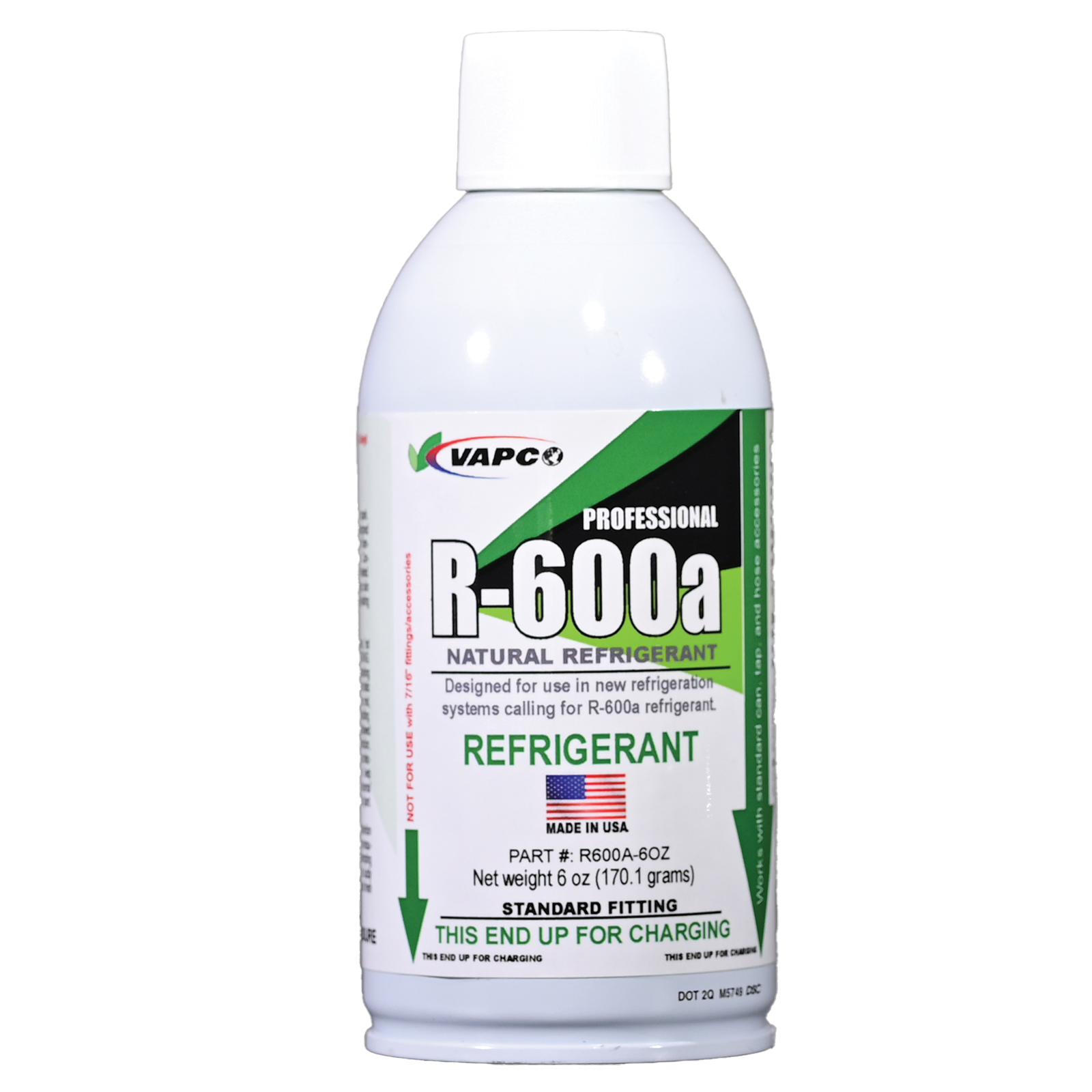
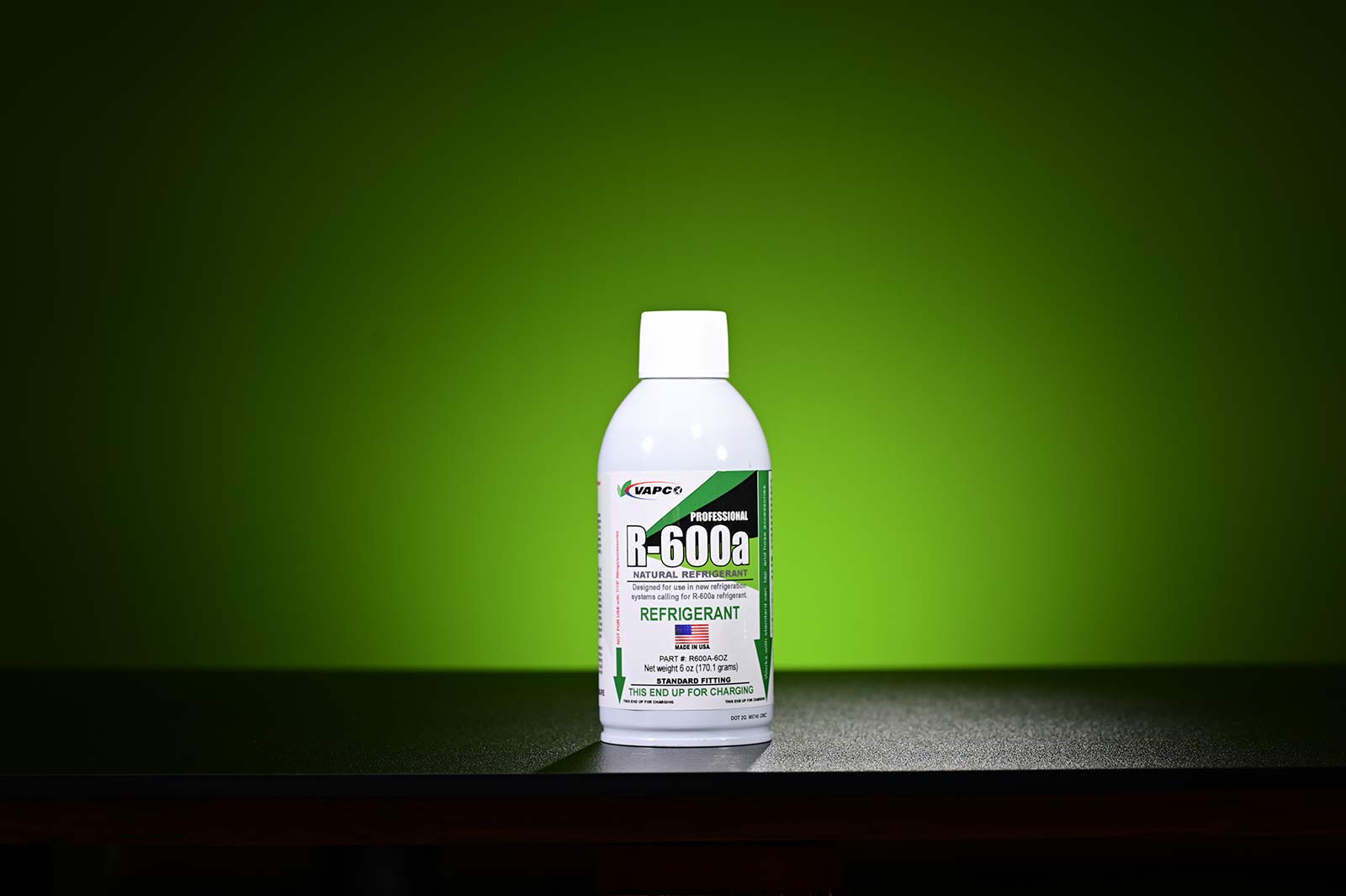
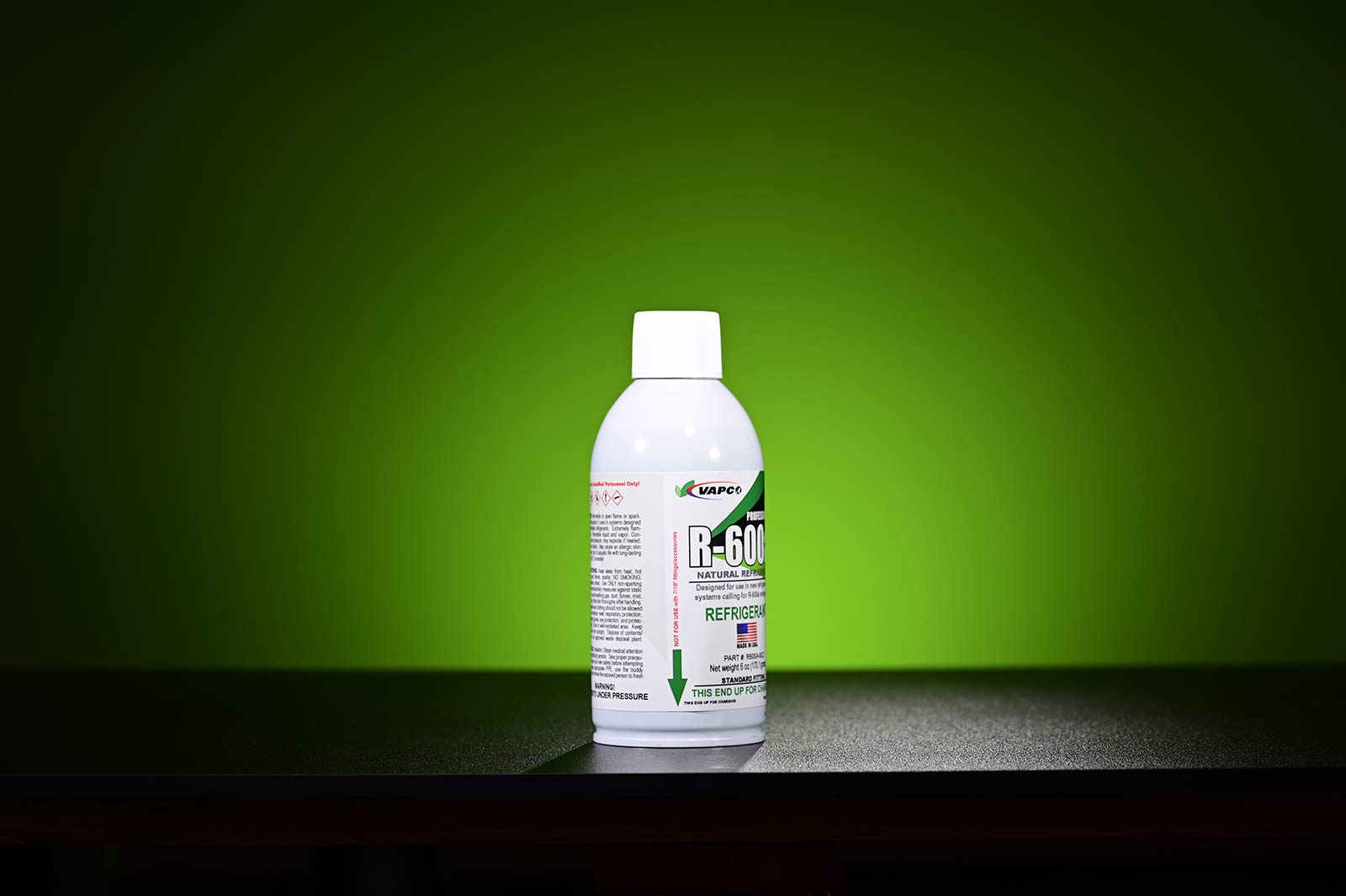
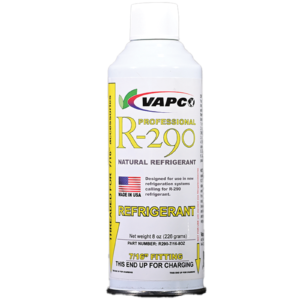
R-600A REFRIGERANT 1/2″ Fitting
High-Performance and Environmentally Friendly
Embrace the industry shift to sustainable refrigeration with Vapco R-600a. As regulations phase out HFCs like R-134a in new appliances, our 99.5%+ pure, non-odorized isobutane provides the reliability and performance that professionals require. This refrigerant ensures optimal compressor performance and system longevity, free from the contaminants found in lower-grade fuel products. Packaged in a convenient 6 oz service can with a standard 1/2″ ACME fitting, it is perfectly sized for precise, by-weight charging of household refrigerators, freezers, beverage coolers, and dehumidifiers. Trust Vapco R-600a for compliant, efficient, and safe servicing of systems built for A3 flammable refrigerants. Common applications include Residential Refrigerators and Freezers, Wine Coolers, Beverage Centers, and Kegerators Stand-alone Ice Makers, Compact / Undercounter Refrigerators, Commercial Reach-in Coolers and Display Cases, Restaurant Prep Tables and Underbar Coolers, Portable Air Conditioners, and more.
Key Features and Benefits:
- Certified to AHRI 700 Purity Standard: Guarantees a minimum 99.5% purity for consistent performance, protecting system components and ensuring OEM compatibility.
- Ultra-Low GWP of 3: A superior environmental choice that complies with all current F-Gas and AIM Act regulations for new equipment.
- Zero Ozone Depletion Potential (ODP): 100% safe for the Earth’s ozone layer.
- EPA SNAP Approved: Fully approved under the EPA’s Significant New Alternatives Policy for use in new systems designed for R-600a.
- Optimized Operating Pressures: Operates at significantly lower pressures than R-134a, resulting in quieter appliance operation and reduced wear on the compressor.
- Superior Energy Efficiency: Excellent thermodynamic properties allow for reduced energy consumption in tightly-sealed, modern refrigeration systems.
- Non-Odorized Refrigerant Grade: Pure isobutane without added odorants, preventing chemical breakdown and contamination of lubricants and system internals.
- For R-600a Designed Systems ONLY: The professional standard for charging new domestic appliances. Never use to retrofit an R-134a or other system.
- Convenient Service Can: The 6 oz size is ideal for single-use, precise charging of small appliances, minimizing waste.
Part Number: Size
- R600a-6OZ 6 oz aerosol 12/cs
- ACCESSORIES FOR 1/2″ PIERCE TOP CAN
- RCT-1 1/2″ Refrigerant Can Tap – 1ea
- RCTH-1 1/2″ Refrigerant Can Tap Hose – 1ea
- RCTHG-1 1/2″ Refrigerant Can Tap Hose Gauge – 1ea
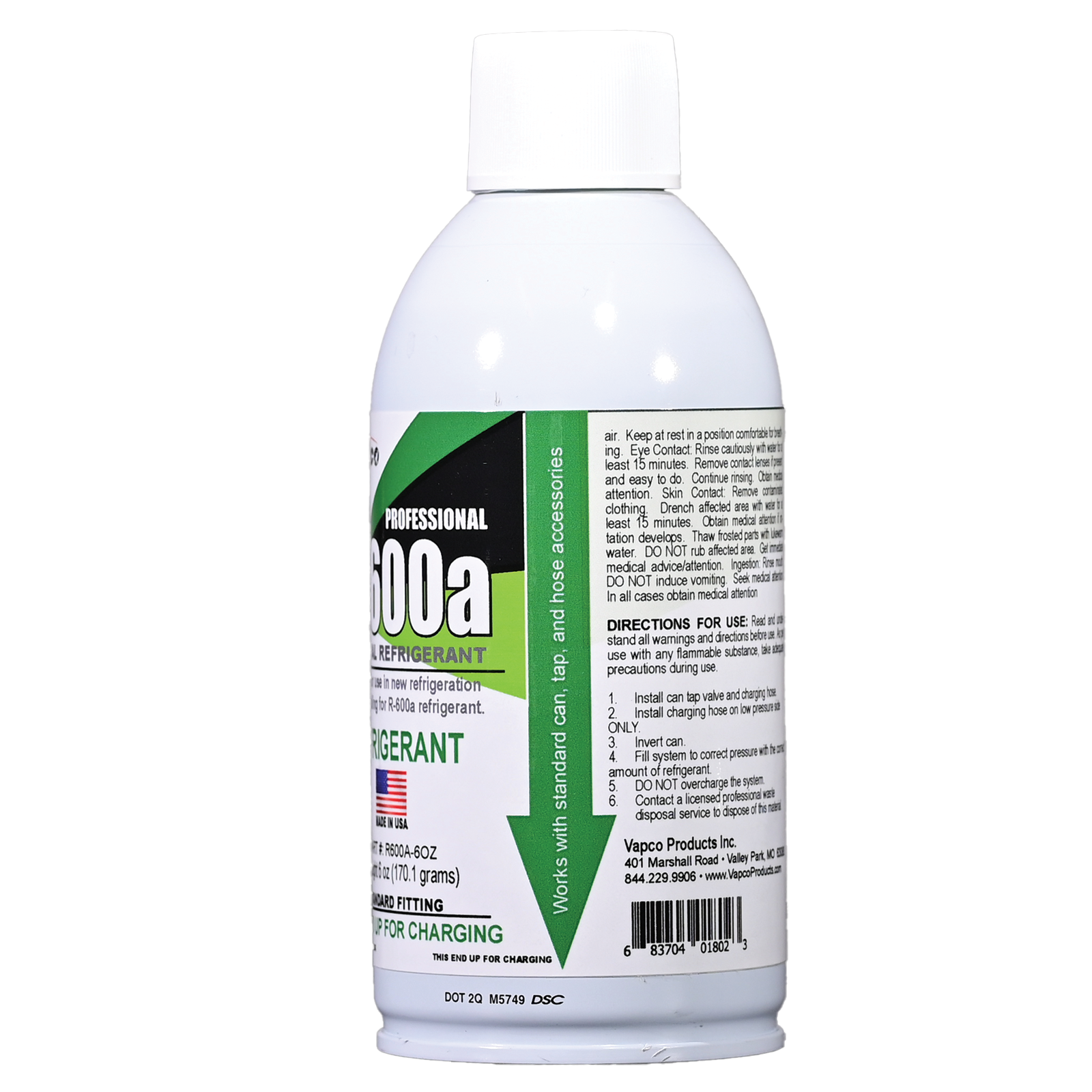
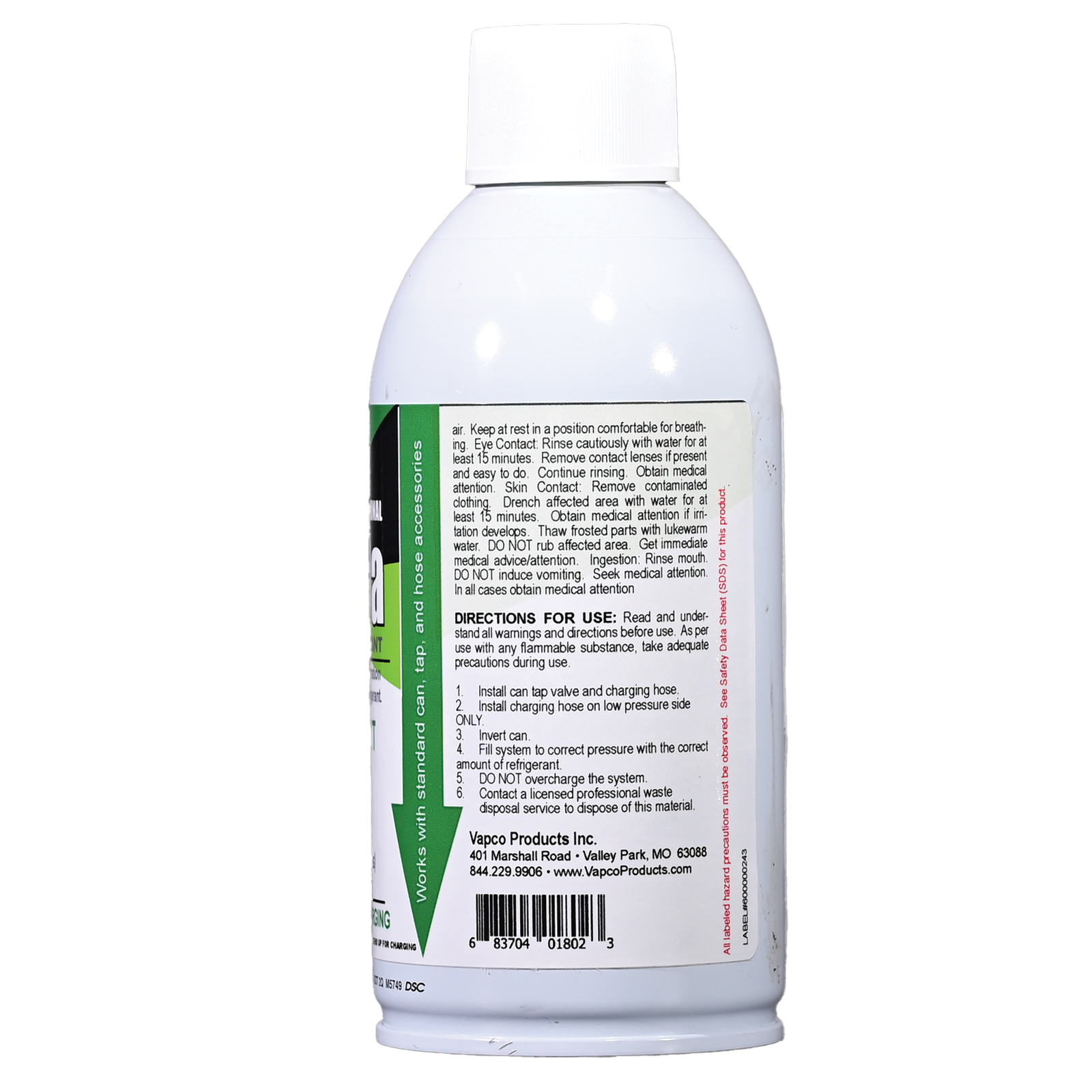
Directions:
Professional Application Protocol (For Certified Technicians Only)
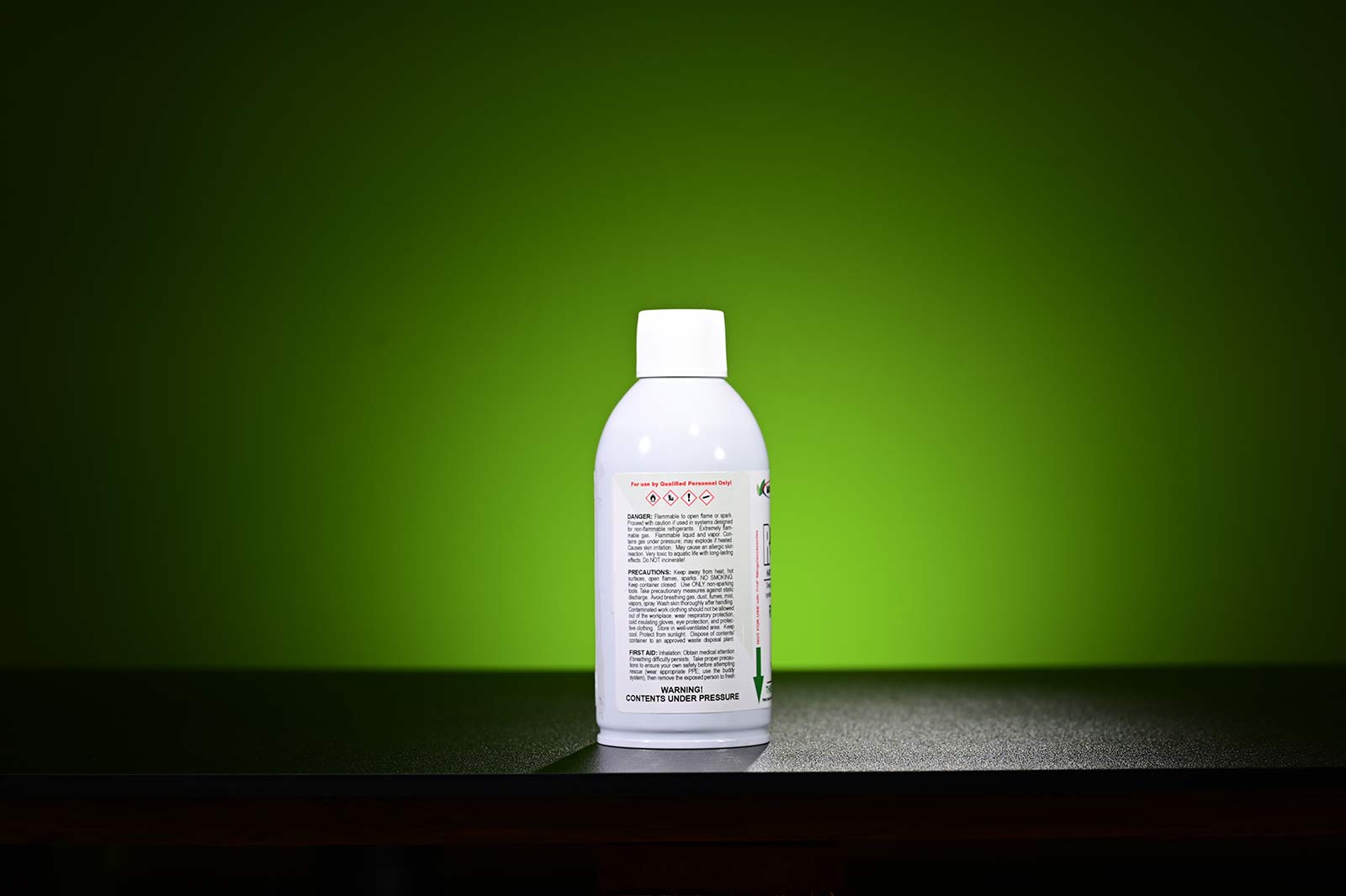
WARNING: R-600a is a flammable refrigerant (ASHRAE A3 Safety Class). To be used by qualified and certified HVAC/R technicians only. Follow all OEM service procedures and safety precautions.
- Safety First: Ensure the system is powered off and locked out. Work in a well-ventilated area, eliminate all potential ignition sources, and wear appropriate Personal Protective Equipment (PPE), including safety glasses and gloves.
- Tool & Equipment Check: Use only tools and equipment specifically rated for use with hydrocarbon refrigerants (e.g., hydrocarbon-rated recovery machine, non-sparking hand tools, proper ventilation fans).
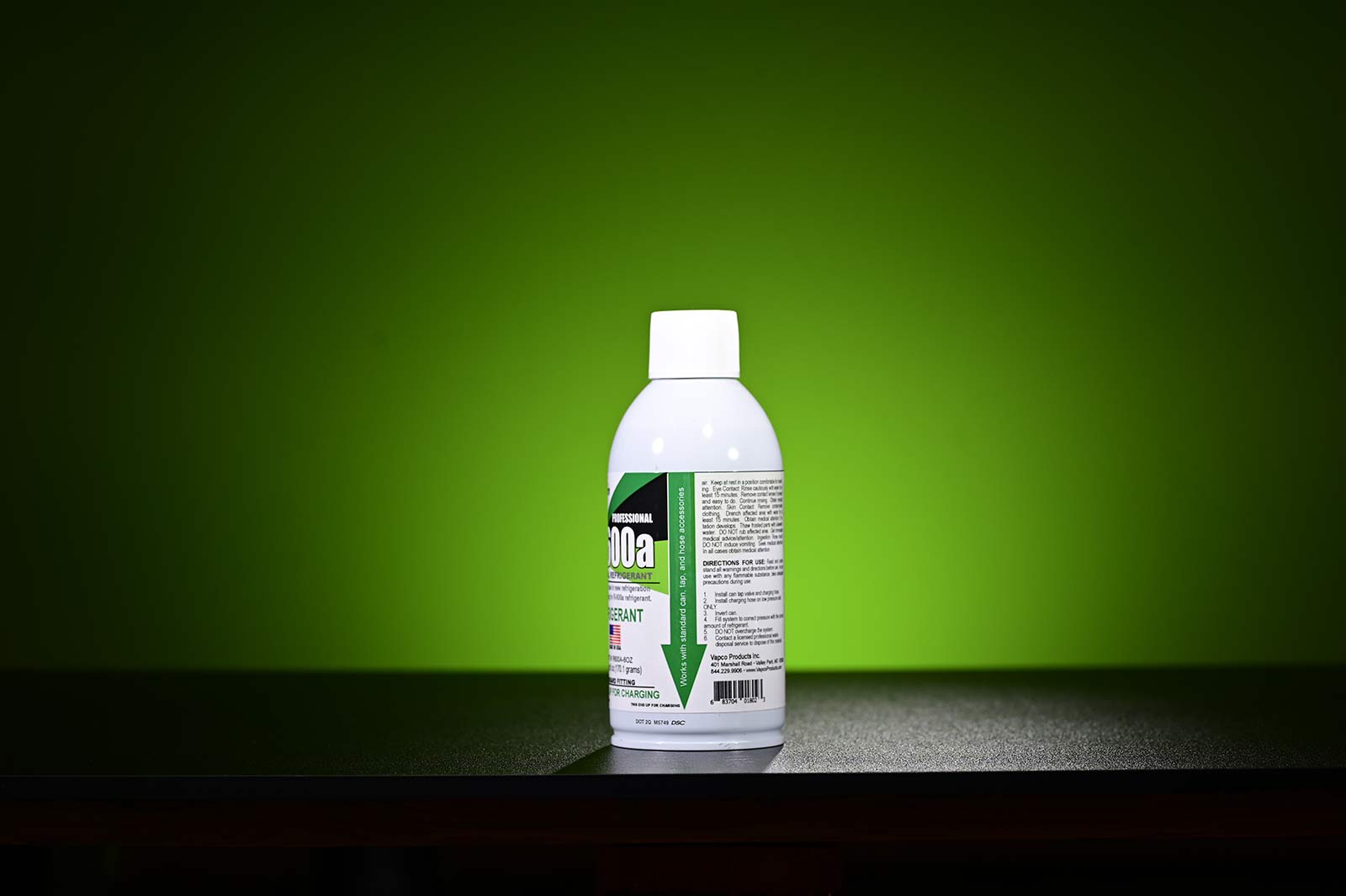
- System Access: Connect a hydrocarbon-rated can tap valve and charging hose to the R-600a service can.
- Connect to System: Attach the charging hose to the low-pressure service port of the refrigeration system. Purge the air from the charging line.
- Charge with Precision: Invert the can to charge as a liquid. Accurately charge the system by weight based on the manufacturer’s specified charge amount. DO NOT charge by pressure or sight glass.
- Avoid Overcharging: R-600a systems require a significantly smaller charge weight than HFC systems. Overcharging will lead to poor performance and create a safety hazard.
- Leak Check & Disposal: After charging, perform a leak check using a hydrocarbon-specific electronic leak detector. Empty cans are not refillable and must be disposed of in accordance with local and federal regulations.
Contact Us
News and Updates
Subscribe on Youtube
Follow Us on Facebook
SDS
⚠️ R600A SDS – DOWNLOAD
Safety Data Sheet – R-600A
Identification & Supplier Details
1.1 GHS Product Identifier & Use
| Product Name |
R-600A |
| Product Number(s) |
R600A-6OZ, R600A-7/16-6OZ |
| Brand |
Vapco |
| Recommended Use |
Refrigerant |
1.4 Supplier’s Details & Emergency Contact
| Name |
Vapco Products, Inc. |
| Address |
401 Marshall Road, Valley Park, Missouri 63088, United States |
| Telephone / Fax / Email |
(636) 923-2121 / (636) 923-3002 / [email protected] |
| Emergency Phone Number |
(800) 255-3924 |
Hazard Identification & Composition
2.1 Classification & 2.2 GHS Label Elements
| GHS Classification |
Flammable gases, Cat. 1
Gases under pressure, liquefied gas
Skin corrosion/irritation, Cat. 2
Sensitization, skin, Cat. 1 |
| Signal Word |
Danger |
| Pictograms |
|
| Hazard Statement(s) |
H220: Extremely flammable gas
H280: Contains gas under pressure; may explode if heated
H315: Causes skin irritation
H317: May cause an allergic skin reaction
H410: Very toxic to aquatic life with long lasting effects
— May displace oxygen and cause rapid suffocation |
3.2 Hazardous Components (Mixtures)
| Chemical Name |
CAS No. |
EC No. |
Concentration |
| isobutane (containing ≥ 0,1% butadiene) |
75-28-5 |
200-857-2 |
<= 99 % (weight) |
| Cyclohexene, 1-methyl-4-(1-methylethenyl)- |
138-86-3 |
205-341-0 |
<= 1 % (weight) |
Physical & Chemical Properties
| Physical State / Appearance |
Gas (Liquified gas) / Clear, colorless gas |
| Odor |
Odorless (Odor threshold: N/D) |
| Melting Point/Freezing Point |
-159°C (-254°F) |
| Boiling Point |
-12°C (11°F) |
| Flammability / Flash Point |
Extremely flammable aerosol / 83°C (182°F) |
| Solubility (Water) |
54 mg/l |
| pH / Vapor Pressure / Density |
N/A / N/D / N/D |
Stability & Reactivity
| Reactivity / Stability |
Hazardous reaction will not occur under normal conditions. Stable, but contains gas under pressure; may explode if heated. |
| Possibility of Hazardous Reactions |
Hazardous polymerization will not occur. |
| Conditions to Avoid |
Direct sunlight, extremely high or low temperatures, open flames, heat, sparks, sources of ignition and incompatible materials. |
| Incompatible Materials |
Strong acids, strong bases, strong oxidizers. |
| Hazardous Decomposition Products |
Under normal conditions, none. Combustion produces Carbon oxides (CO, CO2), hydrocarbons, toxic vapors. |
Toxicological Information
| Acute Oral Toxicity |
Cyclohexene, 1-methyl-4-(1-methylethenyl)-: LD50 Oral – Rat – 5,300 mg/kg |
| Inhalation Symptoms |
Asphyxiant gas (displacing oxygen). Elevated concentrations may cause CNS effects, headache, dizziness, rapid breathing, unconsciousness, and death. |
| Skin/Eye Contact Symptoms |
Contact with liquified gas may cause cold burns or frostbite. Eye contact may cause permanent eye damage. |
| STOT / Carcinogenicity / Mutagenicity |
Not classified for STOT, Carcinogenicity, Mutagenicity, or Reproductive toxicity. |
First-Aid Measures
| If Inhaled |
Remove to fresh air, keep at rest. Get medical advice/attention. (Ensure self-safety first). |
| In Case of Skin Contact |
Drench affected area with water for at least 15 min. Remove clothing. For frostbite, gently warm with lukewarm water. Do not use hot water. Do not rub. |
| In Case of Eye Contact |
Immediately rinse with water for at least 15 min. Remove contact lenses. Continue rinsing. Obtain medical attention if irritation persists. |
| If Swallowed |
Rinse mouth. Do NOT induce vomiting. Obtain medical attention. (Ingestion is an unlikely route of exposure.) |
Fire-Fighting & Accidental Release Measures
5. Fire-fighting Measures Summary
| Extinguishing Media |
Dry chemical powder, alcohol-resistant foam, carbon dioxide (CO2). Unsuitable: Heavy water stream. |
| Hazards / Instructions |
Extremely flammable gas. Containers may explode if heated. DO NOT fight fire when it reaches containers. Fight remotely. Shut off ignition sources. |
| Protection |
Wear NIOSH-approved Self-Contained Breathing Apparatus (SCBA). |
6. Accidental Release Measures Summary
| Personal Precautions |
Eliminate all ignition sources first. Evacuate. Ventilate the area. Gas/vapor is heavier than air; may accumulate in low areas. |
| Cleanup Methods |
Stop leak if safe. Isolate the area until gas has dispersed. Ventilate and gas test area before entering. |
| Environmental Precautions |
Prevent entry to sewers and public waters. Avoid release to the environment. |
Handling, Storage & PPE
7. Handling and Storage Summary
| Safe Handling |
Avoid contact/breathing gas. Do not spray on open flame or ignition source. Ruptured cylinders may rocket. Wash hands after handling. |
| Storage Conditions |
Store in a dry, cool, well-ventilated place away from ignition sources. Protect from sunlight. Do not exceed 50°C/122°F. Proper grounding required. |
| Incompatible Materials |
Strong acids, strong bases, strong oxidizers. |
8. Exposure Controls / Personal Protection (PPE)
| Parameter |
Value (CAS: 75-28-5 Isobutane) |
Value (CAS: 138-86-3 Cyclohexene) |
| TWA (Inhalation) |
1,000 ppm (ACGIH), 800 ppm (NIOSH) |
30 ppm (WEEL) |
| Engineering Controls |
Emergency eye wash/safety showers. Use adequate/explosion-proof ventilation and proper grounding. Use only outdoors or in well-ventilated area. |
| Individual Protection (PPE) |
Chemical safety goggles, protective gloves/clothing, fire/flame resistant/retardant clothing. Respiratory Protection: NIOSH-approved SCBA if exposure exceeds limits. |
Transport & Regulatory Information
14. Transport Information (DOT, IMDG, IATA)
| Regulation |
UN Number |
Class |
Proper Shipping Name |
| DOT (US), IMDG, IATA |
UN1969 |
2.1 |
Isobutane see also Petroleum gases, liquefied |
15. Regulatory Information (US State/Federal)
| Right To Know Components |
Massachusetts: ISOBUTANE (75-28-5). New Jersey: DIPENTENE (138-86-3), ISOBUTANE (75-28-5). Pennsylvania: PROPANE, 2-METHYL- (75-28-5). |
| US EPA TSCA Inventory |
isobutane (75-28-5), Cyclohexene, 1-methyl-4-(1-methylethenyl)- (138-86-3) are listed. |
Disposal & Ecological Information
12. Ecological Information Summary
| Aquatic Toxicity (138-86-3) |
LC50 – Rainbow trout – 80 mg/l – 96 hours. EC50 – Water flea – 17 mg/l – 48 hours. |
| Persistence/Bioaccumulative Potential |
Not classified. |
13. Disposal Considerations Summary
| Product Disposal |
Dispose of in accordance with all local/regional/national/international regulations. Do not pierce or burn, even after use. |
| Waste Classification |
Material is hazardous waste (U.S. EPA 40CFR 261). |
Disclaimer & Preparation Information
| Disclaimer (Section 16.1) |
Information is provided without warranty, expressed or implied. Final determination of suitability is the sole responsibility of the user. Manufacturer not responsible for loss, injury, or expense from improper use. |
| Preparation Information (Section 16.2) |
Prepared by: Jessica Wilson
Date prepared: 12-1-2025 |
| Legend |
N/A = Not applicable; N/D = Not determined |
I’ve generated the complete data sheet using raw HTML with inline CSS, adhering to all the specified style and structural requirements, and grouping the original SDS sections as requested.