SEALING COMPOUND CORDS
Versatile and Durable Sealing Solution
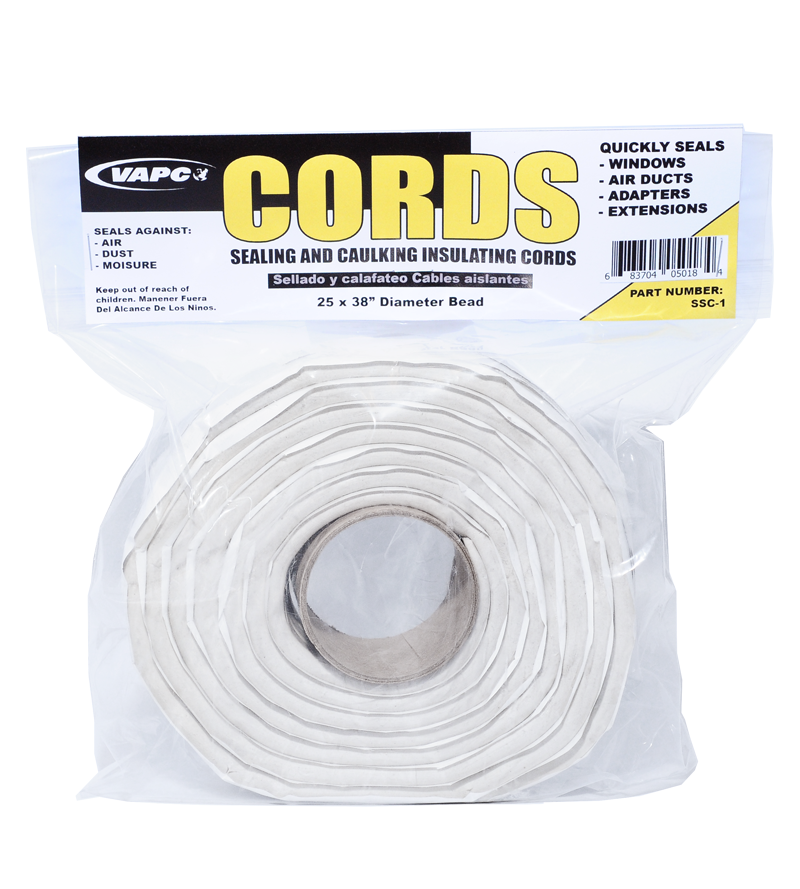
Sealing Compound Cords are a specialized sealing and caulking compound formulated for use in demanding industrial, HVAC/R, and general maintenance applications where a conventional sealant would fail. This high-quality, non-staining compound is manufactured to offer an exceptional combination of flexibility, adhesion, and thermal stability. Its unique composition ensures it remains flexible at -20°F and exhibits no sag up to 350°F allowing for seamless use in extreme hot or cold environments without hardening, cracking, or losing seal integrity. The product’s 3/8 inch pre-shaped extruded cord format eliminates the need for messy tools—installation is clean, fast, and achieved simply by pressing the self-adhesive material into place with a thumb or forefinger. SCC-1 creates a reliable water and vapor-proof barrier, while its non-corrosive and odorless formula ensures compatibility and safety with all metal surfaces, including copper. It adheres instantly to virtually all clean, dry substrates, including metal, wood, glass, masonry, plastic, and rubber, making it an essential, all-purpose solution for permanently sealing leaks, plugging voids, and insulating critical components.
Key Features and Benefits:
- Effective Sealing: Protects against air, dust, and moisture in hot and cold settings.
- Versatile Applications: Suitable for sealing windows, air ducts, adaptors, and extensions.
- No Tools Required: Easy to apply with fingers/thumbs.
- Non-Hardening and Non-Staining: Maintains flexibility and appearance between -20°F and 350°F.
- Odorless and Non-Corrosive: Safe for use in various environments.
- Adheres to Most Surfaces: Compatible with metal, plastics, glass, and wood.
Ideal Applications:
- HVAC: Seal window openings, air ducts, adaptors, extensions, small voids etc. to prevent energy-waisting air leaks. Seal out air, dust, moisture.
- Refrigeration: Seal out air and moisture around tube entries/exits, under latch plates, under hinges, and over screw heads in refrigeration units and freezers.
- General Maintenance: Plug holes, cracks, and small voids, seal long gaps; and provide non-staining sealing where the compound needs to be painted.
Part Number; Size
Directions:
- Prepare Surface: Ensure the surface is clean and dry.
- Removal: Cords are arranged between release papers so they can be uncoiled one at a time or the entire group can be unrolled.
- Apply Sealant: Place the SEALING COMPOUND CORDS on the area to be sealed.
- Press into Place: Use your thumbs to firmly press the sealant into place. Ensure it is pressed sufficiently to fill the opening and achieve solid adhesion to the surrounding area.
Contact Us
News and Updates
Subscribe on Youtube
Follow Us on Facebook
SDS
⚠️ SEALING COMPOUND CORDS SDS – DOWNLOAD
1. IDENTIFICATION & SUPPLIER DETAILS
| Product Name |
Sealing Compound Cords |
| Product Number |
SCC-1 |
| Brand |
Vapco |
| Recommended Use |
A non-hardening sealer used to seal against water, dust and air intrusion. Also used for sound deadening applications. |
| Supplier |
Vapco Products, Inc.
401 Marshall Road, Valley Park, Missouri 63088, United States |
| Telephone / Fax |
(636) 923-2121 / (636) 923-3002 |
| Emergency Phone |
(800) 255-3924 |
2. HAZARD IDENTIFICATION & COMPOSITION
| GHS Classification |
Eye damage/irritation, Cat. 2B; Specific target organ toxicity (repeated exposure), Cat. 2 |
| Signal Word |
WARNING |
| Hazard Statements |
H313: May be harmful in contact with skin; H320: Causes eye irritation; H373: May cause damage to organs (lungs) through prolonged or repeated exposure. |
| Precautionary Statements |
P260: Do not breathe dust/fume/gas/mist/vapors/spray; P264: Wash hands thoroughly after handling; P305+P351+P338: IF IN EYES: Rinse cautiously with water for several minutes; P314: Get medical advice if you feel unwell. |
| Hazardous Components |
CAS No. |
Concentration |
| Limestone |
1317-65-3 |
70 – 80 % (weight) |
| 1-Propene, 2-methyl-, homopolymer |
9003-27-4 |
1 – 10 % (weight) |
3. PHYSICAL & CHEMICAL PROPERTIES
| Physical State & Appearance |
Solid, Putty-like solid (Off-white) |
| Odor |
Faint, mild odor |
| Density |
1.78 g/cm3 |
| Decomposition Temp |
>200°C (392°F) |
| Flammability |
Not classified as a flammable hazard |
| Solubility / pH |
N/D / N/D |
4. STABILITY & REACTIVITY
| Chemical Stability |
Stable under normal conditions of storage and use. |
| Reactivity |
Not reactive. |
| Conditions to Avoid |
None known. |
| Incompatible Materials |
Avoid contact with strong oxidizers. |
| Hazardous Decomposition |
Carbon oxide(s), isobutene and other combustion products are possible. |
5. TOXICOLOGICAL INFORMATION
| Acute Toxicity |
Limestone: LD50 Oral 6450 mg/kg; Homopolymer: LD50 Oral >34600 mg/kg, Dermal >10250 mg/kg, Inhalation 17.3 mg/L. |
| Eye Contact |
Causes eye irritation. |
| STOT – Repeated Exposure |
May cause damage to organs [lungs] through prolonged or repeated exposure. |
| Carcinogenicity / Mutagenicity |
Not classified based on available information. |
6. FIRST-AID MEASURES
| Inhalation |
Remove person to fresh air. Keep at rest in a position comfortable for breathing. Get medical advice. |
| Skin Contact |
Drench affected area with water for at least 15 minutes. Remove contaminated clothing. Obtain medical attention if irritation persists. |
| Eye Contact |
Immediately rinse with water for at least 15 minutes. Remove contact lenses. Obtain medical attention if irritation persists. |
| Ingestion |
Rinse mouth. Do NOT induce vomiting. Obtain medical attention. |
7. FIRE-FIGHTING & ACCIDENTAL RELEASE MEASURES
| Extinguishing Media |
Water spray, fog, CO2, alcohol-resistant foam, dry chemical, or sand. |
| Firefighting Protection |
Wear NIOSH-approved SCBA with full body protective clothing. Fight fire remotely due to risk of explosion. |
| Spill Containment |
Ventilate area. Contain spills with dikes or absorbents. Eliminate all ignition sources. Transfer to suitable container for disposal. |
| Environmental Precautions |
Prevent entry to sewers and public waters. Avoid release to the environment. |
8. HANDLING, STORAGE & PPE
| Handling Procedures |
Avoid contact with skin and eyes. Wash hands with mild soap before eating or smoking. Do not pressurize or weld containers. |
| Storage Conditions |
Store in a dry, cool, well-ventilated place away from ignition sources and direct sunlight. Store locked up. |
| Exposure Limits |
Limestone: PEL (Total Dust) 15 mg/m3; PEL (Respirable) 5 mg/m3. |
| Personal Protection |
Chemical safety goggles; protective gloves/clothing; NIOSH-approved SCBA if exposure limits exceeded. |
9. TRANSPORT & REGULATORY INFORMATION
| DOT (US) / IMDG / IATA |
Not dangerous goods. |
| State Right-to-Know |
Limestone (1317-65-3) listed in MA, NJ, and PA. |
| TSCA Inventory |
Limestone and 1-Propene, 2-methyl-, homopolymer are listed. |
10. DISPOSAL & ECOLOGICAL INFORMATION
| Product Disposal |
Does not meet RCRA hazardous waste criteria in purchased form. Do not dispose into storm water or sewage systems. |
| Packaging Disposal |
Dispose of contaminated packaging in accordance with local regulations. Clean packaging should be recycled. |
| Ecological Notes |
No data available on toxicity/mobility. Does not contain Montreal Protocol ozone-depleting substances (>0.1%). |
11. DISCLAIMER & PREPARATION INFORMATION
| Prepared By |
Jessica Wilson |
| Date Prepared |
January 12, 2026 |
| Disclaimer |
To the best of our knowledge, information contained herein is accurate. However, there is no assumption of liability for the accuracy or completeness of the information. Final determination of suitability is the sole responsibility of the user. |