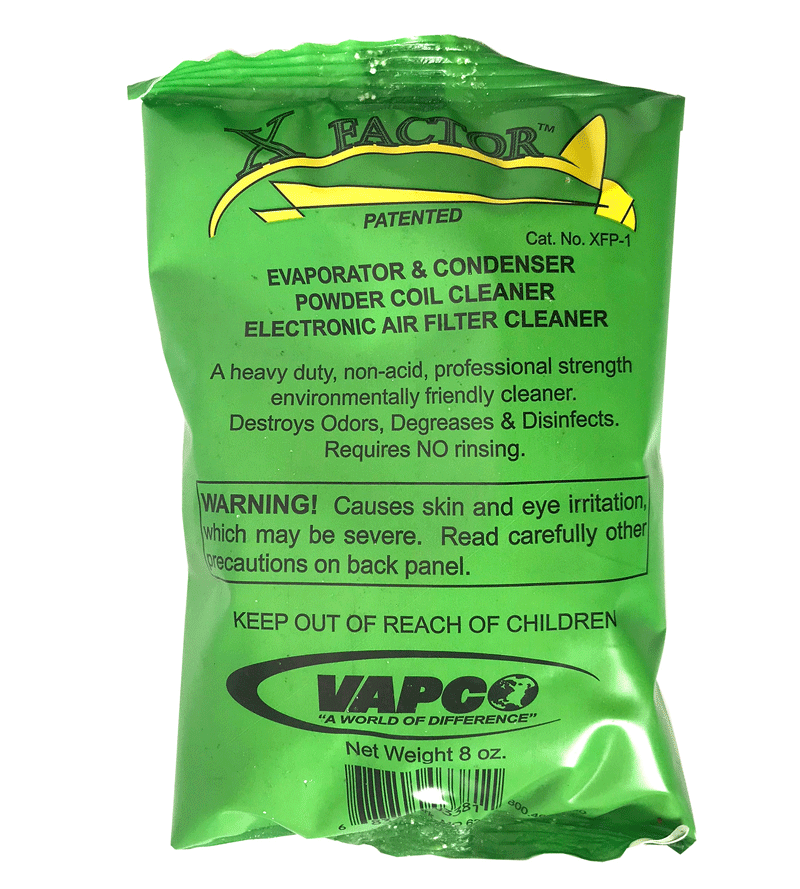
X-FACTOR: Powerful, Odor-Eliminating Cleaner
X-FACTOR is a professional-grade detergent designed to tackle tough cleaning tasks while effectively destroying odors and the bacteria that cause them. Its unique formula converts unsaturated fats and grease into cleaning agents, providing a powerful and effective cleaning solution.
Key Features and Benefits:
- Heavy-Duty Cleaning: Removes stubborn dirt, grease, and grime.
- Odor Elimination: Destroys odors and the bacteria that cause them.
- Non-Acid Formula: Gentle on surfaces while providing powerful cleaning action.
- Environmentally Friendly: Biodegradable and has zero VOC content.
- Multi-Purpose Cleaner: Suitable for a wide range of cleaning tasks.
- No Rinsing Required: Saves time and effort.
Ideal for:
- Electronic air filters
- Evaporator coils
- Ventilation and exhaust systems
- Concrete floors
- Cooling towers
- Refrigerators
- Tools
- And more
X-FACTOR is a versatile and effective cleaning solution that can be used on various surfaces without damaging metals. Its powerful odor-eliminating properties and ease of use make it a valuable asset for both residential and commercial applications.
Available Size:
DIRECTIONS:
Effective Cleaning for HVAC Systems
Before Use:
- Consult SDS: Refer to the Safety Data Sheet (SDS) for detailed safety information.
- Wear Protective Gear: Always wear protective clothing.
Application:
- Power Off: Turn off the HVAC system.
- Add Water: Pour 1 gallon of water into the sprayer.
- Apply X-FACTOR: Add the contents of one bag of X-FACTOR to the sprayer.
- Mix: Close the sprayer and shake vigorously for 1-2 minutes to dissolve.
Specific Applications:
- Evaporator Coils: Apply to the air intake side while the fan is running (if possible). No rinsing is necessary.
- Condenser Coils: Rinse thoroughly after application.
Electronic Air Filters: Spray onto the filter and fan, wetting all areas of the plate. Rinsing is recommended.
By following these steps, you can effectively clean and deodorize your HVAC system using X-FACTOR.
DANGERS & PRECAUTIONS:
Read and understand the product’s label and Safety Data Sheet. It causes skin and eye irritation, which may be severe. Vapors, spray, mist, or dust can cause severe irritation to the nose, throat, and lungs. This material liberates oxygen, which may intensify a fire. Keep out of reach of children. Wash hands thoroughly after handling. Do not get on clothes or skin. Wear protective gloves and eye protection. General ventilation recommended. Do not mix with strong acids.
Contact Us
News and Updates
Subscribe on Youtube
Follow Us on Facebook
SDS
⚠️ X FACTOR SDS – DOWNLOAD
SAFETY DATA SHEET
X-FACTOR
1. Identification & Supplier Details
Product Identification (Section 1.1)
| GHS Product Identifier (Product Name) |
X-Factor |
| Product Number |
XFP-1 |
| Brand |
Vapco |
Recommended Use (Section 1.3)
| Recommended Use |
Concrete cleaner |
| Restrictions on Use |
N/A (Not Specified) |
Supplier Details & Emergency Contact (Section 1.4 & 1.5)
| Supplier Name |
Vapco Products, Inc. |
| Supplier Address |
401 Marshall Road
Valley Park, Missouri 63088, United States |
| Telephone |
(636) 923-2121 |
| Fax |
(636) 923-3002 |
| Email |
[email protected] |
| Emergency Phone Number |
(800) 255-3924 |
2. Hazard Identification & Composition
GHS Classification (Section 2.1)
| Category |
Classification |
| Eye Damage/Irritation |
Cat. 2A (Causes serious eye irritation) |
GHS Label Elements (Section 2.2)
| Signal Word |
Warning |
| Pictograms |
|
| Hazard Statement(s) |
- H319: Causes serious eye irritation
|
| Precautionary Statement(s) |
- Prevention: P264, P280
- Response: P305+P351+P338, P337+P313
|
Hazardous Components (Section 3.2)
| Chemical Name |
CAS Number |
Concentration (weight %) |
| Carbonic acid disodium salt, compd. with hydrogen peroxide (H2O2) (2:3) |
15630-89-4 |
40 – 70 % |
| D-Gluconic acid, monosodium salt |
527-07-1 |
7 – 15 % |
| Sulfonic acids, C14-16-alkane hydroxy and C14-16-alkene, sodium salts |
68439-57-6 |
7 – 15 % |
| Carbonic acid disodium salt (Soda Ash) |
497-19-8 |
5 – 10 % |
3. Physical & Chemical Properties
Basic Physical and Chemical Properties (Section 9)
| Physical State |
Solid |
| Appearance / Color |
Powder / Off-white |
| Odor / Odor Threshold |
No distinct odor / N/D |
| pH |
N/A |
| Melting Point/Freezing Point |
N/D |
| Boiling Point or Boiling Range |
N/D |
| Flash Point |
N/D (Not considered a flammable solid) |
| Flammability (Solid, Gas) |
Not considered a flammable solid by OSHA (29 CFR 1910.1200) |
| Vapor Pressure |
>18 mmHg |
| Relative Vapor Density |
1 (Air=1) |
| Density and/or Relative Density |
1.09 at 77°F (25°C) |
| Solubility |
Soluble in water |
| Evaporation Rate |
<0.8 (Slow) |
4. Stability & Reactivity
Reactivity and Stability (Section 10)
| Reactivity |
Chemically active metals and acids. |
| Chemical Stability |
Stable under normal conditions of storage and use. |
| Possibility of Hazardous Reactions |
None known. |
| Conditions to Avoid |
Do not mix with strong acids. |
| Incompatible Materials |
Strong acids, strong oxidizing agents. |
| Hazardous Decomposition Products |
Carbon oxide(s). |
5. Toxicological Information
Information on Toxicological Effects (Section 11)
| Acute Toxicity |
Not established. |
| Skin Corrosion/Irritation |
Causes irritation, absorbed, may cause burns if left on skin. |
| Serious Eye Damage/Irritation |
Causes severe irritation, burning, redness, tearing, pain, may cause lens or corneal damage. |
| Respiratory or Skin Sensitization |
Causes irritation to the respiratory tract, upper respiratory damage. |
| Carcinogenicity/Mutagenicity/Reproductive Toxicity |
Not classified. |
| Acute Health Hazards (Summary) |
Eyes: Redness, tearing, blurred vision. Skin: Redness and dermatitis. |
| Chronic Health Hazards (Summary) |
Respiratory diseases and dermal related medical conditions. |
6. First-Aid Measures
Description of Necessary First-Aid Measures (Section 4.1)
| General Advice |
Never give anything by mouth to an unconscious person. If you feel unwell, seek medical advice (show the label where possible). |
| If Inhaled |
Remove person to fresh air. Keep comfortable for breathing. Get medical advice/attention. |
| In Case of Skin Contact |
Immediately drench affected area with water for at least 15 minutes. Remove contaminated clothing immediately. Obtain medical attention if irritation develops or persists. |
| In Case of Eye Contact |
Immediately rinse cautiously with water for several minutes (at least 15 minutes). Remove contact lenses if present and easy to do. Continue rinsing. Obtain medical attention if irritation persists. |
| If Swallowed |
Rinse mouth. Do NOT induce vomiting. Obtain medical attention. |
Immediate Medical Attention & Special Treatment (Section 4.3): If exposed or concerned, get medical advice and attention. The absence of visible signs or symptoms of burns does not reliably exclude the presence of actual tissue damage.
7. Fire-Fighting & Accidental Release Measures
Fire-Fighting Measures (Section 5)
| Suitable Extinguishing Media |
Use appropriate media for surrounding fire (e.g., dry chemical, foam, or carbon dioxide (CO2)). |
| Specific Hazards |
None known. |
| Hazardous Combustion Products |
Alkaline vapors in fire. |
| Protection During Firefighting |
Wear NIOSH-approved Self-Contained Breathing Apparatus (SCBA) with full face piece and full body protective clothing. |
Accidental Release Measures (Section 6)
| Personal Precautions/PPE |
Do not get in eyes, on skin, or on clothing. Do not breathe vapors. Keep away from heat/ignition sources. Use appropriate PPE. |
| Containment & Clean Up Methods |
Ventilate the area. Contain spills with dikes or absorbents. Eliminate all ignition sources. Take up liquid spill (after dissolution) into absorbent material. |
| Waste Disposal |
Dispose of in accordance with local, regional, national, and international regulations. Product should be fully characterized prior to disposal (40 CFR 261). |
8. Handling, Storage & PPE
Precautions for Safe Handling (Section 7.1)
| Precautions for Safe Handling |
Do not handle until all safety precautions have been read and understood. Avoid contact with skin, eyes and clothing. Wash hands and other exposed areas thoroughly after handling. |
| Hygiene Measures |
Handle in accordance with good industrial hygiene and safety procedures. |
Conditions for Safe Storage (Section 7.2)
| Storage Conditions |
Store locked up/in a secure area. Store in a dry, cool, well-ventilated place away from ignition sources. Protect from sunlight. Do not expose to temperatures exceeding 50°C/122°F. |
| Incompatible Materials |
Strong acids, strong oxidizing agents. |
Individual Protection Measures (PPE) (Section 8.3)
| Appropriate Engineering Controls |
Emergency eye wash fountains and safety showers should be available. Ensure adequate ventilation. Use only outdoors or in well-ventilated area. |
| Eye/Face Protection |
Chemical safety goggles. |
| Skin/Body Protection |
Wear protective gloves (chemical resistant) and clothing. Wear fire/flame resistant/retardant clothing. |
| Respiratory Protection |
Use a NIOSH-approved Self-Containing Breathing Apparatus whenever exposure may exceed established Occupational Exposure Limits. |
9. Transport & Regulatory Information
Transport Information (Section 14)
| Regulation |
UN Number |
Class / PG |
Proper Shipping Name |
| DOT (US) |
UN3261 |
8 / III |
Corrosive solid, acidic, organic, n.o.s |
| IMDG |
UN3261 |
8 / III |
Corrosive solid, acidic, organic, n.o.s |
| IATA |
UN3261 |
8 / III |
Corrosive solid, acidic, organic, n.o.s |
Regulatory Information (Section 15)
| US EPA TSCA Public Inventory |
All hazardous components are listed. |
10. Disposal & Ecological Information
Ecological Information (Section 12)
| Toxicity |
None established. |
| Persistence and Degradability |
This product is biodegradable. |
| Bioaccumulative Potential |
This product is not expected to bioaccumulate. |
| Mobility in Soil |
This product is mobile in soil. |
Disposal Considerations (Section 13)
| Product Disposal / Waste Treatment |
Dispose of contents/container in accordance with local, regional, national, and international regulations. Waste likely considered hazardous under RCRA, however product should be fully characterized prior to disposal (40 CFR 261). |
| Other Disposal Recommendations |
Container may remain hazardous when empty. Continue to observe all precautions. Do not puncture or incinerate container. |
11. Disclaimer & Preparation Information
Preparation Information (Section 16.2)
| Prepared by |
Jessica Wilson |
| Date Prepared |
2-25-2025 |
Disclaimer (Section 16.1):
To the best of our knowledge, information contained herein is accurate. However there is no assumption of liability for the accuracy or completeness of the information contained herein. Final determination of suitability of any material is the sole responsibility of the user. All materials may present unknown hazards and should be used with caution. The user is responsible for full compliance with various government agency regulations. No warranty, expressed or inferred, regarding the product described in this SDS shall be created or inferred by any statement in this SDS.
Key: N/A = Not applicable; N/D = Not determined