TL;DR
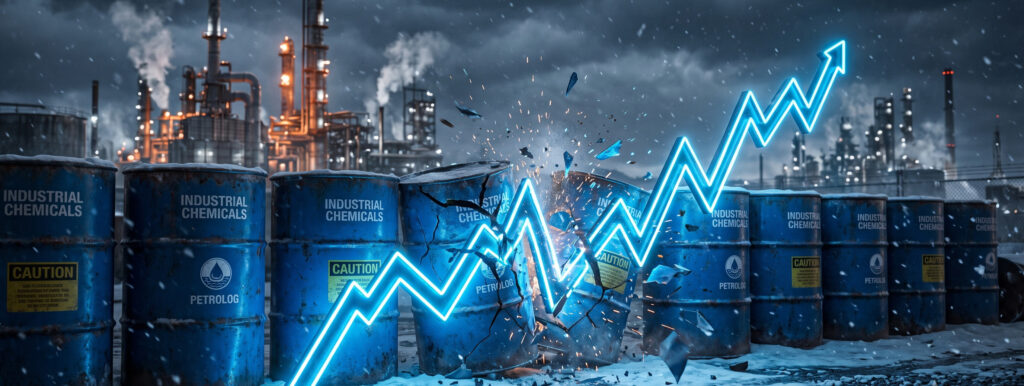
- Prices Spiked: Standard industrial-grade material jumped over 3x. Virgin material spiked even harder and was hard to find at any price.
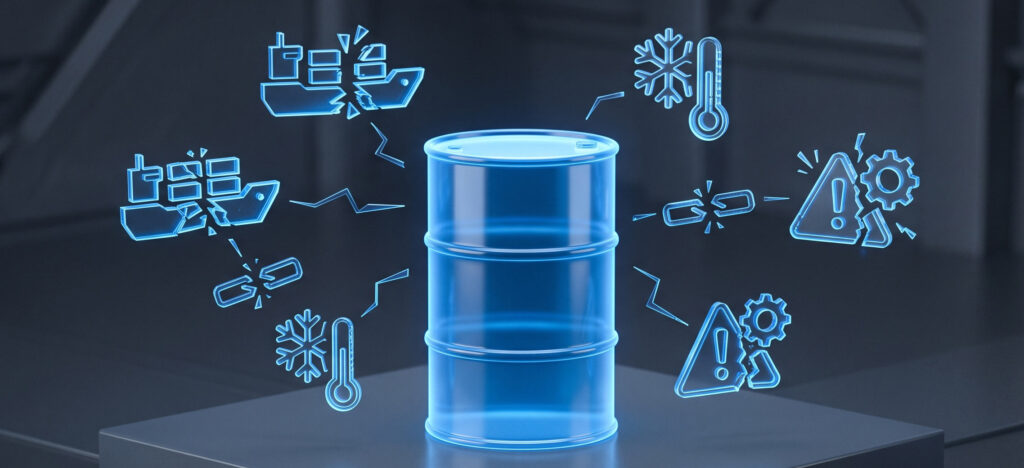
- The Perfect Storm: A fire at LyondellBasell's Bayport, TX propylene oxide plant; force majeure at Dow's Freeport and Plaquemine facilities; the Iran conflict and Strait of Hormuz feedstock shock; refined glycerine (the bio-based PG feedstock) hitting historic highs and getting diverted to higher-value markets; and imports from China and the Middle East effectively cut off.
- Current State: They're off the March panic peaks, but still well above where they started the year.
- Looming Threat: Every buyer who waited out the March spike is coming back to the market before Q4, into an already-tight supply chain.
The Bottom Line: Lock in your winter glycol needs now, and buy from a company that actually manufactures and blends what they sell — not a relabeler who's fully exposed to every spot-market ripple.
The Price Story: A Punch to the Gut
If you bought propylene glycol in Q2 2026, you already know what this article is about. For everyone else, here's the shape of it:
- August 2025 through January 2026: Flat No signal of what was coming.
- February to March 2026: Vertical Standard industrial-grade PG more than tripled in roughly 60 days. Virgin material climbed even higher, with allocation cuts making it hard to source at any price. Distributors watching their invoices went from "steady" to "what just happened" in about six weeks.
- Mid-2026 (Today): Off the panic highs Standard-grade has retreated meaningfully, virgin has come down as well — but neither is anywhere near where they were before the spike. Both are still trading at multiples of their pre-2026 levels.
Industry pricing indexes called it a "moderate feedstock disruption." That's the polite version. Here's the real version.
What Actually Happened
1
LyondellBasell's Bayport, Texas fire (March 12, 2026)
LyondellBasell's Bayport Choate complex is one of the largest propylene oxide production sites in North America — roughly 600,000 tonnes per year of PO capacity. The site also produces propylene glycol and glycol ethers directly. In March, a fire at the plant forced LyondellBasell to declare force majeure on its entire PO and derivatives portfolio.
Within weeks, at least two major polyether polyol producers — customers of LyondellBasell — announced 50% allocation cuts to their own customers.
2
Dow's freeze events at Freeport and Plaquemine
Around the same window, Dow Chemical had to shut down PO and PG production at its Freeport and Plaquemine plants after freezing temperatures took the units offline. Dow declared its own force majeure on propylene oxide and propylene glycol, and announced two separate PG price increases in 2026 — one effective February, another effective June.
Between LyondellBasell and Dow, a huge percentage of North American merchant propylene glycol supply was suddenly on allocation or off the board entirely.
3
The Iran conflict and the Strait of Hormuz
Escalating tensions in the Middle East disrupted crude oil and naphtha flows starting in late February. Naphtha is a primary feedstock for propylene. Propylene is the feedstock for propylene oxide. Propylene oxide is the feedstock for propylene glycol. Every layer of that chain got hit at once, with freight premiums and rerouting costs stacking on top.
Petrochemical prices worldwide moved up sharply in early March 2026 on the combination of higher crude, weaker cracker utilization, and force majeure notices piling up.
4
The bio-route quietly collapsed too
Here's the piece the trade press mostly missed: PG doesn't only come from petroleum. There's a second production route from bio-based glycerine, a co-product of biodiesel manufacturing. In early 2026, refined glycerine prices hit historic highs. La Niña rains disrupted palm oil harvests in Southeast Asia. Indonesia's B40 biodiesel mandate pulled feedstock into fuel instead of oleochemicals. Red Sea and Hormuz freight friction added cost. Meanwhile, personal care, food, and pharmaceutical buyers were bidding aggressively for the refined glycerine that did make it to market.
The result: producers who could make PG from glycerine had every reason not to. It was more profitable to sell the glycerine straight into personal care and pharma than to convert it into PG at a compressed margin. The bio-route quietly went into brownout at the exact moment the petroleum route was on fire.
Both production paths choked at the same time. There was no fallback route to absorb the shock.
5
Imports weren't there to save us
Normally, when North American PG supply tightens, imports from China, South Korea, and the Middle East step in to backfill. Not this time. Anti-dumping measures had already reduced Chinese inflows. Middle East export restrictions cut off a second source. And logistics premiums on the cargoes that did move added an estimated 15–30% to delivered cost on top of the higher unit price.
The door that usually opens didn't.
Why Relabelers Cost More — Every Day, Not Just In a Crisis
Here's the part every HVAC contractor and distributor should think about before the next glycol purchase.
There are two kinds of companies selling propylene glycol under a brand name you'd recognize:
1. Manufacturers
Companies who buy raw PG, blend it in-house with their own inhibitor package, and ship it under their own name.
2. Relabelers
Companies who buy finished, packaged, pre-inhibited PG from someone else, put their sticker on the drum, and mark it up.
The relabeler math is simple and it's always working against the buyer. The relabeler pays a manufacturer's price plus the manufacturer's margin, then adds their own margin on top so their number lands where they need it. Two markups stacked on the same drum, and the buyer pays for both.
In a normal market, that means relabeler pricing runs significantly higher than manufacturer-direct pricing on the same product — day in, day out. It's why anyone actually comparing quotes side-by-side finds manufacturer pricing beats relabeler pricing consistently.
In an allocation market like Q1 2026, that gap blows wide open, because the relabeler has none of the tools a manufacturer has to protect the customer from the storm:
- If their contract supplier goes on allocation, they don't have the technical staff or supply relationships to shift sources, blend it themselves, and hit spec.
- When contract volumes get cut, they buy the shortfall on spot at whatever the market demands — and every dollar of it passes straight through to the customer.
- No in-house cost reduction lever, no ability to substitute grades, no way to absorb any part of the increase.
- They're buying whatever they can get.
The Custom-Blend Advantage
The bigger day-to-day story is what a relabeler physically can't do that a manufacturer can.
If a contractor needs Arctic Protection at 35% in a 55-gallon drum, in green, for a specific job — Vapco blends it, in-house, to spec, and ships it.
- Any percentage.
- Any color from the standard palette.
- Any container size (5-gal to 4,000+ gal bulk).
Try that with a relabeler. In most cases, custom blends aren't even on the menu unless you're buying a full truckload — because the relabeler isn't actually blending anything. They're pulling factory-set percentages off a shelf. Custom means calling their upstream manufacturer, waiting weeks, and ordering enough volume to make it worth someone else's time to run the batch.
For a contractor sizing a specific system to a specific climate, that's the difference between buying exactly what the job needs and over-buying a stock percentage — then diluting on-site and hoping the math works out. It's also the difference between filling out a color-coded facility where every fluid loop has its own tag, and being told "you get what's on the shelf."
Normal Market
Relabeler pricing is higher because two markups are baked into every drum, and custom work isn't practical without a truckload commitment.
Allocation Market
All of the above, plus the buyer eats every spot-price ripple with no protection.
If your invoice ran high this spring — or it's just been running high for years — there's a good chance you're buying from a company two steps removed from the material.
Where Prices Are Now — And Why They're Not Dropping Further
The market has come off the March panic peaks, but it's not returning to where it was last summer. Here's why the floor is probably in:
1. The Q4 Demand Surge
Chilled water systems, hydronic loops, snowmelt, fire sprinkler protection, data center cooling — all pull hard on PG in Q4. Every year, without fail.
2. The Wait-and-See Backlog
Every buyer who deferred purchases during the spring spike still has an unfilled need. That backed-up demand is coming to market before the first hard freeze.
3. Lingering Supply Chain Fractures
LyondellBasell's Bayport is still recovering. Dow is running with cost pressure. The geopolitical risk hasn't gone away. Import inflows haven't returned to pre-crisis levels.
Anyone expecting prices to drop back to 2025 levels before winter is probably going to be disappointed. The realistic outlook: prices stabilize where they are, or firm up as demand ramps into Q4.
What To Do Before Winter
If you're a contractor:
- Lock it in now. Get your Q4 and winter PG orders locked in now. Don't wait until the first cold snap. That's when everyone else calls their supply house at the same time.
- Know what you actually need. Don't over-buy 95% when the job runs at 40%. Use a real calculator: refractometer readings, freeze/burst points, dosage math, flow and tonnage. Free, works on your phone at the job.
- Ask where it comes from. If the answer is "we private-label it" or they can't tell you, you're one layer removed from the volatility. Ask about the inhibitor package. Ask about custom percentages. Ask about lead time on a 275-gallon tote.
If you're a distributor:
- Stop the margin bleed. A private-label line tied to spot pricing is going to keep bleeding margin as demand returns through winter.
- Upgrade your offering. Move to a manufacturer for better cost, custom blend flexibility, and stable supply through Q4.
- Rely on real lead times. Stock 5-gallon, 55-gallon, and 275-gallon Arctic Protection blends ship from Vapco in 24–48 hours. Custom blends in 48–96 hours after PO. Bulk tankers (4,000+ gallons) require 21 days.
Bottom Line
The 2026 propylene glycol market wasn't a supply disruption. It was five simultaneous supply disruptions, hitting a market with no import backstop and no bio-route safety valve. Prices have settled at a new, higher normal — and winter demand is likely to firm them up again before the year is out.
The best move between now and October is to lock in what you need, from a company that actually makes it.
Frequently Asked Questions
Why did propylene glycol prices spike in 2026?
A combination of five overlapping supply shocks in the first quarter: a fire at LyondellBasell's Bayport, Texas propylene oxide plant; force majeure at Dow's Freeport and Plaquemine facilities; feedstock disruption from the Iran conflict and Strait of Hormuz; refined glycerine (the alternate PG feedstock) hitting historic highs and being diverted to personal care and pharmaceutical markets; and reduced imports from China and the Middle East. Both production routes for propylene glycol — petroleum-based and bio-based — got constrained at the same time.
Are propylene glycol prices coming back down?
They've come off the March 2026 peaks, but they're still trading at multiples of pre-2026 levels. With winter demand ramping and delayed buyers returning to the market, most industry observers do not expect prices to fall much further before Q4.
How much propylene glycol does my system need?
Use a system volume calculator that accounts for pipe size and length, expansion and buffer tanks, and target concentration based on your lowest ambient temperature. The Vapco Glycol Calculator handles system volume, refractometer freeze and burst points, dosage adjustments for existing loops, and design flow rate.
Open the Free Glycol Calculator
Open the Free Glycol Calculator
When should I order glycol for the winter?
Now. Standard 5-, 55-, and 275-gallon Arctic Protection blends ship in 24 to 48 hours. Custom blends in 48 to 96 hours after PO. Bulk tanker orders (4,000+ gallons) require 21 days. Waiting until the first cold snap means competing with every other contractor doing the same thing.
What's the difference between buying glycol from a manufacturer vs. a private-label brand?
A manufacturer buys raw propylene glycol, blends its own inhibitor package, and controls the finished specification. Because a private-label brand pays the manufacturer's price plus margin and then adds its own, private-label pricing runs consistently higher on the same product.
In a stable market, manufacturer-direct pricing wins on cost and on custom blend flexibility. In an allocation market like 2026, the manufacturer also has sourcing flexibility, technical control, and a margin buffer that private-label brands don't.
In a stable market, manufacturer-direct pricing wins on cost and on custom blend flexibility. In an allocation market like 2026, the manufacturer also has sourcing flexibility, technical control, and a margin buffer that private-label brands don't.
Can I get a custom percentage or color of propylene glycol?
Yes — from an actual manufacturer. Vapco blends Arctic Protection to any percentage, in any standard color, and in any container size from 5 gallons up to a 4,000+ gallon bulk tanker. Custom blends ship in 48 to 96 hours after PO. Relabelers typically require a full truckload for custom work because they're not blending in-house.
Is a 20% or 25% glycol concentration enough?
Vapco strongly advises against concentrations below 25%.
Calculate Your Required Dosage
Below that range, glycol loses its bacteriostatic properties, and biological growth (bacteria, algae, slime) can flourish, clogging pumps and fouling heat exchangers.
For most HVAC applications, target 30% or higher.
Calculate Your Required Dosage