
Evaporator Coil Disinfectant:
Why Cleaning Isn't Enough
What's Growing on Your Evaporator Coil and Why It Matters to Everyone Inside
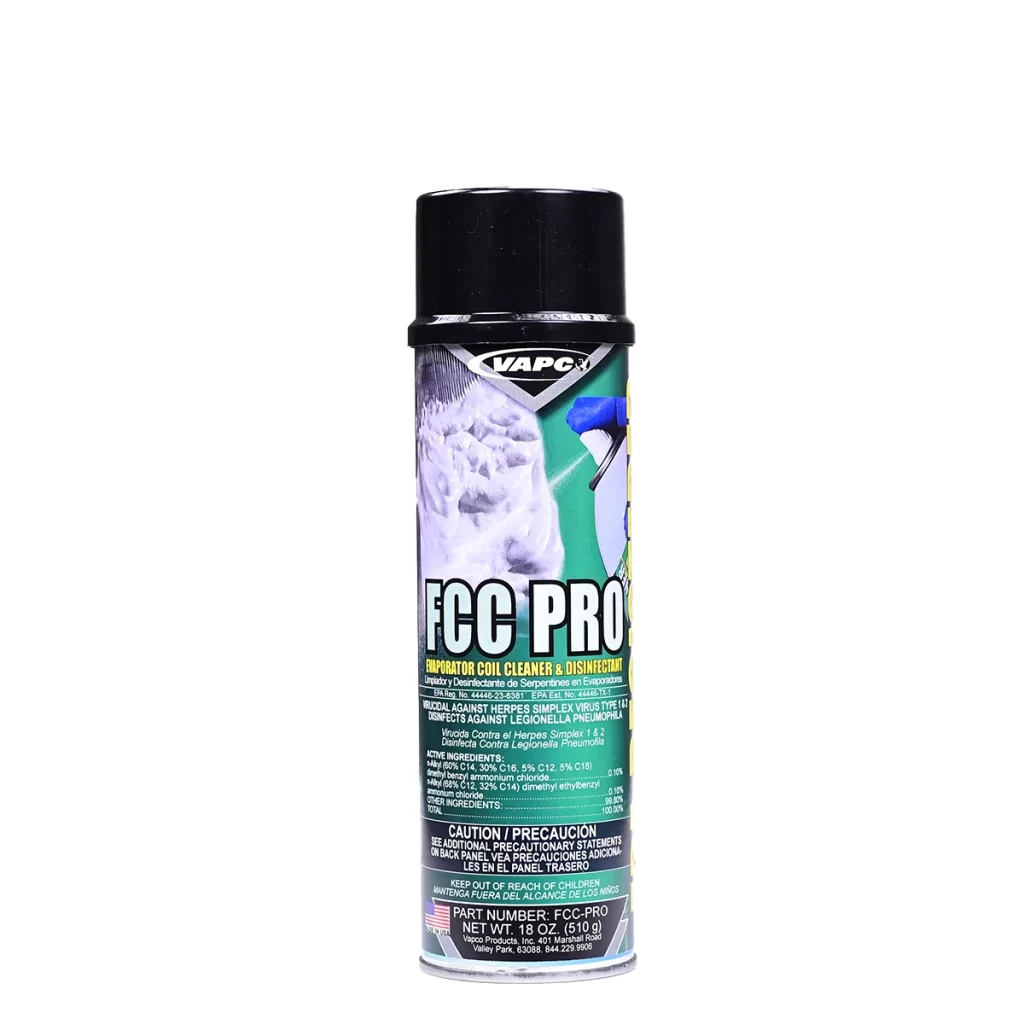
Every HVAC system you service has the same hidden problem. The evaporator coil—wet, dark, and fed by a continuous stream of organic dust—is one of the most productive biological incubators in any building. Mold, bacteria, and biofilm grow there by design. The biology doesn’t care whether the building is a hospital, a school, or a residential home. The risk is the same. What changes is who’s breathing the air on the other side. FCC-Pro (EPA Reg. No. 44446-23-6381) is a purpose-built evaporator coil disinfectant that addresses what standard cleaners cannot.
This article is for the technician with their hands on the equipment, for the counter professional explaining why an EPA-registered disinfectant costs more than a generic cleaner, and for the sales rep building the case for stocking a complete IAQ protocol. The science is the same for all three conversations,
dirty evaporator coils are active biological incubators.
The distinction between evaporator coil disinfectant vs cleaner is the difference between a true Indoor Air Quality (IAQ) solution and just a cosmetic fix. Every time the blower motor kicks on, it aerosolizes the microbes living on that coil, pushing evaporator coil bacteria and mold spores into the ductwork and, ultimately, into the lungs of the building occupants.
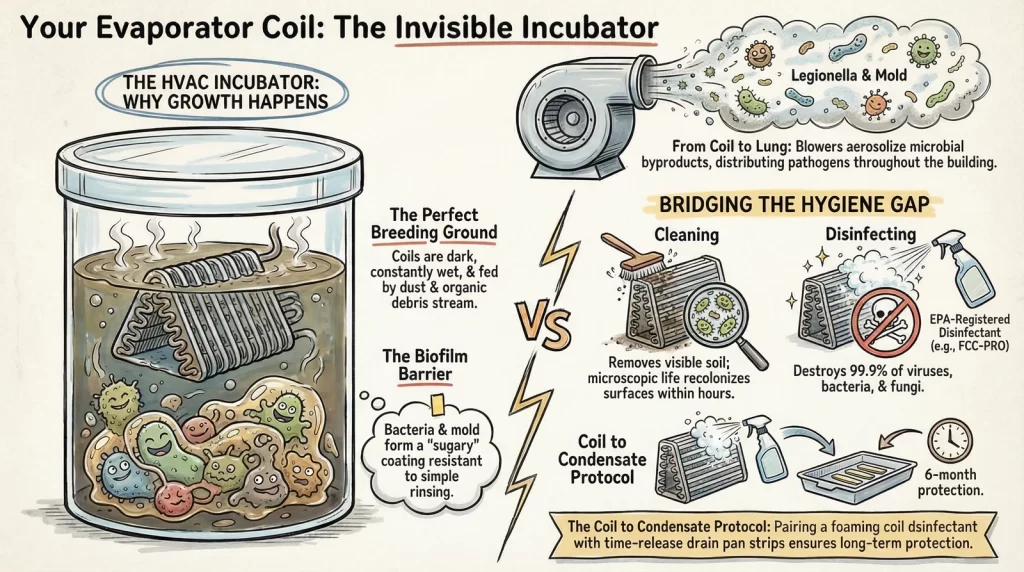
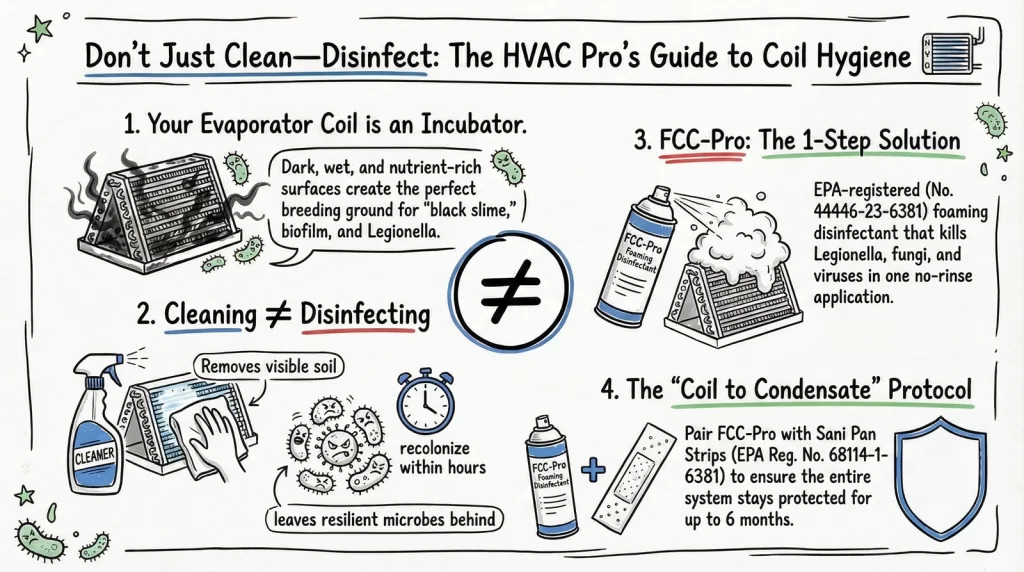
Your Evaporator Coil Is an Incubator
Microbes need three things to establish a colony: moisture, nutrients, and a stable environment. An evaporator coil provides all three in continuous supply. Condensate keeps the fin surfaces wet during every cooling cycle. Airborne dust, skin cells, and organic particulates deliver a steady nutrient load. The dense fin geometry creates sheltered microclimates that easily clog and then resist airflow disruption.
The result is biofilm—a complex, slimy matrix that bacteria and fungi construct to anchor themselves to the aluminum surface. Biofilm is not passive contamination. It is an active biological structure that protects the organisms inside it from mechanical removal and chemical disruption. A standard coil cleaner formulated to lift dirt and restore heat transfer does not have the chemistry to break through it.
The “Aerosol” Effect
A contaminated coil doesn’t hold its biological load in place. Every time the blower runs, it aerosolizes microscopic droplets from the wet fin surface—pulling mold spores, bacterial fragments, and microbial byproducts off the coil and into the supply airstream. The duct system becomes a distribution network. The CDC’s environmental infection control guidance notes that in HVAC systems where moisture is present, bursts of organisms can be released into the airstream—particularly upon system start-up—increasing the risk of airborne infection. This isn’t a theoretical pathway. It’s documented mechanism.
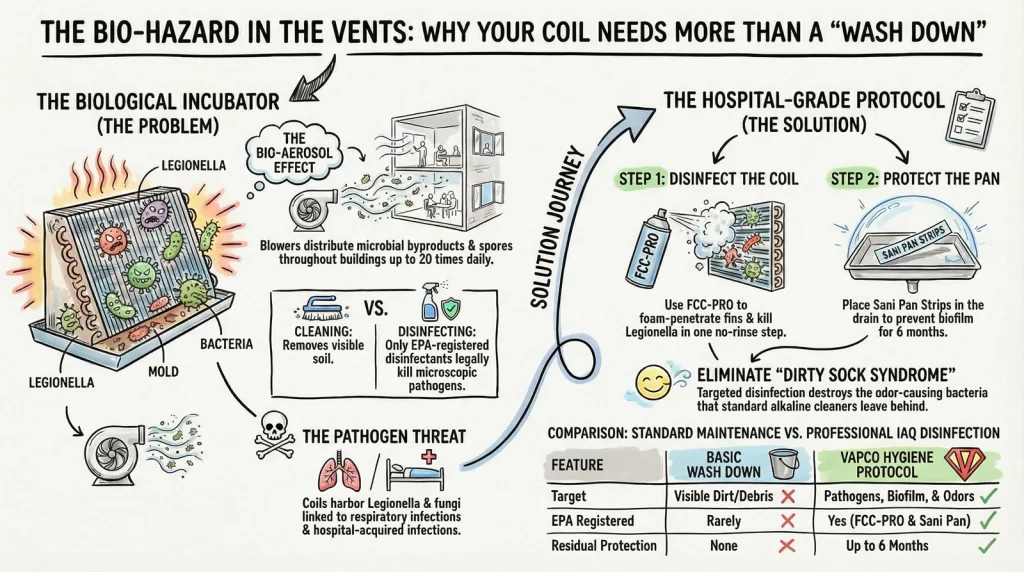
What Grows on Evaporator Coils and Why It Matters
The organisms that colonize evaporator coils are not benign. Understanding what they are and what they do is the foundation of the IAQ conversation—whether you’re a technician writing a service report or a counter rep answering “why does this cost more?” Biological growth in HVAC systems is the primary driver of dirty sock syndrome HVAC complaints, but the health implications go much further than a bad smell.
Legionella Pneumophila
Legionella thrives in warm, stagnant water and nutrient-rich wet surfaces. A fouled evaporator coil and its drain pan are textbook habitat. Legionella is responsible for Legionnaires’ disease—a severe, potentially fatal form of pneumonia. While large cooling towers carry more public awareness of the risk, residential and light commercial evaporator coils are equally capable of harboring the pathogen. The difference is that cooling towers have regulated maintenance protocols in most jurisdictions. Evaporator coils largely do not.
Mold & Fungal Spores
Fungal growth on the coil surface produces spores that are easily aerosolized and small enough to reach the lower airways. For building occupants with asthma, allergies, or compromised immunity, ongoing mold spore exposure from an HVAC system is a meaningful health exposure, not an inconvenience. Mold on the coil also produces the volatile organic compounds responsible for dirty sock syndrome—the musty, locker-room odor that generates callbacks and drives occupant complaints.
Dirty Sock Syndrome
Dirty sock syndrome is a symptom, not the root problem. The odor-causing bacteria—primarily Actinobacteria species—are specifically resistant to standard alkaline coil cleaners. Cleaning the coil removes visible soil and temporarily suppresses the smell. Without disinfection, the organisms responsible for the odor remain on the surface and recolonize within hours. This is why the problem returns after every PM visit that uses a cleaner-only product. It’s also why the conversation at the counter should never be “this cleaner vs. that cleaner”—it should be “cleaner vs. cleaner-plus-disinfectant.”
Lessons from Healthcare: Hospital-Acquired Infections
The link between HVAC system contamination and healthcare- associated infections is well-documented. Surgical site infections—among the most common and costly hospital-acquired complications—have been directly associated with inadequate operating room ventilation and air handling conditions. Peer- reviewed research published in medical literature, cited by the CDC and ASHRAE, establishes HVAC systems as structural determinants of baseline infection exposure in clinical environments.
The relevance for non-clinical buildings is this: the biology of an evaporator coil doesn’t change based on what the building is used for. A coil in a residential home or commercial office runs the same biological processes as one in a hospital. The difference is that hospital facilities managers have protocols and procurement standards built around this risk. Residential and commercial buildings largely do not—yet. That gap is where the IAQ service opportunity lives.
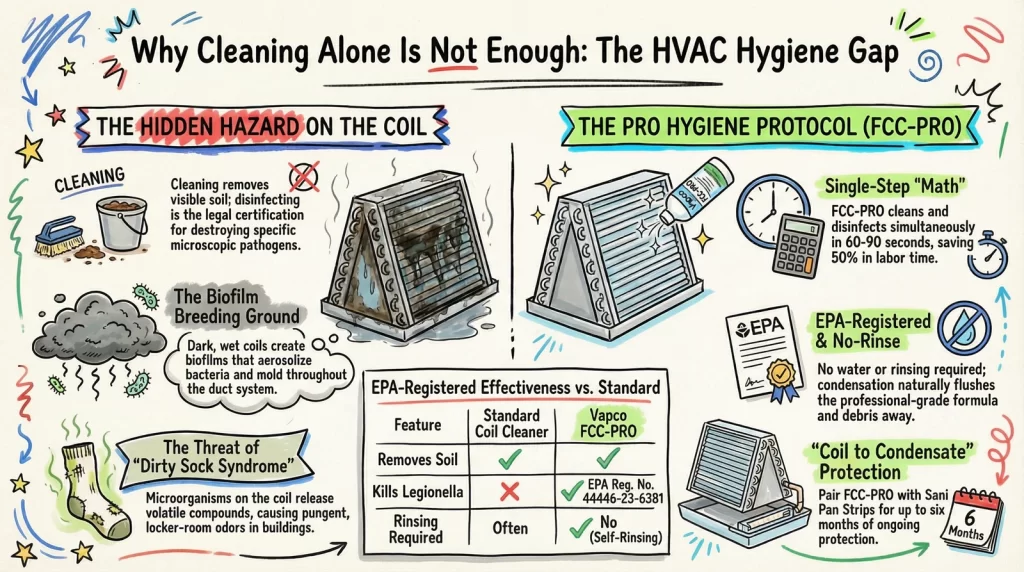
Why Cleaning Alone Is Not Enough
The industry default for decades has been visual cleanliness. If the fins are shiny and airflow has been restored, the job is done. This standard made sense when HVAC maintenance was understood purely as a mechanical efficiency problem. It doesn’t hold when the coil is understood as a biological surface with direct access to occupied airspace.
The distinction between cleaning and disinfecting is regulatory, not just semantic. Cleaning removes visible soil and improves heat transfer. Disinfecting is an EPA-regulated claim—a product that carries an EPA registration number has been independently lab-tested and proven to destroy specific pathogens at stated contact times. A product without EPA registration makes no proven kill claim, regardless of what the label implies.
Standard alkaline coil cleaners are formulated to break down grease and lift dust from fin surfaces. They do that job well. They are not formulated to kill Legionella, destroy biofilm, or eliminate the organisms responsible for dirty sock syndrome. Using a cleaner-only product on a biologically contaminated coil is not a partial solution—it is a different solution to a different problem.
For the counter professional and sales rep: this is the core of the pitch. When a contractor asks why FCC-Pro costs more than their usual cleaner, the answer is that their usual cleaner and FCC-Pro are not doing the same job. One restores mechanical efficiency. The other restores mechanical efficiency and eliminates the biological load. These are different deliverables—which means they justify a different price point and, for contractors billing IAQ services, a different line item on the invoice.
FCC-Pro: The Professional IAQ Standard for Evaporator Coils
FCC-Pro (EPA Reg. No. 44446-23-6381) is a heavy-duty foaming aerosol formulated to do both jobs in a single, no-rinse application. The foam expands deep into the coil bed—reaching interior fin surfaces that brush cleaning and liquid spray cannot access. During dwell time, it simultaneously lifts biological soil and delivers EPA-registered disinfection against:
– Legionella pneumophila
– Pathogenic fungi
– SARS-CoV-2 and Monkeypox virus
– Staphylococcus aureus and Salmonella enterica
The no-rinse design is not a convenience feature—it’s a protocol feature. In an attic, a crawlspace, or any installation where bringing water to the coil is impractical, a product that requires rinsing is a product that doesn’t get used correctly. FCC-Pro’s formula is designed so that normal condensate production during operation flushes the loosened debris and product residue into the drain pan. The coil does the rinsing itself.
FCC-Pro cleans and disinfects in 60–90 seconds. For a contractor running a maintenance agreement route, that’s the difference between a PM visit that adds IAQ value and one that just checks a box.
The Complete Evaporator Hygiene Protocol
Treating the coil addresses the primary source of contamination, but not the entire wet zone. The drain pan collects everything that comes off the coil—the loosened biofilm, the microbial debris, the condensate. Without ongoing protection, the pan becomes a secondary reservoir that recontaminates the system between PM visits.
Step 1: Coil Disinfection with FCC-Pro
Apply FCC-Pro top to bottom with the system powered off. The foaming action penetrates the fin bed and kills the biological load at the source. Allow 60–90 seconds of dwell time. No rinsing required—condensate handles the flush during the next operating cycle.
Step 2: Drain Pan Protection with Sani Pan Strips
Place Sani Pan Strips (EPA Reg. No. 68114-1-6381) directly in the condensate pan after coil treatment. The water-activated, time-release polymer matrix continuously releases antimicrobial chemistry into the pan for up to six months, preventing slime buildup, biofilm regrowth, and drain line clogs between service visits. This is the difference between a PM visit that treats today’s contamination and a protocol that prevents the next six months of it.
Step 3: Hard Surface Sanitation with Disinfect Pro
For situations requiring broader surface disinfection—air handler cabinet walls, blower housings, or supply plenums— Disinfect Pro aerosol (DIPA-1) or liquid (DIP-1) extends the same EPA-registered kill chemistry to hard surfaces throughout the system.
Associated Products for IAQ Excellence
To implement this protocol effectively, ensure your service trucks are stocked with the following EPA-registered solutions:
FCC-Pro Evaporator Coil Disinfectant: The primary engine for coil disinfection and heavy-duty cleaning.
Sani Pan Strips: Long-term protection for condensate pans to prevent clogs and odors.
Disinfect Pro Aerosol: Hospital-grade disinfectant for air handler cabinets and hard surfaces.
| Category | FCC-PRO | Disinfect Pro (DIPA-1) | Sani Pan Strips |
|---|---|---|---|
| Key Features & Pros | Triple-action: cleans, deodorizes, disinfects. No-rinse convenience, deep-penetrating foam. Works in 60-90s. | Hospital-grade; eliminates 99.9% of pathogens. Neutralizes odors; reach difficult areas; no-rinse. | Water-activated time-release tech. Prevents slime/clogs. Dependable odor and mold control. |
| Target Contaminants | Legionella, SARS-CoV-2, Monkeypox, pathogenic fungi, mold/mildew, bacteria. | Viruses (SARS-CoV-2/Monkeypox), bacteria (30s), fungi (10m), mold. | Mold, bacteria, mildew, and odor-causing organisms in stagnant water. |
| Application Area | Evaporator coils (Hospitals, Schools, Residential). | Air handler cabinets, blower housings, vents, hard surfaces. | Condensate drain pans (A/C, Refrigerators, Dehumidifiers). |
| Protocol Steps | 1. Turn off power. 2. Spray top to bottom. 3. Wait 60-90s. 4. Condensation self-rinses. |
1. Pre-clean soil. 2. Spray surface. 3. Wait 30s (Bacteria) / 10m (Viruses). 4. Air dry. |
1. Place strip in pan to be activated by water. 2. Replace every 6 months. |
| EPA Registration No. | 44446-23-6381 | 44446-67-6381 | 68114-1-6381 |
What This Means for the Building Owner
Most building owners—residential or commercial—have no idea their HVAC system is capable of harboring Legionella or distributing mold spores. They call when the system smells bad or when an occupant complains. By that point, the biological load is established and the callbacks have already started.
The contractor who can explain the difference between cleaning and disinfecting, point to EPA registration as the proof standard, and document a complete IAQ protocol is doing something categorically different from one who shows up with a spray bottle and a brush. That’s not a minor service upgrade—it’s a different category of service, and it should be priced accordingly.
The Standard is the Proof
FCC-Pro carries EPA registration because it earned it through independent laboratory testing. Sani Pan Strips and Disinfect Pro aerosol and liquid carry EPA registrations for the same reason. That registration is not a marketing claim—it is a federal determination that the product destroys the organisms it claims to destroy, at the stated contact time, under the tested conditions. No unregistered product can make that claim legally.
Every evaporator coil in every building you service is running the same biological process right now. The question is whether the protocol your team uses actually addresses it. Cleaning moves the dirt. Disinfection eliminates the biology. Both matter—and only one product category does both.
For a complete look at protecting the drain pan side of the protocol, see: Chlorine Tabs, Gel Pucks, and the Drain Pan Problem Nobody Talks About
Frequently Asked Questions
1. What causes dirty sock syndrome in HVAC systems?
Dirty sock syndrome is caused by Actinobacteria and other microbial species that colonize evaporator coil surfaces. When the coil cycles between wet and dry states, these organisms release volatile organic compounds that are pulled into the airstream. Standard alkaline cleaners do not eliminate these organisms—only an EPA-registered disinfectant kills them at the biological level.
2. Can evaporator coil mold affect indoor air quality?
Yes. Mold spores from contaminated coils are aerosolized directly into the supply airstream during normal system operation. For occupants with asthma, allergies, or compromised immunity, this represents continuous low-level exposure. In clinical settings, contaminated HVAC systems have been linked to healthcare-associated infections. The biology is identical in non-clinical buildings.
3. What is the difference between cleaning and disinfecting an evaporator coil?
Cleaning removes visible soil and restores heat transfer efficiency. Disinfecting is an EPA-regulated function—a product with an EPA registration number has been independently tested and proven to destroy specific pathogens. Only EPA-registered products can legally claim to kill Legionella, fungi, or viruses.
4. Is FCC-Pro safe for no-rinse use on evaporator coils?
Yes. FCC-Pro is formulated for self-rinsing application. Condensate produced during normal system operation flushes the product and loosened debris into the drain pan. No additional water source is required.
5. How do you prevent biofilm growth between PM visits?
Apply FCC-Pro to the coil during each PM visit to eliminate the active biological load, then place Sani Pan Strips in the condensate pan. The strips provide six months of continuous time-release antimicrobial protection between service visits.
6. What is the best EPA-registered evaporator coil disinfectant?
FCC-Pro (EPA Reg. No. 44446-23-6381) is formulated specifically for evaporator coil disinfection. It combines heavy-duty cleaning with EPA-registered kill chemistry in a single no-rinse foaming application—eliminating Legionella, pathogenic fungi, and viruses without requiring a separate disinfection step.
7. Can you clean and disinfect an evaporator coil in one step?
Yes. FCC-Pro’s foaming formula cleans soil and biofilm while simultaneously delivering EPA-registered disinfection. Applied in 60–90 seconds, it eliminates the need for a separate cleaner and a separate disinfectant on the same service call.
8. Who should know about evaporator coil disinfectants-not just technicians?
Counter professionals and distributor sales reps benefit from understanding this distinction because the question contractors ask at the counter is often “why does this cost more?” The answer is that FCC-Pro and a standard coil cleaner are not competing products—they are solving different problems. One restores mechanical performance. The other restores mechanical performance and eliminates a documented health risk. That’s a different value proposition, a different conversation with the building owner, and a different line item on a service invoice.