
HVAC Coil Cleaner Application Methods: What Works Best
Matching HVAC Coil Cleaner Application Methods to Your Chemistry
By Elliot Garner, VP of Sales & Marketing / Technical Director — Vapco Solutions
You bought the right cleaner. You mixed it to the ratio on the label. You sprayed the coil, rinsed it, and the system is still not performing the way it should. Before you blame the chemistry, ask yourself a different question: are you using the right HVAC coil cleaner application methods for the job?
The equipment you use to put cleaner on a coil determines whether the chemistry can actually do its job. The wrong application method can waste product, reduce cleaning effectiveness, or completely defeat the purpose of the formulation you chose.
TL;DR (For those reading this at a red light):
The gear matters: Buying premium chemistry and blasting it out of the wrong equipment is a great way to waste your money. (I’ll happily sell you more product, but there’s a better way).
Pump Sprayers = Control: They give you exact dilution ratios and save product. Matches the design perfectly for delayed-foaming cleaners like Foaminator.
Hose-End Guns (HEGs) = Speed: Great for flying through light residential PMs with non-foaming cleaners, but you will burn through more concentrate. Do not put Foaminator in these—you’re instantly killing the delayed-foam effect you literally paid for.
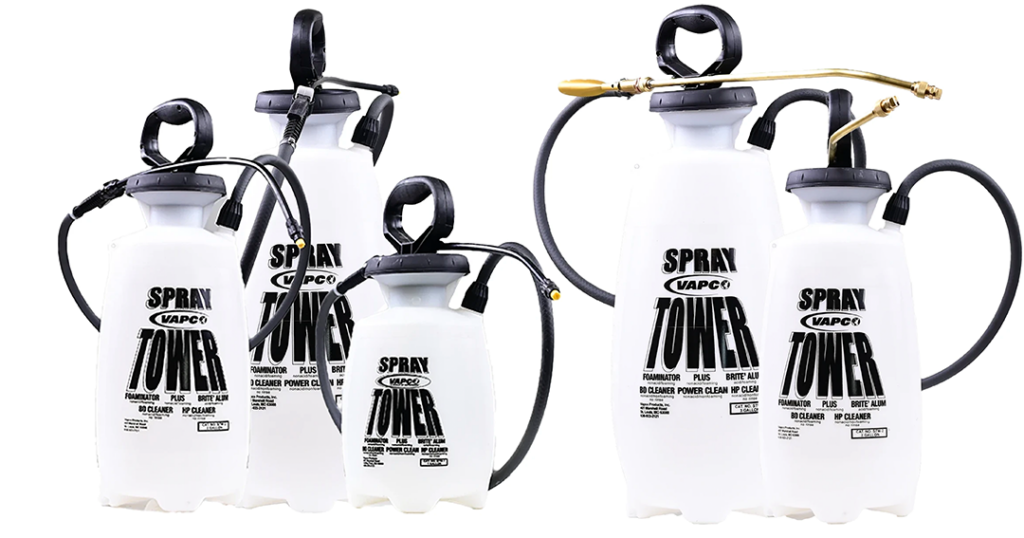
Stop buying cheap hardware store sprayers:
If it isn’t rated for low pH acids AND high pH alkalines, the harsh chemicals will eat it alive, and you’ll get it on something you wish you hadn’t.
Water first, then chemical: Unless you enjoy caustic chemical splashback and a tank full of useless bubbles, always fill your water before adding the concentrate. (If you want to know why you’re accidentally sabotaging your own coil cleanings and maybe your wallet, keep reading.)
Pump-Up Sprayers: The Control Play. The key advantage of a pump sprayer is precision. You pre-mix chemical and water in the tank at the exact dilution ratio you want, and every drop that hits the coil is at that concentration. No guesswork, no variance from nozzle pressure or water flow rate.
That precision matters more for some chemistries than others. A product like Foaminator is the extreme example.
Foaminator is a delayed-foaming condenser cleaner — it stays liquid for 60 to 90 seconds after application so the chemistry can penetrate past the outer fin rows and saturate the interior of the coil before the foam reaction kicks in. That delay is the entire reason the product exists. It is what separates it from every other foaming condenser cleaner on the market.
Foaminator is also viscous. At working concentration (3:1 to 5:1), it sprays as a cohesive stream, not a mist. That viscosity is a safety feature — it keeps the chemical on the coil and reduces the chance of blow-back on your skin. But it also means the product physically cannot be pulled through a Venturi-style hose-end gun. The fluid is too thick if poured in straight. If you thin it down enough to get it through the gun, you have defeated the delayed-foam mechanism in the process.
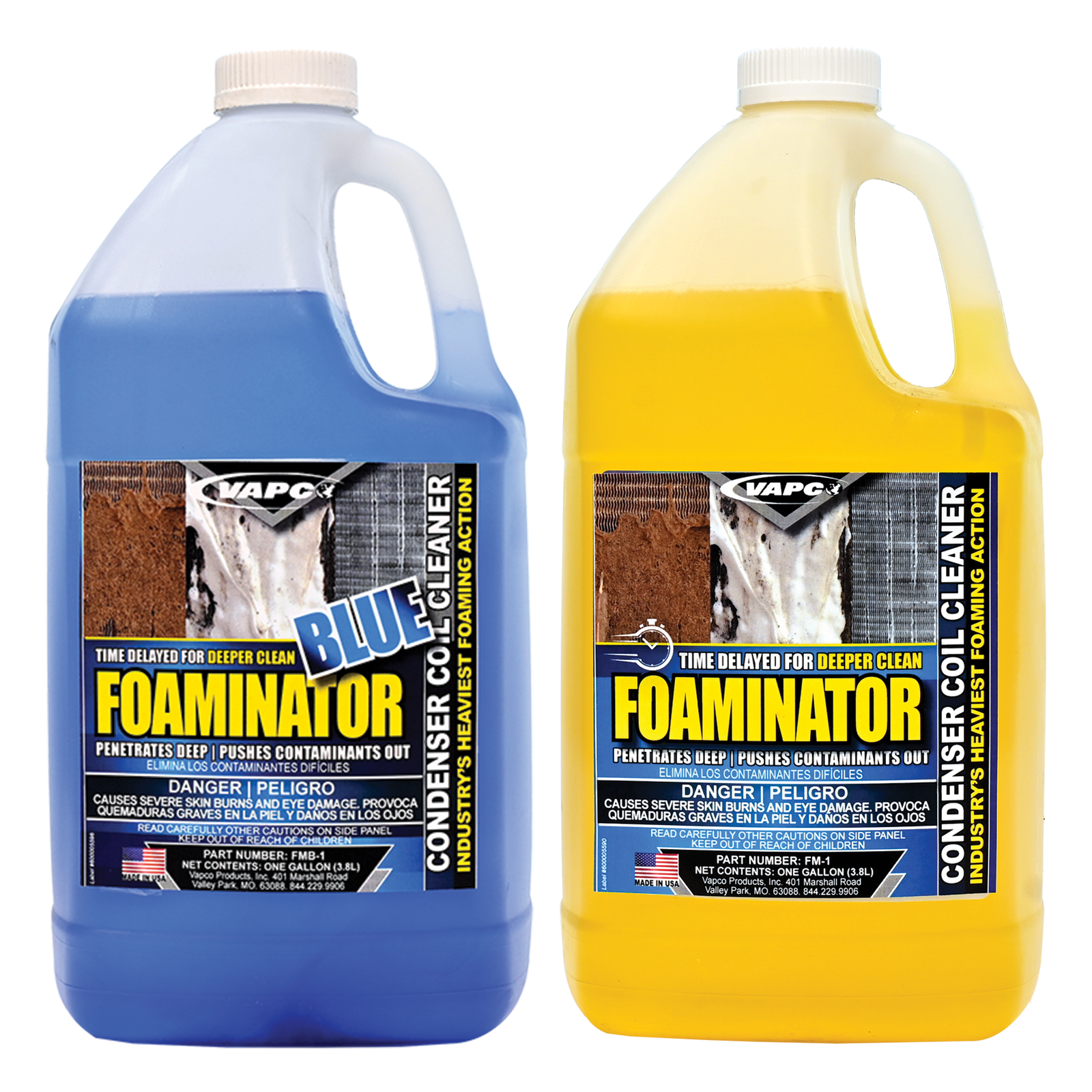
For Foaminator, a pump-up sprayer is not a preference. It is a requirement.
Different situations
Mongoose (MC-1 concentrate) is a different situation. Mongoose is a non-foaming alkaline cleaner that works at specific dilution ratios depending on the application — 10:1 for evaporators, 4:1 for heavily soiled condensers. A pump sprayer lets you hit those ratios exactly. You could run Mongoose through an HEG, and the chemistry would still work — in fact, the turbulent mixing generates some surface foam that actually helps a non-foaming product cling to the fins. But even with the ratio dialed in correctly on the gun, the sheer volume of solution coming through at hose pressure means you are putting significantly more product on each coil than a pump sprayer would. On a PM route where you are cleaning 15 condensers in a day, that adds up fast.
Eco Clean (EC-1) is the most forgiving option. It is a surfactant-based, non-foaming cleaner with an EPA DfE designation, so even if application is imprecise, the safety margin is wide. A pump sprayer still gives you the best ratio control and the lowest product consumption, but the consequences of a less precise method are lower. Like Mongoose, the HEG turbulence generates some foam that aids surface coverage.
How to mix in a pump sprayer
Water goes in first. Always. Pour your water into the tank to the level you need, then add the concentrate on top. This is not optional and it is not a preference — it is how you avoid splashing undiluted chemical out of the tank when you add water and keeping it off yourself, your truck, or a customer’s property. Concentrated alkaline and acid coil cleaners are not something you want hitting bare skin at full strength.
There is a practical reason too. If you pour concentrate in first and then add water on top of it, the water hitting the concentrate creates turbulence and foam inside the tank. Most coil cleaners are very similar to soaps, designed to foam when agitated. Pouring straight cleaner in first, then adding water is a recipe for a sprayer full of bubbles trying to escape the top while you’re still adding water to get your dilution ratio right. Water first, concentrate second. Same thing applies for powders if you like that route, always water first. No splashing, no foaming in the tank, and the ratio is exactly what you intended.
What to look for in a pump sprayer
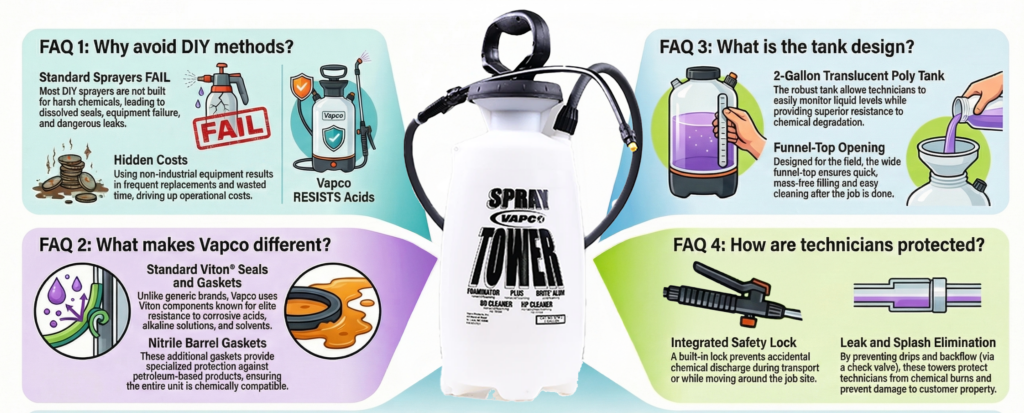
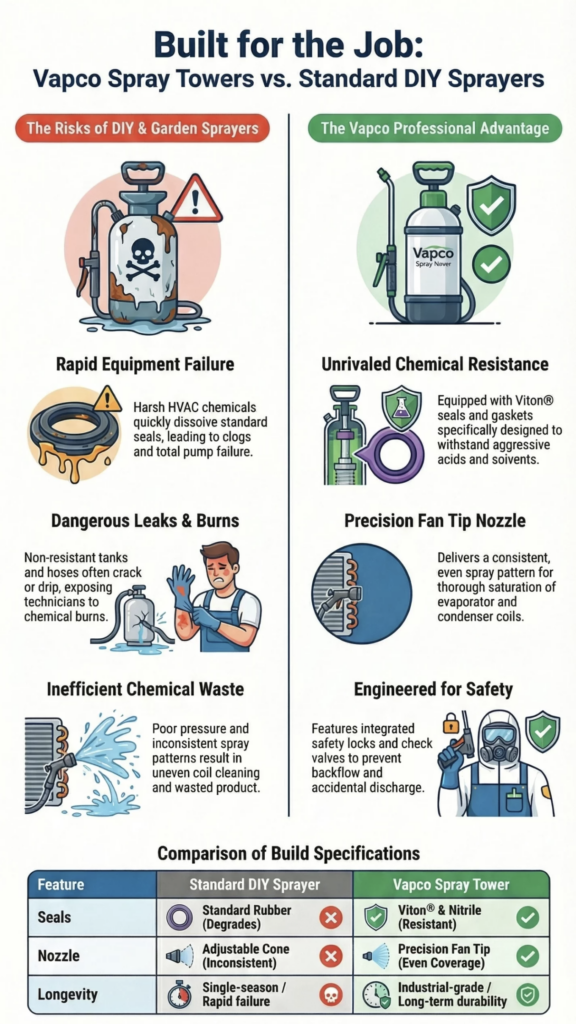
Not all pump sprayers are built for chemical service. The standard garden sprayer from the hardware store uses rubber or EPDM seals. Those materials handle water and mild fertilizers fine. They do not hold up to concentrated alkaline or acid coil cleaners. One or two uses and the seals swell, the pump sticks, the wand drips, and you have caustic chemistry leaking onto your hands, clothes, truck, the customer’s equipment, their roof, driveway, basement steps…
Professional-grade chemical sprayers use Viton seals and gaskets. Viton is a fluoroelastomer that resists degradation from acids, caustics, and solvents — the same material used in chemical processing and fuel systems. If your sprayer seals are not Viton, your sprayer is on borrowed time the moment you put a concentrated coil cleaner in the tank.
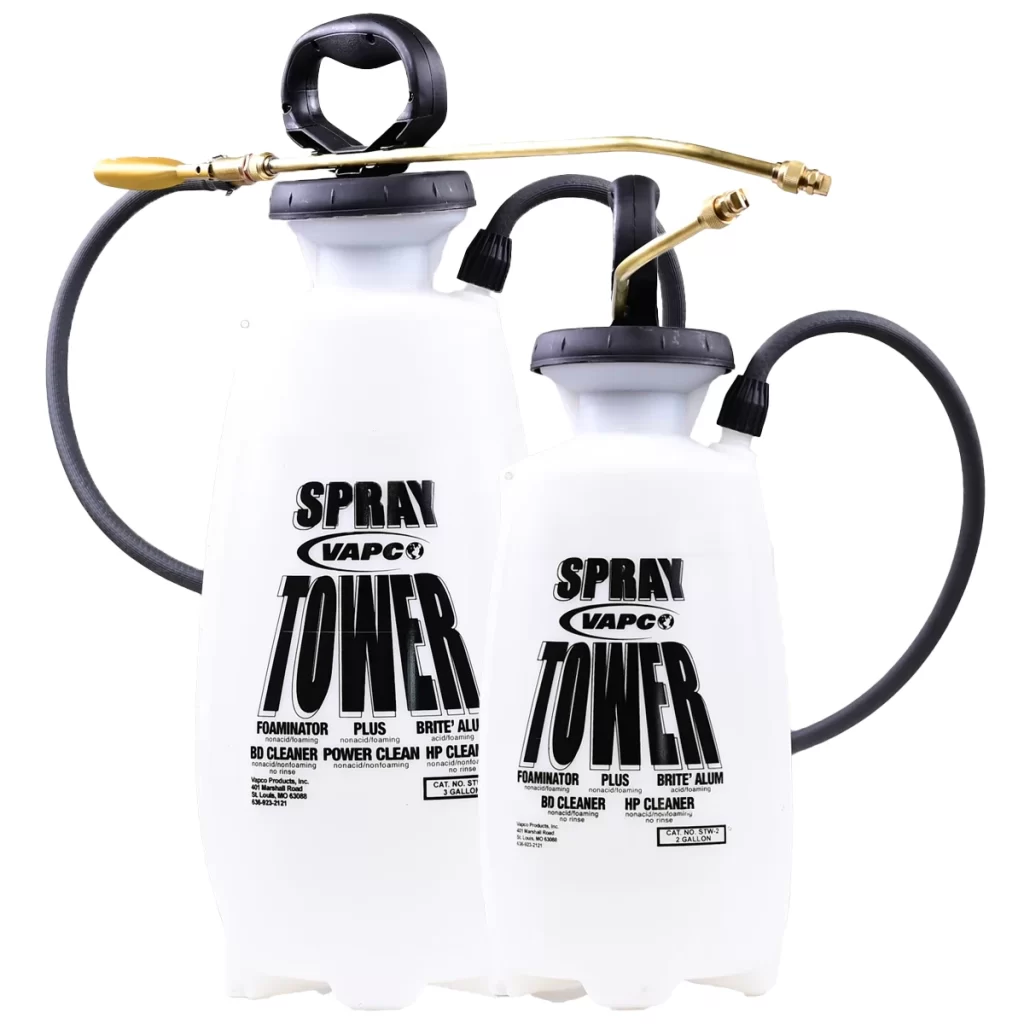
Beyond seals, look for: chemical-resistant hoses (not garden hose), a safety lock to prevent accidental discharge during transport, a check valve to prevent chemical backflow into the pump mechanism, and an extension wand long enough to reach the full face of the coil without putting your hands in the spray zone. An 18-inch wand with a fan tip nozzle is the standard for HVAC work — the fan pattern gives even coverage across the fin surface without concentrated streams that can bend fins.
One more thing that most techs learn the hard way: rinse the sprayer at the end of the day. Every day. Empty the tank, fill it partway with clean water, pump it up, and spray water through the hose and wand until it runs clear. This takes two minutes and adds tons of PMs to the life of the seals. Even Viton will degrade faster if chemical sits on it overnight, every night, for an entire cooling season.
Hose-End Guns: Speed vs. Chemistry
A hose-end gun connects to a garden hose and pulls concentrated chemical through a Venturi, mixing it with the water stream on the fly. No pre-mixing, no pumping. For a tech doing a stack of residential PM calls, the time savings are real.
Here is where it gets more nuanced.
The Venturi mixing process is inherently turbulent. For a non-foaming cleaner, that turbulence is actually beneficial — it generates a light foam from a chemistry that would not foam on its own, helping the solution cling to fin surfaces with better dwell time. Products like Mongoose, Eco Clean, High Tech Evap, BD Cleaner, Power Clean, HP Cleaner, and other non-foaming concentrates can work well through an HEG precisely because that turbulence-generated foam gives the chemistry better surface coverage.
But for a foaming cleaner — one that is specifically designed to foam — that turbulence becomes a problem, and the severity depends on the formulation.
A delayed-foaming product like Foaminator depends on staying liquid during the application phase so it can flow past the outer fin rows before the foam reaction kicks in. If the HEG has already whipped it into foam inside the nozzle, you have a surface cleaner. The penetration advantage you paid for is gone. And because Foaminator is viscous at working concentration (3:1 to 5:1), it physically cannot be pulled through a Venturi at full strength.
An instant-foaming product like Blue 41 is less catastrophic but still compromised. Blue 41 is a foaming alkaline condenser cleaner — think of it as Foaminator’s economy counterpart without the delayed-foam mechanism or the same surfactant load. It can flow through an HEG, and the chemistry will still work. But the foam is being generated at the spray nozzle instead of on the coil face, which means the foam hits the outer fins already somewhat expanded. Less liquid penetration into the inner rows, less depth of clean. For a lightly soiled residential condenser, that trade-off might be acceptable. For anything with real buildup, you are leaving performance on the table.
There is also the product consumption issue. Most HEGs have a dial that lets you set the dilution ratio and even shut off the chemical draw entirely for a water-only rinse. The problem is not ratio control — it is volume. At hose pressure, the total amount of solution hitting the coil per second is far higher than a pump sprayer delivers. An HEG at 4:1 and a pump sprayer at 4:1 are the same ratio but wildly different volumes of chemical per minute. You use more product not because the ratio is wrong, but because the delivery rate is so much higher. Contractors who track usage consistently report higher consumption with HEGs versus pump sprayers on the same number of jobs.
When an HEG makes sense
Despite the limitations, hose-end guns earn their place on the truck in specific scenarios:
High-volume residential PM routes where you are using a non-foaming cleaner on lightly soiled condensers. Speed matters, the chemistry is forgiving, and the coils do not need deep penetration.
Non-foaming concentrates where the turbulent mixing is actually an advantage. The agitation creates surface foam from a product that would not foam otherwise, improving cling time and coverage. If you are running Mongoose, Eco Clean, BD Cleaner, or a similar non-foaming concentrate through an HEG on a moderately dirty residential condenser, you are getting decent results at a good pace.
Instant-foaming cleaners on light maintenance where the coil is one season dirty, not three years of neglected grease. A product like Blue 41 through an HEG will still clean a lightly soiled residential condenser. You are giving up some penetration depth, but on a coil that does not need deep penetration, the speed trade-off can be worth it.
When an HEG does not make sense
Delayed-foaming products. Foaminator really wasn’t designed to be used in an HEG. The viscosity prevents it from being siphoned at working concentration, and the turbulence defeats the delayed-foam mechanism. Sure, you can thin it out and use it in an HEG but it’s built for a pump sprayer. If you want to miss out on the benefits and fly through coil cleaner, I’m certainly not going to stop you…but there’s a better way to use it.
Precise dilution requirements. If the SDS or label specifies a narrow dilution range for safety or performance, an HEG’s dial is likely not accurate enough. Water pressure fluctuations, hose length, and flow rate all affect the actual ratio being delivered. A pump sprayer is the only way to guarantee the ratio.
Commercial or industrial coils where the contamination is heavy, multi-layered, and requires deep penetration at full working concentration.
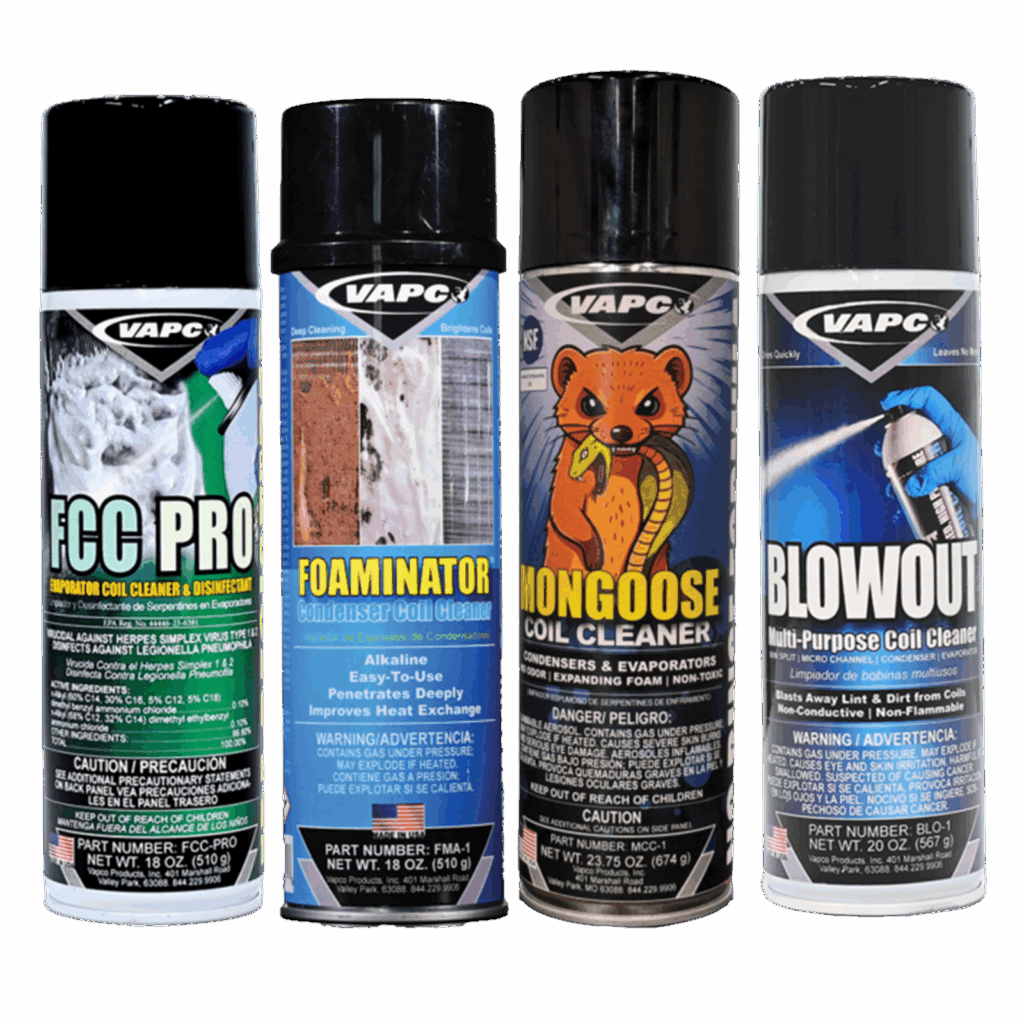
Aerosol Cans: The Convenience Tool
Aerosol coil cleaners have their place — evaporator coils in tight mechanical closets, mini-split blower wheels, quick spot treatments where hauling a sprayer is not practical.
But aerosols are not a system cleaning method. A 19-ounce can covers one coil face, maybe two if the contamination is light. A gallon of concentrate mixed at 4:1 gives you five gallons of working solution — enough for multiple units on a single route. The math is not close.
The right approach for most contractors is both: cans on the truck for evaporators and quick access, pump sprayer loaded with concentrate for condenser PM routes.
| Cleaner Type | Best Application Method | Why? |
|---|---|---|
| Delayed-Foaming (Foaminator) | Pump-Up Sprayer | Requires low-turbulence to penetrate fins before foaming. |
| Instant-Foaming (Blue 41) | Pump-Up Sprayer | Foam needs to build on the coil face, not inside a gun. |
| Non-Foaming (Mongoose, Eco Clean) | Pump Sprayer OR Hose-End Gun | Turbulence from HEG creates helpful surface foam for better cling. |
| Aerosols | Direct Application | Best for evaporators, mini-splits, and quick spot treatments. |
Matching Your Application Method to Your Chemistry
Here is the practical framework. Not every cleaner works with every application method, and choosing wrong does not just reduce performance — it can waste product and undo the engineering you are paying for…and that’s coming from the guy selling you cleaner. I’d benefit a lot more telling you to pour it on straight, who cares about dilution ratios or getting the most out of your cleaner…USE MORE PRODUCT! But that’s not what we’re about so maybe just take a second to think about how you’re using your cleaner and if you’re using it correctly.
Foaminator (FM-1): Pump sprayer recommended. The delayed-foam mechanism requires laminar, low-turbulence application at working concentration. An HEG defeats the formulation by design. Pre-mix 3:1 to 5:1 in the tank, apply with the fan tip from bottom to top, and let the chemistry do its job.
Blue 41 (BL41-1): Pump sprayer preferred. Blue 41 is a foaming alkaline condenser cleaner — same family as Foaminator but without the delayed-foam mechanism. It can go through an HEG, but the foam forms inside the gun instead of on the coil face, reducing penetration on anything beyond light surface contamination. For best results, pre-mix in a pump sprayer and let the foam build on the coil where it belongs.
Mongoose Concentrate (MC-1): Pump sprayer and HEG are both acceptable. Works at specific dilution ratios (10:1 evaporator, 4:1 condenser). A pump sprayer gives you exact ratio control and lower product consumption. An HEG works — and the turbulence actually generates some foam from the non-foaming chemistry — but the higher delivery volume at hose pressure means more product per coil even at the correct ratio setting. For PM routes with multiple units, the pump sprayer pays for itself in product savings within a week.
Eco Clean (EC-1): Both methods work. EPA DfE compliance means the safety margin is wide even with imprecise application. The surfactant-based chemistry is forgiving on method, and the HEG turbulence gives it some additional surface foam.
Non-foaming concentrates (BD Cleaner, Power Clean, HP Cleaner, HTEC, 1953): Both methods work well. An HEG is a legitimate tool here — the turbulent mixing generates surface foam from these non-foaming chemistries, improving cling and coverage on the coil face. For high-volume residential PM work where speed is the priority, an HEG with a non-foaming alkaline concentrate is a solid workflow. Just make sure you’re checking dilution ratios.
Aerosol (Mongoose MCC-1, Foaming Cooling Coil Cleaner): Designed for evaporators, mini-splits, and spot applications. Not a condenser cleaning method.
The Sprayer Is Part of the System
Match the tool to the chemistry. Use Viton-sealed equipment for anything concentrated, alkaline or acid. Pre-mix in a pump sprayer when precision matters. Use an HEG when speed matters and the chemistry allows it. And rinse your sprayer at the end of the day.
The chemistry is the brain of the operation. The sprayer is the hands. If the hands are not doing their job, it does not matter how smart the formula is.
Frequently Asked Questions
Can I use a standard garden sprayer for professional HVAC coil cleaners?
You can, but you will regret it quickly. Standard garden sprayers use basic rubber or EPDM seals that swell, stick, and fail after just a few uses with concentrated alkaline or acid coil cleaners. Always use a professional chemical sprayer equipped with Viton seals and chemical-resistant hoses to prevent caustic chemistry from leaking all over you and the job site.
Why shouldn't I use a hose-end gun (HEG) with Foaminator?
Foaminator is a specialized delayed-foaming condenser cleaner. At its working concentration, it is simply too viscous to be pulled through the Venturi of a hose-end gun. Even if you dilute it to make it flow, the turbulent mixing inside an HEG triggers the foam reaction before the chemical ever reaches the coil. This completely defeats the deep-penetration, delayed-foam mechanism you paid for.
Do hose-end guns waste more coil cleaner than pump sprayers?
Generally, yes—but not because the dilution ratio is wrong. The issue is water volume. At standard hose pressure, the total amount of cleaning solution blasting the coil per second is far higher than what a pump sprayer delivers. You are getting the exact same chemical ratio, but a drastically higher volume of product per minute, meaning you burn through your concentrate much faster.
What seal material is best for an HVAC chemical sprayer?
Viton. It is a fluoroelastomer that actively resists the harsh acids, caustics, and solvents that instantly destroy standard rubber and EPDM seals. If a sprayer manufacturer does not explicitly specify Viton seals, assume the equipment is not built for professional HVAC chemical service.
How long do Viton sprayer seals last, and how do I maintain them?
With daily rinsing, Viton seals can easily last an entire cooling season or longer. The single most effective maintenance step you can take is thoroughly flushing the tank, hose, and wand with clean water at the end of every single work day so caustic chemistry does not sit on the seals overnight.
What size pump sprayer do I need for HVAC maintenance?
- 1-gallon: Perfect for spot work, mini-splits, and tight indoor jobs.
- 2-gallon: The sweet spot for residential preventative maintenance (PM) routes. For what it's worth, we sell more 2-gallon sprayers than anything else.
- 3-gallon: Built for heavy commercial jobs or all-day condenser runs.
- Brass wand models: These add necessary durability if you run acid cleaners or do daily commercial work.