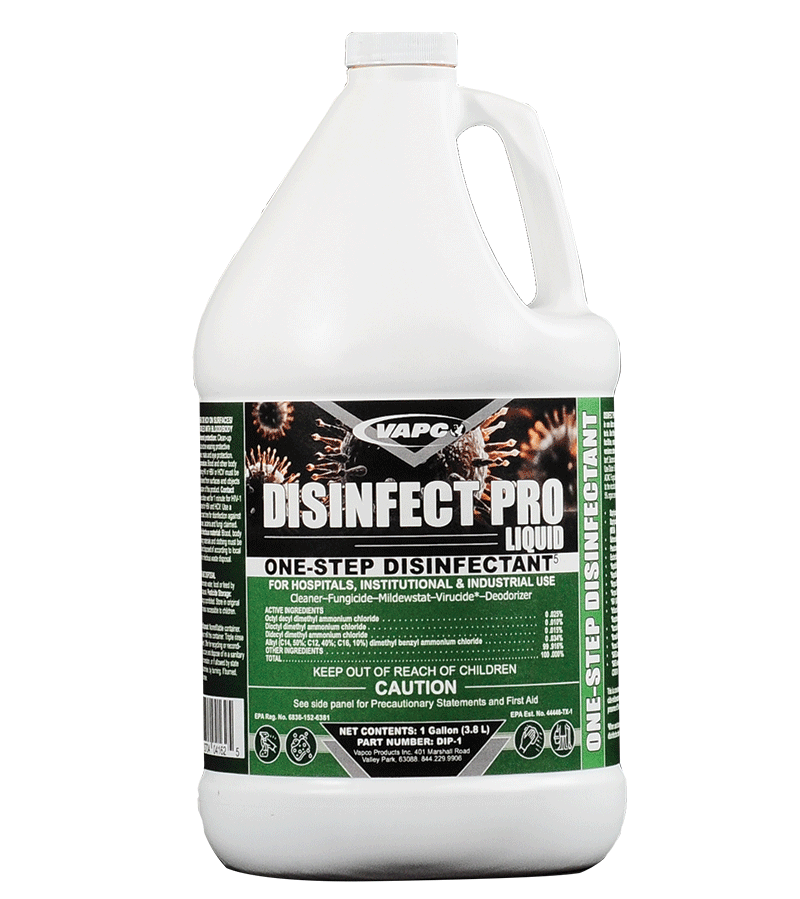
DISINFECT PRO LIQUID
Powerful, Multi-Purpose Disinfectant
DISINFECT PRO LIQUID is designed for versatile cleaning applications, itcombines powerful disinfection with cleaning and deodorizing capabilities in one convenient formula. This EPA-registered liquid disinfectant meets professional standards for pathogen control while offering the flexibility needed for various surface types and cleaning methods. Whether applied by spray bottle, mop, or cloth, DIP-1 delivers consistent results across healthcare facilities, offices, schools, and homes. Its multi-purpose formulation streamlines cleaning protocols by eliminating the need for separate cleaning and disinfecting products, while effectively neutralizing odors and leaving surfaces hygienically clean.
Key Features and Benefits:
- EPA-registered multi-purpose formula: Combines cleaning, disinfecting, and deodorizing in one product for streamlined protocols
- Broad-spectrum antimicrobial action: Kills bacteria, viruses, and fungi for comprehensive pathogen control
- Versatile liquid application: Suitable for spray bottles, mop buckets, and wipe-down methods for flexible use
- Professional-grade efficacy: Meets commercial and healthcare standards while safe for residential use
- Wide surface compatibility: Effective on various hard surfaces in commercial and residential environments
- Integrated odor control: Neutralizes unpleasant odors while disinfecting for fresher, cleaner spaces
- Cost-effective solution: Eliminates need for multiple products, reducing inventory and training requirements
- Ready-to-use or ‘dilutable’ options: Adaptable concentration for different cleaning needs and applications
- Time-saving efficiency: Clean and disinfect in one step, reducing labor time and improving productivity
- Reliable pathogen elimination: Provides peace of mind with proven EPA-registered effectiveness
Part Number; Size
Directions
- Preparation: Pre-clean heavily soiled surfaces. Ensure adequate ventilation in the area.
- Application Methods:
- Spray Application: Pour into spray bottle. Spray directly onto surface until thoroughly wet.
- Mop Application: Add recommended amount to mop bucket. Apply with clean mop.
- Wipe Application: Apply to clean cloth or disposable wipe. Wipe surface until wet.
- Contact Time: Keep surface wet for required contact time (typically 30 seconds to 10 minutes depending on pathogen – consult label for specific times).
- Post-Application: Allow to air dry or wipe with clean, damp cloth if needed. No rinse required for most surfaces.
- For Deodorizing: Apply to odor source and allow to dry completely for maximum odor elimination.
- Dilution (if applicable): Follow label directions for proper dilution ratios based on intended use and soil level.
- Safety: Wear appropriate PPE as directed. Avoid mixing with other chemicals. Keep out of reach of children.
- Storage: Store in original container in a cool, dry place. Keep container tightly closed when not in use.
Note: Always refer to the product label for complete EPA-registered directions, specific dilution rates, pathogen claims, and safety information.
Contact Us
News and Updates
Subscribe on Youtube
Follow Us on Facebook
SDS
⚠️ DISINFECT PRO LIQUID SDS – DOWNLOAD
SAFETY DATA SHEET
DISINFECT PRO LIQUID
1. Identification & Supplier Details
Product Identification (Section 1.1)
| GHS Product Identifier (Product Name) |
Disinfect Pro Liquid |
| Product Number / Brand |
DIP-1 / Vapco |
Recommended Use (Section 1.3)
| Recommended Use |
EPA Registered One-Step Disinfectant |
| EPA Registration Number |
6836-152-6381 |
| EPA Establishment Number |
44446-TX-1 |
Supplier Details & Emergency Contact (Section 1.4 & 1.5)
| Supplier Name |
Vapco Products, Inc. |
| Supplier Address |
401 Marshall Road
Valley Park, Missouri 63088, United States |
| Telephone / Fax |
(636) 923-2121 / (636) 923-3002 |
| Email |
[email protected] |
| Emergency Phone Number |
(800) 255-3924 |
2. Hazard Identification & Composition
GHS Classification & Label Elements (Section 2.1 & 2.2)
| GHS Classification (OSHA) |
Not a hazardous substance or mixture. (Does not present a hazard according to OSHA (29 CFR 1910.1200)) |
| GHS Label Elements |
Not applicable. |
| Other Hazards Not Resulting in Classification |
None known. |
| Ingredients of Unknown Toxicity |
0% |
Composition/Information on Ingredients (Section 3.2)
| Hazardous Components |
Does not contain any hazardous ingredients at or above reportable levels as defined by OSHA (29 CFR 1910.1200). |
3. Physical & Chemical Properties
Basic Physical and Chemical Properties (Section 9)
| Physical State / Appearance |
Liquid / Blue Liquid |
| Odor / Odor Threshold |
Floral / N/D |
| pH |
11.0 |
| Melting Point/Freezing Point |
<32°F (0°C) |
| Boiling Point or Boiling Range |
>212°F (100°C) |
| Flammability / Flash Point |
Not considered a flammable liquid by OSHA / N/D |
| Vapor Pressure |
23.8 mmHg at 77°F (25°C) |
| Relative Vapor Density |
1 at 77°F (25°C) |
| Density and/or Relative Density |
1.01 at 77°F (25°C) |
| Solubility / Kinematic Viscosity |
Completely soluble in water / N/D |
| Evaporation Rate |
<1 |
| Volatile Organic Compounds (VOC) |
<0.1% |
4. Stability & Reactivity
Reactivity and Stability (Section 10)
| Reactivity |
None known. |
| Chemical Stability |
Stable under normal conditions of use. |
| Possibility of Hazardous Reactions |
None known. |
| Conditions to Avoid |
None known. |
| Incompatible Materials |
Strong oxidizing agents and reducing agents. |
| Hazardous Decomposition Products |
Oxide(s) of carbon, irritating gases and vapors. |
5. Toxicological Information
Information on Toxicological Effects (Section 11)
| Acute Toxicity |
None established. |
| Skin Corrosion/Irritation |
May cause irritation. |
| Serious Eye Damage/Irritation |
May cause irritation. |
| Respiratory or Skin Sensitization |
May cause slight irritation. |
| STOT – Single & Repeated Exposure |
None known. |
| Carcinogenicity, Mutagenicity, Reproductive Toxicity, Aspiration Hazard |
No data available. |
| Medical Condition Aggravated |
Pre-existing disorders of the skin, respiratory system, and eyes will be aggravated by over-exposure. |
6. First-Aid Measures
Description of Necessary First-Aid Measures (Section 4.1)
| General Advice |
Never give anything by mouth to an unconscious person. If you feel unwell, seek medical advice (show the label where possible). |
| If Inhaled |
Remove person to fresh air. Keep comfortable for breathing. Get medical advice/attention. |
| In Case of Skin Contact |
Immediately drench affected area with water for at least 15 minutes. Remove contaminated clothing immediately. Obtain medical attention if irritation develops or persists. |
| In Case of Eye Contact |
Immediately rinse with water for at least 15 minutes. Remove contact lenses, if present and easy to do. Continue rinsing. Obtain medical attention if irritation develops or persists. |
| If Swallowed |
Rinse mouth. Do NOT induce vomiting. Obtain medical attention. |
Most Important Symptoms/Effects (Section 4.2): None known (Acute or Chronic).
Immediate Medical Attention & Special Treatment (Section 4.3): If exposed or concerned, get medical advice and attention. Treatment should be directed at the control of symptoms and the clinical condition of the patient.
7. Fire-Fighting & Accidental Release Measures
Fire-Fighting Measures (Section 5)
| Suitable Extinguishing Media |
Carbon dioxide, standard chemical fire extinguisher, and water fog. Use appropriate media for surrounding fire. |
| Specific Hazards |
None known. |
| Hazardous Combustion Products |
Oxide(s) of carbon. |
| Protection During Firefighting |
Wear NIOSH-approved Self-Contained Breathing Apparatus (SCBA) with full face piece and full body protective clothing. |
Accidental Release Measures (Section 6)
| Personal Precautions/PPE |
Do not get in eyes, on skin, or on clothing. Do not breathe vapors. Keep away from heat/ignition sources. No smoking. Use appropriate PPE. |
| Containment & Clean Up Methods |
Ventilate the area. Contain any spills with dikes or absorbents to prevent entry into sewers. Eliminate all ignition sources. Take up liquid spill into absorbent material. |
| Waste Disposal |
Dispose of in accordance with local, regional, national, and international regulations. Containers may be hazardous when empty. Do not flame cut, braze, or weld. |
8. Handling, Storage & PPE
Precautions for Safe Handling (Section 7.1)
| Precautions for Safe Handling |
Avoid contact with skin, eyes and clothing. Do not breathe gas, mist, spray, vapors. Wash hands before eating, drinking or smoking and when leaving work. Do not spray on open flame or other ignition source. |
| Additional Hazards When Processed |
Do not pressurize, cut, or weld containers. |
| Hygiene Measures |
Handle in accordance with good industrial hygiene and safety procedures. |
Conditions for Safe Storage (Section 7.2)
| Storage Conditions |
Store in a dry, cool, well-ventilated place away from ignition sources. Protect from sunlight. Keep/Store away from direct sunlight, extremely high or low temperatures and incompatible materials. Store locked up/in a secure area. |
| Incompatible Materials |
Strong oxidizing agents and reducing agents. |
Individual Protection Measures (PPE) (Section 8.3)
| Appropriate Engineering Controls |
Emergency eye wash fountains and safety showers should be available. Ensure adequate ventilation. Use only outdoors or in well-ventilated area. |
| Eye/Face Protection |
Chemical safety goggles. |
| Skin Protection |
Wear protective gloves and clothing. |
| Respiratory Protection |
Use a NIOSH-approved Self-Containing Breathing Apparatus whenever exposure may exceed established Occupational Exposure Limits. |
9. Transport & Regulatory Information
Transport Information (Section 14)
| DOT (US) |
Not dangerous goods |
| IMDG |
Not dangerous goods |
| IATA |
Not dangerous goods |
Regulatory Information (Section 15)
| Rating System |
Ratings |
| US EPA TSCA Public Inventory |
All chemicals are listed or exempted. |
| HMIS Rating |
Health: 1 |
Flammability: 0 |
Physical Hazard: 0 / Personal Protection: A |
| NFPA Rating |
Not specified in detail. |
10. Disposal & Ecological Information
Ecological Information (Section 12)
| Toxicity |
None established. |
| Persistence and Degradability |
Component(s) of this product are not biodegradable. |
| Bioaccumulative Potential |
This product is not expected to bioaccumulate. |
| Mobility in Soil |
This product is mobile in soil. |
Disposal Considerations (Section 13)
| Product Disposal / Waste Treatment |
Dispose of contents/container in accordance with local, regional, national, and international regulations. This material, as supplied, is hazardous waste according to federal regulations (U.S. EPA 40CFR 261). |
| Other Disposal Recommendations |
Container may remain hazardous when empty. Continue to observe all precautions. Do not puncture or incinerate container. Product should be fully characterized prior to disposal. |
11. Disclaimer & Preparation Information
Preparation Information (Section 16.2)
| Prepared by |
Jessica Wilson |
| Date Prepared |
11-19-2025 |
Disclaimer (Section 16.1):
To the best of our knowledge, information contained herein is accurate. However there is no assumption of liability for the accuracy or completeness of the information contained herein. Final determination of suitability of any material is the sole responsibility of the user. All materials may present unknown hazards and should be used with caution. The user is responsible for full compliance with various government agency regulations. No warranty, expressed or inferred, regarding the product described in this SDS shall be created or inferred by any statement in this SDS.
Key: N/A = Not applicable; N/D = Not determined