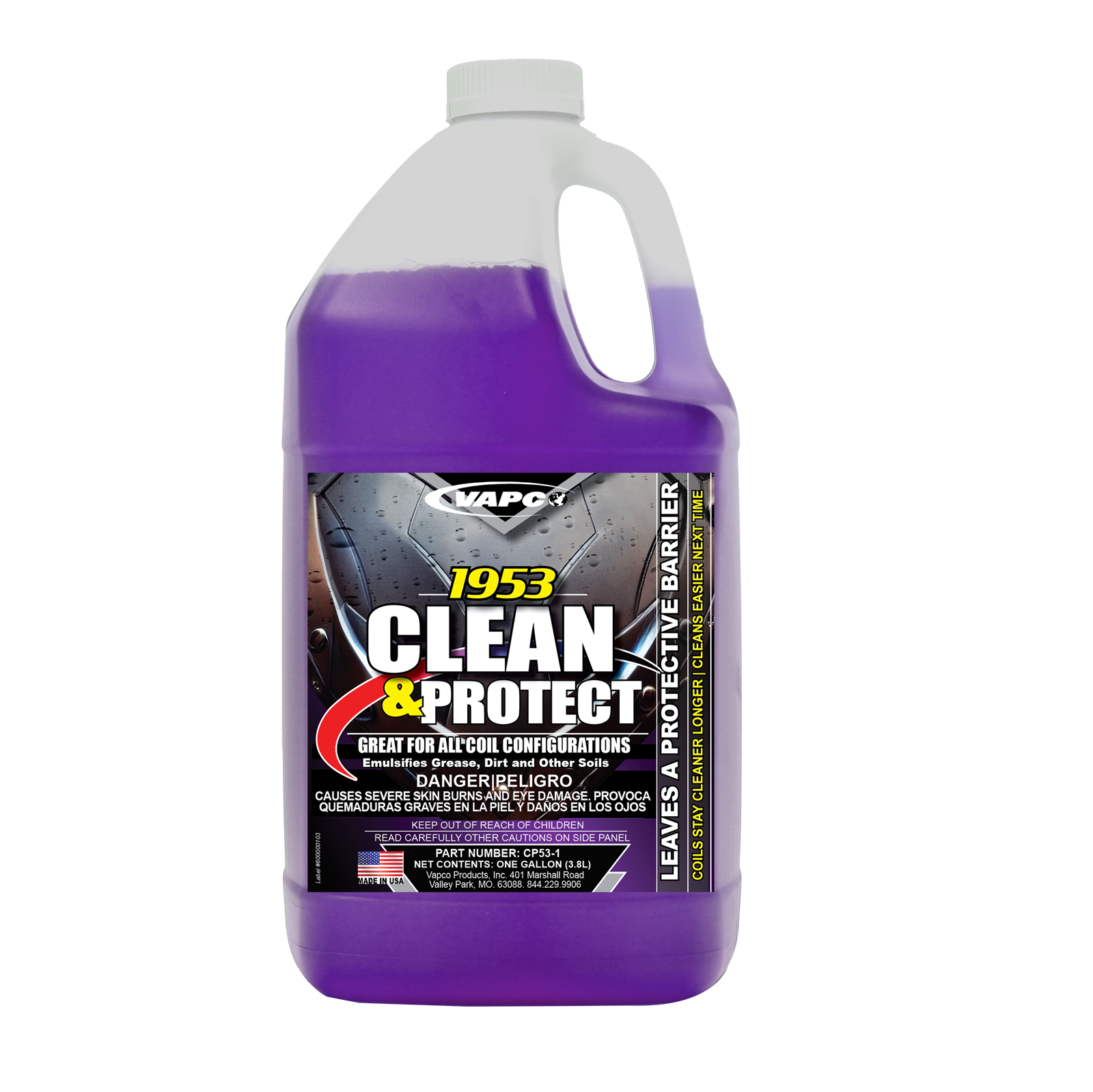
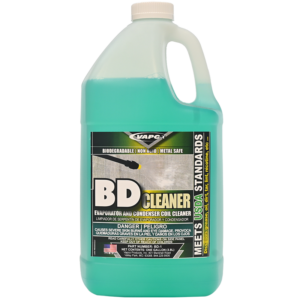
HVAC coil cleaner with protectant | Liquid 1953 Clean & Protect CP53-1
Clean Today. Protect Tomorrow. Faster Service Next Time.
Traditional coil cleaners stop at “clean.” They remove soil, rinse away, and leave the coil ready to start collecting contamination again the moment the unit runs. 1953 Clean & Protect is different: it’s an HVAC coil cleaner with protectant that does more than clean—leaving behind a microscopic ceramic micro-barrier engineered to help resist dirt re-adhesion and routine re-soiling between service intervals. The non-foaming chemistry is built for evaporators and routine/light condenser cleaning—lifting grime the right way, then helping coils stay cleaner longer so the next visit is easier, faster, and more consistent.
Heritage Note: “1953” is a callback to Vapco’s founding year—and this product launched during our 70th anniversary as a modern upgrade to coil cleaning: clean + protect in one step.
Manufacturer’s Tech Note (Mixing Matters): 1953 is engineered to leave a protective micro-barrier behind. To maintain that protective finish, keep dilution between 3:1 to 4:1 (water:cleaner). Over-diluting reduces the amount of protectant available to form the barrier. For best control, use a pump-up sprayer so you can hit your exact ratio every time.
The Protection Math: One Ratio Range That Does Both Jobs
Because the protective finish is part of the performance, 1953 is designed to run in a tight dilution window—strong enough to clean effectively, while leaving behind enough protectant to do its job.
- 3:1 Ratio (Water:Cleaner): Routine/light condenser cleaning and heavier PM soil loads where you still want a protective finish. Rinse condensers as needed.
- 4:1 Ratio (Water:Cleaner): Evaporators and maintenance cleaning where control and coverage matter. Ideal where condensate provides the rinse pathway during normal operation.
Professional Application: Apply by sprayer, allow dwell, and rinse based on the job. For heavily impacted outdoor coils (thick cottonwood mats, heavy grease, severe blockage), start with a dedicated deep cleaner first, then follow with 1953 to leave the protective finish.
| KEY FEATURE / SPECIFICATION |
TRADE BENEFIT / RESULT |
| Clean + Protect Chemistry |
Two-Step Result in One Step: Removes soil now and leaves a protective micro-barrier to help resist re-adhesion between PM cycles. |
| Microscopic Ceramic Barrier |
Stays Cleaner Longer: Helps resist dirt, mold, and biological growth so future cleanings are faster and more consistent. |
| Non-Foaming by Design |
Better Control: No foam overflow, better visibility, and easier application on indoor coils and routine outdoor service work. |
| Designed for Routine PM |
Consistency Across Visits: Great for repeat maintenance intervals—clean, protect, and reduce the “reset from scratch” effect next time. |
| Application Guidance |
Right Tool for the Job: Apply by sprayer, allow dwell, and rinse based on coil type and soil load. Maintain 3:1–4:1 to preserve the protective finish. |
| Compatibility & Use Limits |
Evaps + Routine Condensers: Intended for evaporators and routine/light condenser cleaning. For severe blockages and heavy impacted coils, use a deep cleaner first, then follow with 1953 to protect. |
Vapco Field Guide: Performance Matrix
How 1953 stacks up on real-world PM contaminants. (★★★ = Best in Class)
| CONTAMINANT |
RATING |
WHY IT WINS |
| Dirt, Dust, & Pollutants |
★★★ |
Non-foaming wetting + soil lift for routine PM, plus a protective micro-barrier to help slow re-adhesion. |
| Biofilm, Mold & Biological Growth |
★★★ |
Cleans and leaves a barrier designed to help resist biological growth between maintenance cycles. |
| Tobacco / Nicotine Stains |
★★★ |
Rated Best-in-Class for cutting sticky nicotine film on coils and surfaces during PM work. |
| Light Grease / Mixed Soil (PM) |
★★ |
Great for routine grime and mixed soils. For heavy kitchen grease or severe impacted coils, start with a deep cleaner first. |
| Seasonal Debris (Light Cottonwood / Bugs) |
★★ |
Ideal for routine cleanup and finishing. For thick mats and deep blockages, deep clean with a foaming cleaner first, then protect with 1953. |
| When to Use a Deep Cleaner First |
NOTE |
Severely impacted outdoor coils: thick cottonwood mats, heavy grease, severe blockage. Deep clean first, then finish with 1953 for protection. |
Part Number Reference:
1. Select Your Size
| CONTAINER |
SIZE / PACK |
APPLICATION FIT |
| Gallon Bottle
CP53-1 |
1 Gallon (4/cs) |
Service Truck Standard: Easy mixing in pump sprayers for repeat PM work. |
Recommended Application Tools
Pump-up sprayers recommended to maintain your exact 3:1–4:1 ratio and consistent coverage.
| PART NUMBER |
CAPACITY |
SERIES FEATURES |
| STW-1 / STW-2 / STW-3 |
1, 2, & 3 Gallon |
Professional Standard: Heavy-duty polyethylene tank with chemically resistant seals and reinforced hose assemblies.
(Note: The 2-Gallon STW-2 is a popular size for general service work.) |
| STW-2B / STW-3B |
2 & 3 Gallon |
Premium Brass Series: Upgraded with a solid brass spray wand and handle assembly for maximum durability and impact resistance. |
Maintenance Tip: To extend sprayer seal life, always empty chemical and rinse the tank/hose with fresh water at the end of the day.
Why “Clean-Only” PM Leaves Performance on the Table: Upgrade to HVAC coil cleaner with protectant
| THE PAIN POINT (Traditional Cleaners) |
THE 1953 ADVANTAGE |
“Clean Today, Dirty Tomorrow”
Cleaner rinses away and the coil immediately starts collecting contamination again. |
“Clean + Protect”
Leaves a micro-barrier designed to help resist re-adhesion between maintenance cycles. |
“Foam Mess & Guesswork”
Heavy foam can take time to break down and suspend the actual cleaners away from the debris where they’re needed. |
“Non-Foaming Control”
Spray on, starts attacking soils immediately and designed to dwell just right to be self rinsed on evaporators. |
“Two Products / Two Steps”
Clean now, then separate protectant later (or skip protection entirely). |
“One Step Finish”
Clean and leave protection in the same service visit—built for repeat PM efficiency. |
FAQs
Frequently Asked Questions: 1953 Clean & Protect (Liquid Coil Cleaner with Protectant)
Application & Performance
Q: What is 1953 Clean & Protect designed to do?
A: 1953 is a non-foaming PM coil cleaner that lifts routine soil and helps leave a microscopic protective barrier designed to reduce dirt re-adhesion and routine re-soiling between service intervals. It’s built for repeat maintenance on evaporators and routine/light condenser cleaning.
Q: What dilution should I use?
A: Use dilution that supports the protectant finish:
- Evaporator Coils: Mix 3–4 parts water : 1 part 1953. Spray, allow a 4–6 minute dwell, then follow the label rinse pathway (self-rinse only when appropriate operating conditions exist; otherwise use a manual rinse/wipe approach as needed).
- Outdoor Condenser Coils (Routine/Light Soil): Mix 3–4 parts water : 1 part 1953. Spray, allow a 4–6 minute dwell, then rinse thoroughly with water.
Q: Why does dilution matter more for this product?
A: 1953 is designed to leave a protective micro-barrier behind. Staying in the 3:1–4:1 range helps ensure enough protectant remains after cleaning. Over-diluting can reduce the protective finish and shorten the time until routine re-soiling returns.
Q: Do I have to rinse it?
A: Outdoor condensers: YES—rinse thoroughly with water after dwell. Evaporators: follow label directions and job conditions. If your application depends on a “self-rinse” pathway, that requires the system to be in cooling mode and producing condensate.
*Tech Note: If the system is not producing condensate (low humidity, heating mode, fans only), use a manual rinse/wipe approach after dwell time per standard service practice and the product label.*
Q: Is 1953 a replacement for a heavy-duty deep-clean?
A: No. 1953 is a PM platform intended for routine soil removal and a protective finish between visits. For severely impacted coils (thick mats/heavy blockage), deep clean first, then finish with 1953 to leave the protective barrier that helps reduce dirt re-adhesion between PM cycles.
Q: Can I use it on outdoor condenser coils?
A: Yes—on routine/light soil. Use 3–4:1, allow a 4–6 minute dwell, then rinse thoroughly with water. It’s ideal when you want routine cleaning plus a protective finish between PM cycles.
Q: What type of sprayer should I use?
A: A standard pump-up sprayer or professional coil-cleaning sprayer works best. Use a fan tip that delivers even coverage and avoid atomizing into a mist indoors. After use, rinse the sprayer, wand, and nozzle thoroughly with clean water.
Q: What’s the correct mixing order?
A: Always add water first, then add concentrate to reach your dilution. This improves mixing and reduces splash-back risk. Use clean water and keep your dilution consistent for repeatable outcomes.
Q: Is foam required?
A: No. 1953 is a non-foaming cleaner designed to wet fin surfaces and lift routine soil while leaving a protective finish. Focus on even wetting, proper dwell, and the correct rinse pathway.
Q: How much ready-to-use solution does one gallon make?
A: It depends on your dilution:
- 3:1 (water:product): makes 4 gallons of ready-to-use solution per 1 gallon of concentrate.
- 4:1 (water:product): makes 5 gallons of ready-to-use solution per 1 gallon of concentrate.
Q: Do I need to neutralize it? Can I mix it with other chemicals?
A: Do not mix this product with other chemicals. Use it as directed at the recommended dilutions and rinse logic. Always follow the product label and SDS for safe handling and cleanup.
Q: How should I store it (truck, heat, freezing temps)?
A: Store sealed and upright. Avoid extreme heat and do not allow the product to freeze. If it has been exposed to freezing conditions or shows separation, follow your facility’s standard practice before use (and always follow the product label/SDS guidance).
Safety & Compatibility
Q: Is 1953 safe for microchannel coils or mini-splits?
A: Yes—when used as directed. Use the recommended dilution, do not over-dwell, and do not allow the product to dry on the coil. Microchannel/mini-split coils should be rinsed—do not rely on a self-rinse pathway for these coil types. Rinse outdoor coils thoroughly and follow label guidance for indoor applications.
Q: Can I let it dry on the coil?
A: No. Do not allow the product to dry on coil surfaces. Drying increases the risk of residue and inconsistent outcomes. Re-wet if needed during dwell, and complete the appropriate rinse pathway.
Q: Is it safe on coated coils?
A: Coil coatings vary by manufacturer. As a best practice, test a small inconspicuous area first and follow the equipment manufacturer’s cleaning recommendations for coated coils.
Q: Do I need PPE?
A: Yes. Always follow the product label and SDS. Wear appropriate PPE such as chemical-resistant gloves and eye protection and use standard chemical handling procedures on the job-site.
Q: What about electrical components and surrounding surfaces?
A: Avoid direct spraying into motors, control boards, sensors, and exposed electrical components. Use standard service practices: protect sensitive areas, control overspray, and wipe or rinse overspray on surrounding surfaces to prevent residue and maintain a professional finish.
Logistics & Value
Q: Why choose 1953 instead of a standard coil cleaner?
A: 1953 is built for repeat preventive maintenance. You get routine soil removal plus a protective micro-barrier designed to help reduce dirt re-adhesion between visits—ideal for service intervals where “clean today, stay cleaner longer” matters.
Q: What is the shelf life?
A: Vapco products carry a 1 year manufacturer warranty. When stored sealed and properly, 1953 has a shelf life of 3+ years.
Q: How do I dispose of the empty container?
A: Follow local regulations. Rinse the container per your facility’s standard practices and recycle or dispose of it according to municipal and job-site guidelines.
SDS & Instructions
📄 DOWNLOAD FULL SDS (PDF)
⚠️ Professional Use Only | Corrosive Alkaline CleanerAlways wear chemical-resistant gloves, eye protection, and protective clothing. Rinse/flush overspray from surrounding areas after use.
Field Guide: Contaminant Removal Matrix
1953 Clean & Protect is a non-foaming coil cleaning platform designed for repeat preventive maintenance:
it lifts routine soil and leaves a microscopic protective barrier behind to help resist re-adhesion between service intervals.
| TARGET CONTAMINANT |
TYPICAL SOURCE |
ACTION |
PERFORMANCE / WHY IT WORKS |
| Dust, Lint & Indoor Pollutants |
Indoor Air / PM Routes |
Wetting + Lift |
Non-foaming wetting action helps the solution reach fin surfaces and emulsify routine soils. Protective micro-barrier helps slow re-adhesion between visits. |
| Biofilm / Mold & Biological Growth |
High Humidity / Drain Pans |
Lift + Barrier |
Cleans routine buildup and leaves a barrier designed to help resist biological growth between maintenance cycles (when used as directed). |
| Tobacco / Nicotine Film |
Bars / Smoking Areas |
Emulsification |
Penetrates sticky nicotine film and helps release it from metal surfaces for removal during PM cleaning. Heavy deposits may require a second pass. |
| Routine Outdoor Soil (Light Dust / Pollen) |
Residential / Light Commercial |
PM Cleaning |
Designed for routine/light condenser cleaning where you want soil removal plus a protective finish. Rinse outdoor coils thoroughly with water. |
System Material Compatibility
| MATERIAL / COMPONENT |
STATUS & PROTOCOL |
| Indoor Evaporator Coils |
✅ RECOMMENDED
Do not over-dwell or allow product to dry. Follow dilution protocol. |
| Mini-Splits / Micro-Channel Coils |
✅ SAFE WHEN USED AS DIRECTED / RINSE REQUIRED
Use recommended dilution + short dwell. Do NOT leave for “self-rinse.” Rinse thoroughly with water after dwell. |
| Outdoor Condenser Coils |
✅ RECOMMENDED / RINSE REQUIRED
Rinse thoroughly with water after dwell to remove lifted soil. |
| Coated Fins / OEM Coatings |
⚠️ CAUTION
Always test a small area first. Follow OEM guidance. |
| Severely Impacted Outdoor Coils |
⚠️ NOT A DEEP-CLEAN REPLACEMENT
For thick mats/heavy blockage, deep clean first, then finish with 1953 to leave the protective barrier. |
Directions for 1953 Clean & Protect (HVAC Coil Cleaner with Protectant)
1. Preparation
Step 1: Turn Off (Disconnect Power).
- Shut off power to the unit at the disconnect or breaker to ensure safety while working.
Step 2: Remove Loose Debris.
- Brush/vacuum loose debris from the coil face (leaves, lint, cottonwood, dust mats).
- Why? Removing the “blanket” first lets the solution reach fin surfaces instead of being wasted on surface trash.
2. Mixing & Application (Protectant Protocol)
Step 3: Mix in a Pump Sprayer (Maintain the Barrier).
Always pour chemical into water.
Tech Tip: 1953 is designed to leave a protective micro-barrier behind. Keep dilution between
3:1 to 4:1 (water:cleaner) so enough protectant remains after cleaning. Over-diluting reduces the protective finish.
| APPLICATION |
DILUTION |
RINSE? |
| Evaporator Coils |
3–4 parts water :
1 part 1953 |
Self-Rinse* |
| Mini-Splits / Micro-Channel Coils |
3–4 parts water :
1 part 1953 |
YES (Water Rinse) |
| Outdoor Condenser Coils (Routine/Light) |
3–4 parts water :
1 part 1953 |
YES (Water Rinse) |
*Self-rinse applies to standard indoor evaporators only when sufficient humidity is present to produce condensate after the system is returned to cooling mode. Mini-splits and micro-channel coils must be rinsed with water after dwell.
Mini-Split / Micro-Channel Note: These coil designs often have limited rinse pathways and tight fin geometry. Treat them as a rinse-required application: short dwell, do not allow to dry, then rinse thoroughly with water.
Step 4: Apply Solution.
- Spray the solution onto the coil using a sweeping motion to saturate the coil.
- For evaporators, apply to the air-entry side where accessible. For outdoor coils, apply evenly across the coil face.
3. Dwell & Rinse Protocol
Step 5: Dwell Time.
- Allow to stand for 4–6 minutes.
- Do not allow product to dry on the coil.
Step 6: Rinse (Conditional).
| APPLICATION |
ACTION |
| Mini-Splits / Micro-Channel Coils |
LIGHT RINSE REQUIRED. Rinse thoroughly with water after dwell to remove lifted soil and residue. Do not leave for “self-rinse.” |
| Outdoor Condenser Coils |
RINSE REQUIRED. Rinse thoroughly with water to remove lifted soil and residue. |
| Evaporator Coils |
SELF-RINSE. run the unit as directed to complete the rinse pathway (condensate). |
Finish Note: 1953 is designed to leave a protective micro-barrier behind. Maintain 3:1–4:1 dilution and do not over-rinse beyond what’s required to remove lifted soil (especially on routine applications).
🧪 SDS SECTION: 1953 CLEAN & PROTECT
(CP53-1)
1. Identification & Supplier Details
| Product Name |
1953 Clean & Protect |
| Product Numbers |
CP53-1 |
| Recommended Use |
Coil Cleaner |
| Emergency Phone |
(800) 255-3924 |
2. Hazards Identification
| GHS Classification |
Skin Corrosion (Cat 1A)
Serious Eye Damage (Cat 1) |
| Signal Word |
DANGER |
| Hazard Statements |
H314: Causes severe skin burns and eye damage. |
| Precautionary Statements |
P260: Do not breathe mist/spray.
P264: Wash skin thoroughly after handling.
P280: Wear protective gloves/protective clothing/eye protection/face protection.
P301+P330+P331: IF SWALLOWED: Rinse mouth. Do NOT induce vomiting.
P303+P361+P353: IF ON SKIN (or hair): Take off immediately all contaminated clothing. Rinse skin with water/shower.
P304+P340: IF INHALED: Remove person to fresh air and keep comfortable for breathing.
P305+P351+P338: IF IN EYES: Rinse cautiously with water for several minutes. Remove contact lenses if present and easy to do. Continue rinsing.
P310: Immediately call a POISON CENTER/doctor.
P363: Wash contaminated clothing before reuse.
P390: Absorb spillage to prevent material damage.
P405: Store locked up.
P501: Dispose of contents/container in accordance with local/regional/national regulations. |
3. Composition / Ingredients
| Component Name |
CAS Number |
Concentration |
| 2-Butoxyethanol |
111-76-2 |
1 – 10% |
| Pentasodium triphosphate |
7758-29-4 |
1 – 10% |
| Dodecylbenzenesulfonic acid, sodium salt |
25155-30-0 |
0.1 – 1% |
| Potassium Hydroxide |
1310-58-3 |
0.1 – 1% |
4. First-Aid Measures
| Skin Contact |
CORROSIVE. Take off contaminated clothing immediately. Rinse skin with water/shower. Immediately call a POISON CENTER/doctor. |
| Eye Contact |
SEVERE DAMAGE. Rinse cautiously with water for several minutes. Remove contact lenses if present and easy to do. Continue rinsing. Immediately call a POISON CENTER/doctor. |
| Inhalation |
Remove person to fresh air and keep comfortable for breathing. Call a POISON CENTER/doctor if you feel unwell. |
| Ingestion |
Rinse mouth. Do NOT induce vomiting. Immediately call a POISON CENTER/doctor. |
5. Fire-Fighting Measures
| Suitable Extinguishing Media |
Water spray, CO2, dry chemical, or foam. |
| Specific Hazards |
Hazardous combustion products may include carbon oxides and metal oxides. |
| Special Protective Actions |
Wear self-contained breathing apparatus and full protective gear when responding to a fire. |
6. Accidental Release Measures
| Personal Precautions |
Wear appropriate PPE. Avoid breathing mist/spray. Avoid contact with skin and eyes. |
| Environmental Precautions |
Prevent entry into waterways, drains, or sewers. |
| Cleanup Methods |
Contain spill. Absorb with inert material and place in suitable container for disposal. Rinse area with water after pickup (as appropriate). |
7. Handling & Storage
| Safe Handling |
Avoid contact with skin and eyes. Do not breathe mist/spray. Wash thoroughly after handling. Do not eat, drink, or smoke when using this product. |
| Safe Storage |
Keep container tightly closed in a cool, well-ventilated place. Protect from sunlight. Store locked up. Do not expose to temperatures > 122°F (50°C). |
| Incompatible Materials |
Strong acids; oxidizing agents; reactive metals. |
8. Exposure Controls / Personal Protection
| Exposure Limits |
2-Butoxyethanol (111-76-2):
OSHA PEL 50 ppm (TWA); ACGIH TLV 20 ppm; NIOSH REL 5 ppm (Ceiling). |
| PPE (Personal Protective Equipment) |
Eyes/Face: Chemical safety goggles and/or face shield.
Skin: Chemical-resistant gloves and protective clothing.
Respiratory: Use adequate ventilation. If ventilation is inadequate, use NIOSH-approved respiratory protection appropriate for the conditions of use. |
9. Physical & Chemical Properties
| Physical State |
Liquid |
| Color / Odor |
Purple / Bland |
| Solubility |
Completely Soluble in Water |
| pH |
12.0 – 13.0 |
| VOC Content |
< 4% |
10. Stability & Reactivity
| Reactivity / Stability |
Stable under normal conditions. |
| Conditions to Avoid |
Excessive heat. Do not allow product to dry on sensitive surfaces. Avoid contact with incompatible materials. |
| Hazardous Decomposition |
Carbon oxides and metal oxides (including sodium and silicon oxide(s)). |
11. Toxicological Information
| Acute Toxicity |
ATE (Oral) > 4,500 mg/kg (estimated). |
| Skin/Eye |
Causes severe skin burns and serious eye damage. |
| Carcinogenicity |
Not classified. |
12. Ecological Information
| Ecotoxicity |
Avoid release to the environment. May be harmful to aquatic life. |
| Persistence / Mobility |
Mobile in soil. Low potential for bioaccumulation. |
13. Disposal Considerations
| Disposal Method |
Dispose of contents/container in accordance with local/regional/national regulations. |
14. Transport Information
| Regulation |
UN Number |
Class |
Proper Shipping Name |
| DOT (US) / IMDG / IATA |
UN1719 |
8 |
Caustic alkali liquids, n.o.s. (contains Potassium Hydroxide) |
15. Regulatory Information
| US Federal / State |
TSCA: All components are listed or exempt.
SARA 313: 2-Butoxyethanol (111-76-2).
SARA 311/312: Fire Hazard; Acute Health Hazard; Chronic Health Hazard.
Right To Know (example): Potassium hydroxide; 2-Butoxyethanol; Pentasodium triphosphate (per applicable state lists). |
| California Prop 65 |
Does not contain chemicals known to the State of California to cause cancer or reproductive harm. |
16. Other Information
| Preparation |
Prepared by: Jessica Wilson
Date prepared: 11/17/2025
Version: 1.0 |
| Disclaimer |
The information provided is believed to be accurate but comes without warranty. User is responsible for full compliance with local regulations. |
Specs & Logistics
1. Physical & Chemical Properties
| Product Name |
1953 Clean & Protect |
| SKU / Product # |
CP53-1 |
| Recommended Use |
Non-foaming, detergent multi-purpose coil cleaner |
| Base Chemistry |
Alkaline Detergent Cleaner (Caustic Alkali + Surfactant/Protectant System) |
| Physical State |
Liquid |
| Appearance / Color |
Purple |
| Odor |
Bland |
| pH Level (Concentrate) |
12–13 |
| Specific Gravity |
1.02–1.04 |
| Solubility |
Completely Soluble in Water |
| VOC Content |
< 4% |
| Flammability |
Not flammable (OSHA) |
| Performance Profile |
Non-foaming cleaner designed for routine coil cleaning and repeat PM service, leaving a micro-barrier intended to help resist re-adhesion between intervals (when used as directed). |
| Recommended Dilution Range |
3:1 to 4:1 (Water:Cleaner) to maintain protective finish (per product use guidance) |
| Freeze/Thaw Stability |
Not determined (store to avoid extreme temperatures; follow SDS/storage guidance) |
2. UN & DOT Shipping Classification
| Proper Shipping Name: |
Caustic alkali liquids, n.o.s. (Potassium hydroxide) |
| UN Number: |
UN1719 |
| Hazard Class: |
8 (Corrosive) |
| Packing Group: |
III |
| Label Required: |
Corrosive (Class 8) |
3. Master Shipping & Dimensions Guide
| ITEM |
INDIVIDUAL UNIT |
QTY / CASE |
CASE SPECS |
PALLET CONFIGURATION |
CODE |
| Part # |
Wt (lbs) |
H (in) |
W (in) |
L (in) |
Units |
Wt (lbs) |
H (in) |
W (in) |
L (in) |
Cases/Pallet |
Total Units |
Wt (lbs) |
H (in) |
W (in) |
L (in) |
UPC |
CP53-1
(1 Gal) |
[ ] |
[ ] |
[ ] |
[ ] |
4 |
[ ] |
[ ] |
[ ] |
[ ] |
48 |
192 |
[ ] |
[ ] |
40 |
48 |
683704345310 |
Harmonized Tariff Code (HTS): 3402.20.5100 (Cleaning Preparations)
NMFC Code: 48580 (Compounds, Cleaning, Liquid) – Class 55