
Why Your Wasp Spray Stops Reaching the Nest Halfway Through the Can
TL;DR: Range / Pressure Degradation
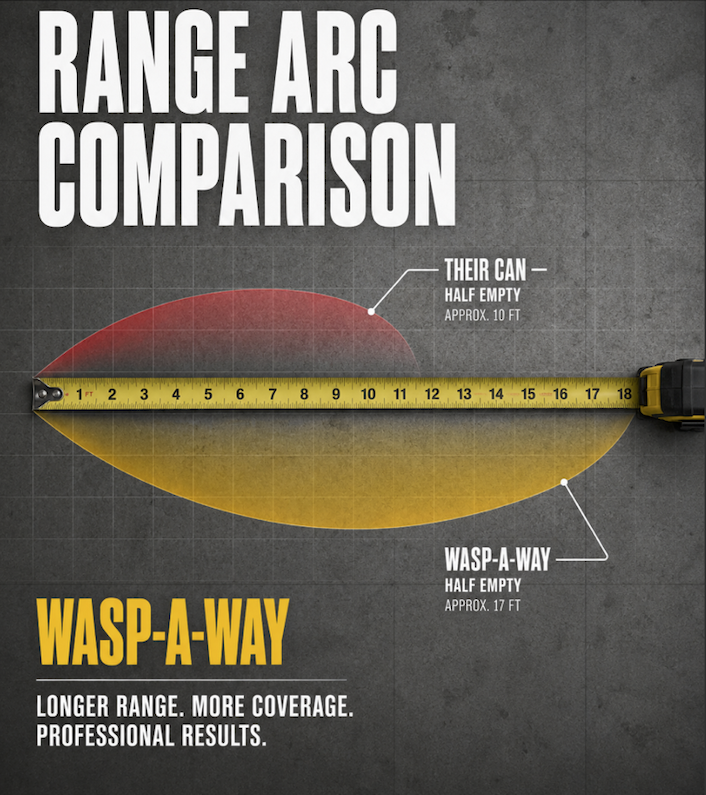
Every wasp spray says 20 feet. Technically true — for the first few sprays on a full can. Standard aerosols drop to 10–12 feet by half-empty because propellant pressure falls as the can depletes. Wasp-A-Way uses a double-charge fill process that puts more pressure in every can from the start — and batch tests every production run at multiple points and again after production has finished and sat, to verify 18+ feet holds through the full life of the can. Higher starting pressure means higher pressure at every point after it and keeps you further away from the a-holes with wings.
You've been there. The nest is 20 feet up under the soffit. You shake the can, point it at the nest, press the button — and a weak, sputtering arc falls short of the target. The can says 20 feet. You're standing at 12 half empty can in hand. The wasps now know you're there.
This is not a defective can. This is how almost every wasp spray on the market is designed — and the label is technically not lying. It just isn't telling you the whole truth.
The Physics of What's Happening
Every aerosol wasp spray uses pressurized propellant — typically a hydrocarbon blend of butane, propane, or isobutane — to drive the insecticide through the nozzle at high velocity. That velocity creates the long-range jet stream. More pressure equals more velocity equals more distance.
At full fill, the can contains maximum propellant at maximum pressure. That is when it achieves its advertised range. That is also the only moment the manufacturer is required to stand behind that number.
As the can is used, propellant depletes. Pressure drops. Spray velocity decreases. The jet stream breaks up earlier in its arc, losing coherence and distance. By the time the can is half empty, a product rated at 20 feet is typically performing at 10–14 feet. By the last quarter, you may be looking at 8–10 feet — if that.
The label says 20 feet. The label is accurate for approximately the first third of the can's life, if you're lucky.
Why This Is a Safety Issue, Not Just a Performance Complaint
Most wasp spray labels claim 20-foot range. That distance isn't arbitrary — getting and staying outside a nest's defensive zone is the whole point of a long-range formula. Pursuit distance varies by species and colony size, but yellow jackets and bald-faced hornets — the two most aggressive species a contractor is likely to encounter — will chase a perceived threat well beyond arm's reach. A meaningful standoff isn't a comfort preference. It's the difference between a resolved problem and a sting incident.
The issue is that "20 feet" on the label describes a moment, not a guarantee. Aerosol propellant pressure decreases as the can empties. Spray velocity drops with it. The jet stream loses coherence and falls short earlier in its arc. On most retail wasp sprays, a can that's half empty is performing significantly inside that 20-foot claim — closer to 10–12 feet of effective reach under real conditions.
A tech standing 18 feet from a nest, trusting a label that says 20 feet, with a can that's two-thirds empty, has less coverage distance than they think — and no way to know it. The can still sprays, you've potentially just alerted the flying jerks to your presence and you can only spray so far.
That's the part the label doesn't show you.
The Test That Reveals the Truth
You don't need special equipment to verify this. You need a tape measure and a flat surface. Just aim the spray down wind...
Mark a point on the ground at 15 feet from where you're standing. Use a full can of your current wasp spray, spray a one-second burst parallel to the ground, and note where the stream lands. Then use the same can after it's half empty — same test, same standoff. Note where the stream lands the second time.
The gap between those two landing points is your pressure degradation loss. On most retail wasp sprays, it is significant. On some, it is alarming.
Run this test before you're standing on a ladder or on a small access roof next to a live nest.
What Batch Testing Actually Means
Not all wasp sprays verify range performance before they leave the manufacturer — and most don't fill their cans in a way that would pass if they did.
Wasp-A-Way is filled using a double-charge process that puts more propellant pressure into every can than a standard single-charge fill. Physics still applies — pressure drops as the can empties — but the curve starts higher and stays higher throughout the can's life. A half-empty WAW-1 has more remaining pressure than a half-empty can filled to standard. That's not a marketing claim. It's what a higher starting pressure produces at every subsequent point on the depletion curve.
Every production run is then batch tested at multiple points — at fill, after completion, and after the cans have sat — verifying that effective spray range holds to 18+ feet throughout the full can, not just at initial pressure. The documented standard: 18+ feet of effective range across the full life of the can.
This matters operationally in two specific ways:
- A technician using a partially-used can on the second job of the day can apply the same standoff distance they used on the first job and trust it. The range doesn't quietly disappear as the propellant depletes.
- The last third of the can isn't wasted. A spray that loses effective range at half-fill means the back half is useless for its primary purpose — treating a nest at distance. WAW-1 delivers what you paid for through the last application.
The Question to Ask Your Supplier
If you want to know whether your current wasp spray maintains its rated range, the label won't tell you. The manufacturer's rep probably won't volunteer it either.
Ask directly: is this product batch tested for spray range consistency? At multiple fill points — not just initial pressure? Is that test data documented and available?
If the answer is no, or vague, or they need to check on it: you have your answer. A company that verifies range performance will be able to tell you immediately. Having been stung by plenty of wasps...
Field Rules Until You Switch
If you're working with retail wasp spray before transitioning to a batch-tested product, these adjustments account for pressure degradation:
- Increase standoff distance as the can gets lighter. At full fill, work at the labeled range. Once the can feels lighter than half full, add 4–6 feet of additional standoff. You'll get less coverage penetration but you'll stay outside the defensive zone.
- Spray at dawn or dusk. Fewer active foragers outside the nest means less defensive response if your spray doesn't reach optimally.
- Don't rely on the last third of a retail can for primary nest treatment. Reserve it for stragglers or spot applications after the nest is neutralized, not for the initial treatment where range matters most.
- Keep a backup can. A nest that receives insufficient coverage on the first approach is more agitated and more dangerous on the second. Don't start a job you can't finish at distance.
The Bottom Line
"20 feet" on a wasp spray label describes one moment in that can's life — at full pressure, in optimal conditions. What happens to that range as the can empties is the specification the label doesn't show you.
For a homeowner treating a visible nest on a calm morning with a fresh can, this probably doesn't matter. For a technician on a job site — partial can, real conditions, safety margin that needs to be real — it is the specification that matters most.
Ask for the batch test data. If it doesn't exist, the range claim is a peak measurement dressed up as a guarantee.
*Wasp-A-Way (WAW-1) by Vapco Products, Inc. Batch tested for 18+ feet of effective range throughout the full can. EPA Reg. No. 1021-1649-6381. Available through HVAC and industrial supply wholesalers.