What Is Dielectric Wasp Spray and Why It Matters for Electrical and HVAC Work
Dielectric wasp spray uses a petroleum distillate carrier that resists electrical conduction near energized equipment. This guide explains ASTM D-877 testing, how field conditions reduce rated dielectric strength, and how to compare products by spec.
TL;DR: Dielectric Explainer
"Safe near electrical equipment" is on every label. Only one brand publishes the actual test number: 57,200 volts by ASTM D-877. And that's the lab number — on a greasy condenser in August humidity, the real-world number is lower for everyone. Wasp-A-Way just starts higher than anything else in the category, which means it finishes higher too. For techs working near energized equipment, margin isn't a marketing word, it's what keeps you safe and differentiates consumer junk from professional products.
"Dielectric" appears on a growing number of professional wasp spray labels. Most users encounter it without a clear explanation of what it means, how it was tested, or how to evaluate competing claims. This article answers those questions completely — because when you're working near energized equipment, the claim matters more than the marketing.
What Dielectric Means
A dielectric material is one that does not conduct electricity — an electrical insulator. In the context of wasp and hornet spray, "dielectric" describes the spray carrier's ability to resist conducting electrical current while airborne and during the brief window after it contacts a surface.
The dielectric rating of a wasp spray is expressed as a voltage threshold: the point at which the carrier becomes electrically conductive. Below that threshold, the spray acts as an insulator. Above it, it can create an electrical path — potentially back toward the applicator or into sensitive equipment.
This is tested using ASTM Test Method D-877, a standardized procedure that measures the dielectric breakdown voltage of insulating liquids using controlled electrodes under specified conditions. The result is expressed in kilovolts (KV) or volts.
Why It Matters in HVAC and Electrical Environments
Wasps build nests in and around electrical equipment with notable frequency. The protected, weather-resistant cavities that make condenser units, electrical panels, junction boxes, outdoor lighting enclosures, and attic air handlers functional are exactly what makes them attractive to colony-building insects.
When a technician encounters a nest in or near energized equipment, the practical options are: de-energize the equipment before treatment, treat from sufficient distance that spray never contacts live components, or use a spray with verified dielectric properties that documents a safety margin against electrical conduction.
In many field scenarios, de-energizing isn't a reasonable thing to consider or accomplish. Equipment geometry limits distance, plus...the angry hoard waiting to take flight might also have something to say about your tinkering near their residence. The spray's dielectric rating becomes the safety specification — and the difference between products' rated numbers is real, not cosmetic. Most consumer sprays don't even bother to run the test.
What the Rated Voltage Actually Means — and What It Doesn't
This is the part labels don't have the room to explain and most product pages don't take the time to explain, and it's the most important.
The ASTM D-877 dielectric breakdown voltage is measured under controlled laboratory conditions:
- Clean, standardized electrodes
- Controlled temperature and humidity
- Fresh, uncontaminated product
- Standardized electrode gap geometry
This is not a field measurement. It is a ceiling — the best-case performance of the spray under optimal conditions. Real-world effective dielectric is always lower, for three specific reasons:
1. Surface contamination. Electrical and HVAC equipment accumulates compressor oil, grease, refrigerant residue, and atmospheric grime. When spray contacts these surfaces, the carrier mixes with conductive or partially conductive materials. A film of compressor oil in the spray path can cut effective insulation significantly. The combined dielectric of the spray and the contaminated surface is always lower than the spray's clean-lab rating.
2. Ambient moisture. High humidity, condensation on equipment surfaces, and moisture in enclosed spaces degrade the petroleum distillate carrier's insulating properties. HVAC environments — by definition — often involve temperature differentials that produce condensation.
3. Spray stream geometry. The ASTM D-877 test measures dielectric across a controlled electrode gap. A continuous spray stream from nozzle to live component creates a different physical scenario: a column of aerosolized carrier in contact with both the applicator's can and the energized surface. This is the scenario where dielectric strength matters most, and it is furthest from controlled lab conditions.
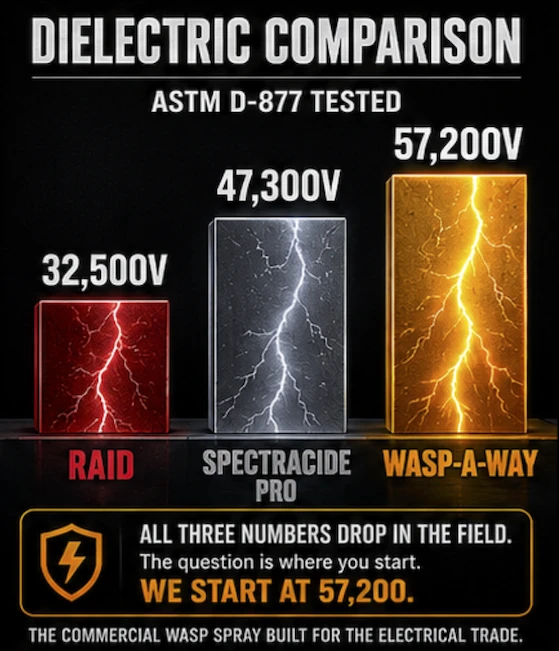
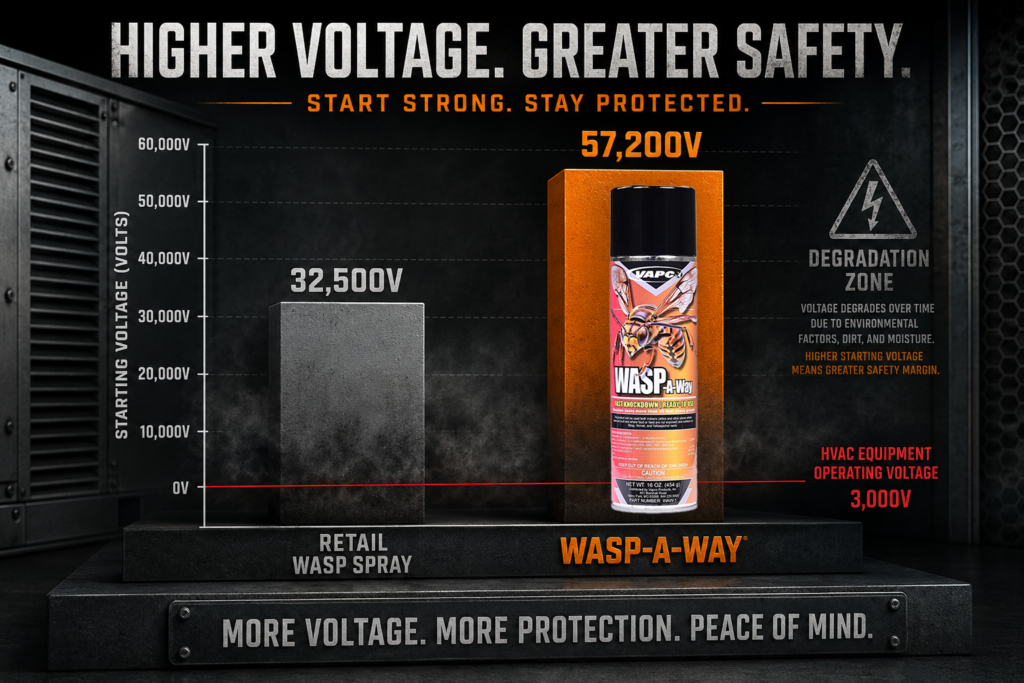
The practical implication: start higher. The rated voltage is the starting line, not the finish line. Both Raid (32,500V) and Wasp-A-Way (57,200V) lose real-world performance from field conditions. The product that starts higher finishes higher.
The Dielectric Ratings: What's Available
| Product | Dielectric Rating | Test Method Specified |
|---|---|---|
| Raid Wasp & Hornet Killer | 32,500V | Not ASTM-specified |
| SpectracidePRO | 47,300V | Not ASTM-specified |
| Wasp-A-Way (Vapco Products) | 57,200V | ASTM D-877 |
Wasp-A-Way's 57,200V rating is the highest published dielectric specification in the commercial wasp spray category. It is also the only one in this comparison with a specified ASTM test method — meaning the number is independently verifiable against a standardized procedure, not a proprietary internal test.
To frame these numbers in context: Raid's rating (32,500V) is approximately 135 times the voltage of a standard 240V HVAC condenser. Wasp-A-Way's rating (57,200V) is approximately 238 times that voltage. When field conditions degrade both — and they will — the product that starts at 57,200V finishes at a higher real-world number than one that starts at 32,500V.
Why the Petroleum Distillate Carrier Is the Key
The dielectric properties of a wasp spray come from its carrier — the liquid base in which active insecticide ingredients are suspended.
Petroleum distillates are refined hydrocarbon fractions with naturally high dielectric properties. Refined mineral oils have been used as electrical insulating fluids in transformers and industrial switchgear for over a century. Youtubers have even done videos where they fill gaming computers with the stuff and everything continues humming along. The same molecular properties — nonpolar structure, low ionic content, resistance to electrical conduction — that make them effective transformer fluids make them effective insulating carriers in aerosol applications.
Water-based wasp spray formulas have essentially no meaningful dielectric properties. Water is a conductor. A water-based formula near energized equipment offers no insulating protection and should not be used in electrical or HVAC environments under any circumstances.
The petroleum distillate carrier in Wasp-A-Way produces three performance properties simultaneously:
- 57,200V dielectric rating — the highest in the commercial category
- Indoor use registration — the same carrier properties that resist ignition risk in enclosed spaces made the indoor label registration achievable
- Fast contact kill — petroleum distillate carriers penetrate insect cuticle more rapidly than water-based carriers, accelerating active ingredient uptake and on-contact kill speed
These are not independent properties. They are all products of one formulation decision — a petroleum distillate carrier engineered for professional trade environments rather than retail price points. We wanted something that was safe, could be used in every scenario, AND killed pests immediately even if you couldn't land a direct hit.
What the Indoor Use Registration Means for Trade Professionals
Most consumer wasp sprays carry an outdoor use only restriction. This is a propellant flammability and EPA registration decision, not primarily a toxicity issue.
In an enclosed space with limited ventilation — an attic, a crawl space, a mechanical room — aerosolized hydrocarbon propellants can accumulate to levels where an ignition source (a pilot light, an electrical arc, a hot surface) creates a risk. Consumer manufacturers don't pursue the additional EPA registration data required for enclosed indoor applications because their product was built for a homeowner's porch.
Wasp-A-Way carries an EPA indoor use registration covering attics and enclosed spaces where nests are built, provided food is not present. The registration covers:
- Attic air handlers and attic spaces
- Crawl spaces and mechanical rooms
- Indoor spaces where nests are constructed (wall voids, structural cavities)
- Commercial interior applications in non-food areas
For HVAC and electrical contractors, this is significant. The job doesn't always happen on an exterior eave or a nice patio. When the nest is in the attic air handler, in the crawl space mechanical room, or in an interior wall void, a product restricted to outdoor use should not be used where that problem lives.
Application Guidance for Electrical and HVAC Environments
- De-energize when practical. Dielectric strength is a safety margin, not authorization to spray live equipment carelessly. The margin exists for field conditions where de-energizing is not immediately achievable.
- Increase standoff distance from live components. More distance breaks up the spray stream into droplets before contact, reducing the continuous conductive column scenario. A broken spray pattern has better real-world dielectric performance than a solid stream at close range.
- Avoid treatment in peak humidity conditions. Condensation on equipment surfaces reduces effective dielectric performance. Morning treatment on dry days provides better insulating performance.
- Do not spray into open, energized panels. The indoor registration covers enclosed nest sites. It does not constitute clearance for saturating open electrical components. Apply to the nest, not the equipment.
Summary: What to Verify Before Buying
When evaluating dielectric wasp spray for professional use:
- Ask for the test method. ASTM D-877 is the standardized measurement. A voltage claim without a specified test method is not independently verifiable.
- Understand the rated voltage is a ceiling. Field conditions always reduce effective performance. Higher rated numbers provide more real-world margin.
- Check the carrier type. Petroleum distillate = meaningful dielectric strength. Water-based = none.
- Verify indoor use registration. Especially for enclosed-space job site applications.
*Wasp-A-Way (WAW-1) is manufactured by Vapco Products, Inc., Valley Park, MO. EPA Reg. No. 1021-1649-6381. Dielectric breakdown voltage: 57,200V by ASTM Test Method D-877. SDS available at vapcosolutions.com.