
Professional Grade vs. Consumer Wasp Spray: What the Label Doesn't Tell You
The wasp spray market has two tiers. Most people — and most purchasing departments — don't know they're buying from the bottom one.
TL;DR: Professional vs. Consumer
The wasp spray at Home Depot has 0.02% active ingredient. Wasp-A-Way has 0.200%. That's not a rounding error — it's ten times the knockdown agent, two actual killing ingredients instead of one killer and a helper, and the highest dielectric rating in the category. One was built to move off a shelf. The other was built to CYA inside, outside, and from a safe distance for the whole can. 1 can is for the occasional weekend warrior, ours is for the everyday one.
What "Professional Grade" Actually Means and why it's worth it
The term gets applied freely. In the context of wasp and hornet spray, it has a specific, measurable meaning: active ingredient concentration, testing documentation, and label registrations that cover the environments professionals actually work in.
A consumer wasp spray is formulated to a price point. The goal is a product that kills a porch nest under reasonable conditions from a reasonable distance. Nothing beyond that is required.
A commercial or professional grade wasp spray is formulated to a performance standard. The goal is a product that handles imperfect conditions — a moving target, a confined space, live electrical equipment nearby, a tech on a ladder in August — and still eliminates the problem on the first application.
That gap shows up directly on the label, in the active ingredient percentages.
The Active Ingredient Comparison Nobody Talks About...until now
Every wasp spray is required by the EPA to list its active ingredients and their concentrations. Most people never look at this section. Contractors and facilities managers should make it the first thing they check.
Raid Wasp & Hornet Killer — dominant consumer brand by shelf share:
- Prallethrin: 0.02%
- Cypermethrin: 0.05%
- Dielectric rating: 32,500 volts
Spectracide Wasp & Hornet Killer — standard consumer SKU:
- Prallethrin: 0.025%
- Lambda-cyhalothrin: 0.010%
- No dielectric rating published
SpectracidePRO — their "professional" retail upgrade at Lowe's and Home Depot:
- Tetramethrin: 0.10%
- Permethrin: 0.25%
- Piperonyl Butoxide: 0.50%
- Dielectric rating: 47,300 volts
Wasp-A-Way by Vapco Products (EPA Reg. No. 1021-1649-6381):
- Tetramethrin: 0.200%
- Sumithrin: 0.125%
- Dielectric rating: 57,200 volts (ASTM D-877)
The number that matters most: Tetramethrin concentration.
Tetramethrin is the fast-knockdown agent in professional wasp formulas — a pyrethroid that disrupts insect nerve sodium channels within seconds of contact, causing rapid paralysis. Raid puts 0.02% in every can. Wasp-A-Way puts 0.200%. That is ten times the active knockdown ingredient per application.
SpectracidePRO, which markets itself as the professional option, reaches 0.10% Tetramethrin — double Raid, but still half of Wasp-A-Way.
Why Concentration Matters: The Direct Hit Problem
Most wasp sprays are designed around one assumption: that you will get a clean, direct hit on the target insect. At 0.02% active ingredient, you need to. A glancing blow, a partial spray, an insect at the edge of the stream — at that concentration, those are misses.
At 0.200% Tetramethrin, the effective kill radius of every droplet is larger. An insect in the spray cloud — not just in the direct stream — receives a lethal dose. The margin for an imperfect shot becomes real. In field conditions, that margin is the difference between a resolved problem and a bunch of really angry flying jerks coming your way.
Think of it this way: a low-concentration formula requires a perfect shot. A high-concentration formula requires proximity. On a calm morning from a clear angle, precision is achievable. On a job site with a bunch of variables, proximity is more honest.
The Three-Ingredient Claim: What They're Not Telling You
SpectracidePRO lists three active ingredients. That sounds more comprehensive. It isn't.
The third ingredient — Piperonyl Butoxide at 0.50% — does not kill insects. PBO is a synergist: it inhibits the enzyme that allows insects to metabolize pyrethroids, making the other two ingredients work harder. It is a legitimate formulation tool. It is not a third weapon.
Count the actual killers in SpectracidePRO's formula: two.
Count the actual killers in Wasp-A-Way: two.
The difference is that Wasp-A-Way's fast-knockdown agent is double the concentration — 0.200% vs. 0.10% — with no inactive synergist padding the ingredient count.
When a vendor tells you they have three active ingredients: ask which ones actually kill.
Dielectric Strength: The Spec That Separates Professional Sprays from Everything Else
Every wasp spray sold to the trade market claims to be "safe near electrical equipment." Almost none explain what that means or how it was measured.
Dielectric breakdown voltage — tested by ASTM D-877 — is the voltage at which the spray's carrier becomes electrically conductive. Below that threshold, it acts as an insulator. Above it, it can conduct current back toward the user or into sensitive equipment.
| Product | Dielectric (ASTM D-877) |
|---|---|
| Raid | 32,500V |
| SpectracidePRO | 47,300V |
| Wasp-A-Way | 57,200V |
What the label doesn't tell you: that number is measured under ideal laboratory conditions — clean surfaces, controlled temperature, fresh product. In the field, surface contamination, humidity, and continuous spray stream geometry all reduce effective dielectric performance below the rated number. The rated voltage is the ceiling, not the operating number.
This is why the gap between 32,500V and 57,200V matters even when you're working near 240V equipment. You are not comparing lab numbers to operating voltage. You are comparing how much margin remains after real-world conditions take their cut. Raid starts at 32,500V and loses ground. Wasp-A-Way starts at 57,200V and loses ground from a much higher place.
For a full technical breakdown of what dielectric ratings mean in field conditions, see: [What Is Dielectric Wasp Spray and Why It Matters for Electrical and HVAC Work]Consistent Range: Why "20 Feet" on the Label Isn't the Whole Story
Every major wasp spray claims 18-20-foot range, some cheaper ones even get down to 15 ft. The label doesn't say when that range was measured.
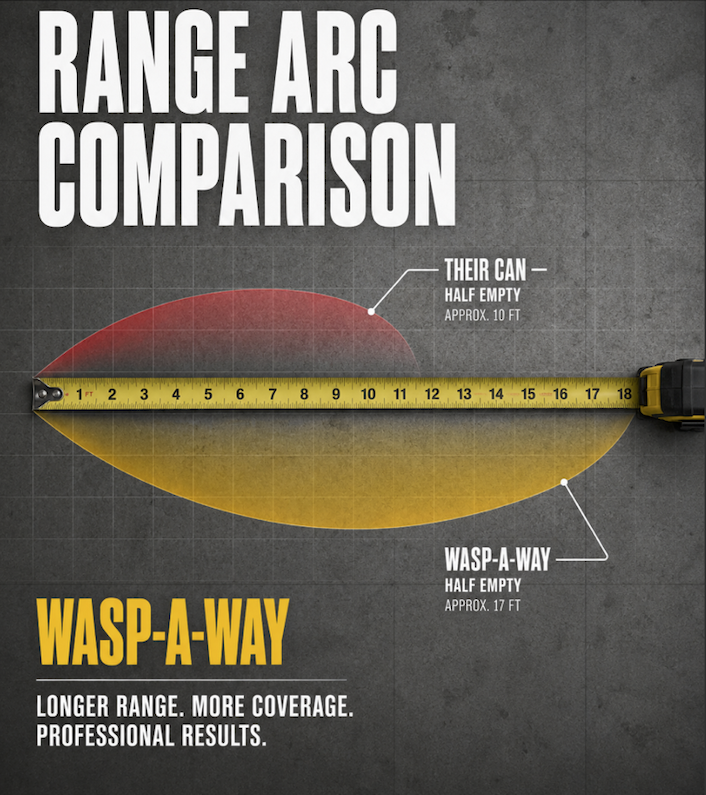
Aerosol propellant pressure decreases as the can empties. Maximum range is achieved at full pressure — the first portion of the can. As propellant depletes, spray velocity drops, the jet breaks up earlier, and effective range shrinks. By the time most retail cans are half empty, "20 feet" is performing closer to 10–12 feet, at the end of the can...8 feet is generous. We use a "double charge" filling method to help overcome the drop in pressure where we give the cans extra propellant to ensure the drop doesn't impact the spray distance as significantly as others.
A technician standing at 18 feet from a nest — trusting a label that says 20 feet — with a half-empty can, is not at a safe distance. They don't know this. The can still sprays. It just doesn't reach.
Wasp-A-Way is batch tested at multiple points throughout filling and after completion to verify 18+ feet of effective spray range throughout the entire can. Not just at full pressure. Through the full life of the can. That is a documented specification. Ask your current supplier for the same.
Indoor Use: Why Most Wasp Sprays Can't Go Where the Job Goes
Most consumer wasp sprays carry an "outdoor use only" restriction. This is a flammability and registration decision, not primarily a toxicity concern.
Hydrocarbon propellants combined with petroleum distillate carriers are flammable. Outdoors, aerosol disperses immediately. In an enclosed attic or mechanical room with limited air exchange, repeated spraying can build vapor concentration to ignition-risk levels. Consumer manufacturers writing products for homeowners spraying porch eaves don't pursue the additional EPA registration data required for enclosed-space indoor applications.
Wasp-A-Way carries an indoor use registration covering attics and enclosed spaces where nests are built. That registration required additional submitted data. It exists because the product was built for trade environments from the start — attic air handlers, mechanical rooms, wall voids, and crawl spaces are standard job site scenarios, not edge cases.
The formula's petroleum distillate carrier — the same chemistry that produces the 57,200V dielectric rating — was selected with these environments in mind. The indoor label is evidence of design intent, not a marketing addition.
What "Residual Kill" Actually Means — and What the 4-Week Claim Doesn't
SpectracidePRO claims up to four weeks of residual kill. That claim has scientific basis: Permethrin persists on surfaces for one to three weeks outdoors.
Here is the biology that makes it largely irrelevant: wasps do not reuse treated nests. Once a colony is eliminated, that nest is permanently abandoned. The only wasps you need to catch after treatment are foragers who were out during application. All of them return within 24–48 hours.
That is the entire window. Two days. Not four weeks.
Wasp-A-Way's Sumithrin degrades faster than Permethrin — that is true. But at 0.200% Tetramethrin, the dose deposited on nest surfaces at treatment is higher than any competitor in this category. The effective lethal threshold covers the 48-hour return window with margin to spare.
Four-week residual solves a problem wasp biology doesn't produce. The 48-hour window is the only one that matters, and Wasp-A-Way covers it plenty.
EPA Registration and Commercial Documentation
Wasp-A-Way carries EPA Registration Number 1021-1649-6381, registered directly to Vapco Products, Inc. — not a private-label distributor.
For commercial facilities and contractors maintaining pesticide application records, this matters. A private-label product traces to a distributor, not a manufacturer. Vapco's registration traces directly to the formulating source, with full SDS and technical data documentation available for compliance records.
The Bottom Line
The retail wasp spray market is built around one use case: a homeowner, clear conditions, outdoor application, direct shot at a visible nest.
If your application involves electrical equipment, enclosed spaces, imperfect shot angles, windy rooftops, ladders, a technician whose time costs money, or liability exposure if the problem isn't resolved on the first call — the formula specifications matter.
Ten times the active ingredient. Highest verified dielectric rating in the category. Consistent range through the full can. Indoor use registration. EPA registration to the manufacturer of record.
That is what commercial grade actually means.
*Wasp-A-Way (WAW-1) is manufactured by Vapco Products, Inc., Valley Park, MO. EPA Reg. No. 1021-1649-6381. Dielectric breakdown voltage 57,200V by ASTM D-877. Available through HVAC and industrial supply wholesalers.