
Refrigerant Leak Sealant Has a Reputation Problem — Here's Where It Actually Came From
Does refrigerant leak sealant damage compressors, TXVs, etc?
Refrigerant leak sealant has damaged HVAC systems. It has clogged TXVs, fouled metering devices, and left residue in recovery equipment. Technicians who stopped trusting it made the right call based on what they saw. That reputation is real and it's documented.
But it doesn't belong to refrigerant leak sealant as a category. It belongs to a specific set of competing products that rushed to market with the wrong chemistry, chasing a formula that had already solved the problem correctly.
Refrigerant leak sealant, as a category, was created in the late 1990s and commercialized in the early 2000s by a single organosilane monomer formula—the exact chemistry behind Xpress Seal Inject. It was the first product to solve the actual problem the refrigerant industry faces: stay completely inert inside a closed, pressurized system, and react only at the exact point where the leak meets the atmosphere. That formula worked the first time and hasn't needed to change since.
Stop-leak chemistry existed long before the late '90s, but it was solving a completely different physical problem. Automotive radiators and engine cooling systems have used particulate-suspension stop-leak products since at least the 1950s. These were water-based formulas using ground-up plant material, mineral compounds, or fine solid particles designed to physically lodge inside a crack.
That chemistry made sense for its native habitat: an open, low-pressure, refillable aqueous cooling loop. It was never designed for a sealed refrigerant circuit running under high pressure through a mechanical compressor and micro-metering devices, and it does not transfer cleanly to one.
When true refrigerant leak sealant proved viable and began taking market share from costly coil and component replacements, competitors moved fast to catch up. Some tried adapting brute-force automotive thinking into a space that required a surgical solution; others invented their own approaches without calculating the closed-loop consequences. The resulting wave of rushed products birthed the horror stories.
This approach works by injecting pre-formed macromolecules into the system, attempting to plug a leak with material that is already a finished, fully-formed compound before it ever enters the service ports.
These macromolecules are physically large—often large enough to obstruct the tight, precisely engineered tolerances of the TXVs, capillary tubes, and orifice devices they pass through.
A second category of imitators abandoned chemical reactions entirely, designing oil-based formulas meant to seal leaks purely through sheer volume and high liquid viscosity.
While the theory possessed a certain intuitive counter-appeal, the practical thermodynamic reality inside a high-pressure phase-change loop created severe, widespread systemic drag.
The technicians who swore off sealant entirely weren't being overcautious.
They were pattern-matching correctly from direct experience at supply counters across the country.
Refrigerant systems are engineered for vapor. A compressor compresses gas. That's the entire operating principle. Liquid slugging—non-compressible liquid entering a compressor built to handle vapor—is a well-documented failure mode in refrigeration engineering. As described by ACHR News, when liquid enters the cylinder during operation, outcomes include broken valves, broken head gaskets, and broken connecting rods. The underlying physics doesn't care if the liquid came from improper charging, off-cycle migration, or an additive.
Oil-based sealants cannot distribute reliably through a system. Unlike refrigerant vapor, which travels the full circuit uniformly under pressure, a viscous oil-based product struggles to maintain consistent coverage through tight runs, complex geometry, and the upper circuits of a coil where leaks commonly develop.
Getting a meaningful concentration of oil-based sealant to an actual leak point requires introducing a substantial volume of product—potentially a quart or more in light commercial applications. A compressor that can't tolerate a slug of migrated refrigerant isn't built to handle a slug of additive either. The sheer volume required to make an oil-based product work handicaps it from the start.
An oil-based sealant introduced in bulk doesn't blend into the fine system balance; it moves as its own separate mass. Technicians who have run these products have heard it happen: a slug of non-miscible material hitting the compressor, audibly.
The same property that prevents it from distributing evenly also prevents it from scaling. Push enough oil-based product into a system to treat a commercial-sized coil, and the volume problem and the miscibility problem compound simultaneously. This is why no oil-carrier sealant has successfully or safely covered commercial tonnage.
This isn't theoretical. A contractor who runs Xpress Seal and several other Vapco products was recently called in for a system changeout after the homeowner's original contractor failed to fix the issue.
After flushing a twenty-foot line set, the new tech pulled a substantial volume of red, coagulated material—far more than normal oil circulation leaves behind. The homeowner confirmed the previous tech had injected a product to stop a leak.
The result? Weeks later, the leak was still there, the system had stopped cooling, the charge was gone, and the compressor was heavily stressed by both the additive and running undercharged. The system wasn't worth repairing.
Note: We've heard versions of this story repeatedly. The competitor's product didn't stay inert, didn't stay distributed, and didn't seal the leak. It simply left residue in copper that flushed out visibly months later. For what it's worth, Xpress Seal won't solve every system leak either—it's designed for specific leak rates, not as a magic "fountain of youth" potion.
Even with the correct organosilane monomer chemistry, delivery methods had to evolve to meet the needs of technicians in the field.
The formula's original packaging was a canister filled and sealed under vacuum. Once pierced and connected, the pressure differential between the charged system and the vacuum inside the can drew the product into the line.
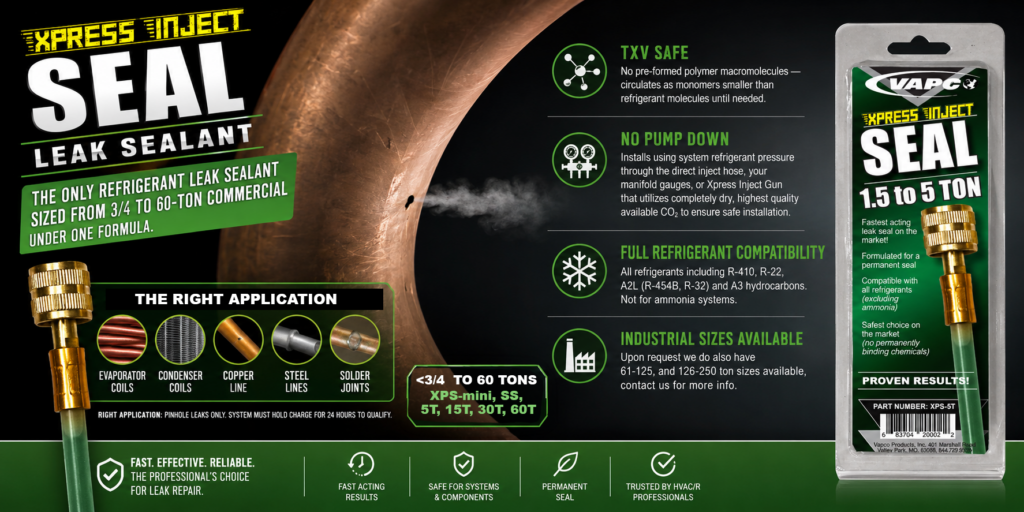
The direct-inject tube solved the speed issue. It connects straight to the low side and uses the system's own existing refrigerant pressure to carry the product into the line while the system runs.
The technicians who stopped trusting sealant after experiences with the products described above made the right call.
They just stopped trusting the wrong products.
Xpress Seal is built on organosilane chemistry—the exact same formula that created this category, unchanged since it first reached the market. The chemical mechanism explains why it never suffered the failure modes described earlier. This isn't marketing language. It's a fundamental difference in how the sealing agent behaves inside the system.
Organosilane-based sealants circulate as unlinked monomers. A monomer is the individual building block of a polymer—before it has bonded to anything, before it has formed a chain, and before it has any meaningful physical size.
Inside a closed refrigeration system, these monomers remain completely inert. They circulate harmlessly with the refrigerant. They pass through TXVs, capillary tubes, compressor components, and metering devices without reacting, without accumulating, and without forming anything.
When refrigerant escapes through a pinhole leak, it carries monomers with it. As they exit, they meet the three exact conditions required to trigger polymerization. They bond, form a solid polymer, and seal the leak from the outside in. Nothing forms inside.
A useful way to think about it: Blood platelets circulate harmlessly through your body until there's a wound, then they aggregate at the breach and clot. They don't clot randomly inside healthy vessels. The mechanism is activation by exposure, not continuous reaction. Organosilane sealants work on the exact same principle. The system is the healthy vessel. The leak point is the wound.
This is why the "polymer-free" language showing up en masse on modern packaging requires a clarifier. The sealant is not polymer-free at the seal point—it becomes a polymer at the seal point. That's what makes it seal. What it is actually free of is pre-formed polymer macromolecules: the large, already-formed chains that competing products injected, which caused the clogging failures. That distinction is the entire ballgame.
The damage story is real. But it belongs to pre-formed polymer macromolecule sealants and oil-based volume products—the wave of competitors that rushed to market trying to catch up. The organosilane monomer chemistry behind Xpress Seal was the original solution, not a later fix. It doesn't form anything inside the system and has no pathway to the failures described above, because it was built around the actual constraint (stay inert until the leak point) from the start.
Xpress Seal runs on that same unchanged formula today.
If you want to understand the full product line or verify refrigerant compatibility for your specific application, our product page is the right next stop.
With polymer macromolecule sealants, this was a real risk. With organosilane monomer-based sealants, there is nothing inside the system large enough to obstruct a metering device.
The monomers are actually smaller than refrigerant molecules. They pass through every component without reacting. Because the seal forms only at atmospheric exposure outside the closed system, there is nothing to clog.
This concern traces back to the flawed products described earlier: polymer macromolecule sealants and oil-based volume sealants, which both left heavy residue that could carry into recovery equipment.
Xpress Seal's monomer chemistry doesn't behave that way. Unreacted monomers circulate with the refrigerant and exit normally during recovery—exactly the same way any refrigerant-soluble additive does. Nothing is introduced that wouldn't come out cleanly in a standard recovery process.
UV dye in refrigerant systems behaves exactly the same during recovery regardless of whether it's delivered standalone or combined with a sealant. If you're already comfortable running UV dye (and most technicians are), the dye component of a combined product isn't a different animal.
This is where honest guidance matters more than any marketing claim. Every active leak loses refrigerant continuously. The real question is the rate of loss.
If the system can run for several days (or longer) without losing its full charge, the pinhole is appropriately sized for chemical sealant.
If the system empties out within hours, the leak is physically too large for a sealant to bridge. You are looking at a mechanical repair.
*UV dye can help locate these larger leaks if you can't pinpoint them with other methods.
Some products historically did, specifically pre-formed polymer macromolecule sealants and oil-based volume sealants, both of which could obstruct metering devices or introduce non-compressible liquid mass into the compressor.
Organosilane monomer-based sealants like Xpress Seal Inject don't share this risk because nothing forms or accumulates inside the system.
Polymer macromolecule sealants could, because they injected pre-formed compounds large enough to obstruct metering devices.
Monomer-based sealants circulate as molecules smaller than refrigerant and don't react until they reach atmospheric exposure at the leak point, so there's nothing inside the system capable of clogging a TXV.
Not literally. The sealant does form a polymer, but only at the leak site upon atmospheric exposure.
"Polymer-free" refers to the absence of pre-formed polymer macromolecules circulating inside the system, which is the mechanism that caused historical clogging damage.
Products that used pre-formed macromolecules or bulk oil carriers could leave residue during recovery.
Monomer-based sealants exit with the refrigerant during recovery the same way any refrigerant-soluble additive does, without leaving comparable residue.
Every active leak loses refrigerant continuously, so the test isn't whether the system holds charge perfectly. It's the rate of loss.
If the system can run several days without losing its full charge, it's a reasonable candidate. If it empties out within hours, the leak is physically too large for sealant and needs a different repair approach.
Yes. Xpress Seal Inject is compatible with all refrigerants including A2L (R-454B, R-32) and A3 hydrocarbons.
Note: It is not compatible with ammonia systems.