
Why Formula History Matters When You’re Choosing — or Stocking — a Refrigerant Leak Sealant
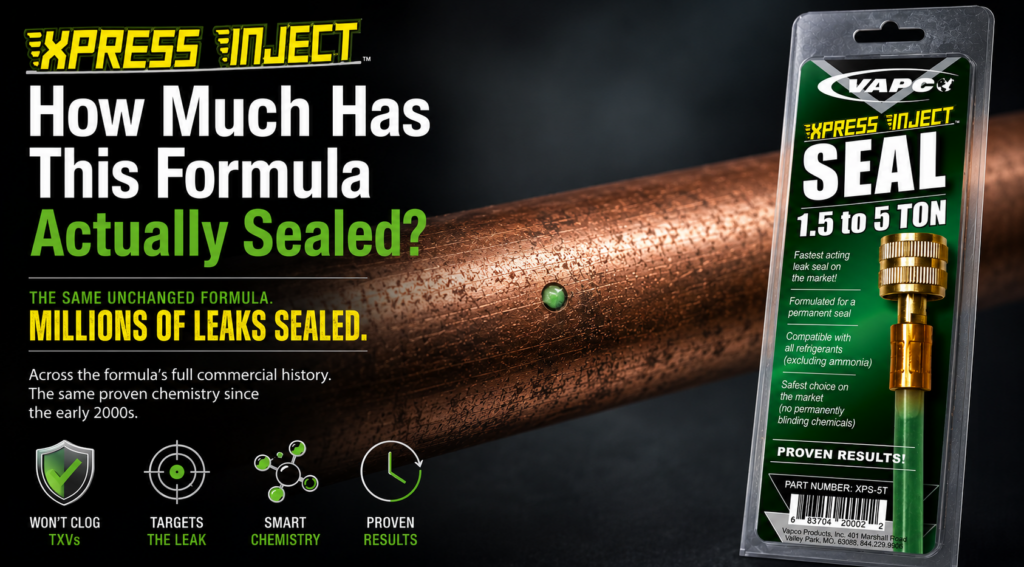
Refrigerant Leak Sealant History — One Formula, No Changes
Xpress Seal runs on the same organosilane formula that created the refrigerant leak sealant category in the early 2000s. Vapco acquired the rights to sell that line in 2016. The chemistry hasn't changed since it first reached the market.
If you're choosing which sealant to stock or recommend, that single fact—unchanged formula, two-plus decades, one continuous track record—is worth more than any spec sheet comparison.
When Was Refrigerant Leak Sealant Actually Invented?
Refrigerant leak sealant as a category didn't really exist before the late 1990s. It was developed then and commercialized in the early 2000s, built on organosilane monomer chemistry—a formula designed specifically to stay inert inside a closed, pressurized refrigerant circuit and react only at the point where a leak meets the atmosphere.
That's a different problem than automotive stop-leak chemistry was ever built to solve. Radiator and engine cooling stop-leak products go back decades earlier, using particulate-suspension formulas designed for an open, low-pressure, refillable cooling loop, not a sealed system running through a compressor and metering devices.
The organosilane formula that became Xpress Seal was the first product to solve the refrigerant-specific version of the problem. It worked, and the category exists because of it.
Why Did the Original Formula Change Hands?
There was a split between the original chemical manufacturer and the company that had been marketing the formula for years. Several accounts of that split exist from people on different sides of it, and they don't fully agree. That's not unusual in any business separation. We don't know the complete story. From what we've heard and from life experience, the truth usually lies somewhere in between the recollections of everyone involved, and we're not going to pretend otherwise.
What matters more than who said what is what's true today: the original manufacturer kept making the same chemistry. Vapco acquired the rights to sell that line in 2016, and the formula hasn't changed since. Not a tweak, not a "new generation," not a reformulation. It's the same chemistry that created the category in the early 2000s, with millions of leaks sealed under its track record.
That's not true everywhere in this category. Other products on the market today have gone through multiple documented reformulations over the past decade: different active chemistry, different delivery systems, different marketing names for each new version. Each relaunch is effectively a new, unproven formula wearing a familiar label. The track record resets every time the chemistry changes, no matter how long the brand name has been around.
Xpress Seal has never needed a relaunch.
Does Formula Consistency Actually Matter, or Is That Just Marketing?
Every time a sealant manufacturer reformulates, the new version is unproven. It might work as well as the chemistry it replaced. It might not. The only way to know is years of field use, which is exactly the thing a brand-new formulation doesn't have yet, no matter what the marketing claims on launch day.
That's the practical argument for treating formula history as a real purchasing and stocking criterion, not a nostalgia point. A formula with one continuous, unbroken track record has had every weakness found and reported by now. If organosilane monomer chemistry had a hidden failure mode, it would have surfaced industry-wide over two-plus decades of field use, not stayed hidden.
A reformulated product is starting that clock over. Whatever track record the old version built doesn't transfer to the new chemistry. The "trusted name" stays the same, but what's actually in the tube does not.
"Ask how long the exact current formula has been on the market, not how long the brand has existed."
Those are different questions, and the second one is the one that actually tells you what you're stocking or recommending. This is the question worth asking before committing shelf space or putting your name behind a recommendation: is this the formula with the track record, or is it this year's version of something that's already been changed more than once, with no guarantee it won't need change again?
How Much Has This Formula Actually Sealed?
The honest version of this number: millions of leaks sealed, across the formula's full commercial history. That's not a Vapco-specific sales figure, it's a track record claim for the chemistry itself, going back to when it first reached the market in the early 2000s.
Under Vapco specifically, that's a decade-plus of continuous distribution on the same unchanged chemistry, with the product line expanding around it. The line has grown, but the core formula behind the seal hasn't changed at all.
The Expanded Product Line
-
Seal + Protect For systems needing both sealant and acid/moisture control.
-
Standalone Protect & Enhance For system treatment and protection without sealing.
-
Combination Products Covering everything from mini splits under 0.75 tons up to 60-ton commercial systems.
Volume isn't the differentiator. Continuity is. A competitor can sell more units in a single year than this formula has sealed in a decade and it still won't change the fact that their chemistry has been reformulated multiple times in that same window. Every one of those relaunches started the track record over at zero, regardless of how many units moved before or after. This formula never had to.
The short version: if a "tried and tested, proven formula" matters in how you stock or how you recommend, this is the one with the history to back that claim.
What This Means If You're Stocking or Recommending a Sealant
For Distributors & Sales Reps
The practical takeaway is simple. Xpress Seal is the original chemistry, not a reformulation, sold under a continuous business relationship with the company that has produced it since the category began. There's no new version to worry about, no relaunch to explain to a customer, and no "this one's different from what we used to carry" conversation.
For HVAC Technicians
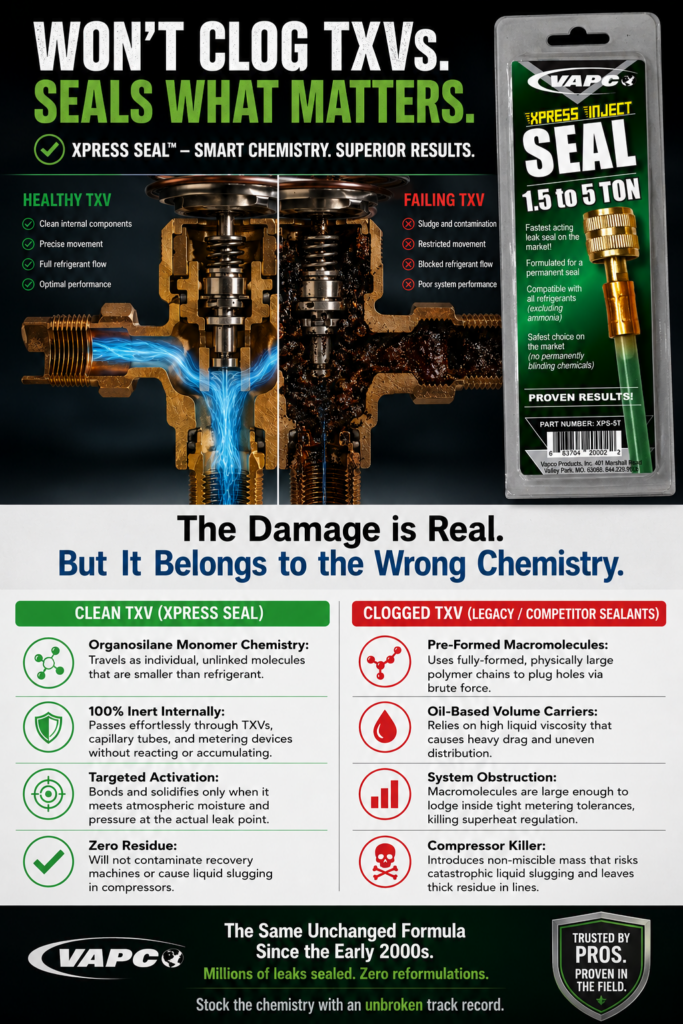
When evaluating whether to trust a sealant in the first place, the deeper chemistry explanation matters. Why this specific formula doesn't clog TXVs, doesn't contaminate recovery equipment, and behaves nothing like the early, rushed products that earned the category its reputation is covered in full elsewhere.
Frequently Asked Questions
How old is the Xpress Seal formula?
The organosilane chemistry behind Xpress Seal Inject was developed in the late 1990s and commercialized in the early 2000s, making it the formula that created the refrigerant leak sealant category.
Has the Xpress Seal formula ever been changed or reformulated?
No. The core chemistry has remained unchanged since it first reached the market, including through Vapco's acquisition of the rights to sell the line in 2016.
What has changed?
The offering... both in size and variety.
Originally, the line only covered systems smaller than 1.5 tons and systems smaller than 5 tons using 2 different tubes. Now, the line features different combinations and various sizes, making it the largest offering in the industry.
Explore the Xpress Inject Category*Be sure to replace the "#" in the href attribute with your actual category page link.*
What's the difference between Xpress Seal and Xpress Inject?
Xpress Seal refers to the actual product that does the sealing, and there are multiple products that contain that sealant.
Xpress Inject refers to the whole product category that includes UV Dyes, system enhancers, and acid scavengers / moisture removers.
Why does it matter if a sealant manufacturer has reformulated their product over time?
Each reformulation resets the field track record. A newly reformulated product hasn't had years of real-world use to surface potential weaknesses, regardless of how the brand name or marketing claims compare to the previous version.